

Merging duplicate business listings consolidates fragmented review signals by connecting customer feedback with the correct business entity. The most effective approach depends on whether duplicate listings can be legitimately consolidated, require correction, or need a different reputation-management response.
Reputation management strategies differ based on the structure, visibility and authority of the information affecting an entity. Online reputation control methods are evaluated through search visibility, review distribution, entity credibility, sentiment signals and the way information appears across search results. Duplicate Google Business listings create a specific reputation problem because reviews can become distributed across profiles representing the same organisation. Evaluating the available approaches therefore requires more than comparing review counts; it requires analysis of entity relationships, listing accuracy and SERP composition.
Is Merging Duplicate Listings More Effective Than Managing Separate Profiles?
Merging duplicate listings is generally more structurally effective when multiple profiles represent the same legitimate business entity. Consolidation operates by reducing competing listing records and concentrating relevant business information and review signals around the appropriate profile. Managing duplicate profiles separately preserves fragmentation and creates additional records that users and search systems must interpret. The difference is therefore based on information architecture rather than simply administrative convenience.
A consolidated listing creates a clearer relationship between the business entity, its customer feedback and its local search presence. Reviews remain connected to one business representation rather than being distributed across competing profiles. This improves the coherence of sentiment distribution and makes the visible review history easier to interpret. Separate profiles, by contrast, can create different review counts, ratings and historical signals for what users understand as the same organisation.
The limitation is that not every duplicate listing qualifies for consolidation. A listing representing a genuinely separate location, business entity or operational structure requires independent treatment. Attempting to consolidate entities that are not legitimately duplicates creates inaccurate business information and introduces additional entity credibility risks. Evaluation therefore begins by establishing whether the profiles actually represent the same business.
How Does Listing Consolidation Affect Google Review Signals?
Listing consolidation affects Google review signals by reducing the fragmentation of customer feedback across duplicate business profiles. Review signals include rating patterns, review volume, recency, written sentiment and the contextual relationship between customer feedback and the business entity. When these signals are distributed across duplicate records, each profile presents only part of the available reputation evidence. Consolidation creates a more coherent representation of that evidence.
Search engines evaluate business information within an entity-based framework rather than treating every review as an isolated item. The relationship between a review and the listing carrying it influences how that information contributes to the overall business representation. Duplicate listings therefore introduce an additional structural layer into reputation evaluation. A consolidated profile provides a clearer entity context for the available review information.
This does not mean that merging automatically produces stronger rankings. Search ranking influence depends on additional factors including relevance, prominence, location, authority and search intent. Consolidation primarily addresses fragmentation and entity clarity. Its value therefore lies in improving the structural quality of reputation signals rather than guaranteeing a particular search position.

Should Businesses Remove Duplicate Listings or Consolidate Them?
Consolidation is preferable when duplicate profiles represent the same eligible business entity and the applicable platform process supports a merger. Removal addresses the existence of an unnecessary listing, while consolidation focuses on resolving the relationship between duplicate records and preserving legitimate business information. The two approaches therefore solve related but different structural problems.
Removal can be appropriate when a duplicate profile has no independent business identity and does not require preservation as a separate listing. However, deleting or suppressing a profile without analysing its associated information can create additional complications. Review history, business attributes and established references form part of the wider reputation structure. A decision based solely on listing existence does not account for these connected signals.
Consolidation focuses on maintaining one authoritative representation where duplicate records genuinely describe the same entity. This approach reduces competing information sources while preserving the conceptual continuity of the business’s review profile. The appropriate method therefore depends on entity status, listing eligibility and the relationship between the profiles rather than a simple preference for removal.
How Does Content Enhancement Compare With Duplicate Listing Consolidation?
Content enhancement and listing consolidation address different layers of reputation management. Content enhancement strengthens authoritative information surrounding a business through accurate profiles, relevant business pages, professional references and other credible sources. Listing consolidation corrects the underlying structure connecting reviews and business information to the appropriate entity. Enhancement improves the surrounding information environment, while consolidation resolves fragmentation within the business listing structure.
The strength of content enhancement lies in its ability to expand the range of credible information supporting entity perception. A business with accurate website information, consistent directories and authoritative references provides search systems with stronger contextual evidence. However, enhancement does not automatically resolve duplicate listing records. A business can develop stronger external content while still maintaining fragmented review signals across multiple profiles.
Consolidation has a narrower but more direct mechanism. It addresses duplicate records rather than attempting to compensate for them through additional content. This makes it particularly relevant when the primary problem is fragmented reviews or conflicting listing information. A broader reputation strategy can use both mechanisms when the search environment contains structural duplication alongside weak supporting content.
Dive Deeper With Our Expert Guides:
How to Respond When a Reviewer Demands Money to Delete a Review
How to Get Star Ratings to Display in Your Google Search Results
Is Reactive Listing Management Better Than Organic Reputation Development?
Reactive listing management addresses an identified problem after it becomes visible, while organic reputation development strengthens legitimate signals continuously over time. Reactive management operates through actions such as identifying duplicate profiles, correcting inaccurate information and addressing specific listing conflicts. Organic development operates through consistent business information, genuine customer feedback and authoritative references that gradually strengthen the entity’s digital footprint.
Reactive methods provide greater precision when a specific reputation problem has already been identified. A duplicate listing can be analysed directly, and its relationship with the primary business profile can be evaluated. This creates a defined intervention pathway rather than relying on broad reputation improvement. The limitation is that reactive management focuses on existing problems rather than preventing future fragmentation.
Organic reputation development provides sustainability because it strengthens the underlying information ecosystem. Consistent business details across legitimate sources reduce entity ambiguity and support clearer search interpretation. Genuine customer reviews also provide continuing sentiment signals associated with the correct business profile. Organic development therefore complements reactive listing management rather than replacing it.
What Is the Difference Between Short-Term Listing Correction and Long-Term Reputation Control?
Short-term listing correction focuses on resolving an immediate structural problem, while long-term reputation control focuses on maintaining coherent reputation signals after the initial correction. A duplicate listing can create an immediate visibility and review-distribution issue that requires direct investigation. Once the structural problem is resolved, continued monitoring becomes necessary to identify new duplicate records or conflicting business information.
Short-term intervention provides measurable structural outcomes. These include reducing the number of competing profiles, improving consistency between business information sources and creating a clearer review history. These outcomes can be evaluated through listing status, review distribution and the accuracy of entity information. However, they do not automatically establish long-term reputation stability.
Long-term control requires continuous evaluation of the digital footprint. New locations, website changes, directory references, customer reviews and business information can alter the search ecosystem over time. Maintaining consistent entity information reduces the probability of new fragmentation. The long-term objective is therefore not simply to merge one duplicate listing but to maintain a coherent business entity across the wider search environment.
How Does Sentiment Distribution Change After Listing Consolidation?
Sentiment distribution becomes easier to evaluate when customer feedback is associated with one appropriate business listing. Sentiment distribution refers to how positive, neutral and negative review signals are spread across the available reputation sources. Duplicate profiles can separate these signals, creating different sentiment patterns across listings that actually represent one organisation. Consolidation provides a more coherent view of the available customer feedback.
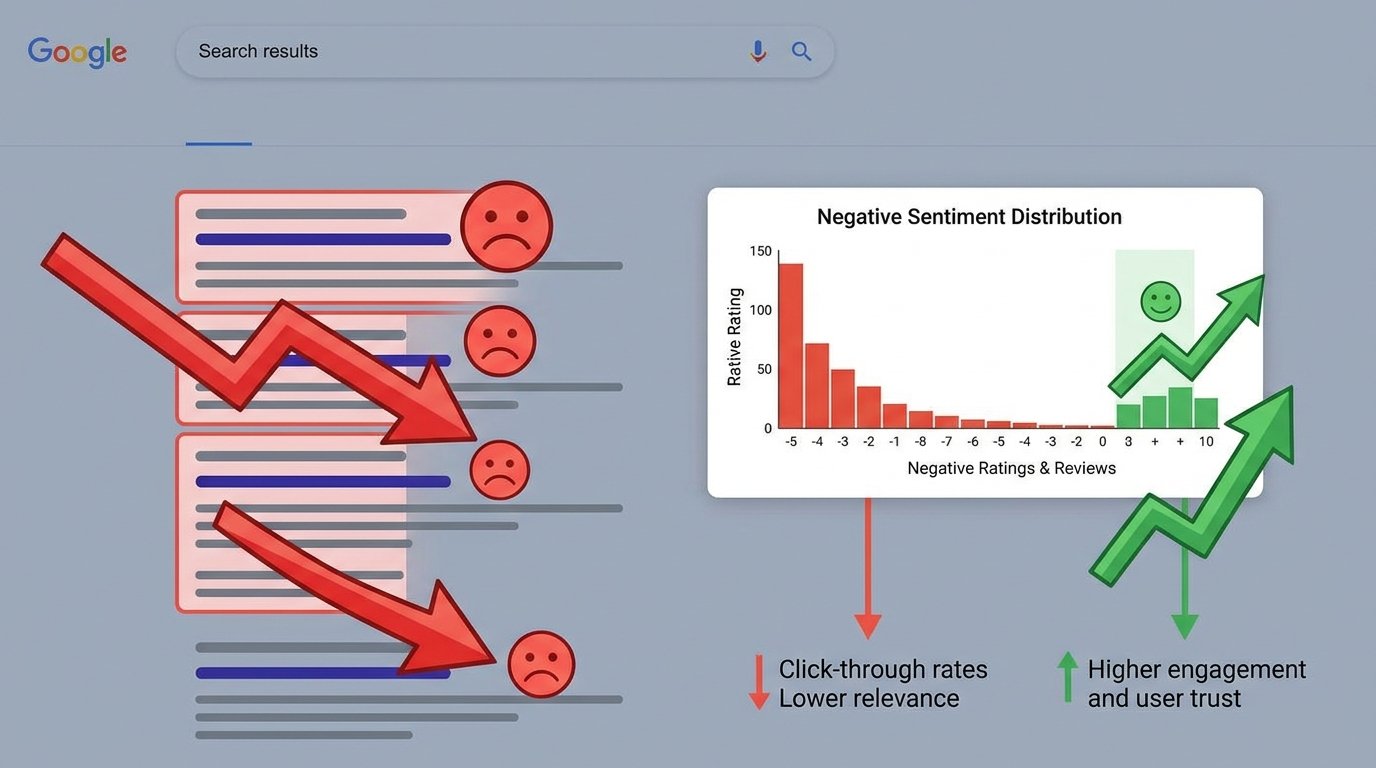
A fragmented sentiment profile can distort perception because users often evaluate the listing that appears for their specific search. One profile can contain a stronger rating while another contains additional negative or positive feedback. The visible listing therefore represents only part of the broader customer-feedback environment. Consolidation reduces this structural separation where the listings legitimately represent the same entity.
Consolidation does not alter genuine customer sentiment. It changes the organisational structure through which that sentiment is represented. This distinction is important because reputation management based on accurate information focuses on improving entity representation rather than manipulating customer opinions. The result is a more transparent relationship between the business and its genuine review history.
How Does Duplicate Listing Consolidation Influence SERP Composition?
Duplicate listing consolidation can influence SERP composition by reducing competing business representations and clarifying which entity is associated with local search information. SERP composition refers to the combination and ordering of content that users encounter for a search query. When duplicate profiles exist, different business records can compete for visibility or present inconsistent information. Consolidation reduces this duplication at the listing level.
The impact on search ranking influence remains dependent on wider local search signals. Relevance, prominence, geographic factors, business information and review signals continue to influence how listings are evaluated. Consolidation therefore does not function as an isolated ranking technique. Its primary function is to improve the coherence of the entity being evaluated.
The relationship between listing structure and search perception is nevertheless significant. Users can interpret different review counts, ratings and business details as evidence of separate organisations when duplicate records are visible. A clearer entity structure reduces this ambiguity. This supports more consistent interpretation of the business without relying on artificial ranking manipulation.
How Should Businesses Evaluate the Risk of Merging Duplicate Listings?
Businesses can evaluate consolidation risk by first confirming whether the duplicate profiles represent the same legal or operational entity. The analysis then examines location, business name, category, website, contact information and review history. These attributes establish whether the profiles have a legitimate relationship. A structural decision made without this assessment can create inaccurate entity information.
A practical evaluation framework includes:
- Verify the entity relationship by comparing business identifiers, locations and operational information across the duplicate profiles.
- Assess review distribution by comparing rating history, review volume, recency and sentiment across each listing.
- Evaluate search visibility by identifying which profile appears for important local queries and how each listing contributes to SERP composition.
- Select the appropriate mechanism by distinguishing legitimate consolidation from correction, removal or independent listing management.
This evaluation separates structural accuracy from reputation objectives. The strongest approach is the one that correctly represents the underlying business entity while preserving legitimate information. Risk therefore relates to entity accuracy, platform compliance, review continuity and search interpretation rather than simply the number of listings involved.
Is Google Review Consolidation a Sustainable Reputation Strategy?
Google review consolidation is sustainable when it resolves the underlying duplication rather than treating the visible symptom alone. A successful consolidation establishes a clearer business entity and reduces the fragmentation of review signals. This creates a stronger structural foundation for future customer feedback and local search evaluation. Sustainability therefore depends on maintaining the accuracy of the resulting listing.
Ongoing reputation control also requires monitoring for new duplicate records. Business expansions, address changes, rebranding, directory inconsistencies and third-party references can introduce new entity conflicts. Without monitoring, the same fragmentation problem can reappear over time. Sustainable management therefore combines an initial structural correction with continued information consistency.
The broader reputation strategy also needs to distinguish consolidation from content suppression. Duplicate listing consolidation resolves structural duplication, while content suppression addresses the visibility of damaging information through legitimate mechanisms. Content enhancement strengthens authoritative information around the entity. Comparing these mechanisms demonstrates that reputation control is not one intervention but a collection of methods matched to specific information problems.
When Is Merging Duplicate Listings the Most Appropriate Approach?
Merging duplicate listings is most appropriate when separate profiles demonstrably represent the same business entity and the duplication has fragmented legitimate reputation information. The mechanism addresses a structural conflict rather than attempting to influence genuine customer sentiment. It is particularly relevant when reviews, ratings and business information are distributed across profiles that users understand as representing one organisation.
The approach becomes less appropriate when the listings represent genuinely separate locations or independent entities. In those circumstances, consolidation can reduce entity accuracy rather than improve it. Each legitimate business profile requires its own reputation signals and local relevance. Evaluation must therefore distinguish duplication from legitimate business separation.
Where consolidation is appropriate, Consolidate Duplicate Listing Reviews provides a useful strategic objective because it focuses on bringing fragmented customer feedback into a more coherent entity structure. The value comes from resolving the relationship between the listing and the underlying business rather than artificially changing the review record. This keeps the strategy centred on information accuracy, entity credibility and search visibility.
What Provides Better Long-Term Value: Consolidation, Enhancement or Removal?
The strongest long-term value depends on the underlying reputation problem rather than one universally superior method. Consolidation addresses duplicate entity structures, enhancement strengthens legitimate authority and removal addresses qualifying content or unnecessary listing records. Each mechanism operates at a different level of the search ecosystem. Comparing them without considering the underlying problem produces an incomplete assessment.
Consolidation offers structural value because it reduces fragmentation and creates a clearer relationship between the business and its review history. Enhancement offers authority value because it expands credible information supporting the entity. Removal offers risk-reduction value when content or a listing qualifies for legitimate removal through an applicable platform or publisher process.
A sustainable reputation strategy therefore evaluates the mechanisms together. Structural problems require structural solutions, weak authority signals require credible information development, and qualifying harmful content requires appropriate removal or correction pathways. This approach avoids treating every reputation problem as a ranking issue. It also creates a clearer relationship between intervention, risk and measurable search outcomes.
Merging duplicate listings is primarily an entity-structure strategy that consolidates fragmented Google review signals around the appropriate business profile. Its effectiveness depends on whether the duplicate records genuinely represent the same business and whether consolidation is supported by the relevant platform process.
Compared with content enhancement, consolidation provides a more direct response to fragmented listing information, while enhancement strengthens the broader authority environment. Compared with removal, consolidation focuses on resolving duplicate representation rather than simply eliminating a profile. Reactive correction addresses immediate structural problems, while organic reputation development supports longer-term information consistency.
The most sustainable approach evaluates consolidation, enhancement, correction and legitimate removal according to the specific reputation problem. Search visibility, sentiment distribution, entity credibility and SERP composition all depend on the accuracy of the information structure surrounding the business. A coherent listing structure therefore provides an important foundation for interpreting genuine customer feedback and maintaining consistent online reputation signals.
Can duplicate Google Business listings be merged?
Duplicate Google Business listings can be consolidated when they represent the same eligible business entity. The appropriate process depends on factors such as listing ownership, business location, profile information and whether the profiles genuinely represent the same organisation.
How do duplicate listings affect Google Reviews?
Duplicate listings can split reviews, ratings and sentiment signals across separate business profiles. This fragments the visible review history and can make the business appear to have fewer or less consistent reputation signals on the profile users find.
Does merging duplicate listings combine Google Reviews?
When Google consolidates eligible duplicate profiles, associated business information and eligible review signals can be brought into a more coherent listing structure. The outcome depends on Google’s review and Business Profile policies and the specific relationship between the listings.
Should I delete a duplicate Google Business Profile or merge it?
Merging is generally the more appropriate route when two profiles represent the same business and the applicable Google process supports consolidation. Deleting or removing a profile without assessing its relationship with the primary listing can create additional information and review-management issues.
How can businesses consolidate reviews from duplicate listings?
Businesses can first identify duplicate profiles, verify that they represent the same entity, and compare their business information and review histories. The appropriate consolidation process can then be evaluated based on listing eligibility, entity accuracy and Google’s applicable Business Profile guidelines.