
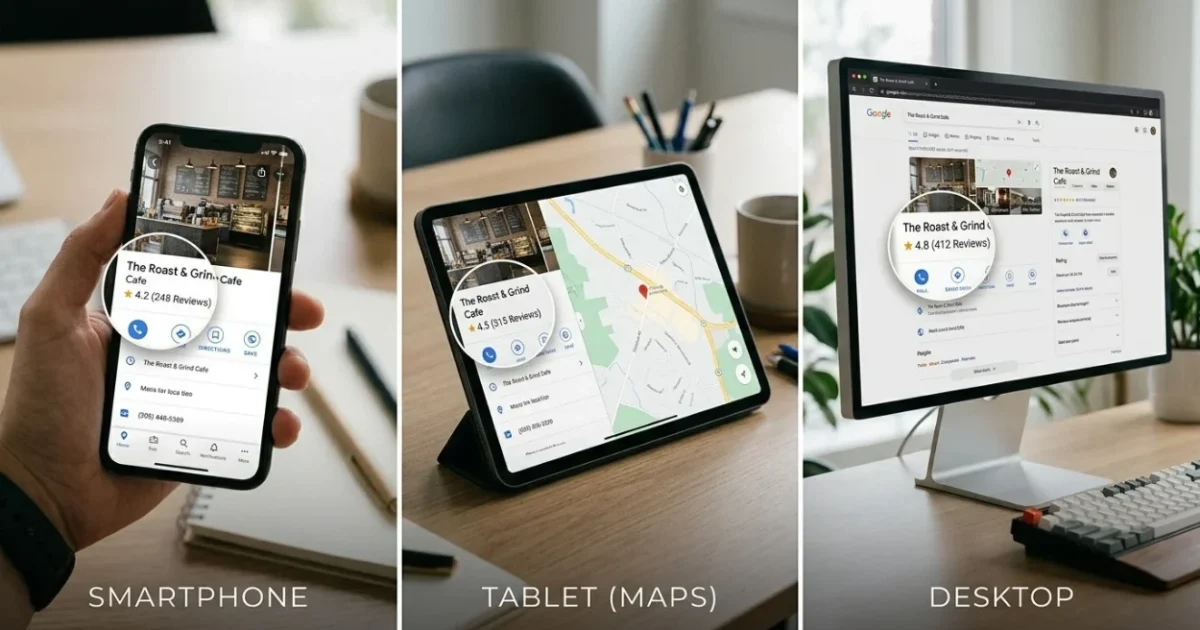
A Google rating can differ across mobile search, Google Maps and desktop because each interface presents review information through different layouts, data refresh cycles and contextual search features. Small differences in displayed ratings do not automatically indicate that reviews have been removed or that a business profile has changed.
Reputation management is the analysis of how information about an entity is collected, displayed and interpreted across digital platforms. Online reputation refers to the overall perception formed from reputation signals, including customer reviews, star ratings, business details and third-party information. Within Google’s search ecosystem, these signals appear across multiple interfaces, each designed to meet a particular user intent. Understanding why ratings differ requires separating the underlying review data from the way search interfaces display and update it. This distinction explains how search visibility, content indexing and entity perception interact.
Why Does Your Google Rating Differ Across Mobile, Maps and Desktop?
Google ratings can appear different across devices because search interfaces do not always display the same information at the same time or in the same format. A business profile can appear in standard Google Search, Google Maps and mobile search results, but each interface has its own presentation and contextual features. The visible rating represents a summary of customer feedback rather than a complete record of every review. Differences in when data is refreshed, how the interface loads and which profile is displayed can affect what users see. Therefore, a rating discrepancy needs to be investigated before it is interpreted as a reputation problem.
Google Search presents business information in response to a query, while Google Maps prioritises place discovery, geographic relevance and local business information. Mobile interfaces organise these elements around smaller screens, often placing key information in compact panels or expandable sections. Desktop interfaces provide more space for business details, review summaries and supporting content. Although these interfaces draw on Google’s business information systems, their displayed components and update timing are not necessarily identical. A difference in presentation does not establish that Google maintains a separate underlying rating for each device.
The distinction between the displayed rating and the review record is central to understanding the discrepancy. A displayed rating is the numerical summary shown to a user, while the review record consists of the individual reviews associated with a business profile. If the rating differs across interfaces, the first step is to confirm that each interface refers to the same business and profile. A similarly named business, duplicate listing or different location can produce an apparently inconsistent result. Correct entity identification prevents an unrelated listing from being mistaken for a change in reputation signals.
How Does Google Calculate and Display Business Ratings?
Google business ratings summarise customer reviews into a star-based score, displayed alongside the number of reviews associated with the profile. The rating is intended to provide a quick indication of customer sentiment, but it does not explain the circumstances behind each review. Google’s displayed rating is based on the ratings it receives, and the calculation can differ from a simple manual average of the visible reviews. Google does not publicly provide a complete formula that enables users to reproduce every displayed score precisely. As a result, a business cannot reliably infer that a rating discrepancy represents a specific calculation error from the visible numbers alone.
The review count and the star rating describe related but different aspects of the same reputation signal. Review count indicates how many reviews are associated with the profile, whereas the star rating summarises their ratings. A change in either measure can affect how people interpret the profile, particularly when they compare businesses in the same category. However, a high review count does not independently prove that every review is genuine, and a high average does not establish the accuracy of every claim. Interpreting reputation requires considering the overall distribution of ratings, the content of reviews and the consistency of the business information.
Displayed information also depends on the processing and presentation of review data. New reviews, edited submissions, removed content and changes to a profile can affect what appears to users over time. Google applies moderation systems and policies to reviews, and some content is removed when it violates those policies. Changes are not necessarily reflected in every interface at exactly the same moment. This explains why a business can observe temporary differences without sufficient evidence to conclude that the rating system is malfunctioning.
How Do Search Algorithms Influence Rating Visibility?
Search algorithms determine which business information appears for a particular query and how prominently it is presented, while the displayed rating summarises review information associated with the selected profile. These functions are connected but not interchangeable. Google’s local search results consider factors including relevance, distance and prominence when determining local rankings. The rating visible in a result is one component of the information presented to users, rather than a complete explanation of the business’s ranking position. A rating difference and a ranking difference therefore require separate analysis.
Relevance refers to how closely a business profile matches the user’s search intent. Distance concerns the location of the business in relation to the searcher or the location specified in the query. Prominence reflects how well-known a business is, with information from across the web contributing to Google’s assessment. These factors help explain why the same business appears differently for searches performed in different locations or with different wording. They do not establish that mobile users receive a different rating calculation simply because their search results differ.
Search engine results pages (SERPs) also change according to the type of information requested. A branded query can return a business profile prominently, while a broader service query can produce a local pack, organic pages and directory listings. Each result format provides a different amount of review information and context. When users compare ratings across interfaces, they can unintentionally compare a business profile with another listing or a differently formatted summary. Accurate SERP evaluation therefore begins with confirming the identity of the result and the specific information being compared.
How Do Review Signals Affect Online Reputation and Customer Trust?
Review signals are pieces of information derived from customer feedback, including star ratings, review volume, recency and written sentiment. These signals influence how people assess credibility because they provide visible evidence of other customers’ reported experiences. A rating offers a compressed numerical summary, while review text provides details about service quality, reliability and recurring concerns. Neither signal fully represents the business on its own. A meaningful assessment considers both the numerical score and the information contained in the reviews.
Sentiment distribution describes how positive, neutral and negative evaluations are represented within a collection of feedback. A profile with a strong average rating can still contain detailed criticism that influences customer decisions. Equally, a lower average can coexist with informative responses that demonstrate how a business handles complaints. Readers interpret these signals in context, comparing the rating with the substance of the feedback and the relevance of the reviews to their needs. This means reputation is shaped by the relationship between numerical summaries and the content that explains them.
Trust signals also extend beyond reviews. Consistent business names, addresses, opening hours and service descriptions help users identify the correct entity across digital sources. Accurate information reduces confusion between businesses with similar names and supports a coherent digital footprint. Conflicting details can weaken confidence because users struggle to determine which source is authoritative. Entity credibility therefore depends on the consistency and reliability of information across the platforms where a business is represented.
Why Does Google Maps Sometimes Show a Different Rating from Google Search?

Google Maps and Google Search serve related but distinct discovery purposes, which affects how business information is displayed. Maps focuses on places, locations and local discovery, while Search organises information around the meaning and context of a query. The same business can appear in a Maps listing, a local search result or a business profile panel. These formats can display review information differently, and updates are not guaranteed to appear simultaneously. A discrepancy between them is not, by itself, proof that one interface has the correct rating and the other has an incorrect one.
Profile identity is an important factor when comparing these interfaces. Businesses operating at multiple locations can have separate profiles with separate review histories and ratings. A search result that points to a branch is not directly comparable with a Maps listing for the organisation’s other location. Duplicate or outdated profiles can also create confusion about which review record belongs to the active business. Comparing the profile name, address and review count helps establish whether the observed discrepancy concerns the same entity.
Content indexing and data refresh timing also affect what users encounter. Search engines process information through systems that discover, update and present content, while platform interfaces retrieve and render information according to their own technical processes. A recently changed review record can therefore appear differently across interfaces for a period of time. The exact cause cannot be identified from the displayed ratings alone. Checking the same profile at different times and comparing the review count and visible reviews provides a more reliable basis for investigating the difference.
How Can You Distinguish a Genuine Rating Change from a Display Discrepancy?
A genuine rating change involves an alteration in the review information or rating associated with the correct business profile, while a display discrepancy occurs when interfaces show inconsistent information about that profile. Distinguishing between them requires checking the source rather than assuming that every difference reflects a change in customer sentiment. A rating that changes alongside the review count or the visible review record provides different evidence from a rating that differs only between interfaces. The comparison must also account for profile identity, location and the time at which each result was viewed. This process prevents a temporary display difference from being interpreted as a confirmed loss of reputation.
A consistent comparison uses the same business profile, the same observation period and comparable rating information. Record the rating and review count shown in mobile Search, Google Maps and desktop Search, then verify that each result points to the same business. Review the visible feedback for new, edited or missing entries and repeat the comparison after an appropriate interval. If the difference persists, consult the business profile and Google’s available support resources to determine whether the issue relates to the profile or the display. This establishes a clearer evidence trail than relying on a single screenshot.
The investigation also needs to separate a rating discrepancy from a ranking discrepancy. A business can retain the same star rating while appearing in a different position because the search query, location or local ranking factors have changed. Conversely, the rating can change without a corresponding movement in search position. These outcomes measure different parts of the search ecosystem and require separate records. Treating them as distinct variables improves the accuracy of reputation analysis and prevents incorrect conclusions about search performance.
Dive Deeper With Our Expert Guides:
How Review Bombing Campaigns Target Businesses Overnight
Why Unanswered Google Reviews Cost You More Customers
How Do Digital Footprints and Content Authority Shape Search Perception?
A digital footprint is the collection of information about an entity across websites, profiles, directories, publications and other online sources. Search systems use information from these sources to identify relevant pages and present results for specific queries. A consistent digital footprint makes it easier for users to recognise the correct business and understand its services. Inconsistent names, outdated addresses or conflicting descriptions create ambiguity about the entity being evaluated. This ambiguity can affect user confidence even when the underlying Google rating remains unchanged.
Content authority refers to the perceived or algorithmically assessed relevance, quality and credibility of a source for a particular subject. A well-maintained business website provides direct information about services, locations and policies, while independent sources can add context to the organisation’s public profile. Search engines evaluate individual pages and other signals rather than accepting every published statement as verified truth. Consequently, the presence of a business on multiple websites does not automatically establish authority or guarantee higher rankings. Credibility develops through the quality, relevance and consistency of the available information.
Search perception influence describes how the selection and presentation of digital information affect the impression users form about an entity. Google ratings are one visible component of that process, but they operate alongside business details, review text, organic results and third-party publications. A complete understanding of online reputation therefore requires examining the wider set of results rather than relying on one rating in isolation. This broader perspective also explains why a device-specific display difference does not necessarily indicate a fundamental change in the business’s reputation.
What Does Rating Consistency Reveal About Reputation Management?
Rating consistency reveals whether the same business information is being presented coherently across the interfaces people use to discover it. A stable rating across mobile Search, Maps and desktop provides a clearer basis for comparison, although consistency alone does not prove that every review is accurate or authentic. Differences require investigation into profile identity, review updates, moderation and display timing. Why Your Google Rating Varies by Device provides a relevant framework for understanding these differences and identifying the factors that influence rating presentation. Separating these factors allows businesses and researchers to distinguish technical presentation issues from genuine changes in customer feedback. It also creates a more reliable basis for evaluating reputation signals over time.
The key concepts are connected but distinct: the review record contains customer feedback, the displayed rating summarises that feedback, and search ranking determines where a business appears for a query. Interface design and update timing influence how the information is presented, while the wider digital footprint shapes the context in which users interpret it. No single rating provides a complete measure of entity credibility or search performance. A sound analysis compares like-for-like information, verifies the correct profile and evaluates ratings separately from ranking changes. These principles explain why Google rating differences require evidence-based interpretation rather than immediate assumptions about review removal or algorithmic penalties.
Why does my Google rating differ between mobile, Google Maps and desktop?
Your Google rating can differ across mobile Search, Google Maps and desktop because of differences in data refresh timing, interface presentation or the business profile being displayed. Check that each platform shows the same business listing before concluding that your rating has changed.
Does Google calculate different ratings for mobile and desktop users?
Google does not publicly document separate rating formulas for mobile and desktop users. Differences in displayed ratings are not sufficient evidence of separate calculations and can relate to data updates, presentation or profile identification.
Why has my Google Business Profile rating changed without new reviews?
Google ratings can change when reviews are removed, updated or processed through its moderation systems, even when no new review is immediately visible. Differences in displayed information or the profile being viewed can also explain an apparent change.
How can I check which Google rating is correct?
Compare the same business profile across Google Search, Google Maps and desktop, checking the star rating, review count and visible reviews. Repeat the comparison later to identify persistent discrepancies and verify that each interface refers to the correct business location.
Do differences in Google ratings affect local search rankings?
Rating differences can influence customer perception, but they do not automatically indicate a ranking penalty. Google’s local rankings consider relevance, distance and prominence, so rating changes and search position need to be assessed separately.