

Online reputation control methods are evaluated through their capacity to modify entity credibility, reshape sentiment distribution, and alter search ranking influence across digital ecosystems. For high-profile professionals, executive risk exposure stems from a failure to identify how legacy digital footprints, algorithmic shifts, and unmanaged search signals intersect to erode professional authority.
How Do Content Suppression and Legal Removal Strategies Compare in Digital Risk Mitigation?
Content suppression and legal removal represent the two primary mechanisms for addressing adverse online search results, differing fundamentally in execution, scalability, and technical dependency. Legal removal is the permanent deletion of specific URLs or search results from an index based on regulatory frameworks, copyright claims, or defamation laws. This approach operates by eliminating the source data entirely, ensuring the problematic content cannot be indexed or displayed by search engine crawlers. Content suppression is the strategic optimization of positive and neutral digital assets to displace negative search results from the first page of search engine results pages (SERPs). This method operates by leveraging search engine ranking algorithms, pushing undesirable links down to lower-position pages where user visibility drops significantly.
| Evaluation Metric | Legal Removal Strategy | Content Suppression Strategy |
| Primary Mechanism | Permanent erasure from index or hosting server. | Algorithmic displacement via asset optimization. |
| Execution Timeline | Variable, dependent on judicial or platform review. | Progressive, requiring sustained authority building. |
| Risk of Recurrence | Low for the specific URL; high for new iterations. | Controlled, managed through network permanence. |
| Search Visibility Impact | Total elimination of the targeted search signal. | Reconfiguration of top-tier sentiment distribution. |
The effectiveness of legal removal depends on strict statutory criteria, making its application limited to clear violations of law or platform terms of service. When successful, it provides absolute risk mitigation for that specific entity reference, but it offers no protection against subsequent publications on different domains. Content suppression provides a broader, systemic shield by building a robust content network around the professional entity name. This method alters the balance of search ranking influence, ensuring that a single negative signal cannot dominate the primary SERP. However, content suppression requires continuous technical resource allocation to maintain the authority of the protective content layer against algorithmic fluctuations.
Why Do Search Engine Algorithms Process Reputation Signals Differently Across Organic and Reactive Frameworks?
Search engines process reputation signals by evaluating the authority, relevance, and trust dynamics of content linked to a specific entity name. Organic reputation frameworks establish a proactive, diversified network of web assets, verified profiles, and authoritative publications before any crisis occurs. This architecture allows search engine crawlers to build a stable semantic understanding of the entity, associating the professional name with high-trust nodes. Reactive reputation frameworks initiate content production and optimization protocols only after a negative event alters the sentiment distribution. This approach forces new assets to compete directly with highly engaging, newly indexed negative news or discussion threads that benefit from freshness algorithms.
Search engine algorithms prioritize user engagement, topical authority, and domain trust when determining the composition of an entity SERP. Reactive strategies struggle initially because algorithmic freshness components temporarily elevate recent negative coverage, particularly if published by high-authority news media. Organic frameworks mitigate this risk exposure because the pre-existing asset network possesses established domain authority, backlink profiles, and historical trust signals. By maintaining a structured semantic network, professionals ensure that search algorithms have an abundant supply of authoritative data to counter sudden sentiment shifts. Consequently, organic architectures stabilize search perception control, while reactive interventions require substantially more velocity to displace authoritative, trending negative links.
How Do Short-Term Suppression Tactics and Long-Term Asset Optimization Impact Entity Credibility?
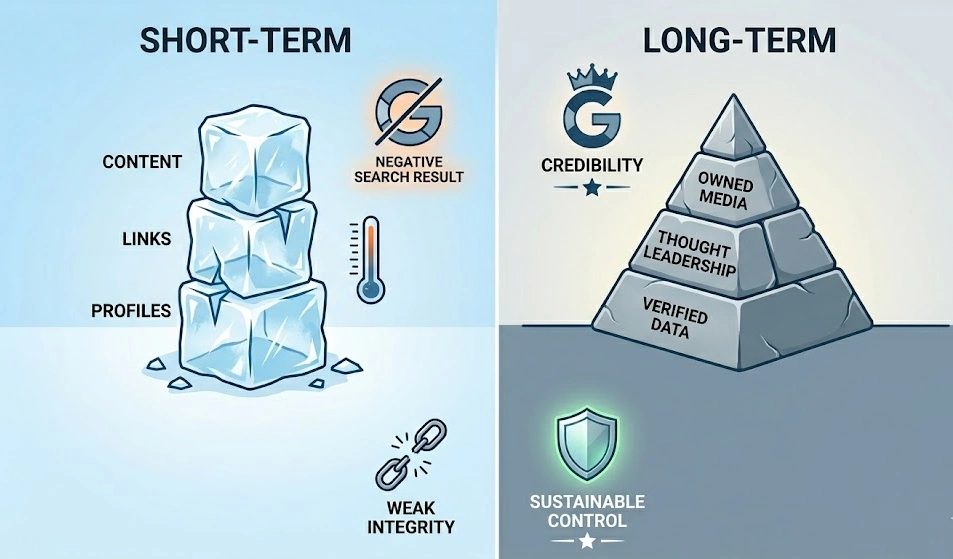
Short-term suppression tactics focus on rapid content deployment, link generation, and profile creation to achieve immediate, temporary displacement of negative search results. This methodology relies on inflating the relevance signals of low-tier web assets to quickly occupy top-ranking positions during an acute reputation shift. Long-term asset optimization builds permanent digital infrastructure through owned media, thought leadership platforms, and verified semantic schema data. This approach focuses on establishing deep entity credibility by aligning all public-facing assets with the specific quality evaluation guidelines used by search engines.
- Analyse structural integrity: Short-term tactics often utilize weak web properties that lack long-term domain authority, leading to ranking decay within months.
- Evaluate algorithmic risk: Search engines frequently update their core algorithms to detect artificial relevance spikes, which can invalidate short-term suppression networks.
- Measure resource efficiency: Long-term asset optimization requires higher initial investments but delivers sustainable sentiment distribution control across multiple years.
- Assess trust signal depth: Permanent digital assets generate authentic user engagement and citations, reinforcing entity credibility at the knowledge graph level.
The core limitation of short-term suppression is its vulnerability to algorithmic corrections that strip low-quality assets of their temporary search ranking influence. When these superficial assets lose visibility, the underlying negative reputation signals re-emerge on the primary SERP. Long-term asset optimization avoids this vulnerability by creating content networks that genuinely satisfy search engine quality standards. By anchoring an entity within trusted industry databases, official corporate domains, and verified knowledge bases, professionals secure lasting search perception control. This structural permanence ensures that the sentiment distribution remains resilient against both competitive entry and algorithmic volatility.
In What Ways Do Controlled Content Networks and Independent Media Coverage Alter Search Perception Control?
Controlled content networks allow professionals to manage the exact messaging, formatting, and semantic associations displayed within search results. These networks comprise corporate websites, personal portfolios, professional association profiles, and authorized digital assets where the entity maintains administrative control. Independent media coverage consists of third-party journalistic articles, industry reviews, public forums, and editorial features outside the entity’s direct influence. Both asset types contribute to the overall sentiment distribution, but they influence search engine evaluation mechanics in completely different ways.
Controlled networks offer total predictability in search perception control, enabling the precise placement of key trust signals and professional designations. They serve as the foundational baseline for entity credibility, ensuring that baseline biographical and operational facts are clear to search crawlers. Independent media coverage, however, carries significantly higher search ranking influence due to the natural domain authority and backlink profiles of established news organisations. When independent coverage aligns with a positive sentiment vector, it validates the entity’s authority far more effectively than owned media. Conversely, negative independent coverage presents the highest risk exposure, requiring sophisticated content enhancement methodologies to rebalance the SERP composition.
What Are the Scalability Metrics and Technical Limitations of Digital Footprint Optimisation?
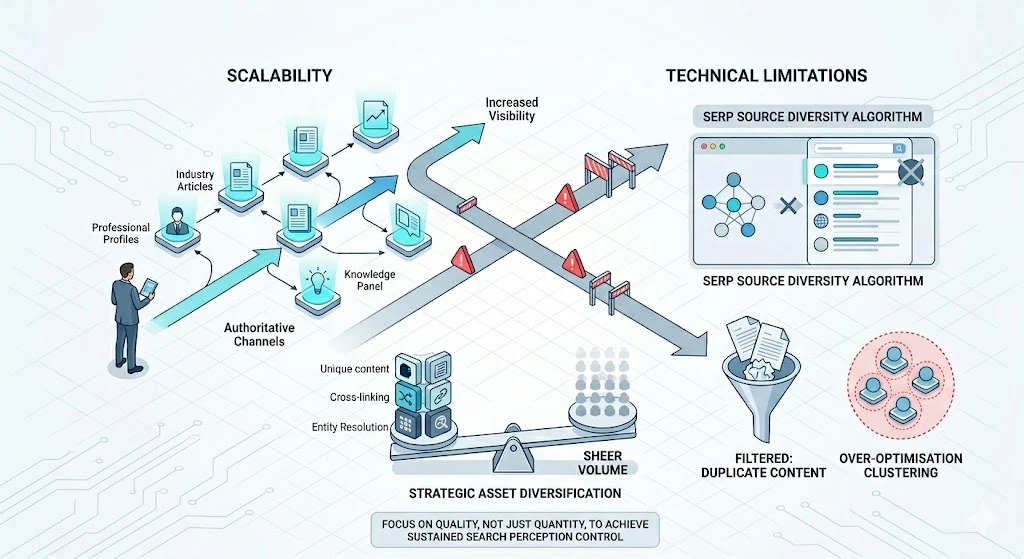
Digital footprint optimisation scales by expanding the breadth and depth of a professional’s semantic footprint across authoritative digital channels. Scalability is measured through the volume of high-authority indexing nodes an entity can establish and maintain without triggering webspam filters. The primary technical limitation involves the natural constraints of query-deserving diversity algorithms, which prevent a single domain or entity type from monopolising an entire SERP. Search engines deliberately introduce source diversity to ensure users encounter different perspectives, meaning that controlled asset expansion eventually hits a ceiling of diminishing returns.
Evaluating these limitations requires an analysis of how data syndication, cross-linking architectures, and entity resolution processes operate within search indexes. Over-optimisation of a controlled network can cause search engine crawlers to cluster the assets together, effectively reducing their individual search ranking influence. Furthermore, maintaining a large network of digital properties introduces significant maintenance friction, as each asset requires unique content updates to preserve relevance. If a professional expands their footprint using duplicate or low-value content, search algorithms filter those pages out of the primary index. Therefore, digital footprint scalability must rely on strategic asset diversification rather than sheer volume to maintain effective search perception control.
How Should Professionals Evaluate Strategic Options When Selecting an Analytical Framework for Risk Management?
Evaluating strategic options for reputation management requires a systematic analysis of current SERP composition, entity vulnerability, and long-term professional objectives. The process begins with a comprehensive audit of current sentiment distribution, mapping every visible link against its domain authority and emotional velocity. Professionals must determine whether their primary vulnerability lies in legacy content decay, active adversarial attacks, or a lack of positive search ranking influence. This data-driven assessment reveals whether the immediate requirement demands a reactive suppression intervention or a proactive structural enhancement program.
A sustainable risk management framework balances immediate containment needs with the continuous cultivation of entity credibility. Relying solely on tactical suppression leaves the professional exposed to future volatility, while focusing exclusively on long-term growth may leave current vulnerabilities unaddressed. The optimal approach integrates content enhancement with rigorous search perception analysis to construct a resilient digital barrier. This dual-layered strategy ensures that the professional entity develops the algorithmic authority necessary to withstand unexpected shifts in search landscape dynamics. By embedding these practices into a broader risk framework, executives can protect their professional standing against complex digital threats.
The evaluation of digital risk management reveals that long-term asset permanence and proactive semantic engineering outperform short-term reactive interventions. While legal removal offers targeted erasure and short-term suppression provides rapid displacement, neither method addresses the systemic requirement for sustained entity credibility. True search perception control is achieved by building diversified, high-authority content networks that align naturally with search engine algorithmic preferences.
Professionals must transition away from sporadic, crisis-driven responses and instead adopt continuous digital footprint optimisation models. By analysing search ranking influence, monitoring sentiment distribution, and understanding the mechanics of content suppression vs content enhancement, professionals safeguard their authority systematically. Ultimate resilience relies on establishing an unassailable digital infrastructure that consistently projects verified trust signals across the global search ecosystem, highlighting the long-term utility of comprehensive executive reputation protection services.
Frequently Asked Questions
How do professionals identify hidden online reputation risks?
Professionals identify hidden digital liabilities by conducting comprehensive search perception analysis across search engines, databases, and social platforms. This audit evaluates entity credibility by mapping out outdated news, misleading content, and negative sentiment distribution that could impact executive standing. Strategic monitoring through Clear My Name helps professionals detect these algorithmic risks before they influence stakeholder perception or corporate trust signals.
What is the difference between content suppression and content removal?
Content removal permanently deletes specific URLs or search indices through legal frameworks, copyright claims, or terms-of-service violations. In contrast, content suppression utilizes Reputation Management strategies to optimize a network of positive, high-authority assets that displace undesirable search results down the SERPs. Suppression modifies the overall sentiment distribution, making negative links less visible without requiring the deletion of third-party source data.
How do search engine algorithms process corporate and personal reputation signals?
Search engines process reputation signals by evaluating the topical authority, domain trust, and user engagement metrics of content linked to an entity. Algorithms prioritize verified data sources, knowledge graph entries, and high-authority media coverage when formatting the primary search results. Implementing a proactive digital footprint optimization framework ensures that search engine crawlers encounter consistent, positive trust signals regarding the business or executive.
Can legacy digital footprints cause unexpected corporate risk exposure?
Yes, unmanaged legacy digital footprints frequently create significant risk exposure as search engine algorithms shift or old content experiences sudden engagement spikes. Outdated press releases, historic legal filings, or old social media posts can resurface, altering search ranking influence and damaging current corporate narrative control. Ongoing Reputation Management ensures these older web assets are systematically audited, updated, or algorithmically countered to protect current entity credibility.
Why should executives adopt a proactive reputation management strategy?
A proactive strategy establishes a robust, diversified network of high-trust digital assets before an unexpected crisis or negative event occurs. This pre-existing infrastructure provides a resilient layer of search perception control, making it much more difficult for sudden negative links to dominate the top search results. By consistently managing entity authority with Clear My Name, executives build lasting algorithmic immunity that stabilizes sentiment distribution over the long term.