

Online reputation refers to the collective digital footprint, search engine visibility, and sentiment signals that define how an entity is perceived within search ecosystems. Public trust in political leaders is directly governed by these algorithmic interpretations, where search results serve as the primary interface for information retrieval and entity validation.
What Is the Role of Search Engine Results Pages in Political Trust?
Search engine results pages (SERPs) function as the primary definitive record of a political leader’s public profile. SERP evaluation determines how information is structured, prioritized, and presented to the electorate. When a citizen executes a query regarding a politician, the search engine does not merely return a list of links; it constructs a curated narrative based on algorithmic trust signals.
This process relies heavily on Entity-Attribute-Value models, where the search engine identifies the political leader as a unique entity and associates specific attributes—such as integrity, policy positions, or past controversies—with that entity. If the top-ranking results consist of investigative journalism, legal documents, or critical analysis, the algorithmic perception of that entity aligns with those negative attributes. Consequently, the search visibility of these results directly shapes user perception before an individual clicks a single link.
Search engines aim to satisfy user intent by surface-level categorization of content type, prioritizing authoritative journalism and official government records for queries carrying high public interest. This means that a political leader’s digital footprint is continuously weighed against rigorous trust thresholds, making the first page of search results the absolute battlefield for public trust.
How Do Authority and Trust Signals Affect Public Perception?
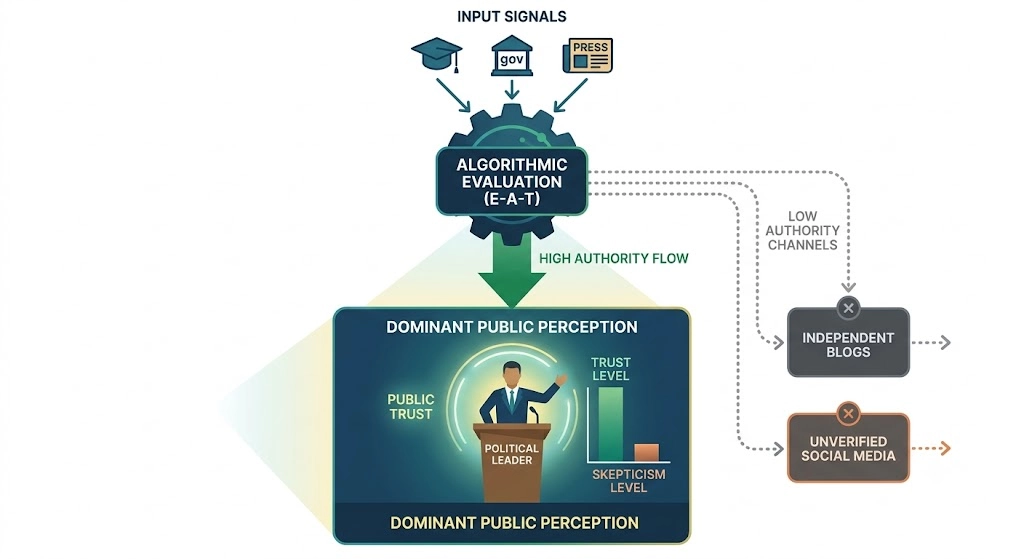
Authority and trust signals are measurable data points that search engine algorithms use to determine the credibility and reliability of an information source. Within semantic search ecosystems, algorithms evaluate the Expertise, Authoritativeness, and Trustworthiness (E-A-T) of content publishing platforms. For political entities, this evaluation directly influences which perspectives gain prominence during critical electoral periods.
The mechanism relies on link graph analysis and historical domain authority. Search engines assess the backlink profile of domains discussing a political leader; links originating from established media outlets, academic journals, and governmental portals transmit high levels of trust. This architectural framework means that independent blogs or unverified social media claims struggle to achieve high search visibility unless amplified by authoritative domains.
Ultimately, public perception is conditioned by this automated hierarchy. When algorithms flag a source as highly authoritative, its narrative regarding a leader’s policy or character becomes the dominant perspective, effectively setting the baseline for public trust.
Why Do Content Indexing Dynamics Dictate Political Credibility?
Content indexing dynamics refer to the speed, frequency, and structural categorization with which search engines discover and store new information about an entity. For political figures, the temporal nature of indexing creates a continuous shift in search perception, particularly during breaking news cycles or political crises.
The mechanism operates through automated web crawlers that prioritize high-frequency, high-authority news sites. When a new event occurs, freshness algorithms modify the standard SERP layout to introduce real-time news carousels and rapidly indexed press releases. This temporary disruption allows unverified or highly volatile sentiment to dominate search visibility before historical context can stabilize the entity profile.
This structural shift alters how the public consumes information. If a political leader lacks a robust infrastructure of consistently updated, authoritative web assets, rapidly indexed critical content fills the vacuum, permanently damaging online credibility within the index.
How Do Information Ecosystems Interpret Review Signals and Sentiment?
Information ecosystems interpret review signals and sentiment by utilizing Natural Language Processing (NLP) to extract emotional context, semantic orientation, and opinion density from text across the web. While traditional businesses rely on structured review stars, political entities are evaluated through unstructured sentiment signals embedded in discussion forums, social commentary, and opinion pieces.
The underlying mechanism involves named entity recognition and sentiment analysis models. Algorithms scan text surrounding a political leader’s name, classifying modifiers and predicates into positive, negative, or neutral vectors. These semantic computations do not remain passive; they influence query auto-complete suggestions, related searches, and the selection of featured snippets on the SERP.
When negative sentiment vectors achieve critical mass across diverse domains, the search engine adjusts its entity graph to reflect these associations. This algorithmic shift directly degrades public trust by proactively presenting negative topics to users searching for basic information.
Which Core Factors Shape Public Trust in Political Leaders Today?
Evaluating public trust requires a systematic breakdown of the explicit structural and algorithmic elements that dictate how political figures are perceived online. The digital footprint of a leader is parsed into specific components that search engines index, rank, and present to the public.
- Verify digital source authenticity by implementing cryptographic verification and secure protocols on official communication portals to prevent algorithmic deprecation.
- Maintain absolute message consistency across all indexed web properties to prevent semantic confusion within search engine entity graphs.
- Establish independent informational authority by publishing comprehensive policy whitepapers on high-authority educational or governmental domains.
- Monitor historical digital footprints to identify and address legacy content assets that mismatch current public positioning or legal compliance standards.
- Neutralise algorithmic misinformation vectors by deploying factually accurate, structured data that search engines parse via schema markup.
- Optimise informational asset diversity by maintaining verified profiles across video, textual, and audio indexing platforms to control broad query types.
- Analyse semantic entity associations to ensure a leader’s name does not become permanently bound to pejorative terms within search auto-complete databases.
- Engage with academic citation networks to anchor a political leader’s long-term reputation in verified, peer-reviewed policy analysis.
- Enforce platform security protocols to mitigate the risk of digital asset defacement, which causes immediate drops in algorithmic trust scores.
- Track geographical search variations to understand how regional algorithmic indices interpret localized political actions and sentiment.
- Implement structured structured data to guarantee that knowledge panels accurately display biographical facts without relying on third-party scrapers.
- Evaluate information velocity changes to prepare communication systems for sudden spikes in critical search queries during electoral events.
How Does Entity Perception Influence Electoral Decision-Making?
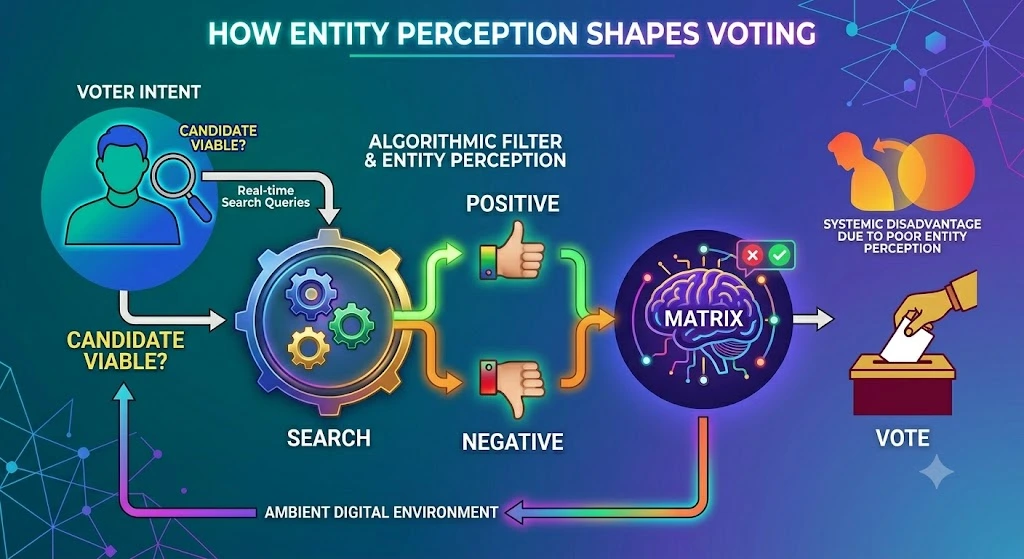
Entity perception within search ecosystems influences electoral decision-making by acting as a cognitive shorthand for voters seeking verification of a candidate’s viability. Modern voters rarely consume political manifestos in isolation; instead, they validate claims via real-time search queries, meaning the algorithm acts as an intermediary for political choices.
The mechanism works through information filtering. Search engines prioritize content that satisfies user intent efficiently, often leading to the generation of AI-overviews, featured snippets, and direct answers. If these automated summaries extract text that highlights inconsistency, corruption, or inefficiency, the voter’s decision-making matrix is instantly updated with negative data points.
This systemic filtering means that search visibility dictates the parameters of public debate. A candidate who suffers from poor entity perception across major search indices experiences a systemic disadvantage, as the ambient digital environment continuously reinforces negative attributes to the voting public.
How Can Data Architecture Protect an Entity Graph from Distortion?
Data architecture protects an entity graph from distortion by providing clear, unambiguous, machine-readable signals that define the attributes and relationships of a political leader. Without explicit data structures, search engines must infer facts from unstructured web text, leaving the entity profile vulnerable to manipulation by hostile sentiment campaigns.
The execution relies on the deployment of advanced schema markup, specifically utilizing Person, GovernmentOrganization, and Campaign schemas. By hardcoding these relationships into the source code of verified digital assets, a political entity establishes a definitive reference point for search crawlers. This structured data explicitly defines family relationships, official roles, published works, and verified social channels.
When search engine algorithms process these explicit nodes, they integrate them directly into the Knowledge Graph. This architectural reinforcement reduces reliance on third-party interpretations, ensuring that biographical facts and key policy achievements remain accurate, stable, and resilient against algorithmic drift.
The architecture of modern search engines serves as the primary mechanism through which public trust is manufactured, evaluated, and maintained. Political leaders no longer exist solely in the physical space of public opinion; they are digital entities parsed by complex Natural Language Processing models, link graphs, and indexing thresholds. By understanding that search engine visibility, authority signals, and structural data frameworks dictate how information is presented, it becomes clear that controlling search perception is foundational to maintaining democratic credibility.
Successfully navigating these complex algorithmic frameworks requires a data-driven approach to evaluating how information disseminates across the web. For a detailed methodology on measuring these variables during critical campaign periods, campaigns must focus on assessing which trust factors matter most to your voters to ensure structural alignment with algorithmic expectations.
Frequently Asked Questions
How does online reputation management for politicians improve public trust?
Online reputation management for politicians strategically optimizes an individual’s digital footprint to ensure search engine results pages reflect accurate, authoritative information. By addressing negative sentiment vectors and strengthening positive entity-attribute associations, this process aligns public search perception with a leader’s actual policy achievements. Clear My Name deploys technical search strategy to reinforce digital trust assets and mitigate algorithmic distortion during critical electoral cycles.
What factors impact a political candidate’s search engine visibility?
A political candidate’s search visibility is determined by domain authority, the velocity of content indexing, and the sentiment signals parsed by natural language processing models. Search engine algorithms prioritize high-trust sources like government portals, peer-reviewed policy networks, and mainstream journalism when evaluating an entity graph. Systematic optimization of these authority signals ensures that verified biographical data and core policy positions rank prominently on the SERP.
How do search engines evaluate trust signals for public figures?
Search engines analyze trust signals through complex link graphs and Expertise, Authoritativeness, and Trustworthiness (E-A-T) evaluations of publishing domains. When high-authority web assets link back to a politician’s verified platforms, it transmits structural credibility to the search engine’s index. Clear My Name manages these digital trust networks to prevent unstructured negative commentary or misinformation from manipulating auto-complete databases and featured snippets.
Why is structured data important for a politician’s online credibility?
Structured data and schema markup provide machine-readable definitions that explicitly declare a political leader’s official roles, relationships, and verified assets to search crawlers. By hardcoding this architecture into an entity knowledge graph, public figures drastically reduce their vulnerability to profile distortion from unverified third-party scrapers. This structural defense stabilizes the presentation of facts within knowledge panels and automated AI summaries during high-stakes campaigns.
How can a political campaign correct negative search engine perception?
Correcting negative search perception requires a systematic approach to neutralising algorithmic misinformation vectors and publishing high-density, factually accurate content assets. Campaigns must deploy secure data protocols, foster academic and press citations, and continuously monitor regional search variations to satisfy user search intent constructively. Professional reputation management for politicians establishes a resilient digital infrastructure that protects an entity’s online credibility against sudden spikes in critical query volumes.