
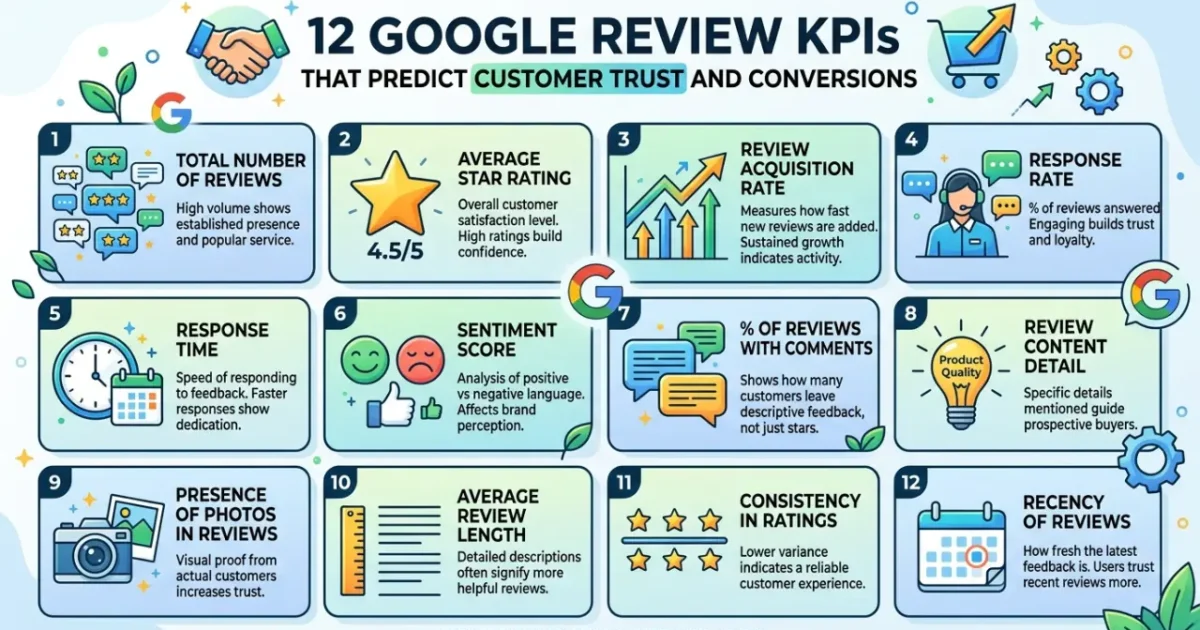
Google review KPIs provide measurable indicators of customer trust, purchase intent, and conversion potential. Businesses that track the right review metrics can evaluate how reputation signals influence visibility, credibility, and customer behaviour across search ecosystems.
Reputation management strategies differ based on whether the goal is to improve review quality, increase review volume, strengthen sentiment distribution, or enhance search ranking influence. Online reputation control methods are evaluated through performance metrics that connect customer feedback with measurable business outcomes.
Why do Google review KPIs matter for customer trust and conversions?
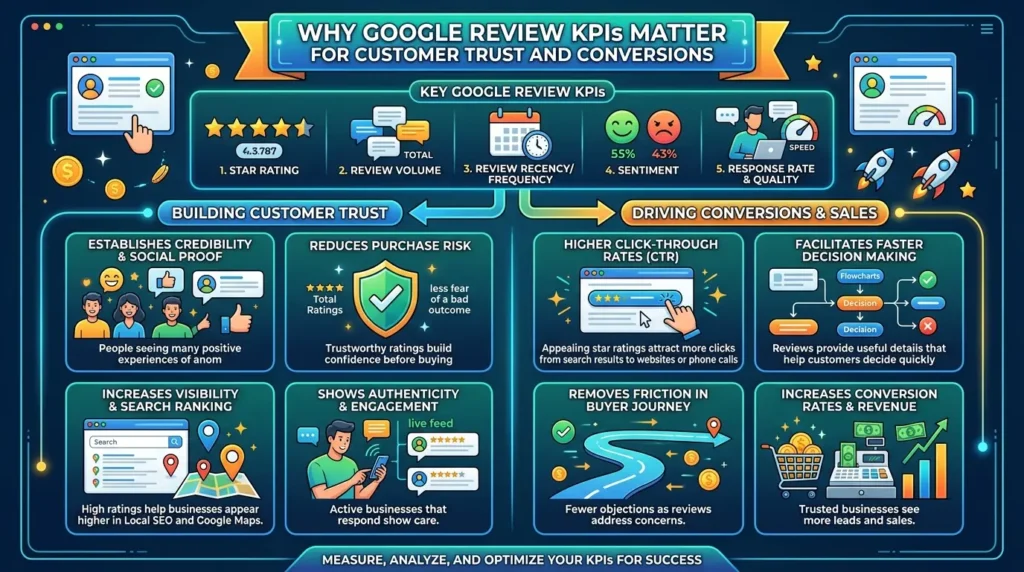
Google review KPIs matter because search engines and consumers both use review data as a credibility signal. Reviews influence local search visibility, click-through rates, and conversion decisions by providing social proof and sentiment indicators.
Google’s local ranking systems evaluate factors such as review quantity, review quality, and review recency. At the same time, customers assess star ratings, detailed feedback, and response behaviour to determine whether a business appears reliable and trustworthy. This dual influence means review KPIs affect both algorithmic visibility and human perception.
Tracking review performance allows businesses to measure:
- Entity credibility across search results
- Customer satisfaction trends
- Brand sentiment distribution
- Conversion efficiency from local search traffic
- Reputation stability over time
Which Google review KPIs are the strongest indicators of customer trust?
1. Average star rating
Average star rating is the most visible trust signal in Google search and Maps results. It operates by summarising overall customer satisfaction into a single numerical score.
Higher ratings generally correlate with stronger click-through rates and increased conversion likelihood. However, ratings alone do not provide full context. A perfect rating with very few reviews often appears less credible than a slightly lower rating supported by substantial review volume and detailed feedback.
2. Review volume
Review volume measures the total number of customer reviews associated with a business profile. It functions as a social proof mechanism by demonstrating customer engagement and market presence.
Search engines interpret larger review counts as stronger evidence of business activity and legitimacy. Consumers also perceive businesses with more reviews as more established and trustworthy.
3. Review recency
Review recency measures how recently customers have left feedback. It indicates whether customer experiences remain current and relevant.
Recent reviews carry greater weight because they reflect the present state of service quality, operational consistency, and customer satisfaction. Outdated review profiles can reduce perceived reliability even when historical ratings are positive.
4. Sentiment distribution
Sentiment distribution analyses the proportion of positive, neutral, and negative reviews. It provides a more nuanced understanding than star ratings alone.
A healthy sentiment distribution typically shows strong positive feedback with manageable negative feedback that is addressed constructively. Search engines and consumers both evaluate sentiment patterns to assess authenticity and reputation stability.
5. Review response rate
Review response rate measures how consistently a business replies to customer reviews. It signals engagement, accountability, and customer care.
Responding to reviews demonstrates active reputation management and operational attentiveness. Businesses that maintain high response rates often strengthen customer confidence and improve public perception.
6. Review response time
Review response time measures the speed at which a business replies to customer feedback. Faster responses indicate responsiveness and operational efficiency.
Timely engagement is particularly important for negative reviews, where delayed responses can amplify dissatisfaction and weaken trust signals.
7. Keyword relevance in reviews
Keyword relevance measures how often reviews naturally mention important products, services, locations, or attributes. It influences local SEO by reinforcing business relevance for specific search queries.
For example, reviews mentioning “emergency plumber in Manchester” or “vegan café in Bristol” strengthen contextual relevance for those search intents.
8. Detailed review depth
Detailed review depth evaluates the length and specificity of customer feedback. In-depth reviews provide richer trust signals because they describe real experiences, outcomes, and service interactions.
Consumers often rely more heavily on detailed reviews than on short generic comments because they appear more authentic and informative.
9. Review consistency across locations
Review consistency across locations measures whether multi-location businesses maintain similar ratings and sentiment patterns across branches. Consistency supports brand reliability and operational standardisation.
Significant rating disparities between locations can weaken overall brand trust and create uncertainty for customers.
10. Negative review ratio
Negative review ratio calculates the percentage of reviews that are one- or two-star ratings. It helps assess risk exposure and customer dissatisfaction trends.
A low negative review ratio supports stronger trust signals, while a rising ratio may indicate operational issues, service inconsistencies, or reputation vulnerabilities.
11. Conversion-related mentions
Conversion-related mentions track reviews that reference outcomes such as successful purchases, repeat visits, problem resolution, or recommendations. These mentions provide direct evidence of customer satisfaction translating into business value.
Reviews stating “I booked again,” “problem solved quickly,” or “highly recommend” are strong indicators of conversion influence.
12. Review velocity
Review velocity measures the rate at which new reviews are acquired over time. A steady review flow suggests ongoing customer engagement and business activity.
Search engines often interpret consistent review generation as a sign of relevance and operational continuity, while sudden spikes or long inactive periods may appear less natural.
How do these KPIs influence search visibility and trust differently?
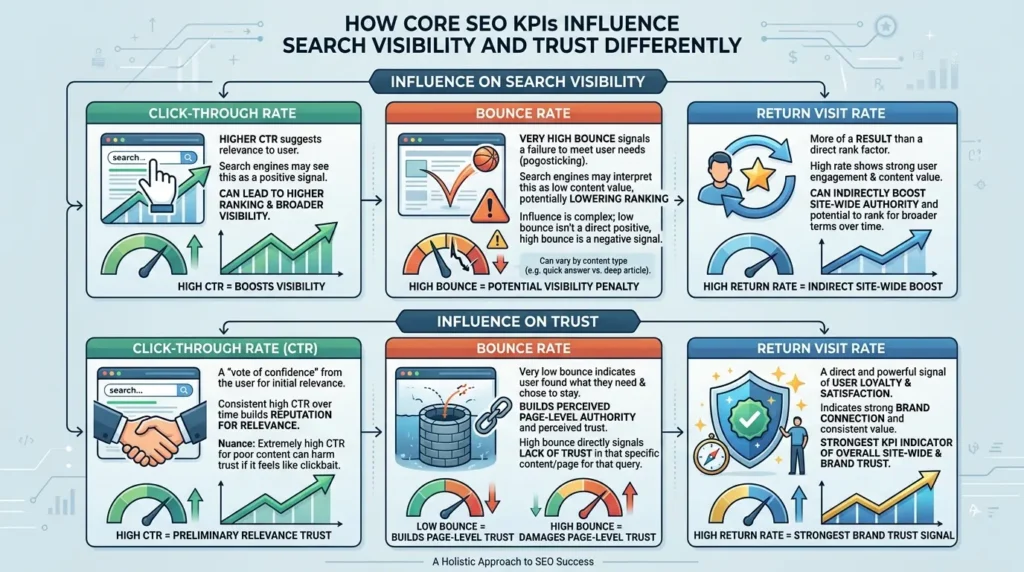
Different review KPIs affect search ecosystems and customer perception through distinct mechanisms.
Search visibility influence
Search visibility is primarily affected by:
- Review volume
- Review recency
- Keyword relevance
- Review velocity
- Average star rating
These metrics help search engines determine local relevance, prominence, and entity credibility. Businesses with consistent, recent, and contextually relevant reviews often achieve stronger placement in local search results and Google Maps listings.
Customer trust influence
Customer trust is primarily shaped by:
- Average star rating
- Sentiment distribution
- Detailed review depth
- Review response rate
- Review response time
- Conversion-related mentions
These metrics influence how customers interpret reliability, authenticity, and service quality. Detailed, balanced, and well-managed review profiles create stronger confidence than profiles that rely solely on high ratings.
Get More Insight:
Google Reviews Audit: 15 Factors Affecting Local Business Reputation
Which review KPIs are most predictive of conversions?
The KPIs most closely linked to conversion performance combine credibility signals with engagement indicators.
Most predictive conversion KPIs
- Average star rating: High ratings increase click-through rates and reduce purchase hesitation.
- Review volume: Larger review counts strengthen social proof and decision confidence.
- Sentiment distribution: Predominantly positive sentiment supports stronger purchase intent.
- Detailed review depth: Specific, experience-based reviews help customers evaluate suitability and reduce uncertainty.
- Conversion-related mentions: Reviews referencing successful outcomes or recommendations provide direct evidence of customer satisfaction influencing buying decisions.
Supporting conversion KPIs
- Review response rate supports conversions by demonstrating customer care and responsiveness.
- Review recency supports conversions by ensuring feedback reflects current service quality.
- Negative review ratio supports conversions by identifying friction points that may deter potential customers.
How should businesses compare and prioritise these KPIs?
Businesses should prioritise review KPIs based on strategic objectives, industry context, and customer decision patterns.
For local search growth
Prioritise:
- Review volume
- Review recency
- Keyword relevance
- Review velocity
These metrics strengthen local SEO performance and improve visibility in map-based searches.
For customer trust improvement
Prioritise:
- Average star rating
- Sentiment distribution
- Detailed review depth
- Review response rate
These metrics shape public perception and credibility more directly.
For conversion optimisation
Prioritise:
- Conversion-related mentions
- Average star rating
- Detailed review depth
- Negative review ratio
- Review response time
These metrics connect reputation performance with customer decision-making and operational responsiveness.
What are the limitations of relying on Google review KPIs alone?
Google review KPIs provide valuable reputation insights, but they do not capture the full customer experience or business performance.
Key limitations
- Selection bias: Reviews often reflect extreme experiences rather than average customer satisfaction.
- Industry variation: Review expectations differ across sectors, making direct comparisons difficult.
- Fake or manipulated reviews: Inauthentic reviews can distort sentiment and credibility signals.
- Incomplete customer journey data: Reviews do not fully explain pricing, operational efficiency, or offline interactions.
- Short-term volatility: A small number of negative reviews can temporarily affect ratings, especially for businesses with low review volume.
To evaluate reputation accurately, businesses often combine review KPIs with broader metrics such as customer retention, referral rates, website conversions, and operational performance indicators.
How can businesses build a balanced review KPI strategy?
A balanced review KPI strategy combines visibility, trust, and conversion metrics rather than focusing on a single indicator.
Recommended framework
- Measure visibility signals: Track review volume, recency, keyword relevance, and velocity.
- Evaluate trust signals: Monitor star ratings, sentiment distribution, detailed review depth, and response behaviour.
- Analyse conversion indicators: Identify reviews mentioning purchases, repeat business, recommendations, and problem resolution.
- Monitor risk exposure: Review negative review ratios and recurring complaint themes to detect operational issues early.
- Track trends over time: Compare KPI performance monthly or quarterly to identify improvements, declines, and seasonal patterns.
This approach helps businesses understand how reputation signals interact across search visibility, customer perception, and conversion outcomes.
Google review KPIs provide a measurable framework for evaluating customer trust, search visibility, and conversion potential. Metrics such as average star rating, review volume, sentiment distribution, and review recency influence both search engine interpretation and consumer decision-making.
The most effective review analysis strategies compare multiple KPIs rather than relying on a single metric. Visibility-focused indicators strengthen local SEO performance, trust-focused indicators shape public perception, and conversion-focused indicators connect reputation with business outcomes.
A balanced review KPI strategy requires continuous monitoring, contextual interpretation, and integration with broader customer experience data. Businesses that analyse review performance systematically gain clearer insight into how reputation signals influence search ranking influence, entity credibility, and customer behaviour.
What are the most important Google Review KPIs for measuring customer trust?
Key Google Review KPIs include average star rating, review volume, review response rate, review recency, and customer sentiment. These metrics help businesses understand how potential customers perceive their reputation and trustworthiness online.
How do Google Reviews affect conversion rates?
Google Reviews can influence purchasing decisions by providing social proof and customer feedback. Higher ratings, recent reviews, and positive review sentiment often increase customer confidence and improve conversion rates.
Why is review response rate considered an important KPI?
Review response rate measures how consistently a business engages with customer feedback. Responding to reviews can improve customer trust, demonstrate accountability, and strengthen overall online reputation management efforts.
How many Google Reviews does a business need to build credibility?
There is no fixed number, but a steady flow of authentic reviews helps establish credibility. Customers often compare review volume alongside ratings to assess whether a business is reliable and actively serving customers.
How can businesses track and improve Google Review KPIs?
Businesses can monitor review trends, customer sentiment, response times, and rating changes using reputation management tools. Clear My Name recommends regularly reviewing these metrics to identify opportunities for improving customer trust and online visibility.