
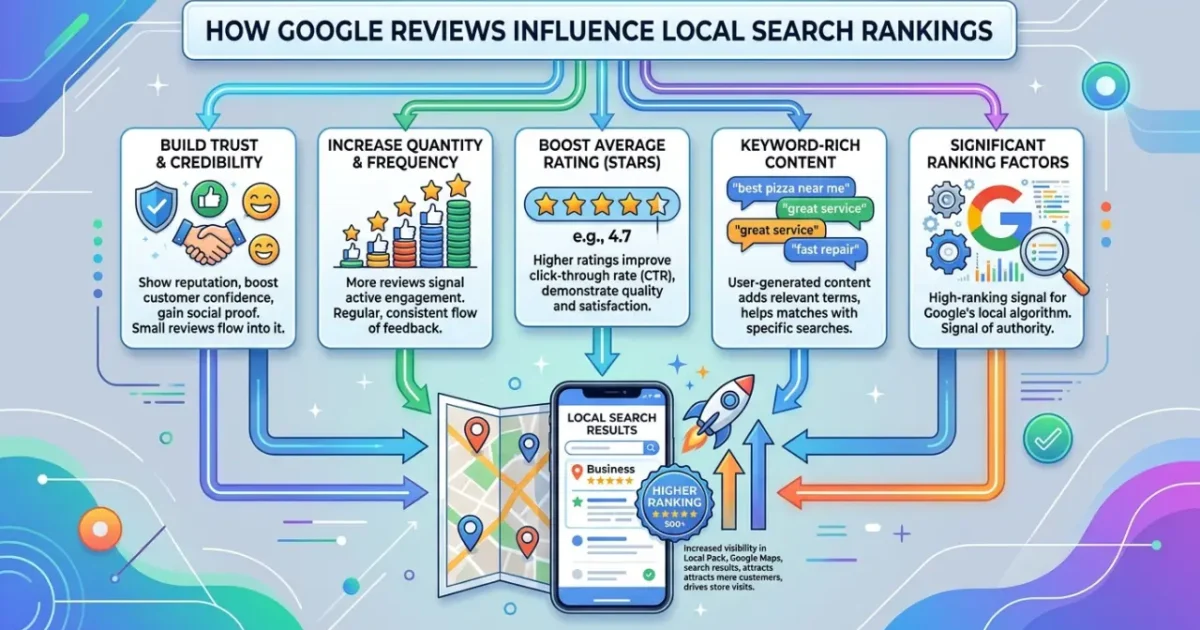
Google Reviews influence local search rankings by acting as reputation signals that search engines use to evaluate trust, relevance, and prominence within local search ecosystems. Review quantity, review sentiment, review recency, and user engagement contribute to how entities are interpreted and positioned in local search results.
Reputation management is the process of monitoring, understanding, and analysing how information about an entity is created, interpreted, and ranked across digital environments. Online reputation refers to the collective perception formed through indexed content, reviews, mentions, and behavioural signals that search engines use to evaluate credibility and relevance.
What are Google Reviews within local search ecosystems?
Google Reviews are user-generated reputation signals attached to a local entity profile. They represent publicly accessible feedback that becomes part of an entity’s digital footprint and searchable information environment.
Within search ecosystems, reviews function as structured content. Search engines index review content, analyse sentiment patterns, evaluate reviewer activity, and associate feedback with specific entities. This process transforms individual opinions into measurable reputation data.
The influence of reviews extends beyond user perception. Search algorithms interpret review information as evidence of prominence, relevance, and trustworthiness. These signals contribute to entity understanding and local search evaluation.
Reviews also provide contextual information through keywords, service references, location mentions, and behavioural indicators. This additional content strengthens entity associations within search databases and improves topical understanding.
As a result, Google Reviews operate as both user-facing information and machine-readable reputation signals that influence local search visibility.
How do search engines interpret review signals?
Search engines interpret review signals through content analysis, sentiment evaluation, and entity association processes. The objective is to determine how reviews contribute to an entity’s overall reputation profile.
Analysing review sentiment
Sentiment analysis refers to the computational evaluation of positive, neutral, and negative language within review content. Search systems analyse wording patterns to identify overall perception trends.
Positive sentiment contributes to stronger trust indicators because it reflects favourable user experiences. Negative sentiment becomes part of reputation evaluation and influences entity perception when patterns remain consistent over time.
The process focuses on aggregate signals rather than isolated reviews. Search engines evaluate sentiment distributions across entire review collections to establish credibility benchmarks.
Evaluating review quality
Review quality refers to the depth, specificity, and authenticity of review content. Detailed reviews provide more contextual information for entity understanding.
Search systems analyse review length, topical relevance, language patterns, and reviewer behaviour. Reviews containing descriptive information offer stronger contextual signals than short generic statements.
Read More:
93% of Consumers Read Google Reviews Before Buying
This evaluation improves content indexing accuracy and enhances entity classification within local search databases.
Why do Google Reviews affect local search rankings?
Google Reviews affect local search rankings because they contribute directly to the assessment of prominence and trust within local search algorithms.
Local search ranking systems evaluate multiple factors simultaneously. Reviews provide measurable indicators of public engagement and entity recognition. These indicators help search engines determine which entities demonstrate stronger local relevance.
Review activity generates continuously updated reputation data. Fresh reviews signal ongoing user interaction, allowing search engines to evaluate whether an entity remains active and relevant within a geographic area.
The presence of consistent review activity also increases information richness. More review content creates additional opportunities for search systems to understand services, products, attributes, and customer experiences.
Consequently, reviews influence both algorithmic evaluation and user decision-making, creating a direct connection between reputation signals and search visibility.
What role does review quantity play in local rankings?
Review quantity refers to the total number of reviews associated with an entity profile. It serves as a measurable indicator of engagement and prominence.
Search engines evaluate review volume as evidence of public interaction. A larger review dataset provides more information for sentiment analysis, credibility assessment, and entity understanding.
Quantity also affects statistical reliability. Larger datasets reduce the influence of isolated feedback and allow algorithms to identify broader reputation patterns. This improves confidence in ranking evaluations.
Review volume contributes to prominence calculations because frequent engagement indicates visibility within a local market. Search systems interpret sustained review accumulation as a signal of continued relevance.
The importance of quantity exists alongside quality and sentiment. Search evaluation focuses on the combined reputation profile rather than a single metric.
How does review sentiment influence entity perception?
Review sentiment influences entity perception by shaping how search systems evaluate credibility and user satisfaction indicators.
Entity perception refers to the algorithmic understanding of an organisation, location, or subject within search ecosystems. Reviews contribute directly to this understanding because they contain descriptive language associated with the entity.
Positive sentiment strengthens trust signals. Search systems interpret favourable patterns as evidence of reliable experiences and stronger reputation consistency.
Negative sentiment contributes to reputation analysis through risk assessment mechanisms. Persistent negative patterns affect credibility interpretation and influence overall reputation evaluation.
The impact extends beyond star ratings. Review text contains contextual details that help algorithms understand service quality, expertise, responsiveness, and customer satisfaction themes.
As sentiment accumulates over time, it becomes part of the entity’s searchable reputation profile and influences future search visibility assessments.
How does review recency affect search visibility?
Review recency refers to the freshness of review activity associated with an entity. It provides search engines with evidence of ongoing engagement.
Fresh reviews indicate that an entity continues to attract interactions. Search algorithms interpret recent activity as a sign of current relevance within local search environments.
Recency improves the accuracy of reputation evaluation because it reflects contemporary user experiences. Older reviews remain valuable but represent historical information rather than current perception.
Search systems combine recency with sentiment and quantity to create a balanced understanding of reputation status. This approach prevents rankings from relying exclusively on outdated feedback.
Regular review activity contributes to dynamic reputation signals. These signals help search engines maintain accurate local search results and current entity assessments.
What is the relationship between reviews and trust signals?
Trust signals are indicators that search systems use to evaluate credibility, authenticity, and reliability. Reviews form a significant category of reputation-based trust signals.
Review content contains evidence of real user interactions. Search engines analyse this evidence to determine whether reputation patterns appear authentic and consistent.

Trust evaluation includes sentiment stability, reviewer diversity, engagement frequency, and content quality. Together, these elements create a comprehensive credibility profile.
Reviews also reinforce other trust signals. Consistent information across reviews, business profiles, and indexed content improves confidence in entity accuracy.
The relationship between reviews and trust signals demonstrates how user-generated content contributes to broader reputation assessment frameworks within search ecosystems.
How do Google Reviews contribute to a digital footprint?
A digital footprint refers to the collection of searchable information associated with an entity across online environments. Reviews represent a significant component of this footprint.
Each review creates additional indexed content connected to an entity profile. This content expands the volume of information available for search engine analysis.
Reviews contribute keywords, service descriptions, geographic references, and sentiment indicators. These elements help define how an entity is categorised and understood within search databases.
The cumulative effect of review content strengthens entity associations and increases informational depth. This enhanced data environment supports more accurate search interpretation.
Because reviews remain accessible and indexable, they become long-term components of reputation formation and digital identity development.
How do review signals interact with local ranking factors?
Review signals interact with local ranking factors by contributing information that supports relevance, prominence, and credibility assessments.
Local ranking systems analyse multiple datasets simultaneously. Reviews provide behavioural and reputational information that complements location data and profile information.
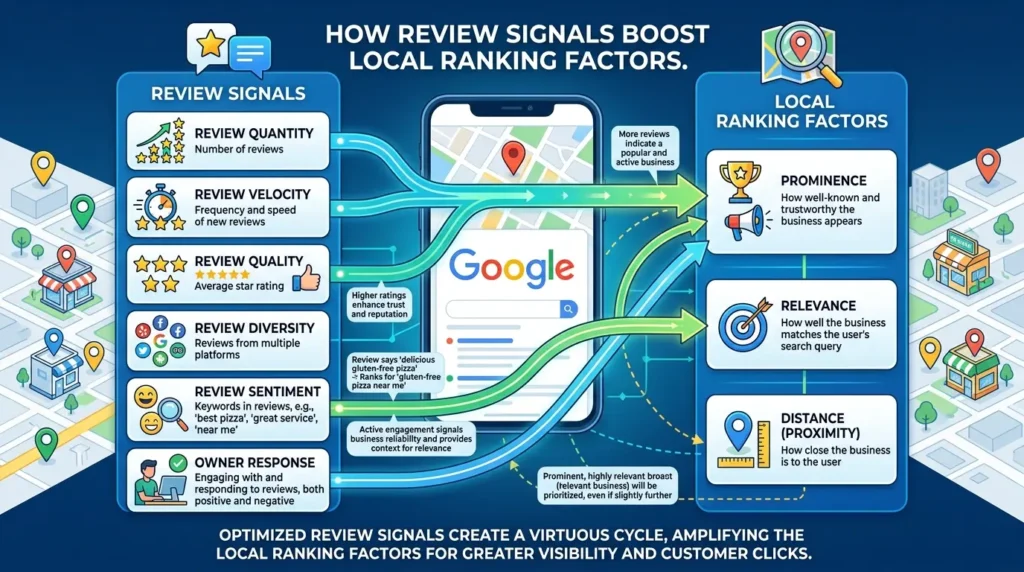
The interaction occurs through structured evaluation processes. Review content strengthens entity understanding, while review volume contributes prominence indicators and sentiment contributes trust assessments.
Search engines combine these signals to produce more comprehensive ranking decisions. This integrated approach improves local search accuracy and aligns rankings with user expectations.
Strengthening relevance
- Identify service attributes through review language, enabling search systems to associate entities with specific topics and search queries.
- Recognise geographic references within reviews, helping algorithms reinforce local relevance signals connected to particular areas.
Enhancing prominence
- Measure public engagement through review volume, providing evidence of visibility and recognition within a local market.
- Evaluate ongoing activity through review recency, demonstrating sustained interaction and relevance.
Why are review-based reputation signals important for search ecosystems?
Review-based reputation signals are important because they provide scalable, continuously updated information about credibility, relevance, and public perception.
Search ecosystems rely on information that can be indexed, analysed, and compared across entities. Reviews supply structured and unstructured data that supports these processes.
The combination of sentiment, quantity, quality, and recency allows search systems to evaluate reputation from multiple perspectives. This multidimensional analysis improves ranking accuracy and entity understanding.
Review signals also strengthen content indexing and semantic interpretation. Search engines gain deeper insight into user experiences, service attributes, and reputation patterns.
As local search evolves, reviews remain a fundamental component of digital trust assessment, entity perception, and search visibility evaluation.
Google Reviews influence local search rankings because they function as reputation signals that help search engines evaluate trust, relevance, prominence, and credibility. Through sentiment analysis, review quantity, review quality, and review recency, search systems build detailed entity profiles that contribute to local search visibility.
Reviews also expand an entity’s digital footprint, strengthen trust signals, and provide contextual information for content indexing and SERP evaluation. Within local search ecosystems, reputation formation depends on how information is created, interpreted, and connected to entity perception. Businesses seeking a deeper understanding of review performance can measure key trust indicators through 12 Google Review KPIs That Predict Customer Trust and Conversions, helping them evaluate how customer feedback contributes to search visibility, reputation strength, and conversion potential. Understanding these mechanisms explains why reviews remain a central component of search reputation analysis and local ranking dynamics.
How do Google reviews affect local search rankings?
Google reviews help search engines assess a business’s relevance, trustworthiness, and popularity. A higher number of genuine reviews, combined with positive ratings and recent feedback, can improve visibility in local search results and Google Maps listings.
Does responding to Google reviews improve local SEO?
Responding to Google reviews shows active customer engagement and helps maintain an up-to-date business profile. Regular responses can strengthen trust signals and contribute to a positive online reputation, which may support local search performance.
Are recent Google reviews more important than older reviews?
Recent reviews provide fresh information about customer experiences and business quality. Search engines often value review freshness because it helps users find businesses that are currently delivering reliable products or services.
Can negative Google reviews impact local search rankings?
Negative reviews may influence customer decisions and affect overall review ratings. While a few negative reviews are normal, consistently poor feedback can reduce consumer trust and potentially impact local search visibility over time.
How many Google reviews does a business need to rank locally?
There is no fixed number of reviews required to achieve strong local rankings. Search engines consider factors such as review quality, quantity, diversity, recency, and overall business relevance when determining local search positions.