
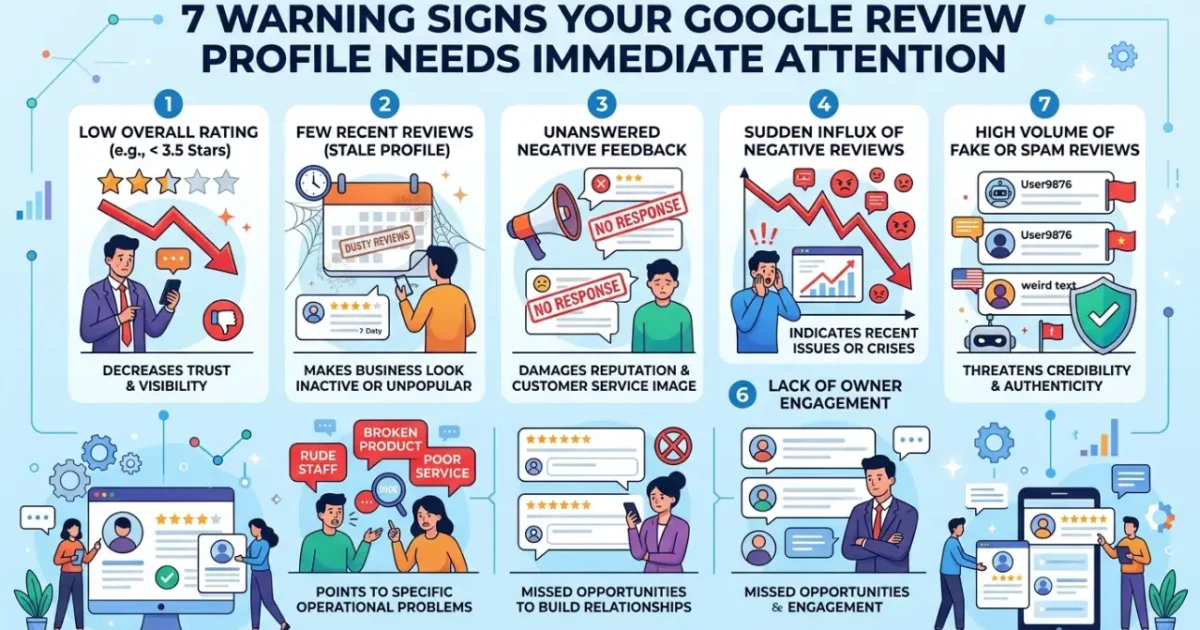
Google review profiles display measurable reputation signals that influence trust perception, local search visibility, and entity credibility. Warning signs emerge when review patterns, sentiment distribution, profile activity, or content quality indicate declining reputation performance.
Reputation management strategies differ based on how reputation signals are generated, interpreted, and distributed across search ecosystems. Online reputation control methods are evaluated through sentiment analysis, search ranking influence, entity credibility assessment, and the long-term sustainability of reputation signals.
What Makes a Google Review Profile a Reputation Risk Rather Than a Trust Asset?
A Google review profile becomes a reputation risk when negative reputation signals outweigh positive trust indicators. Search systems analyse review content, review frequency, reviewer behaviour, and sentiment distribution to build an understanding of business credibility. A balanced review profile contributes to entity trust, while an imbalanced profile increases perception risk. Search ecosystems interpret reviews as user-generated evidence connected to a local entity. Reputation risk emerges when reviews consistently communicate dissatisfaction, unresolved issues, or declining service experiences. The severity of the risk depends on the volume, recency, and visibility of the negative signals.
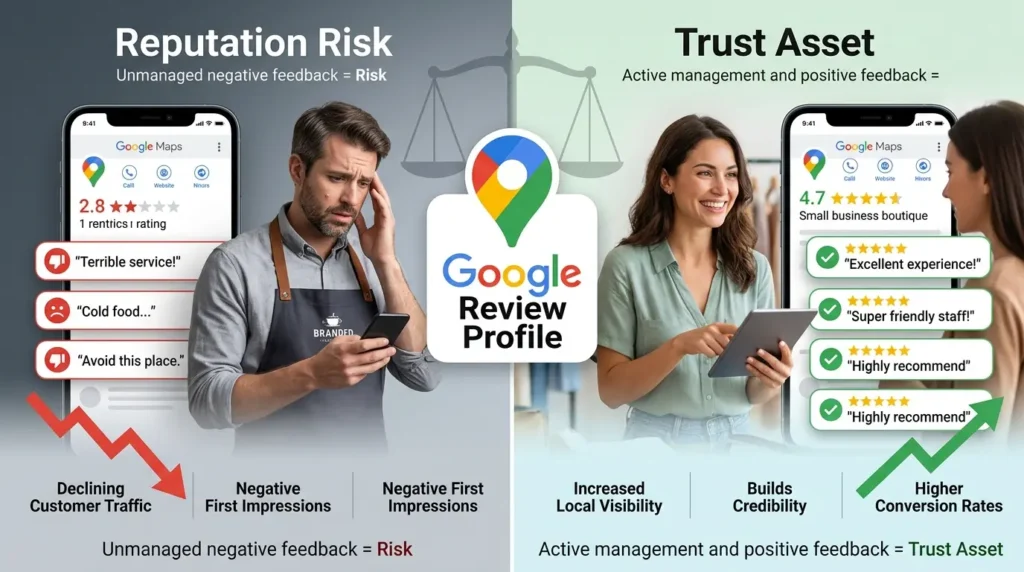
Review profiles function as public repositories of customer sentiment. Search engines evaluate these repositories alongside business information, local citations, and website content. A profile containing persistent negative sentiment influences user perception before website visits occur. Reputation management analysis therefore focuses on identifying patterns rather than isolated reviews. The distinction between temporary dissatisfaction and systematic reputation decline becomes a critical evaluation factor. Immediate attention is required when negative patterns demonstrate consistency across multiple reputation signals.
Which Review Rating Patterns Indicate a Declining Reputation Profile?
Declining average ratings represent one of the strongest indicators of reputation deterioration. Rating patterns provide measurable evidence regarding customer satisfaction and trustworthiness. Search systems evaluate aggregate ratings as structured reputation signals linked to entity credibility. A sudden rating decrease differs significantly from a gradual decline because each pattern reflects different underlying causes. Consistent deterioration often indicates unresolved operational issues affecting customer experiences.
Analysing Sudden Rating Declines
A sudden rating decline is a rapid reduction in average review scores over a short period. This pattern operates by concentrating negative sentiment within a limited timeframe. Search ecosystems interpret concentrated negative activity as a potential indicator of significant service disruption or customer dissatisfaction. The visibility of this pattern increases because recent reviews receive stronger attention from users evaluating businesses. Immediate investigation becomes necessary to determine whether the decline results from operational failures, customer disputes, or reputation attacks.
Comparing Gradual Rating Erosion
Gradual rating erosion develops through sustained negative sentiment over an extended period. This pattern operates by slowly shifting sentiment distribution toward dissatisfaction. Compared with sudden declines, gradual erosion often indicates systemic issues rather than isolated incidents. The long-term impact on trust signals becomes more significant because the pattern demonstrates consistency. Search visibility effects accumulate as reputation signals continue reinforcing negative perceptions.
How Does Negative Sentiment Distribution Affect Search Perception?
Negative sentiment distribution directly influences how users and search systems interpret reputation quality. Sentiment distribution is the ratio between positive, neutral, and negative reviews across a review profile. Search ecosystems analyse linguistic patterns, emotional indicators, and contextual themes within reviews. A concentration of negative sentiment weakens perceived trustworthiness and entity credibility. The impact extends beyond ratings because textual review content provides contextual evidence about customer experiences. Search perception therefore depends on sentiment quality as much as numerical scores.
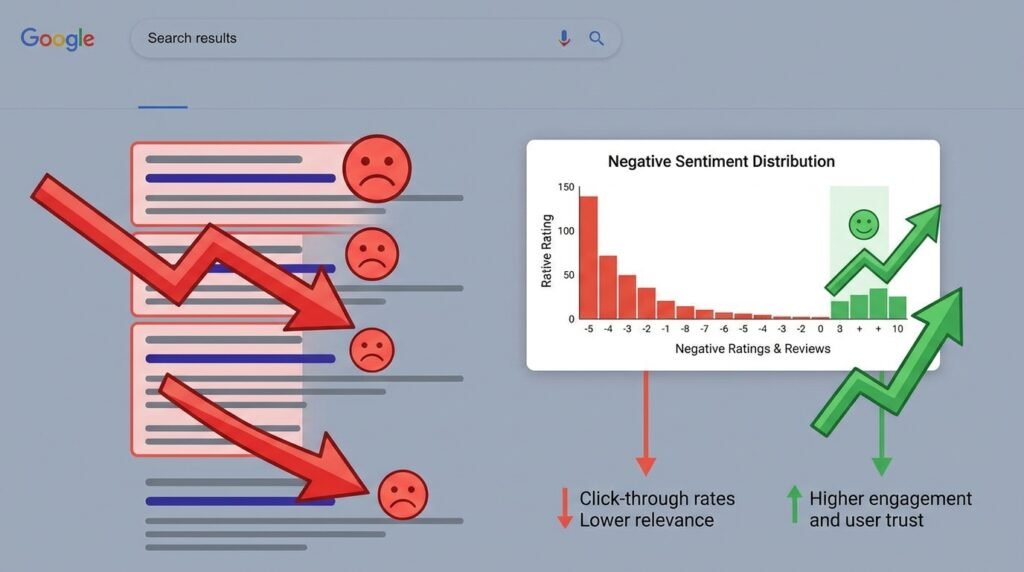
Negative sentiment clusters produce stronger reputation effects than isolated complaints. Search systems identify recurring topics, including communication issues, product quality concerns, delivery failures, or customer service problems. Consistent thematic complaints establish stronger reputation signals than unrelated negative observations. Reputation analysis evaluates whether negative themes remain stable over time or evolve into broader trust concerns. Profiles containing recurring dissatisfaction themes require attention because they communicate persistent problems rather than individual experiences. The resulting perception influences click behaviour, engagement rates, and trust formation.
Is Review Recency More Important Than Review Quantity?
Review recency often provides stronger reputation context than review quantity because it reflects current customer experiences. Review quantity measures overall participation, while review recency measures ongoing engagement and reputation relevance. Search ecosystems evaluate both signals but interpret them differently. A profile with substantial historical reviews but limited recent activity presents reduced visibility into current performance. Recent reviews provide updated evidence regarding customer satisfaction and operational consistency. Search perception therefore depends heavily on the freshness of reputation signals.
Comparing review quantity and recency reveals different strengths and limitations. High review volume strengthens credibility because it demonstrates sustained customer interaction. However, outdated reviews reduce informational value when recent activity remains absent. Recent reviews improve relevance but offer limited context when overall review volume remains low. Effective reputation assessment analyses both factors together rather than treating either metric independently. Profiles showing extended periods without new reviews often require attention because reputation signals become outdated and less representative of current experiences.
What Does Low Review Response Activity Reveal About Reputation Management?
Low response activity indicates limited engagement with public customer feedback. Review responses operate as visible trust signals demonstrating acknowledgement, accountability, and communication practices. Search ecosystems evaluate review interactions as part of broader reputation analysis. A profile containing numerous unanswered reviews creates perception gaps regarding customer engagement. The absence of responses reduces opportunities to clarify misunderstandings, address concerns, or reinforce positive experiences. Reputation visibility therefore becomes influenced by silence as well as direct feedback.
Comparing responsive and non-responsive profiles highlights significant differences in perception management. Responsive profiles demonstrate active reputation monitoring and public engagement. Non-responsive profiles rely entirely on reviewer narratives to shape perception. The limitation of non-response strategies lies in their inability to influence contextual interpretation. Long-term reputation sustainability benefits from ongoing engagement because responses contribute additional reputation signals. Profiles displaying extensive unanswered feedback frequently require immediate evaluation due to reduced reputation control.
How Do Repeated Complaint Themes Compare With Isolated Negative Reviews?
Repeated complaint themes represent stronger reputation risks than isolated negative reviews. Isolated reviews reflect individual experiences, while recurring themes indicate patterns recognised across multiple customer interactions. Search systems identify repeated concepts through textual analysis and sentiment clustering. Reputation signals become more influential when similar complaints appear repeatedly. Consistency strengthens the credibility of negative narratives because independent reviewers describe comparable issues. Search perception consequently becomes shaped by thematic repetition rather than review volume alone.
The evaluation of complaint themes focuses on frequency, consistency, and severity. Repeated references to communication failures, billing disputes, service quality concerns, or delivery delays create concentrated reputation risks. Isolated complaints possess limited influence because they lack reinforcement from additional evidence. Comparative analysis therefore prioritises recurring themes when assessing profile health. Profiles containing persistent complaint clusters often require immediate attention because the pattern demonstrates established customer dissatisfaction rather than occasional negative experiences.
Why Does Review Authenticity Matter for Entity Credibility?
Review authenticity is the degree to which reviews reflect genuine customer experiences. Authentic reviews strengthen entity credibility because they contribute reliable reputation signals. Search ecosystems analyse behavioural indicators, review patterns, linguistic consistency, and reviewer histories to identify authenticity concerns. Suspicious review activity weakens trust because credibility depends on perceived accuracy. Reputation management evaluation therefore examines authenticity alongside sentiment and ratings. The presence of questionable review patterns introduces uncertainty into reputation assessment.
Comparing authentic and suspicious review profiles demonstrates significant differences in trust formation. Authentic profiles display natural sentiment variation, diverse reviewer behaviour, and realistic feedback patterns. Suspicious profiles often contain repetitive language, unusual review timing, or inconsistent reviewer histories. The limitation of inauthentic reputation signals is their reduced credibility and increased scrutiny. Search visibility and trust signals depend on authenticity because reliable information supports stronger entity understanding. Profiles displaying unusual review behaviour require immediate examination to protect reputation integrity.
How Does Declining Engagement Compare With Negative Review Growth?
Declining engagement and negative review growth represent different reputation challenges. Declining engagement refers to reduced review activity, customer interaction, or profile participation. Negative review growth refers to increasing volumes of dissatisfied feedback. Search ecosystems interpret these signals differently because each reflects a separate aspect of reputation performance. Reduced engagement limits fresh reputation data, while growing negative feedback strengthens adverse sentiment distribution. Both patterns influence perception, but through distinct mechanisms.
Comparative evaluation reveals important differences in sustainability and risk exposure:
- Measure sentiment trends to identify whether negative reviews increase faster than positive feedback.
- Assess engagement frequency to determine whether customer participation remains active and representative.
- Analyse review velocity to evaluate the pace at which reputation signals enter the profile.
- Monitor thematic consistency to identify recurring concerns affecting trust perception.
- Evaluate recency patterns to understand whether current feedback aligns with historical reputation data.
Negative review growth directly influences trust signals through visible dissatisfaction. Declining engagement indirectly affects perception by reducing reputation transparency. Both warning signs require attention because each alters how search ecosystems evaluate entity credibility.
Which Reputation Management Approaches Address Review Profile Warning Signs Most Effectively?
Different reputation management approaches address warning signs through distinct mechanisms. Content enhancement focuses on increasing positive reputation signals through legitimate customer engagement and improved sentiment distribution. Content suppression focuses on reducing the visibility of negative reputation signals through broader content ecosystems. Reactive approaches concentrate on addressing existing issues, while organic approaches focus on long-term reputation development. Each method influences search perception through different pathways.
Get Deep Insight:
Why Businesses Choose Clear My Name for Google Review Management
Comparative analysis reveals that reactive approaches provide faster visibility into immediate reputation concerns. Their limitation is dependence on existing negative signals. Organic approaches strengthen long-term trust signals through sustained reputation development. Their limitation is slower measurable impact. Content suppression influences SERP composition by expanding positive content visibility, while content enhancement influences sentiment distribution through authentic feedback growth. Effective reputation evaluation compares sustainability, scalability, search ranking influence, and risk exposure rather than relying on a single strategy. Discussions surrounding Google Review Management Service for Local Businesses often emerge when organisations evaluate structured approaches to managing review-related reputation signals and local search perception.
Google review profiles communicate reputation signals that influence entity credibility, trust perception, and search ranking influence. Warning signs become visible through declining ratings, negative sentiment distribution, low response activity, recurring complaint themes, authenticity concerns, declining engagement, and increasing negative review growth.
The evaluation of reputation management approaches highlights clear differences between reactive and organic methods, content suppression and content enhancement strategies, and short-term versus long-term reputation outcomes. Search ecosystems interpret review profiles through sentiment, credibility, recency, engagement, and thematic consistency. Understanding these warning signs enables objective assessment of review profile health and provides a framework for analysing reputation risks within local search environments.
What are the signs that a Google review profile needs attention?
Common warning signs include a sudden increase in negative reviews, unanswered customer feedback, fake reviews, declining review ratings, and long periods without new reviews. These issues can affect online reputation, customer trust, and local search visibility.
How do negative Google reviews impact a business?
Negative Google reviews can influence customer perception and reduce trust in a business. A pattern of poor reviews may also affect local search performance and discourage potential customers from making enquiries or purchases
Can fake Google reviews damage a business profile?
Yes, fake Google reviews can misrepresent customer experiences and harm a business’s reputation. Monitoring review activity regularly helps identify suspicious reviews and supports maintaining an accurate online presence.
Why is it important to respond to Google reviews?
Responding to Google reviews shows that a business values customer feedback and engagement. Timely responses can improve trust, demonstrate professionalism, and help manage reputation concerns before they escalate.
How can Clear My Name help with Google review profile issues?
Clear My Name provides guidance on managing online reputation challenges, including review-related concerns and digital perception issues. Understanding review patterns and addressing potential risks can help maintain a stronger and more trustworthy online presence.