
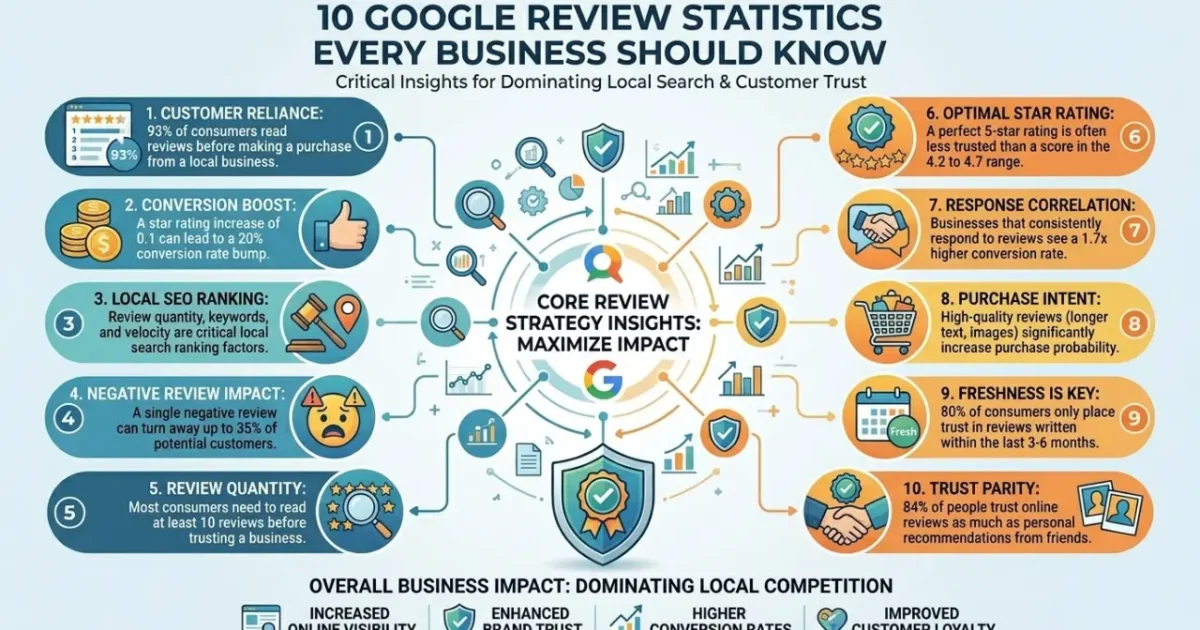
Google Reviews function as measurable reputation signals that influence how entities are interpreted, indexed, and evaluated within search ecosystems. Review data contributes to search visibility, trust assessment, entity perception, and local ranking calculations across search engine results pages.
Reputation management is the process of monitoring, understanding, and analysing how information shapes credibility and trust across digital environments. Online reputation refers to the collection of signals, content, reviews, mentions, and behavioural indicators that search systems use to evaluate entities and determine visibility within search results.
Why Do Google Review Statistics Matter for Reputation Management?
Google Review statistics matter because they reveal how reputation signals are created, interpreted, and incorporated into search evaluation systems.
Within search ecosystems, reviews represent structured user-generated content. Search engines analyse review quantity, review recency, review sentiment, and reviewer activity to develop a clearer understanding of an entity’s credibility. These data points contribute to content indexing and reputation assessment processes.
Review statistics also demonstrate how search engines transform public feedback into measurable ranking signals. Every review adds information to an entity profile, increasing the amount of data available for evaluation. This process strengthens entity understanding and improves contextual relevance.
From a reputation management perspective, review statistics explain how trust is quantified. Search systems analyse patterns rather than isolated comments, allowing algorithms to identify consistency, reliability, and perceived authority. As a result, review metrics directly contribute to search visibility and SERP evaluation.
What Does the Statistic That 98% of Consumers Read Reviews Reveal About Search Perception?
The statistic that 98% of consumers read online reviews demonstrates that review content has become a primary source of reputation formation.
Reviews function as publicly accessible trust indicators. Search users often evaluate reviews before interacting with websites, businesses, or products. This behaviour increases the importance of review content within digital trust ecosystems.

Search engines interpret high review engagement as evidence that review content contains useful information. As engagement increases, review sections become stronger content assets within search results. This process expands an entity’s digital footprint and strengthens content relevance.
The statistic also highlights the relationship between information availability and perception. When users repeatedly consult reviews, search systems recognise review content as an important source of entity understanding. Consequently, review visibility becomes closely connected to reputation visibility.
How Does the Statistic That 87% of Users Trust Online Reviews Explain Digital Credibility?
The finding that 87% of users trust online reviews explains how credibility is established through collective information signals.
Digital credibility refers to the perceived reliability of information available across search ecosystems. Reviews contribute to credibility because they provide continuous streams of independently generated content. Search systems analyse these contributions to determine consistency and trustworthiness.

Algorithms evaluate review language, reviewer authenticity indicators, review frequency, and sentiment patterns. These elements create a credibility framework that helps search systems understand whether an entity demonstrates stable reputation signals.
The significance of this statistic extends beyond user behaviour. Search engines prioritise information sources that users consistently engage with and trust. As trust increases, review content gains greater importance within ranking and perception models.
Therefore, online credibility emerges through the interaction between user trust, review content, and algorithmic interpretation.
Why Is Review Quantity Considered a Strong Reputation Signal?
Review quantity is a strong reputation signal because it expands the volume of information available for entity evaluation.
Search engines rely on data abundance when analysing entities. A profile containing hundreds of reviews provides more contextual evidence than a profile containing only a few reviews. Larger datasets enable more accurate sentiment analysis and credibility assessment.
Review quantity also strengthens entity recognition. Each review contributes additional keywords, contextual references, and topical associations. These elements improve content indexing and help search systems understand entity relevance.
How Does Review Volume Affect Search Interpretation?
Review volume affects search interpretation through pattern recognition.
Search algorithms evaluate collective trends rather than isolated opinions. Larger review datasets produce stronger statistical confidence, allowing search systems to identify recurring themes, service attributes, and sentiment trends.
As information volume increases, entity profiles become more detailed. This improved entity understanding supports stronger SERP evaluation and more accurate relevance assessments.
Why Does Review Recency Influence Search Visibility?
Review recency influences search visibility because it reflects information freshness.
Fresh information is an essential component of search evaluation. Search engines prioritise signals that accurately represent current conditions. Recent reviews provide updated information that contributes to entity relevance assessments.
A review profile containing consistent recent activity demonstrates ongoing engagement. Search systems interpret this activity as evidence that the entity remains active and relevant within its category.
Read More:
How Google Reviews Influence Local Search Rankings
93% of Consumers Read Google Reviews Before Buying
Recency also improves sentiment accuracy. Current reviews allow algorithms to analyse present reputation conditions rather than historical perceptions. This improves ranking precision and strengthens reputation modelling processes.
As a result, review freshness functions as a critical component of search visibility and entity evaluation.
How Does Average Rating Influence Entity Perception?
Average rating influences entity perception because it acts as a summarised trust indicator.
Entity perception refers to how search systems interpret the overall reputation of an organisation, product, service, or individual. Ratings provide condensed numerical representations of public sentiment, making them efficient reputation signals.
Search engines incorporate ratings into trust evaluation frameworks. Higher ratings generally indicate positive sentiment concentration, while lower ratings indicate negative sentiment concentration. Algorithms use these signals when assessing credibility and quality.
Ratings also contribute to visual prominence within search environments. Star ratings create immediate reputation cues that influence information interpretation before users access detailed content.
Consequently, average rating functions as a high-level reputation signal that supports both algorithmic assessment and user perception.
What Does Review Sentiment Analysis Reveal About Reputation Formation?
Review sentiment analysis reveals how search systems transform language into measurable reputation data.
Sentiment analysis is the process of evaluating emotional and contextual meaning within textual content. Search engines use natural language processing to identify positive, negative, and neutral sentiment patterns across reviews.
This process enables algorithms to understand more than numerical ratings. Review text provides detailed information regarding quality, reliability, responsiveness, and user experience. These insights contribute to deeper entity understanding.
How Do Search Engines Interpret Sentiment Patterns?
Search engines interpret sentiment patterns by identifying recurring themes and contextual associations.
- Analyse recurring positive language – Consistent references to reliability create strong trust signals that support credibility assessment.
- Identify recurring negative language – Frequent references to unresolved issues contribute to negative reputation signals within entity evaluation models.
- Evaluate thematic consistency – Repeated discussion of specific attributes helps search systems establish accurate entity associations during content indexing.
Through these mechanisms, sentiment analysis becomes a foundational component of reputation formation.
Why Do Review Responses Contribute to Reputation Signals?
Review responses contribute to reputation signals because they create additional layers of indexed content.
When entities respond to reviews, they generate supplementary information that search engines can analyse. This content increases topical relevance and expands the entity’s digital footprint.
Responses also contribute to transparency assessment. Search systems evaluate communication consistency, responsiveness, and engagement patterns. These indicators strengthen entity understanding and provide additional context for reputation evaluation.
Furthermore, responses generate fresh content associated with review profiles. This supports content indexing and contributes to information freshness signals.
As a result, review responses function as secondary reputation assets within broader search ecosystems.
How Do Google Reviews Expand an Entity’s Digital Footprint?
Google Reviews expand an entity’s digital footprint by continuously generating searchable content.
A digital footprint refers to the total collection of information associated with an entity across online environments. Reviews increase this footprint through ongoing content creation, keyword expansion, and sentiment generation.
Each review introduces new language, topical references, and contextual relationships. Search engines use this information to strengthen entity recognition and improve content classification.
A larger digital footprint also improves information accessibility. More indexed content creates additional opportunities for search systems to understand entity characteristics and establish relevance relationships.
This process demonstrates why reviews play a significant role in reputation management and search perception analysis.
Why Are Google Reviews Important for SERP Evaluation?
Google Reviews are important for SERP evaluation because they provide structured reputation data that supports ranking decisions.
Search engine results pages rely on multiple evaluation layers. Reviews contribute signals related to trust, relevance, prominence, authority, and user engagement. Together, these signals assist search systems in determining visibility priorities.
Review content also supports semantic understanding. Search engines analyse review language to identify entity attributes, topical relevance, and contextual relationships. This information enhances ranking accuracy.
Within local search ecosystems, reviews function as both content assets and reputation indicators. Their dual role increases their influence on entity perception and search visibility.
The importance of reviews in SERP evaluation reflects a broader shift towards information quality, trust measurement, and credibility analysis within modern search systems.
Google Reviews influence reputation management because they generate measurable signals that search engines use to evaluate trust, credibility, relevance, and prominence. Review quantity, review recency, average ratings, sentiment patterns, review responses, and engagement metrics all contribute to entity understanding within search ecosystems.
These statistics demonstrate how online reputation is formed through information creation, content indexing, sentiment interpretation, and SERP evaluation. Reviews expand digital footprints, strengthen reputation signals, and provide contextual data that supports search visibility. Understanding these mechanisms provides a clearer view of how search systems analyse and rank entities based on trust-related information.
Within broader reputation analysis, organisations often monitor indicators associated with 7 Warning Signs Your Google Review Profile Needs Immediate Attention to understand how review patterns affect visibility, credibility, and perception over time.
Why are Google Reviews important for businesses?
Google Reviews help businesses build trust, improve local search visibility, and influence customer decisions. Review quantity, quality, and recency are important factors that can affect how a business appears in local search results and map listings.
How many customers read Google Reviews before choosing a business?
Research consistently shows that most consumers read online reviews before making a purchase or selecting a service provider. Google Reviews often serve as a key source of information because they are prominently displayed in search results and Google Business Profiles.
Do Google Reviews affect local SEO rankings?
Yes, Google Reviews can influence local SEO by providing signals related to relevance, prominence, and customer engagement. Positive reviews, review frequency, and detailed customer feedback may help improve local search performance over time.
How often should businesses collect Google Reviews?
Businesses should aim to collect Google Reviews consistently rather than in large bursts. A steady flow of recent reviews helps keep business information current and provides fresh trust signals for both customers and search engines.
What review rating do customers consider trustworthy?
Many consumers view businesses with ratings between 4.0 and 4.8 stars as credible and reliable. Customers often look beyond the overall rating and also consider the number of reviews and the content of recent feedback.