

Consumer review behaviour demonstrates that online reputation directly influences purchasing decisions. Google Reviews function as a prominent reputation signal because they appear within search results and local business profiles.
Reputation management is the process of monitoring, analysing, and understanding how information shapes public perception across digital environments. Online reputation refers to the collective interpretation of reviews, content, ratings, mentions, and other reputation signals that search engines and users evaluate when forming trust judgments.
Why do 93% of consumers read Google Reviews before buying?
Consumers read Google Reviews before buying because reviews provide publicly accessible reputation signals that help evaluate credibility, reliability, and trustworthiness. Within search ecosystems, reviews operate as informational assets that reduce uncertainty during decision-making processes. Search users interpret review content alongside ratings, review volume, recency, and reviewer activity. These elements create a measurable representation of public perception.
Google Reviews occupy prominent positions within search engine results pages (SERPs). Their visibility places reputation data directly beside business-related search queries. This positioning allows users to conduct immediate reputation assessments without leaving search results. As a result, reviews become part of the search evaluation process rather than a separate research activity.
Review consumption also reflects broader trends in digital trust formation. Users increasingly rely on collective feedback as a verification mechanism. Search engines recognise this behaviour and continue to display review-related information prominently because it aligns with informational intent and reputation evaluation requirements.
How do Google Reviews contribute to online reputation?
Google Reviews contribute to online reputation by creating a structured repository of publicly accessible sentiment and credibility signals. Each review adds information that influences how an entity is perceived within search environments. Reputation emerges through the aggregation of these individual data points.

Reviews contain both quantitative and qualitative information. Star ratings provide measurable evaluation metrics, while written reviews provide contextual explanations. Together, these elements create a detailed reputation profile. Search users analyse both dimensions when assessing trust and credibility.
Online reputation refers to the interpretation of available information across digital touchpoints. Google Reviews influence this interpretation because they remain visible throughout the user journey. Their persistent presence strengthens their role as a reputation-defining factor within search ecosystems.
What reputation signals are contained within reviews?
Google Reviews contain multiple reputation signals that contribute to entity perception:
- Demonstrate sentiment patterns through positive, neutral, or negative language that reflects overall public evaluation.
- Establish review volume through accumulated feedback that indicates the scale of customer interaction.
- Reveal recency indicators through publication dates that show how current the reputation profile remains.
- Display reviewer credibility through contributor history, review activity, and account behaviour.
- Provide thematic consistency through repeated references to specific strengths or weaknesses that shape perception.
Each signal contributes to the broader reputation framework that search users evaluate during information gathering.
How is reputation formed within search ecosystems?
Reputation is formed through the continuous creation, indexing, interpretation, and ranking of information across digital platforms. Search ecosystems collect signals from reviews, websites, social mentions, news publications, directories, and user-generated content. These signals combine to create an entity’s searchable identity.
Search engines do not evaluate reputation through a single metric. Instead, they analyse multiple data sources to understand trust, relevance, authority, and consistency. Information from different sources contributes to an overall perception model. This model influences how entities appear across search results.
Reputation formation involves both algorithmic processing and human interpretation. Search engines organise information, while users evaluate meaning and credibility. The interaction between machine analysis and human judgement creates the final perception outcome.
How does content indexing affect reputation formation?
Content indexing is the process through which search engines discover, store, and organise information. Indexed content becomes eligible for retrieval and ranking within search results. This process directly influences reputation because searchable information becomes accessible to users.
Positive, neutral, and negative content all contribute to indexed reputation profiles. Search engines analyse content characteristics, topical relevance, authority signals, and contextual relationships. These factors determine how information enters the searchable ecosystem.
The indexed information associated with an entity creates a digital footprint. This footprint serves as a reference framework that users encounter during reputation evaluations. Search visibility therefore depends on both information availability and search engine interpretation.
How do search engines interpret trust and credibility signals?
Search engines interpret trust and credibility through the analysis of consistency, authority, relevance, and reputation indicators. These signals help algorithms understand whether information aligns with user expectations and informational needs.
Trust evaluation occurs through pattern recognition. Search systems examine relationships between reviews, content sources, citations, and entity references. Consistent information across multiple trusted sources strengthens credibility assessments. Contradictory or unreliable information weakens those assessments.
Credibility analysis also involves source evaluation. Search engines assess the reliability of content origins and reviewer activity. These assessments contribute to broader reputation calculations that influence search visibility and ranking outcomes.
What role does authority play in reputation evaluation?
Authority refers to recognised expertise, reliability, and informational value within a specific subject area. Search ecosystems use authority signals to evaluate the quality of information associated with an entity.
Authority emerges through sustained publication activity, topical relevance, citation patterns, and external recognition. Search engines analyse these indicators to determine informational credibility. Strong authority signals contribute to more favourable reputation assessments.
Entity perception benefits from authoritative information because users often associate expertise with trustworthiness. Search systems recognise this relationship and incorporate authority evaluation into ranking and visibility decisions.
How do Google Reviews influence search visibility?
Google Reviews influence search visibility because they provide signals that contribute to relevance and reputation evaluation. Search systems analyse review-related information to understand public sentiment and entity reliability.
Review activity generates fresh content that continuously updates reputation profiles. New reviews introduce additional information for search engines to analyse. This ongoing data flow supports search ecosystem understanding of current reputation conditions.
Search visibility is influenced by the quality and consistency of available signals. Reviews contribute to this signal environment by providing structured feedback that search systems can interpret efficiently. Their format supports both algorithmic processing and user evaluation.
Why does review sentiment matter in search perception?
Review sentiment matters because it influences how users interpret credibility and trustworthiness. Sentiment analysis evaluates language patterns to identify positive, neutral, or negative viewpoints within review content.
Search engines use sentiment-related signals to better understand public perception. While sentiment alone does not determine rankings, it contributes to broader reputation assessments. Consistent sentiment patterns create stronger entity associations.
Users also rely heavily on sentiment indicators when evaluating options within search results. This behavioural factor increases the practical importance of review sentiment within reputation ecosystems.
What is the relationship between digital footprint and Google Reviews?
A digital footprint is the collection of searchable information associated with an entity across online environments. Google Reviews form part of this footprint because they contribute publicly accessible information that remains discoverable over time.
Digital footprints contain structured and unstructured information. Structured information includes ratings and review counts, while unstructured information includes written commentary and user observations. Together, these elements create a searchable reputation record.
The accumulation of review content expands digital footprint depth. As more information becomes available, search engines gain additional context for reputation interpretation. Users also gain more evidence for evaluating credibility and trust.
How does a digital footprint affect entity perception?
Entity perception refers to how an organisation, individual, or subject is understood within search ecosystems. Digital footprints influence perception because they provide the informational context used during evaluations.
Search users rarely rely on a single information source. Instead, they compare reviews, website content, third-party references, and search results. The combined interpretation of these sources forms overall perception.
Search engines similarly evaluate relationships between information assets. Consistent reputation signals across the digital footprint strengthen clarity and credibility. Fragmented or contradictory signals create perception complexity.
How are review signals analysed within reputation management?
Review signals are analysed by examining patterns, consistency, frequency, sentiment, and informational quality. Reputation management focuses on understanding how these signals contribute to public perception and search visibility.
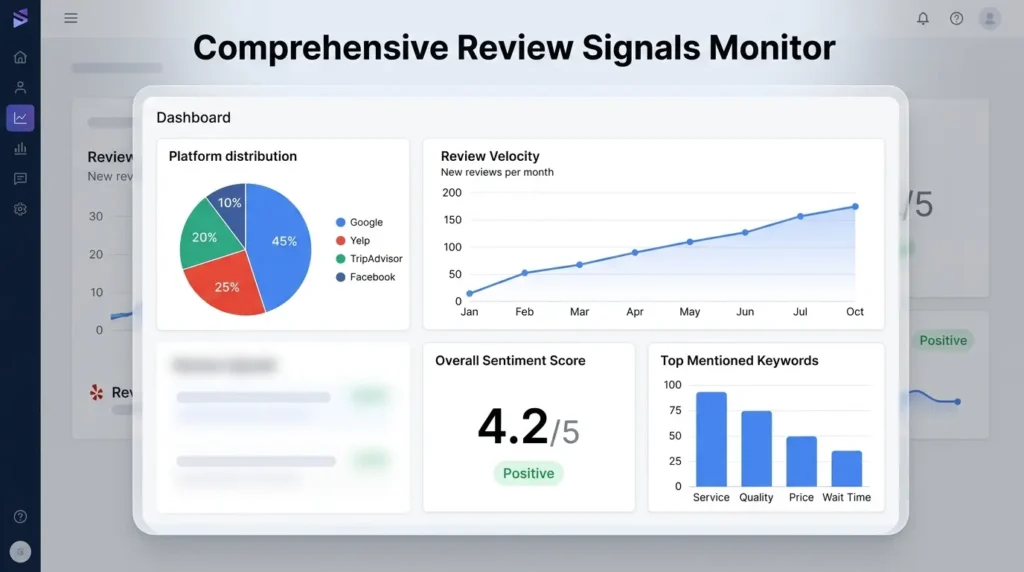
Analysis involves identifying recurring themes across review content. Common topics reveal the attributes most frequently associated with an entity. These associations influence reputation formation because repeated themes strengthen perception patterns.
Review analysis also evaluates signal distribution. Concentrations of positive or negative feedback affect how reputation is interpreted. Search ecosystems process these patterns alongside broader content and authority signals.
What factors influence local business reputation through reviews?
Local business reputation is influenced by multiple review-related factors:
- Evaluate rating consistency because sustained patterns influence credibility assessments.
- Monitor review recency because current information contributes to contemporary reputation interpretation.
- Analyse thematic repetition because recurring topics define dominant perception patterns.
- Assess reviewer authenticity because credibility depends on trusted sources.
- Measure sentiment distribution because balanced evaluation improves understanding of overall reputation conditions.
These factors contribute to local search perception and influence how users interpret trust signals within SERPs.
Why do SERPs play a central role in reputation perception?
SERPs function as reputation evaluation environments because they present multiple information sources simultaneously. Users often form opinions before visiting a website because search results already contain reviews, ratings, descriptions, and third-party references.
Search engine results pages organise information according to relevance and visibility principles. This organisation shapes first impressions and influences information interpretation. Reputation therefore becomes closely connected to search presentation.
SERP evaluation refers to the process through which users analyse available information directly within search results. Reviews play a major role in this process because they provide immediate evidence of public perception. Their visibility makes them influential reputation assets.
The statistic that 93% of consumers read Google Reviews before buying reflects the central role of reputation signals within modern search ecosystems. Google Reviews contribute to online reputation by providing structured sentiment, credibility, and trust indicators that users and search engines evaluate simultaneously.
Reputation management is fundamentally concerned with understanding how information is created, indexed, interpreted, and ranked. Search visibility, digital footprint development, authority assessment, review sentiment, and SERP evaluation all contribute to reputation formation. Google Reviews remain significant because they connect public perception with searchable information, making them an important component of entity reputation within digital environments.
Within local search ecosystems, understanding factors that influence review interpretation provides additional context for reputation analysis. A deeper examination of Google Reviews Audit: 15 Factors Affecting Local Business Reputation expands on the mechanisms that shape review-driven reputation signals and local search perception.
Why do so many consumers read Google reviews before making a purchase?
Google reviews help consumers evaluate trust, product quality, and customer experience before spending money. Reviews often provide real-world insights that can influence buying decisions more than traditional advertising.
How do Google reviews affect a business’s reputation online?
Google reviews are a major factor in online reputation management because they shape public perception and trust. Positive reviews can strengthen credibility, while negative reviews may impact customer confidence and conversion rates.
Can negative Google reviews reduce sales for a business?
Yes, a pattern of negative Google reviews can discourage potential customers from making a purchase. Many consumers compare ratings and review content before choosing a company, product, or service.
What makes consumers trust Google reviews?
Consumers often trust Google reviews because they come from previous customers who share direct experiences. A mix of detailed feedback, star ratings, and recent reviews helps people make informed purchasing decisions.
How can businesses improve their Google review profile?
Businesses can improve their review profile by encouraging genuine customer feedback, responding professionally to reviews, and maintaining consistent service quality. Clear MY Name notes that active review management can help businesses build trust and strengthen their online presence.