

Online reputation influences how individuals, organisations, and entities are interpreted across search ecosystems. Search engines continuously evaluate reputation signals to determine visibility, credibility, and relevance within search results.
Reputation management is the process of monitoring, analysing, and understanding how information contributes to public perception within digital environments. Online reputation refers to the collective interpretation of indexed content, reputation signals, reviews, mentions, and entity associations that shape how an entity is perceived across search ecosystems.
Why Does Online Reputation Matter in Search Ecosystems?
Online reputation matters because search engines use credibility-related signals to evaluate content quality, trustworthiness, and relevance. Reputation functions as a layer of interpretation that influences how users and algorithms assess an entity.
Within search ecosystems, reputation is created through the accumulation of indexed information. Search engines analyse content consistency, source authority, sentiment indicators, engagement patterns, and entity relationships. These elements form a broader understanding of who or what an entity is. The resulting interpretation affects search visibility and SERP evaluation.
Online reputation also affects user behaviour. When users encounter search results, they evaluate available information before making judgments. Titles, descriptions, reviews, articles, profiles, and mentions contribute to this process. Search engines recognise these patterns and continuously refine ranking systems to align with perceived credibility and usefulness.
The importance of online reputation has increased because digital information remains accessible, searchable, and interconnected. Search ecosystems process vast quantities of content and connect entities through semantic relationships. As a result, reputation becomes a measurable component of digital presence rather than a purely subjective concept.
How Is Online Reputation Formed Through Search Results?
Online reputation is formed through the interpretation of indexed information across multiple sources. Search engines analyse content relationships to establish an understanding of entity identity and credibility.
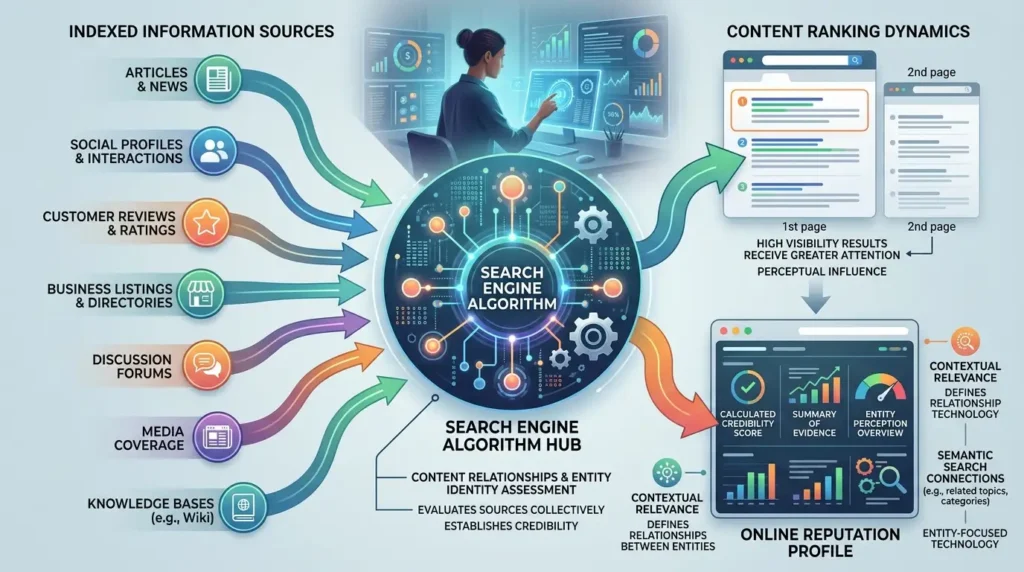
Every indexed page contributes information about an entity. Articles, social profiles, reviews, business listings, forums, media coverage, and knowledge sources become part of a larger information network. Search engines evaluate these sources collectively rather than independently. This evaluation creates a reputation profile based on available evidence.
Content ranking dynamics play a significant role in reputation formation. Highly visible search results receive greater user attention and therefore exert greater influence on perception. Information appearing on the first page of search results often becomes the primary source of entity evaluation.
Search engines also assess contextual relevance. Content connected to recognised topics, categories, and entities helps algorithms define relationships. These associations influence how reputation is interpreted within semantic search systems. As search technologies become increasingly entity-focused, reputation formation becomes closely linked to contextual understanding rather than isolated keywords.
What Is a Digital Footprint and Why Does It Affect Reputation?
A digital footprint is the collection of information associated with an entity across digital environments. Within search ecosystems, a digital footprint represents the searchable record of content, mentions, interactions, and references connected to that entity.
Digital footprints are created through content publication, media appearances, reviews, social activity, directory listings, and third-party references. Search engines discover, crawl, and index this information. Once indexed, the information contributes to entity perception and search evaluation.
The size of a digital footprint is less important than its structure. Search algorithms prioritise relevance, consistency, and authority when interpreting information. A fragmented footprint containing contradictory information creates ambiguity, while a consistent footprint strengthens entity understanding.
Digital footprints influence reputation because they provide evidence. Search engines rely on evidence-based signals to define entities. Users also rely on accessible information when evaluating trust and credibility. Consequently, the digital footprint becomes a foundational element of online reputation within search ecosystems.
How Do Search Engines Interpret Trust and Credibility?
Search engines interpret trust and credibility through the analysis of reputation signals. These signals help algorithms evaluate whether information appears reliable, accurate, and relevant.
Trust signals include source authority, content quality, citation patterns, consistency of information, and recognised expertise. Search engines analyse these elements to determine the reliability of content and the entities associated with it. The process involves comparing signals across multiple sources rather than relying on a single page.
Credibility evaluation is closely connected to entity recognition. Search systems attempt to understand who created the content, what expertise is demonstrated, and how the information relates to established knowledge. Strong alignment between content and recognised expertise contributes to positive credibility assessment.
Search engines also evaluate behavioural indicators. User engagement patterns provide indirect signals regarding content usefulness and relevance. Although engagement alone does not define credibility, it contributes additional context for algorithmic interpretation. Together, these signals form a framework that influences search visibility and reputation assessment.
How Does Content Influence Online Perception?

Content influences online perception because it provides the information users and algorithms use to evaluate an entity. Every indexed piece of content contributes context that shapes understanding.
Content defines topics, expertise areas, relationships, and credibility indicators. Search engines analyse language patterns, semantic relevance, and contextual associations to determine how content contributes to entity perception. This process helps algorithms build knowledge structures around people, organisations, and subjects.
The visibility of content affects its influence. Highly ranked content receives greater exposure and therefore contributes more strongly to public perception. Search results with prominent placement often become dominant reputation signals within SERP evaluation.
Content consistency also plays a critical role. Consistent information reinforces entity understanding and reduces ambiguity. Contradictory information creates uncertainty and can weaken trust signals. Consequently, content quality and contextual alignment remain central factors in online reputation formation.
What Role Do Reviews and Sentiment Signals Play in Reputation?
Reviews and sentiment signals provide searchable indicators of public evaluation. Search ecosystems analyse these signals to understand how entities are perceived across digital environments.
Review content contains structured and unstructured information. Structured elements include ratings and scores, while unstructured elements include written opinions and descriptions. Search engines evaluate both forms of information when interpreting reputation signals.
Sentiment interpretation involves analysing language patterns associated with positive, neutral, and negative evaluations. Search systems use sentiment analysis to identify recurring themes and perception trends. This process helps algorithms understand broader reputation patterns rather than isolated comments.
Reviews influence perception because they represent publicly accessible evaluations. Users frequently encounter review content during SERP evaluation. Search engines recognise this behaviour and treat review-related information as an important source of reputation context. As a result, review ecosystems contribute significantly to online credibility assessments.
How Do Authority Signals Affect Search Visibility?
Authority signals help search engines determine whether an entity is recognised, referenced, and trusted within a topic area. These signals contribute directly to search visibility and reputation evaluation.
Authority is established through evidence. Search engines analyse citations, references, expert associations, publication quality, and topic relevance. These indicators demonstrate whether an entity has recognised connections to a particular subject.
Authority signals influence ranking systems because search engines aim to present reliable information. When multiple sources consistently reference an entity within a specific context, algorithms gain greater confidence in that entity’s relevance and expertise.
Authority also affects entity perception. Recognised entities often benefit from stronger semantic associations and clearer knowledge structures. Search systems use these relationships to improve contextual understanding. Consequently, authority functions as both a ranking factor and a reputation signal within search ecosystems.
How Does Entity Perception Shape Online Reputation?
Entity perception is the algorithmic understanding of a person, organisation, brand, or concept within search ecosystems. It defines how search engines interpret identity, relationships, and relevance.
Search engines build entity profiles by analysing interconnected information sources. Content indexing, structured data, mentions, citations, reviews, and semantic relationships all contribute to entity understanding. The resulting profile influences reputation assessment.
Entity perception affects how information is grouped and interpreted. When search engines clearly understand an entity, they can evaluate associated content more accurately. This improves contextual relevance and reduces ambiguity within search results.
Reputation and entity perception are closely linked because both depend on information quality and consistency. Strong entity recognition supports clearer reputation evaluation, while inconsistent signals create uncertainty. Therefore, entity perception serves as a core mechanism within modern search systems.
When Should You Consider Professional Reputation Management Support?
Professional reputation management support becomes relevant when the volume, complexity, or visibility of indexed information requires structured analysis and ongoing evaluation. Within search ecosystems, reputation signals can originate from multiple sources, creating intricate relationships between content, sentiment, authority, and entity perception.
Search visibility issues, conflicting information, persistent negative sentiment signals, and inaccurate entity associations represent conditions that require deeper reputation analysis. Evaluating these conditions involves understanding how search engines interpret indexed content and how reputation signals influence SERP evaluation.
A comprehensive understanding of:
When Should You Consider Professional Reputation Management Support? requires analysing reputation systems rather than focusing solely on visible search results. Search engines evaluate contextual relationships, authority indicators, and credibility signals simultaneously. Therefore, reputation assessment depends on the broader information ecosystem surrounding an entity.
How Does Online Reputation Continue to Evolve?
Online reputation continues to evolve because search ecosystems continuously update their methods for interpreting information. Advances in entity recognition, semantic search, and content evaluation have transformed reputation assessment from keyword-based analysis into contextual understanding.
Search engines increasingly evaluate relationships between entities, topics, and information sources. This approach allows algorithms to create richer knowledge structures and more accurate reputation profiles. Reputation signals therefore become part of a broader semantic framework.
Content indexing also evolves over time. New information enters search ecosystems while older information is re-evaluated based on relevance and authority. This dynamic process means reputation remains influenced by both historical and current content.
As search systems become more sophisticated, online reputation becomes increasingly connected to credibility, authority, and entity understanding. The focus shifts from isolated pieces of content toward comprehensive interpretation across interconnected information networks.
Dive Deeper With Our Expert Guides:
What Appears When Someone Searches Your Name Online
Why Employers Research Candidates Before Hiring
Online reputation is a measurable outcome of how information is indexed, interpreted, and evaluated across search ecosystems. Search engines analyse reputation signals, authority indicators, content relationships, sentiment patterns, and entity associations to develop an understanding of credibility and relevance.
Digital footprints, review ecosystems, content ranking dynamics, and entity perception all contribute to reputation formation. These interconnected mechanisms influence both search visibility and public interpretation. Understanding how reputation systems operate provides a clearer view of how information shapes perception within modern search environments.
Answers to Key Questions
What is reputation management for individuals?
Reputation management for individuals is the process of monitoring and improving how a person appears in search results and online platforms. It focuses on digital footprint management, online credibility, and search visibility.
Why is online reputation important for individuals?
Online reputation influences how people perceive an individual based on search engine results, reviews, articles, and social profiles. A strong reputation supports trust, while negative or misleading content can affect credibility and perception.
How do search engines influence personal reputation?
Search engines rank and display information based on relevance, authority, and reputation signals. The content that appears prominently in search results often shapes public perception and entity reputation.
What factors affect an individual’s online reputation?
Key factors include search engine results, social media content, online reviews, news mentions, public records, and digital footprint consistency. These elements contribute to overall online credibility and trust signals.