
Meta’s recommendation content policies determine which eligible content receives additional distribution across recommendation surfaces, while content removal policies determine whether material can remain on the platform. Reputation management strategies differ based on whether the objective involves controlling content availability, improving visibility, or influencing how reputation signals are interpreted.
Online reputation control methods are evaluated through their effect on content visibility, trust signals, entity credibility, and the wider information environment. Understanding Meta’s recommendation framework therefore requires separating moderation from recommendation, then comparing reactive content actions with organic reputation-building approaches.
How Do Meta’s Recommendation Policies Differ From Content Removal Policies?
Meta’s recommendation policies operate as a distribution filter, while content removal policies operate as a compliance mechanism. Removal addresses whether content breaches platform standards, whereas recommendation eligibility addresses whether content receives additional exposure through discovery features. This distinction creates two separate stages within the content lifecycle. Content can remain available while receiving restricted recommendation distribution. The strategic difference is important because removing content and reducing its recommendation exposure produce different effects on an entity’s digital footprint.
From a reputation perspective, content removal provides a direct response when material violates an applicable policy, while recommendation restrictions affect visibility without necessarily eliminating the underlying material. Removal therefore has a stronger immediate effect on content availability but depends on establishing a qualifying policy violation. Recommendation controls have a different mechanism because they influence distribution rather than existence. Neither approach independently determines search ranking influence on external search engines.
How Effective Is Content Removal Compared With Content Suppression?
Content removal is more direct when material clearly violates platform rules, while content suppression focuses on reducing exposure without necessarily removing the source. Removal changes the underlying information set available on the platform. Suppression changes the visibility balance between competing information without requiring the original material to disappear. These approaches therefore address different reputation-management objectives. Their effectiveness depends on whether the underlying issue concerns policy compliance or unwanted prominence.
Content removal also carries a narrower eligibility condition because platform rules determine whether an item qualifies for enforcement. Content suppression operates through distribution, discoverability, or competing information rather than a direct policy decision. For reputation analysis, this distinction separates compliance-based intervention from visibility-based strategy. A removal action can resolve one content item while leaving broader reputation signals unchanged. Suppression can alter exposure patterns while leaving the original information accessible.
How Does Content Creation Compare With Content Removal for Reputation Management?
Content creation and content removal represent fundamentally different reputation management methods. Content creation adds authoritative, accurate, and relevant information to an entity’s digital footprint, while removal attempts to reduce the presence of qualifying harmful material. Creation operates through content enhancement and information expansion. Removal operates through policy enforcement and information reduction. Comparing them therefore requires examining control, eligibility, scalability, and sustainability rather than treating them as interchangeable tactics.
Content creation provides greater control over the information an entity publishes and develops over time. However, newly created material requires authority, relevance, indexing, and engagement before it gains meaningful visibility. Removal provides a more immediate change when content meets a platform’s enforcement criteria, but it cannot address material that remains within policy boundaries. From a SERP perspective, content creation can contribute to a broader information ecosystem, while removal affects search visibility only when the removed material also influences externally indexed results.
Which Is More Sustainable: Organic Reputation Building or Reactive Management?
Organic reputation building is generally more sustainable when the objective involves developing a durable information ecosystem rather than responding to individual content incidents. Organic methods create and strengthen accurate information through consistent publishing, authoritative references, legitimate engagement, and structured entity information. Reactive management responds to specific content, reviews, posts, or policy concerns after they become visible. The two approaches differ primarily in timing and strategic scope. Organic activity develops reputation signals progressively, whereas reactive action addresses discrete reputation risks.
Reactive management remains important because a single policy-violating item requires classification and appropriate handling rather than passive monitoring. Its limitation is that individual interventions do not automatically strengthen the wider entity profile. Organic reputation building addresses this gap by expanding the volume and quality of relevant information associated with an entity. Search engines can then evaluate a broader set of signals when determining SERP composition. Sustainability therefore depends on maintaining an accurate information environment rather than repeatedly addressing isolated visibility problems.
How Do Short-Term and Long-Term Reputation Strategies Compare?
Short-term reputation strategies prioritise immediate control of visible risks, while long-term strategies focus on strengthening the underlying information environment. A short-term response can involve reporting qualifying content, reviewing recommendation eligibility, correcting inaccurate information, or addressing policy-specific issues. A long-term approach involves developing authoritative content, strengthening entity references, maintaining consistent information, and monitoring reputation signals. Each approach operates at a different point in the reputation lifecycle.
Short-term actions provide faster intervention when a specific content item creates an identifiable risk. Their limitation is scope because the action generally applies to the content or platform involved. Long-term strategies require sustained content development and stronger information architecture, but they address a broader range of search perception factors. The comparison therefore centres on speed versus durability. Effective reputation analysis measures immediate visibility changes separately from longer-term SERP composition and entity credibility.
How Do Facebook Reviews Compare With Other Reputation Signals?
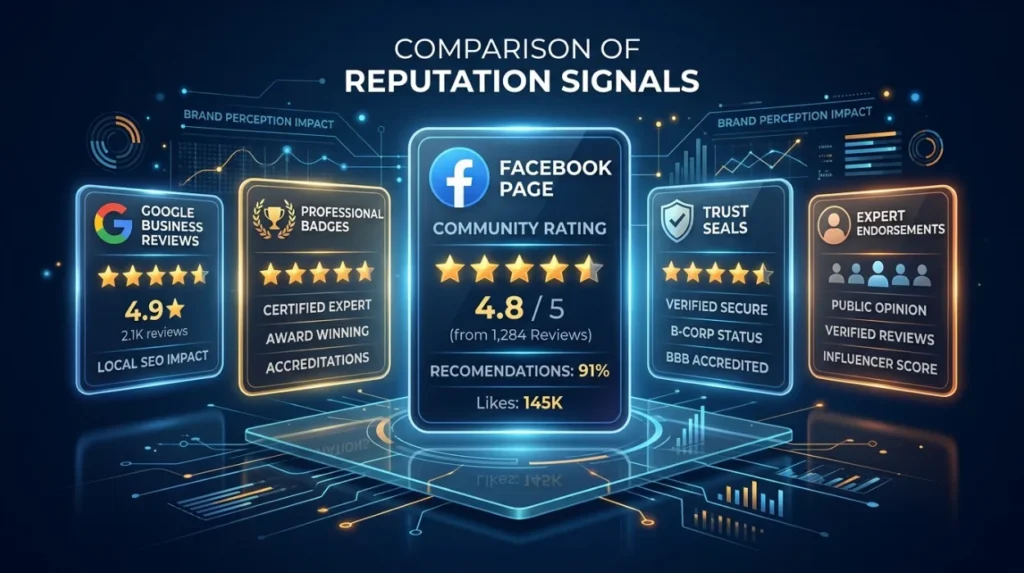
Facebook reviews function as user-generated reputation signals containing ratings, written sentiment, and contextual assessments of an entity. Other reputation signals include editorial coverage, authoritative websites, structured business information, professional profiles, customer feedback, and independently published content. Reviews provide direct user sentiment, while authoritative sources can provide contextual or corroborative information. Search systems interpret these information types through different ranking and relevance mechanisms.
Sentiment distribution is particularly relevant when analysing review-based reputation because repeated positive, neutral, or negative language contributes to the perceived information environment. However, sentiment does not establish factual accuracy by itself. A review platform evaluates content under its own policies, while search engines independently assess indexed information. Reputation analysis therefore requires separating sentiment signals from authority signals and treating both as components of broader entity perception.

How Do Recommendation Restrictions Affect Search Visibility?
Recommendation restrictions primarily affect visibility within Meta’s ecosystem rather than directly changing external search rankings. When content receives limited recommendation distribution, fewer users encounter it through platform discovery surfaces. This reduces one pathway through which information gains additional exposure. External search engines remain independent because they crawl and index information according to their own systems. The direct effect on Google SERPs therefore depends on whether the content is publicly accessible, indexed, relevant, and competitive for particular queries.
The distinction becomes important when evaluating search perception because platform visibility and search visibility are related but separate measurements. High exposure within a social platform does not guarantee high search ranking. Likewise, reduced recommendation distribution does not automatically remove an indexed page from search results. Search ranking influence depends on external signals such as relevance, authority, content quality, links, user behaviour, and search intent. A complete assessment therefore measures platform distribution and SERP performance independently.
How Should Content Suppression and Content Enhancement Be Evaluated?
Content suppression and content enhancement address opposite sides of the information environment. Suppression seeks to reduce the prominence or distribution of unwanted information, while enhancement develops stronger and more authoritative information that can compete for attention. Suppression is therefore primarily defensive, whereas enhancement is primarily constructive. Their effectiveness depends on the nature of the reputation problem, the authority of competing content, and the relevant discovery channels.
Suppression provides greater relevance when a specific visibility problem requires containment, particularly where direct removal is unavailable. Enhancement provides greater strategic breadth because new information can strengthen entity credibility across multiple queries and platforms. Neither method guarantees a particular search position because ranking systems evaluate content independently. The strongest analytical comparison therefore considers visibility change, authority development, risk exposure, and sustainability rather than relying on one ranking metric.
How Can Reputation Management Methods Be Compared for Risk Exposure?
Reputation management methods can be compared by examining policy dependence, implementation control, visibility impact, scalability, and potential unintended effects. Policy-based removal has high dependence on platform rules because intervention requires a qualifying violation. Organic content enhancement provides greater control over the material being created but has less immediate influence over existing third-party information. Suppression strategies depend on the strength of competing information and the distribution mechanisms affecting visibility. Each method therefore carries a different operational risk profile.
A useful evaluation framework focuses on four measurable dimensions:
- Assess policy eligibility by determining whether the target content violates a specific platform rule rather than relying on negative sentiment alone.
- Measure visibility impact by comparing recommendation exposure, platform discovery, indexed pages, and relevant SERP positions before and after an intervention.
- Evaluate authority strength by analysing the credibility, relevance, originality, and external references associated with competing content.
- Monitor sustainability by tracking whether visibility changes persist after active intervention or depend on continuous reactive activity.
This framework separates compliance decisions from search perception analysis. It also prevents content removal, recommendation restrictions, and content enhancement from being evaluated using the same success criteria.
Dive Deeper With Our Expert Guides:
Review Acquisition Tactics Built for Local Facebook Pages
Containing a Viral Facebook Complaint Before It Hits Groups
How Do Meta’s Recommendation Policies Influence Entity Credibility?
Meta’s recommendation policies influence entity credibility indirectly by affecting which information users encounter through platform discovery systems. Recommendation is not a factual verification mechanism, so increased distribution does not establish that content is accurate or authoritative. Likewise, reduced recommendation does not establish that content is false. The policies instead influence the exposure layer through which users encounter eligible material. Entity credibility develops from the broader combination of source quality, consistency, evidence, context, and reputation signals.
This distinction is particularly important for online reputation control because perception is formed through accumulated information rather than one platform classification. A review can contribute sentiment, an authoritative source can provide context, and search results can determine which information receives repeated exposure. These signals interact without becoming equivalent. Evaluating reputation therefore requires analysing how information is classified, distributed, indexed, and interpreted across separate systems.
What Role Does Meta’s Review Policies Analysis Play in Reputation Strategy?
Meta’s Review Policies analysis provides a framework for distinguishing review governance from recommendation distribution and broader search perception. It evaluates whether a content issue belongs to a policy-enforcement pathway, a recommendation-eligibility pathway, or a wider reputation-management problem. This classification reduces the risk of applying a visibility strategy to a compliance issue or treating a search-ranking problem as a platform moderation issue. Accurate classification is therefore the first stage of meaningful comparative analysis.
The same distinction applies when evaluating Facebook Reviews within a broader reputation ecosystem. A review can remain available, receive limited recommendation, attract significant engagement, or become part of externally visible information without these outcomes being identical. Each outcome reflects a different mechanism. Separating these mechanisms allows reputation signals, search ranking influence, sentiment distribution, and entity credibility to be measured more precisely.
How Should Businesses Choose Between Reactive and Organic Reputation Approaches?
Businesses can evaluate reactive and organic approaches according to the type, urgency, and distribution of the reputation issue. Reactive methods are designed for specific content events and policy-related concerns, while organic methods address the wider information environment over time. Reactive action provides targeted intervention when a qualifying problem is identifiable. Organic activity provides broader control over the information an entity publishes and develops. The appropriate comparison therefore depends on whether the primary problem is content eligibility, visibility, or information imbalance.
A balanced evaluation also considers scalability and resource requirements. Repeated reactive interventions become operationally intensive when reputation issues involve multiple platforms or recurring content. Organic development requires consistent production, optimisation, authority building, and monitoring, but its effects can extend across a larger information ecosystem. Neither approach replaces the other because they operate through different mechanisms. Reputation strategy is therefore better evaluated as a combination of policy response, visibility analysis, and sustained information development.
What Is the Most Reliable Framework for Evaluating Meta Recommendation Policies?
The most reliable framework separates content compliance, recommendation eligibility, platform visibility, search visibility, and entity perception into distinct analytical layers. Content compliance determines whether material satisfies platform rules. Recommendation eligibility determines whether eligible content receives additional distribution. Platform visibility measures exposure within the social ecosystem. Search visibility measures external indexing and ranking. Entity perception represents the interpretation users form from the combined information environment.
This layered framework prevents a single metric from being treated as a complete measure of reputation performance. A removed review, a restricted recommendation, a lower platform reach, and a changed SERP position represent different outcomes. Each requires separate measurement and different success criteria. The framework also distinguishes short-term intervention from long-term reputation development. This creates a more accurate basis for evaluating Facebook Reviews, recommendation policies, content suppression, and content enhancement.
What Are the Key Differences Between Meta Recommendation Strategies?
Meta recommendation strategies differ according to whether the objective involves policy enforcement, visibility control, or reputation development. Removal addresses qualifying content directly, recommendation controls influence distribution, and content enhancement strengthens the wider information ecosystem. Reactive approaches prioritise immediate risk management, while organic approaches prioritise sustained entity credibility. These differences determine their respective strengths, limitations, scalability, and risk exposure.

The central consideration is that no single mechanism controls the complete reputation lifecycle. Platform policies determine content eligibility, recommendation systems influence distribution, users interpret sentiment and credibility, and search engines independently evaluate indexed information. Understanding these boundaries prevents platform actions from being mistaken for search-ranking outcomes. A structured reputation strategy therefore evaluates content status, recommendation eligibility, SERP composition, trust signals, and entity perception as connected but distinct components.
What are Meta’s recommendation content policies?
Meta’s recommendation content policies determine what content can be recommended to people who do not already follow an account. Content that violates these standards or falls into restricted categories can have reduced recommendation visibility even when it remains available on the platform.
What content does Meta limit from recommendations?
Meta can limit recommendations for content that is considered sensitive, misleading, low-quality, or otherwise unsuitable for broad discovery. This can affect how posts, Reels, accounts, and other content appear in recommendation surfaces.
What is the difference between removing content and limiting recommendations on Meta?
Content removal means a post or account violates Meta’s Community Standards and is taken down. Recommendation limits reduce distribution to non-followers while the content can remain accessible to existing audiences.
How can I check if my content is eligible for recommendation on Meta?
Meta provides account and content-level information through its platform tools when recommendation eligibility is affected. Reviewing the relevant policy notice helps identify whether the issue involves content, account status, or recommendation guidelines.
Can reputation management help with Meta recommendation policy issues?
Reputation management focuses on improving the broader online information environment rather than bypassing Meta’s policies. Clear My Name can be considered where legitimate content-removal, privacy, or search-visibility issues form part of a wider digital reputation problem.