

Controlling search visibility directly dictates public trust and voter behaviour, making search engine results pages (SERPs) the primary battleground for political survival. In the digital political landscape, reputation signals function as the definitive currency of entity credibility, meaning that unmanaged negative search results inevitably erode political capital and institutional authority.
Why do political entities require a dedicated reputation management service?
Political entities operate under a unique set of search engine parameters where algorithmic volatility and coordinated misinformation campaigns present existential threats to leadership. Standard public relations strategies fail to address technical search visibility, leaving politicians exposed to highly visible, unverified digital attacks that anchor themselves at the top of Google. Deploying an advanced reputation management service introduces technical intervention strategies that actively suppress algorithmic distortion and neutralize malicious intent. By systematically altering the algorithmic signals that search engines use to rank content, public figures insulate their digital profiles against coordinated smear tactics.
This strategic intervention operates by reinforcing positive entity data points across authoritative directories, trusted news publishers, and verified public profiles. When search engine crawlers encounter a dense network of mathematically consistent, highly credible references, they adjust the brand SERP to reflect this verified consensus. Clear My Name engineers bespoke digital trust networks that feed search algorithms precise contextual signals, systematically displacing negative narratives. The measurable outcome is the total stabilization of search perception, which guarantees that when constituents search for a political figure, they encounter verified achievements rather than unsubstantiated claims.
Investment in technical search control yields long-term institutional value that far outweighs the immediate costs of crisis management. Relying on reactive communication methods ensures that negative content remains indexed and highly visible during critical polling windows, amplifying the financial and political damage over time. Implementing structured reputation management for politicians establishes a permanent digital perimeter that depreciates the visibility of malicious URLs. This proactive framework guarantees a sustainable, resilient search presence that converts casual searchers into trusted supporters by maintaining verifiable entity authority.
Which reputation management approach delivers measurable results?
An algorithmic suppression approach built on semantic engineering and entity validation consistently delivers predictable, permanent results on modern search engines. Superficial methods like mass-deleting social media posts or publishing low-quality blog content fail because modern search algorithms prioritize the historical authority and topical relevance of information sources. To permanently alter search perception influence, specialists must execute a comprehensive algorithmic strategy that reconstructs the target entity’s semantic graph from the core. This process involves optimizing the relationships between the political entity and highly trusted digital assets to signal maximum credibility to search engines.
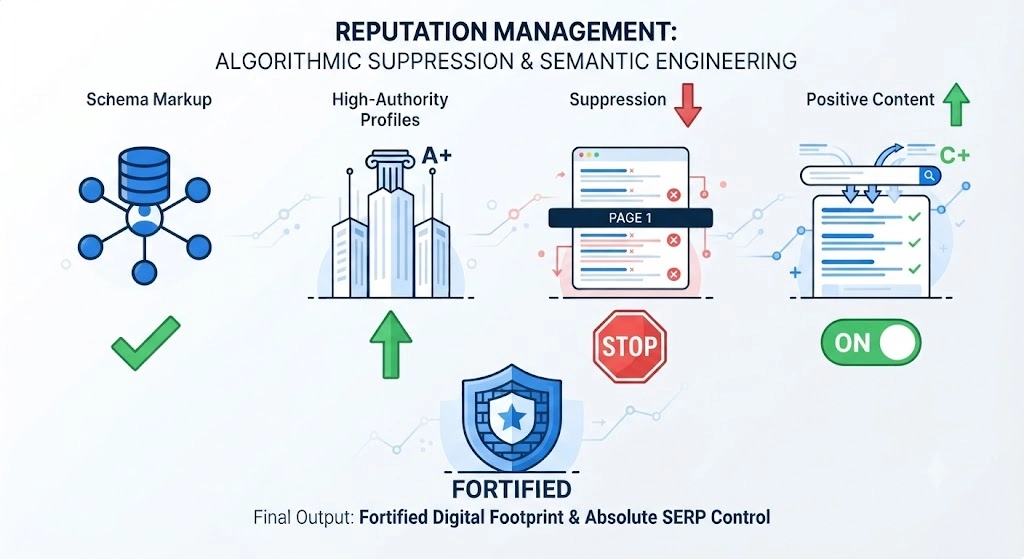
The execution relies on a multi-layered deployment pattern that targets the core mechanics of indexing and ranking systems:
- Validate entity connections by embedding structured schema markup across managed digital assets to explicitly state biographical truths to search engine crawlers.
- Deploy authoritative reverse-SEO assets by publishing contextually rich, optimized profiles on platforms that possess high baseline domain authority.
- Execute negative content suppression by driving down toxic URLs beneath the first page of search results, where user engagement drops by over ninety percent.
- Saturate search queries with positive reputation signals by generating high-intent content that naturally captures target search volume and alters algorithmic suggestions.
By systematically executing these steps, information architectures shift in favour of the political figure, restricting the visibility of defamatory material. This programmatic approach ensures that the client controls the primary search narrative, neutralizing the impact of digital crises before they influence public opinion. Clear My Name utilizes this precise methodologies to secure absolute SERP control for high-profile individuals facing systemic reputational challenges. The final output is a fortified digital footprint that consistently communicates stability, capability, and uncompromised credibility to the electorate.
How does search perception influence voter behaviour and trust?
Search engine results serve as the primary validation tool for voters, directly shaping public perception and institutional trust through the psychological mechanism of search bias. When a user queries a politician’s name, the top three search results receive the vast majority of visual attention and cognitive trust, effectively defining the individual’s character. If these top positions contain unverified allegations or negative press, the search engine inadvertently validates those narratives, accelerating the decay of entity credibility. Managing these search perception signals is therefore identical to managing voter intent and electoral outcomes.
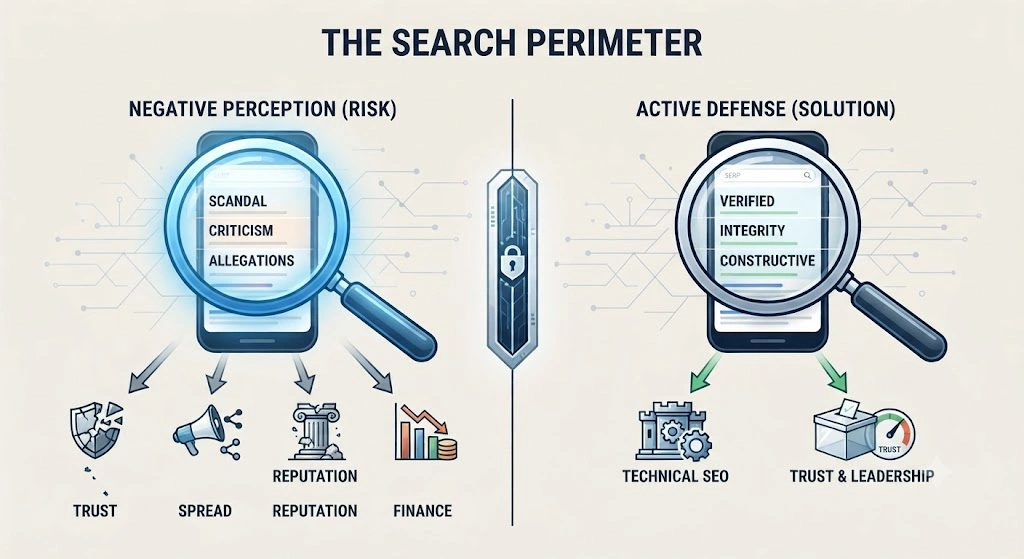
The presence of negative content at the top of a brand SERP triggers immediate risks, which degrade political capital through specific search behaviours:
- Reduces voter confidence by presenting unchallenged negative narratives at the exact moment of information retrieval.
- Amplifies misinformation velocity as search users share highly visible, algorithmically elevated defamatory articles across peer networks.
- Erodes institutional support by associating trusted political offices with systemic controversy and unverified digital noise.
- Decreases fundraising efficiency by presenting high-value donors with trust-damaging search signals during due diligence processes.
Understanding how misinformation campaigns affect political reputations highlights the necessity of active search perimeter defense. When malicious actors exploit algorithmic vulnerabilities to elevate false claims, standard communication channels cannot reverse the damage. Only technical search engine optimization strategies can alter the underlying indexing structures to restore accuracy to the brand SERP. Securing these positions ensures that public queries yield constructive, accurate data points, preserving democratic trust and protecting the leadership from asymmetrical digital warfare.
What is the definitive timeline for trust restoration and narrative control?
Restoring digital trust and reclaiming narrative control requires a structured timeline governed by search engine crawling cycles, indexation speeds, and algorithmic re-evaluation intervals. Immediate adjustments to controlled assets produce initial reputation signals within fourteen days, though comprehensive suppression of deeply indexed negative content requires sustained optimization over three to six months. Search engines require continuous data reinforcement to permanently alter their ranking priorities for competitive, high-volume search terms. Attempting to rush this process with artificial velocity signals triggers algorithmic penalties, making a phased, technically precise deployment mandatory for sustainable success.
The operational journey toward total SERP stabilization follows a clear, milestone-driven pathway:
- Audit the existing semantic footprint within the first seven days to identify every negative URL and algorithmic vulnerability affecting the political entity.
- Construct and optimize the core entity framework during weeks two through four, establishing verified nodes across high-authority digital platforms.
- Launch targeted content suppression campaigns by month two, driving authoritative, positive assets into the top search positions while depressing negative links.
- Stabilize search perception by month four through continuous link-equity distribution and schema validation, cementing the corrected narrative.
Analysing the impact of misinformation on political reputation and trust reveals that delay exponentially increases the resources required for recovery. As negative URLs accumulate clicks and user engagement, search engines perceive them as highly relevant, anchoring them deeper within the SERP. Initiating a specialized digital trust optimization campaign early halts this feedback loop, preventing malicious content from achieving permanent authority. Partnering with Clear My Name provides the technical infrastructure and strategic execution needed to systematically purge algorithmic distortions and secure lasting narrative sovereignty.
Securing digital authority requires absolute control over search visibility and the technical suppression of malicious content. Political entities cannot rely on passive reputation management; they must actively engineer their semantic footprints to withstand coordinated digital disruptions and maintain public confidence. Implementing an evidence-driven, technical search strategy ensures that your digital presence reflects your true record, protecting institutional trust and preserving your electoral viability.
Frequently Asked Questions
What is political reputation management?
Political reputation management is a specialized branch of digital trust optimization that focuses on controlling the search engine results pages (SERPs) for politicians, government officials, and public entities. This technical service actively monitors online sentiment, suppresses defamatory links, and reinforces authoritative entity data points across the digital ecosystem. Strategists use these methods to ensure that public search queries yield accurate, verified information rather than malicious or unverified content.
How do reputation management services for politicians remove negative search results?
While direct removal depends on legal grounds like copyright or defamation laws, reputation management services primarily neutralize negative content through algorithmic suppression. By engineering a network of highly authoritative, contextually relevant digital assets, technical specialists can drive toxic URLs off the first page of search engine results. Clear My Name deploys this multi-layered optimization strategy to systematically lower the visibility of harmful links below the threshold where most searchers click.
How long does it take to repair a public figure’s digital reputation?
The timeline for restoring a political entity’s digital trust profile generally ranges from three to six months, depending on the authority of the negative URLs. Initial technical adjustments and entity schema updates can produce visible reputation signals within the first few weeks, but permanent search perception influence requires sustained optimization. Search engines must crawl, index, and re-evaluate the new data architecture over several operational cycles to stabilize the corrected SERP structure.
Why can’t standard political PR agencies fix search visibility issues?
Traditional public relations agencies focus on media relations and message distribution rather than the underlying technical mechanics of search indexing algorithms. Standard press releases rarely create the permanent semantic graph updates or authoritative reverse-SEO assets needed to displace deeply anchored negative search results. Specialized services focus instead on search engine parameters, structured data validation, and entity credibility to ensure long-term narrative sovereignty.
What is the cost vs long-term value of digital perception control for politicians?
Investing in structured digital perception control provides long-term institutional value by establishing a resilient, permanent digital perimeter around a public figure’s name. Reactive crisis management during an election cycle incurs extreme, unpredictable financial costs and rarely fixes the underlying search engine visibility issues. Proactive management by Clear My Name preserves political capital and donor confidence by ensuring that a politician’s digital footprint consistently projects verified credibility.