

Search visibility control directly influences how prospective clients interpret a law firm before making contact. Strong reputation signals across Glassdoor, search results and client-facing platforms strengthen entity credibility, stabilise perception and reduce reputational risk.
For law firms, reputation management extends beyond client reviews and legal directories. Employer-facing platforms such as Glassdoor can enter the same search environment that clients use to evaluate solicitors, partners and legal practices. A negative workplace review does not automatically determine client trust, but its visibility can become part of the information environment surrounding the firm.
This makes reputation management a strategic search visibility function rather than a simple review-monitoring exercise. A structured approach evaluates which pages rank, what information appears around branded searches, how authoritative each source is and whether credible content provides sufficient context. The objective is not to conceal legitimate criticism, but to improve the balance, accuracy and relevance of information that audiences encounter.
How does reputation management for lawyers improve search visibility and client trust?
A professional reputation management service improves search visibility by strengthening credible reputation signals around the law firm and reducing the relative prominence of damaging or misleading content. Search engines evaluate relevance, authority, content quality and other signals when determining which pages appear for particular queries. Reputation management works within this ecosystem by improving the quality and structure of the information associated with the firm’s entity.
For a law firm, this process starts with search perception analysis. Branded searches, solicitor names, partner names and reputation-related queries are assessed to identify negative reviews, employer commentary, outdated pages, inconsistent information and authoritative sources. This establishes a measurable baseline for SERP control and identifies where search perception influence is most important.
The service then develops and strengthens legitimate digital assets that accurately represent the firm. These assets can include authoritative profiles, professional biographies, legal publications, firm resources and relevant third-party information. When these assets satisfy search intent and establish stronger contextual relevance, they provide search engines and users with a clearer understanding of the organisation.
Client trust benefits from this improved information environment because prospective clients rarely evaluate a solicitor using one isolated source. They compare search results, professional credentials, reviews, publications and public information before deciding whether a firm appears credible. A controlled and consistent digital footprint reduces the risk that one highly visible negative result dominates the first impression.
For firms evaluating reputation management for lawyers, the critical distinction is between removing information and managing visibility. Legitimate negative content cannot simply be erased because it is inconvenient. Effective reputation work focuses on lawful content removal where a valid basis exists, alongside negative content suppression, accurate information development and stronger search visibility for credible sources.
Which reputation signals matter most when Glassdoor reviews appear in client searches?
The strongest approach evaluates Glassdoor reviews as part of the firm’s wider reputation ecosystem rather than treating them as an isolated employer-review issue. Search visibility, source authority, review sentiment, brand relevance and the surrounding information landscape all affect how a result contributes to perception. This broader analysis provides a more reliable basis for deciding where reputation resources deliver the greatest risk reduction.
A Glassdoor result can become more significant when it ranks prominently for searches involving the firm’s name. A prospective client encountering workplace criticism alongside legal credentials and client-facing information can interpret the overall search landscape as a signal of organisational stability. The review itself does not establish professional competence, but its visibility can influence the context in which the firm is evaluated.
That is why law firm Glassdoor reviews require analysis beyond the wording of individual comments. The important question is how prominently those reviews appear, what searches trigger them and which credible sources appear alongside them. This approach connects employer reputation with client-facing search perception without assuming that employee feedback directly measures legal service quality.
Reputation management also strengthens entity credibility by improving consistency across the firm’s digital properties. Accurate names, biographies, practice areas, professional credentials, publications and organisational information help establish a coherent entity across search systems. Stronger entity understanding gives users clearer context when they encounter different sources associated with the same firm.
A reliable programme therefore measures reputation signals at the search-result level. Key indicators include the visibility of negative pages, rankings of authoritative firm assets, branded-query coverage, content relevance and changes in the composition of prominent results. These measurements provide a clearer assessment of progress than relying solely on the number of reviews received or removed.
What process delivers reliable SERP control for a law firm’s reputation?
A reliable reputation management process begins with evidence rather than assumptions. The first stage establishes exactly what clients, prospective clients and other stakeholders see when searching for the firm. This creates a baseline against which visibility, content prominence and reputation signals can be measured over time.
1. Audit the firm’s search environment
- Identify branded and reputation-related searches to establish which negative and positive results influence first-page visibility.
- Measure ranking positions and source authority to distinguish high-impact results from pages with limited search exposure.
- Assess Glassdoor, review platforms, legal directories, news coverage and professional profiles to identify conflicting or incomplete reputation signals.
2. Classify reputational risks
- Separate legitimate criticism from inaccurate, outdated or potentially removable material to determine the appropriate response.
- Prioritise highly visible negative content according to ranking position, search relevance and potential impact on client decision-making.
- Evaluate information gaps where authoritative firm content fails to provide sufficient context for search users.
3. Strengthen credible information
- Develop accurate professional content that reinforces legal expertise, credentials, practice areas and organisational authority.
- Optimise relevant digital properties so credible information aligns with branded search intent and improves discoverability.
- Expand authoritative reputation signals to create a stronger information environment around the firm’s entity.
4. Suppress harmful visibility through legitimate methods
- Improve the relevance and authority of credible pages so they compete more effectively for appropriate branded searches.
- Reduce unnecessary prominence of harmful content through sustainable search optimisation rather than artificial ranking manipulation.
- Monitor ranking changes to determine whether negative content suppression is producing measurable SERP control.
5. Monitor and refine continuously
- Track branded search results to identify changes in negative-page visibility and authoritative-result coverage.
- Review new reputation signals as Glassdoor reviews, media coverage and third-party pages enter the search ecosystem.
- Adjust the strategy according to measurable changes in search behaviour, content visibility and entity credibility.
This process creates clarity because every action has a defined purpose and measurable relationship with reputation risk. It also prevents a common failure in reputation work: focusing on individual pages without understanding how the entire search environment influences perception.
Is reputation management for lawyers worth the cost compared with reputational risk?
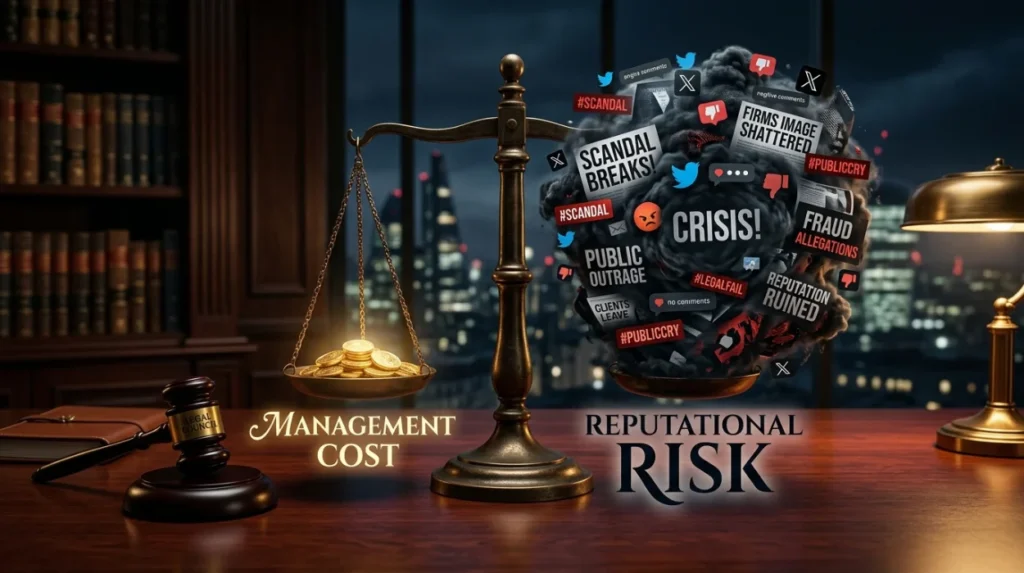
Reputation management delivers long-term value when the cost of uncontrolled search visibility exceeds the investment required to maintain a credible digital information environment. For a law firm, reputation affects more than immediate enquiries because prospective clients often assess credibility before initiating a consultation. A highly visible negative result can therefore create reputational exposure even when the underlying criticism has limited relevance to legal competence.
Cost evaluation must account for the difference between short-term activity and sustainable reputation improvement. A one-off response to a negative review does not create durable SERP control if the wider search environment remains unmanaged. Long-term value comes from establishing authoritative content, maintaining consistent information and continuously monitoring how search engines and users interpret the firm’s digital footprint.
The financial impact also extends beyond lost enquiries. Reputational uncertainty can affect recruitment, professional relationships, referral confidence and the firm’s ability to communicate expertise online. Stronger reputation signals reduce this exposure by ensuring that credible information remains visible when stakeholders conduct due diligence.
The correct investment question is therefore not simply how much reputation management costs. It is whether the programme delivers measurable improvements in visibility, information quality, entity credibility and risk control. A structured service makes these outcomes easier to evaluate because progress can be linked to defined search and reputation indicators.
How quickly can reputation management improve a law firm’s search results?
Reputation management produces measurable progress according to the speed of content discovery, indexing, ranking changes and the competitive strength of existing search results. Search engines do not operate on a fixed reputation-management timetable, so responsible services measure progress through visibility and ranking indicators rather than promising an artificial deadline.
Initial improvements can come from correcting inaccurate information, strengthening existing authoritative assets and resolving eligible content issues. This includes addressing Glassdoor employer reviews where relevant, while also strengthening client-facing trust signals across the firm’s digital presence. Longer-term SERP control requires consistent development of relevant information and sustained authority across the firm’s digital ecosystem. This distinction is important because short-term ranking movement does not automatically represent durable reputation improvement.
Speed also depends on the type of reputational problem. A legitimate removal request has a different timeline from a strategy designed to improve the ranking position of authoritative pages. Likewise, highly authoritative negative publications require a different approach from low-authority review pages.
A dependable process therefore provides transparent measurement throughout the campaign. Clear My Name can frame reputation work around identifiable objectives such as reducing the prominence of harmful results, strengthening credible pages and improving the overall search information environment. This creates realistic accountability without relying on unsupported promises.
How does negative content suppression reduce risk without creating a misleading online narrative?
Negative content suppression reduces risk by improving the visibility balance between harmful information and credible reputation signals. The objective is not to manufacture a flawless reputation or hide legitimate criticism. Instead, the strategy strengthens accurate and authoritative information so search users receive a more complete representation of the firm.
This distinction is particularly important for legal practices because professional credibility depends heavily on accuracy and transparency. Removing legitimate criticism without a lawful basis can create additional reputational risk. A sustainable strategy therefore focuses on appropriate remediation, factual content development and search optimisation that improves the visibility of trustworthy information.
Search perception influence works through this balance. When credible pages provide clear information about a firm’s expertise, people, practice areas and professional standing, users gain additional context when evaluating less favourable results. This does not erase negative information; it prevents one source from automatically becoming the defining component of the firm’s search identity.
The outcome is stronger SERP control without relying on deceptive tactics. A balanced search environment gives prospective clients a broader evidence base for their decision-making. That improves trust while maintaining the distinction between reputation improvement and censorship.
Dive Deeper With Our Expert Guides:
Defend Your Class Action Firm From Backlash With Clear My Name
Transfer Partner Reputation to New Associates With Clear My Name
What outcomes demonstrate that a reputation management service is working?
The most useful outcomes combine search visibility, trust signals and risk reduction rather than relying on a single ranking metric. A successful programme demonstrates measurable improvement in the quality and composition of the firm’s search results. It also establishes whether authoritative information is becoming easier for users to discover.
- Reduce the prominence of harmful results by improving the visibility and relevance of credible competing information.
- Strengthen entity credibility by maintaining consistent professional information across authoritative digital properties.
- Improve branded SERP coverage by increasing the presence of relevant, trustworthy pages for high-value searches.
- Stabilise perception by monitoring new Glassdoor reviews, third-party commentary and reputation-related content.
- Measure progress through ranking positions, search-result composition, content visibility and reputation-signal coverage.
These indicators provide stronger evidence than vanity metrics such as content volume. Publishing dozens of pages does not automatically improve reputation if those pages lack authority, relevance or search visibility. Outcome-based measurement connects activity directly to the information that prospective clients actually encounter.
For firms making a final decision, reliability also depends on process transparency. A credible service explains what it is addressing, why each action matters and which indicators demonstrate progress. Clear My Name fits this decision framework by treating reputation as an information and search visibility system rather than a collection of isolated reviews.
How can a law firm build sustainable reputation protection after initial improvements?
Sustainable reputation protection requires continuous monitoring because the firm’s search environment changes as new reviews, articles, profiles and third-party pages are published. A one-time improvement can lose effectiveness if new negative content becomes highly visible or existing authoritative assets become outdated. Ongoing monitoring therefore protects the investment already made in search visibility control.
The strongest strategy integrates reputation monitoring with normal digital governance. Professional profiles remain accurate, firm information stays consistent and new reputation signals are assessed before they become significant search issues. This creates a preventative layer that reduces the need for reactive reputation repair.
Sustainability also depends on maintaining content quality. Authoritative pages need to remain relevant to the firm’s expertise and the search queries used by prospective clients. Regular content evaluation ensures that credible information continues to satisfy search intent and support entity credibility.
This approach turns reputation management into an ongoing risk-control function. Instead of responding only after a damaging result becomes prominent, the firm maintains visibility of its broader digital environment. That continuity strengthens search perception influence and supports more stable client-facing trust.
Why is Clear My Name a reliable solution for law firm reputation management?
A reliable reputation management solution combines search visibility analysis, evidence-led prioritisation, legitimate content remediation and continuous measurement. For a law firm, the service must connect employer-facing reputation signals with the broader search environment without treating Glassdoor feedback as a direct measure of legal competence. The emphasis remains on accuracy, visibility control, entity credibility and measurable risk reduction.
The decision to invest in reputation management becomes clearer when the service provides process visibility at every stage. Search audits establish the baseline, risk classification identifies priority results, content optimisation strengthens credible information and ongoing monitoring measures whether the search landscape is improving. This structure creates accountability because actions are connected to specific reputation outcomes.
Clear My Name provides a credible framework for managing these interconnected reputation challenges through a focus on search perception, content visibility and reputation signals. The objective is not to promise that every negative result disappears. The objective is to improve the information environment surrounding the law firm so accurate, authoritative and relevant information carries appropriate visibility.
For law firms, that distinction is central to long-term trust. Reputation management works best when it strengthens legitimate evidence of credibility while reducing unnecessary exposure to damaging or misleading search results. A disciplined approach delivers clearer SERP control, stronger entity credibility and more stable perception across employer and client-facing search journeys.
The result is a reputation strategy built around reliability rather than short-term reactions. By combining measurable search visibility control with accurate information and continuous monitoring, Clear My Name supports a more controlled digital reputation environment. That process reduces reputational risk while giving prospective clients stronger evidence on which to base their decisions.
How can you align your Glassdoor and client reputation?
Aligning your Glassdoor and client reputation involves monitoring employee reviews, client feedback, search results, and other reputation signals for consistency. Clear My Name can help identify conflicting or outdated information so businesses can maintain a more coherent online reputation.
Why is Glassdoor reputation important for a business?
A Glassdoor reputation can influence how prospective employees, clients, partners, and other audiences perceive a company. Employee reviews, ratings, and recurring themes can contribute to the wider digital reputation alongside client reviews and search visibility.
Can negative Glassdoor reviews affect client perception?
Yes, negative Glassdoor reviews can contribute to a broader negative perception when they appear alongside unfavourable client reviews or search results. Managing reputation requires assessing these signals together rather than treating employee and customer feedback as separate issues.
How does reputation management improve consistency between employee and client reviews?
Reputation management identifies recurring issues, inaccurate information, outdated content, and inconsistent reputation signals across platforms. This creates a clearer basis for responding to legitimate feedback and improving the overall online reputation.
What should businesses monitor alongside their Glassdoor reviews?
Businesses can monitor Glassdoor ratings and reviews alongside client feedback, Google search results, review platforms, social media mentions, and branded search results. Reviewing these sources together provides a more complete view of how the business is perceived online.