

Law firm Glassdoor reviews affect client trust because public employer feedback contributes to the broader information environment surrounding a legal organisation. Reputation management is the structured analysis of information that influences how an entity is discovered, interpreted and evaluated across digital ecosystems.
Online reputation refers to the collection of publicly available information, signals and interpretations associated with an individual, organisation or brand across search and digital platforms. For law firms, this environment includes client reviews, employer reviews, professional profiles, legal directories, news coverage and other indexed content. Glassdoor reviews occupy a distinct position because they primarily describe employment experiences while remaining publicly accessible to people evaluating the firm as a whole. The relationship between employer reputation and client perception therefore operates through entity perception rather than through a direct measure of legal service quality. Understanding this distinction explains why workplace-related content can influence broader trust signals.
Why Do Glassdoor Reviews Contribute to a Law Firm’s Online Reputation?
Glassdoor reviews contribute to online reputation because search ecosystems evaluate publicly available information as part of an entity’s wider digital footprint. A law firm is represented online through interconnected sources rather than through a single corporate webpage or review platform. Employer feedback becomes one information source within that broader entity representation.
A digital footprint is the collection of discoverable information associated with an entity across websites, platforms, publications and databases. When a law firm has a Glassdoor profile containing employee reviews, that information forms part of its searchable identity. Search engines can index individual review pages, company profiles and related content depending on accessibility and indexing conditions. The resulting information environment gives users additional material through which to evaluate the organisation. Glassdoor content therefore operates as an external reputation signal even though its original purpose concerns employment experiences.
The significance of this signal comes from context rather than from the review platform alone. A prospective client searching for a firm encounters an entity represented through multiple sources, with each source contributing different information. Client reviews address service experiences, while employer reviews describe internal working conditions, management, communication and organisational practices. These information categories remain distinct, but users can interpret them together when assessing organisational credibility. Entity perception is therefore shaped by the cumulative information environment surrounding the firm.
How Can Employer Reviews Influence Client Perception?
Employer reviews influence client perception by introducing additional information about organisational behaviour into the evaluation process. Clients frequently assess professional firms through signals that extend beyond the specific service being purchased. For law firms, perceived reliability involves communication, professionalism, organisational stability and confidence in the institution delivering legal work.
A Glassdoor review does not establish whether a law firm provides effective legal representation. Instead, it provides a perspective about the employee experience. The review can therefore influence perception indirectly when a reader associates workplace conditions with broader organisational characteristics. This interpretation represents a form of entity-level evaluation rather than a direct assessment of legal competence.
The distinction between evidence and interpretation is important. A negative statement from an employee represents an individual review, while the meaning assigned to that review depends on its context, recency, consistency and relationship with other available information. Search users can interpret repeated themes differently from isolated comments. Reputation analysis therefore examines the relationship between individual content items and the broader pattern of reputation signals rather than treating every statement as an equivalent indicator.
What Role Does Search Visibility Play in Glassdoor Reputation?
Search visibility determines how easily Glassdoor information can enter the information environment encountered by prospective clients. Search visibility refers to the extent to which a particular page, profile or content item appears within relevant search results. A review with limited visibility has a different perceptual effect from a review that consistently appears for searches involving the law firm’s name.
Content indexing is the process through which search engines discover, process and store information for potential retrieval. Once a publicly accessible Glassdoor page is indexed, its content becomes eligible to participate in SERP evaluation for relevant queries. Ranking systems assess numerous signals when determining which results provide useful responses to a search. These signals include relevance, content characteristics, authority and other system-level factors.
This means a Glassdoor review does not automatically rank prominently simply because it contains negative or positive language. Search visibility depends on the relationship between the query, the indexed page, competing documents and ranking systems. A review becomes more relevant to reputation analysis when it appears consistently alongside branded or entity-specific searches. The effect on perception consequently depends on both the content itself and its position within the search ecosystem.
How Do Search Engines Interpret Trust and Credibility Signals?
Search engines interpret trust and credibility through multiple signals rather than through a single reputation score assigned to a law firm. Authority refers to the strength and relevance of information sources within a particular search context. Trust-related signals emerge from the characteristics, relationships and consistency of information available across the digital environment.
Search systems do not independently determine whether an employee review is factually correct simply because the review is indexed. Instead, ranking systems evaluate content according to their own retrieval and ranking processes. Human readers then apply additional judgement when interpreting the information presented in the SERPs. This creates two connected but separate processes: algorithmic visibility and human perception.
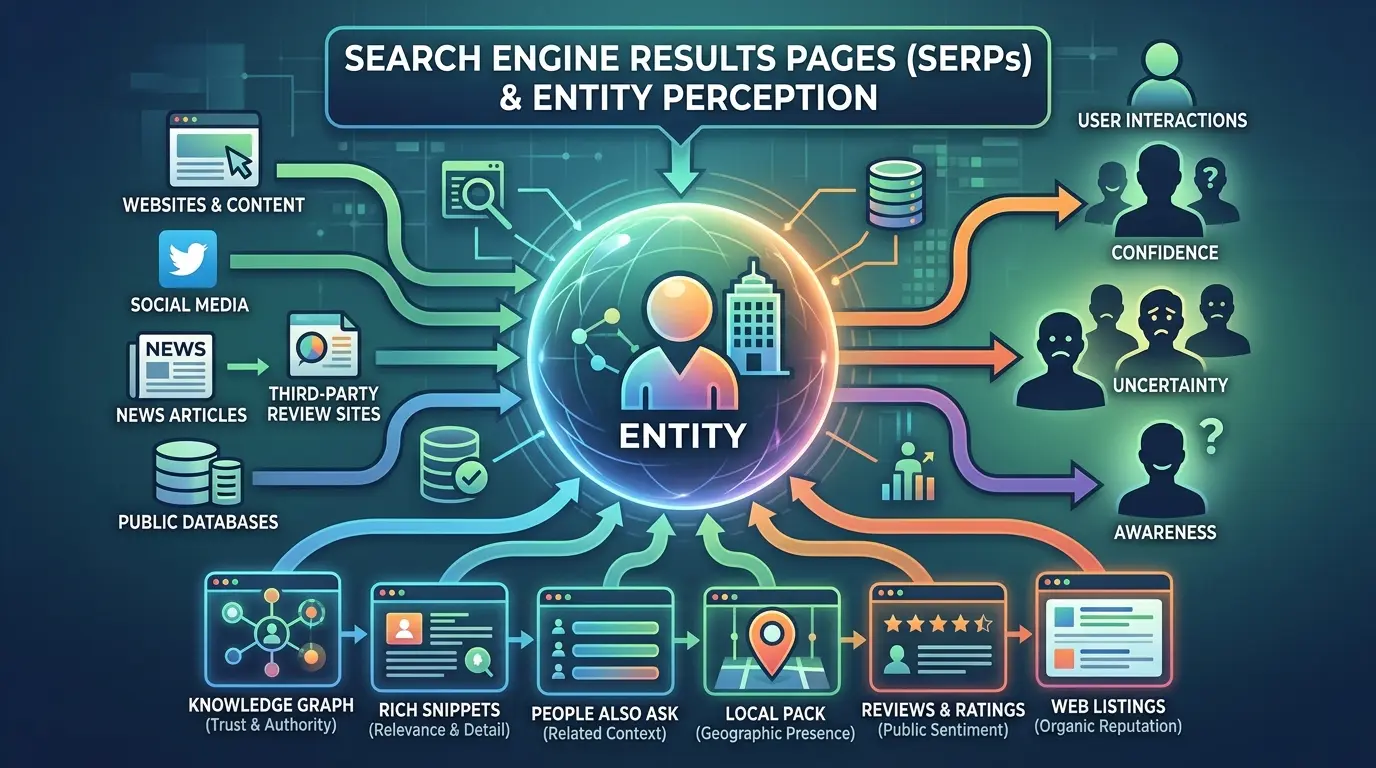
Entity perception develops through the aggregation of information associated with the same organisation. A law firm’s website, professional profiles, legal directory listings, news articles and employer reviews can all exist within that information environment. Consistency across these sources creates a clearer representation of the entity, while conflicting information introduces additional interpretive complexity. Reputation analysis therefore considers relationships between sources rather than treating search results as isolated documents.
Why Do Review Signals Matter in Reputation Evaluation?

Review signals matter because reviews provide structured and unstructured information about experiences associated with an organisation. They contain ratings, written commentary, recurring subjects and sentiment patterns that users can interpret during decision-making. Review signals therefore form part of the broader reputation layer surrounding an entity.
Sentiment interpretation involves identifying whether language expresses positive, negative or neutral attitudes towards a subject. A review containing criticism contributes a different sentiment signal from one describing positive experiences. However, sentiment alone does not establish the credibility or factual accuracy of the underlying statement. Context, specificity, source characteristics and consistency with other information remain relevant to interpretation.
Glassdoor reviews also contain subject-specific signals that distinguish them from client reviews. Employees discuss management, workload, career progression, workplace culture and internal processes, while clients generally evaluate legal service quality, communication and outcomes. These signals belong to different semantic categories. Their relevance to reputation emerges when users combine them while forming an overall perception of the same law firm entity.
How Does Negative Glassdoor Content Affect SERP Evaluation?
Negative Glassdoor content affects SERP evaluation when relevant review pages become visible for queries associated with the law firm. The content does not receive a universal negative ranking value simply because its sentiment is unfavourable. Instead, its search presence depends on relevance, indexing, authority and competition from other pages.
A branded search query creates a particular information environment because the searcher is explicitly looking for information about the named law firm. Results appearing within that environment receive greater attention than content encountered through unrelated queries. If a Glassdoor page ranks prominently for an entity-related query, its workplace commentary becomes part of the information presented to the searcher.
The perceptual effect therefore depends on visibility and interpretation. A negative review appearing deep within search results has a different practical role from a review appearing near the top of the first page. SERP evaluation provides the mechanism through which these differences in visibility occur. Human evaluation then determines how the visible information affects the searcher’s understanding of the organisation.
Can Positive Employer Reviews Strengthen a Law Firm’s Trust Signals?
Positive employer reviews can contribute to a broader reputation environment by providing additional evidence about organisational experiences. They do not independently prove client service quality, professional competence or legal outcomes. Their value comes from adding contextual information about the organisation to an already existing digital footprint.
Positive workplace feedback can introduce themes relating to professionalism, leadership, communication and organisational culture. When these themes appear consistently across credible sources, they contribute to a more complete representation of the entity. This does not transform employer reviews into client testimonials. Instead, the content provides a different category of information that users can consider alongside client-facing evidence.
Trust signals become more meaningful when their sources and subject areas are understood correctly. A client review directly addresses a client experience, while an employee review addresses an employment experience. Both can contribute to entity perception without being treated as interchangeable evidence. Semantic accuracy therefore matters when analysing how reputation information influences search-based evaluation.
Dive Deeper With Our Expert Guides:
How Class Action Attorneys Attract Coordinated Online Backlash
Why Retiring Partners Leave Reputation Gaps for New Associates
How Does the Digital Footprint Connect Employer and Client Reputation?
The digital footprint connects employer and client reputation because both forms of information can exist within the same searchable entity environment. A law firm does not have separate search identities for every audience. Search engines and users encounter information connected to the same organisational entity across multiple platforms.
This creates an information graph in which different sources describe different aspects of the same organisation. Employer review platforms describe internal experiences, while client review platforms describe external service experiences. News sources can discuss disputes or achievements, and professional directories can provide structured information about practice areas and personnel. Each source contributes a distinct semantic relationship to the broader entity.
The resulting reputation environment is therefore multidimensional. A firm can have strong client reviews while receiving criticism from employees, or it can have positive workplace commentary alongside mixed client feedback. These conditions demonstrate why reputation cannot be reduced to one rating or one platform. A complete analysis evaluates the distribution, visibility and meaning of information across the entity’s digital footprint.
What Is the Relationship Between Employer Reputation and Client Trust?
Employer reputation and client trust are related through shared entity perception rather than through direct equivalence. Employer reputation describes how an organisation is perceived as a workplace, while client trust concerns confidence in the organisation’s ability to provide a professional service. The two concepts overlap when users interpret organisational characteristics across audience boundaries.
For example, commentary about communication, management or organisational processes belongs primarily to the employment context. A prospective client can still interpret those characteristics as information about the firm’s wider organisational environment. This interpretation is a human perception process rather than a direct search-engine conclusion.
The distinction is particularly important for legal organisations because professional services depend heavily on credibility and confidence. Clients often encounter information about a firm before speaking with its representatives. Search results consequently function as an initial information layer through which organisational identity is evaluated. Aligning Your Glassdoor Employer Reviews With Client-Facing Trust involves understanding how these different reputation signals coexist within that information environment without treating them as identical evidence.
How Can Law Firms Be Analysed Through Multiple Reputation Signals?
Law firms can be analysed through multiple reputation signals by evaluating the source, subject, visibility and context of information associated with the entity. This approach prevents one review, rating or platform from being treated as a complete representation of organisational reputation. It also separates search visibility from the underlying claims contained within individual documents.
A structured reputation analysis evaluates the relationship between indexed content and branded search queries. It examines which sources appear, what subjects they address, how authoritative they are and how consistently they represent the organisation. The analysis also distinguishes sentiment from factual verification because negative language does not automatically establish an objective negative condition.
This framework creates a more accurate understanding of online credibility. Online credibility refers to the degree to which users perceive available digital information as reliable, relevant and consistent enough to support evaluation. It emerges from the interaction between source characteristics, information quality, contextual relevance and user interpretation. Reputation therefore operates as a dynamic information environment rather than a fixed numerical property.
How Should Glassdoor Reviews Be Understood Within a Law Firm’s Reputation?
Glassdoor reviews are best understood as one category of reputation information within a broader digital footprint. They provide employee perspectives that can contribute to how users interpret the organisation, but they do not independently define client service quality or professional competence. Their relevance depends on their visibility, context and relationship with other sources.
Search engines determine which indexed documents become visible for particular queries, while users interpret those documents according to their own evaluation criteria. This separation between ranking and perception is essential when analysing reputation systems. A visible review becomes part of the searcher’s information environment, but its ultimate meaning depends on how it is understood alongside other evidence.
Law firm reputation therefore operates across interconnected information layers. Glassdoor reviews represent employer sentiment, client reviews represent service experiences, and authoritative sources provide additional organisational context. Search visibility determines which elements enter the user’s immediate field of attention, while reputation signals influence how the entity is interpreted. Understanding these mechanisms provides a clearer framework for analysing why employer reviews can affect client trust without assuming that employment feedback directly measures legal service performance.
Law firm Glassdoor reviews affect client trust through the broader information environment surrounding the organisation. Reputation management is the analysis of how information, reputation signals and digital sources influence entity perception across search ecosystems. Glassdoor reviews form part of the digital footprint because they provide publicly accessible information about the firm’s employment experience. Their effect on client perception depends on indexing, search visibility, contextual relevance and human interpretation.

The key distinction is that employer reputation and client reputation are related but separate information categories. Search engines organise and rank the available content, while users interpret visible information when evaluating organisational credibility. A complete understanding of reputation therefore requires analysis of SERPs, review signals, authority, sentiment and the relationships between different sources. These mechanisms explain why workplace-related content can contribute to client trust without functioning as direct evidence of legal service quality.
Do Glassdoor reviews affect how clients perceive a law firm?
Yes. Glassdoor reviews can influence client perception because they form part of a law firm’s broader digital footprint and reputation signals. Clients can interpret employer feedback alongside client reviews, legal directories and other public information.
Why do law firm Glassdoor reviews matter for online reputation?
Glassdoor reviews matter because publicly accessible employer feedback can be indexed and displayed in search results for law firm-related queries. This makes workplace commentary part of the wider online reputation and entity perception surrounding the firm.
Can negative Glassdoor reviews affect client trust in a law firm?
Negative Glassdoor reviews can affect client trust when they become visible during branded searches and influence how users interpret the organisation. Their impact depends on search visibility, context, credibility and how the content compares with other reputation signals.
Do positive Glassdoor reviews improve a law firm’s reputation?
Positive Glassdoor reviews can contribute to a broader reputation environment by providing information about workplace culture, management and organisational practices. They do not directly prove legal service quality but can add context to the firm’s overall digital footprint.
How can law firms manage the impact of Glassdoor reviews on client trust?
Law firms can analyse Glassdoor content alongside client reviews, search results and other reputation signals to understand how employer information affects entity perception. Clear My Name focuses on the broader principles of reputation management, where search visibility, content indexing and source credibility are evaluated together.