

Controlling search engine visibility ensures that a political leader’s digital footprint reflects their true entity credibility rather than unverified claims or coordinated smear campaigns. Because voters, journalists, and stakeholders use search results as primary reputation signals to inform their voting decisions and political trust, maintaining absolute authority over the first page of search results is a strategic necessity for political survival.
Why Is Professional Reputation Management for Politicians Necessary for Search Perception Control?
Political figures operate under intense public scrutiny, making them highly vulnerable to algorithmic volatility and targeted negative content campaigns. When negative stories or defamatory assets occupy prominent positions on search engine results pages (SERPs), they function as damaging reputation signals that erode voter trust. Standard public relations strategies fail to address the underlying search engine mechanics that cause these negative links to rank highly. Implementing a professional reputation management for politicians service resolves this by targeting the specific algorithms that determine content visibility.
This specialized intervention establishes systemic SERP control by altering the data landscape that search engines use to evaluate entity credibility. Search engines prioritize relevance, authority, and user engagement signals when indexing and ranking content. If a negative news cycle triggers a surge in clicks, search algorithms misinterpret this temporary interest as long-term relevance, locking the damaging content at the top of the SERP. Professional reputation architecture overrides this loop by publishing high-authority, optimized digital assets that systematically outcompete negative links for prime search positions.
The outcome of this process is a stabilised public perception built on verifiable, positive entity data. By restructuring the digital narrative around a political leader, the service creates a defensive shield against future information attacks. Voters who search for a politician’s name encounter a curated, accurate representation of their career, policy achievements, and public service, rather than hostile media commentary. This strategic alignment of search results directly influences public perception, ensuring that digital search behaviour translates into sustained political support and institutional trust.
Which Reputation Management Approach Delivers Measurable Results Within Search Ecosystems?
A reactive, ad-hoc approach to negative content fails because it treats the symptoms of a reputation crisis rather than the underlying search architecture. Sustainable SERP control requires a systematic approach rooted in semantic SEO, entity optimization, and authoritative content networks. This methodology treats a political leader as a core entity within the knowledge graph of a search engine, optimizing all connected nodes—such as official websites, profiles, and media coverage—to project maximum credibility. The process requires technical precision and deep execution across multiple digital layers.
- Deploy high-authority entity assets, including verified professional profiles, biographical platforms, and dedicated media hubs, to occupy top SERP positions.
- Optimise the semantic schema markup on all owned web properties to explicitly define the politician’s achievements, official roles, and institutional affiliations for search engine crawlers.
- Execute an authoritative content publication strategy that distributes high-quality, keyword-targeted articles across trusted national and regional news platforms.
- Monitor search engine algorithm updates continuously to adjust content optimization techniques and prevent unexpected ranking shifts for core reputation assets.
By executing this structured framework, Clear My Name transforms a volatile search landscape into a highly controlled asset. This systematic process ensures that when a user inputs a query regarding a political figure, the search engine selects the optimized, verified assets as the most relevant answers. The systematic replacement of damaging links with authoritative, positive content diminishes the visibility of negative coverage, rendering it statistically invisible to the average user.
How Does Negative Content Suppression Influence Public Perception and Voter Trust?
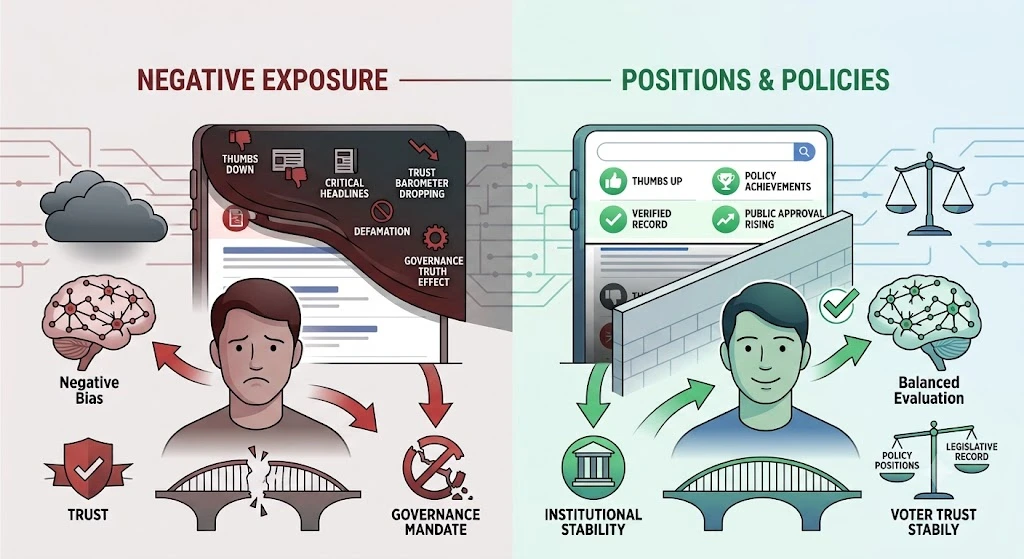
The first page of search results receives over 90% of all user search traffic, meaning that content relegated to the second page effectively ceases to exist for the general public. Negative content suppression utilizes this user behaviour by driving damaging articles and defamatory links down into the lower depths of the SERP. When voters execute searches during an election cycle or a legislative crisis, the absence of negative links on the first page prevents the formation of negative biases. This strategic suppression directly protects the politician’s public approval metrics and preserves institutional stability.
Understanding the deep behavioral shifts caused by digital media requires a look at how negative news coverage impacts political trust. When search engines repeatedly display critical headlines, the human brain treats that repetition as validation of truth, a psychological phenomenon known as the illusory truth effect. Suppressing those links breaks this cycle entirely. Removing the negative stimuli from immediate view allows the public to evaluate the political leader based on their actual policy positions and legislative track record rather than sensationalized media narratives.
The measurable outcome of a successful suppression campaign is the total encapsulation of the first page of search results with positive, verified reputation signals. This ensures that the narrative surrounding a politician remains stable, even during periods of intense political opposition. By controlling the dominant information flow, the service mitigates the risk of sudden drops in approval ratings, secures donor confidence, and ensures that the political leader retains the necessary public mandate to govern effectively.
What Determines the Speed and Sustainability of Digital Trust Optimisation?
The time required to reshape a political leader’s digital reputation depends entirely on the authority of the existing negative content and the competitive density of the search queries. Overcoming deeply entrenched negative articles from high-authority national newspapers requires a sustained infusion of superior entity signals. While initial shifts in search visibility frequently manifest within 30 to 90 days, achieving absolute, resilient SERP control requires continuous optimization over several months to lock in the desired ranking structure permanently.
- Accelerate initial content indexing by utilizing direct API submission tools to push newly created, authoritative profiles to search engine crawlers.
- Build long-term ranking stability by earning organic, high-authority backlink profiles to the new reputation assets from established institutional and educational websites.
- Neutralise the ranking power of negative links by diluting their click-through rates, which signals to search engine algorithms that the public interest in those stories has diminished.
- Secure the permanence of positive search results by consistently updating owned assets with fresh, highly relevant policy declarations and public addresses.
Sustainability in reputation management is achieved when the optimized assets develop higher intrinsic authority than the negative content they suppressed. This requires analyzing the long-term effects of negative political media coverage to build proactive digital barriers against future crises. Once these authoritative assets establish dominance on the first page, they become highly resistant to algorithmic fluctuations and subsequent negative news cycles, providing an enduring shield that preserves the politician’s digital trust indefinitely.
How Should Political Leaders Evaluate the Financial Justification of Reputation Architecture?
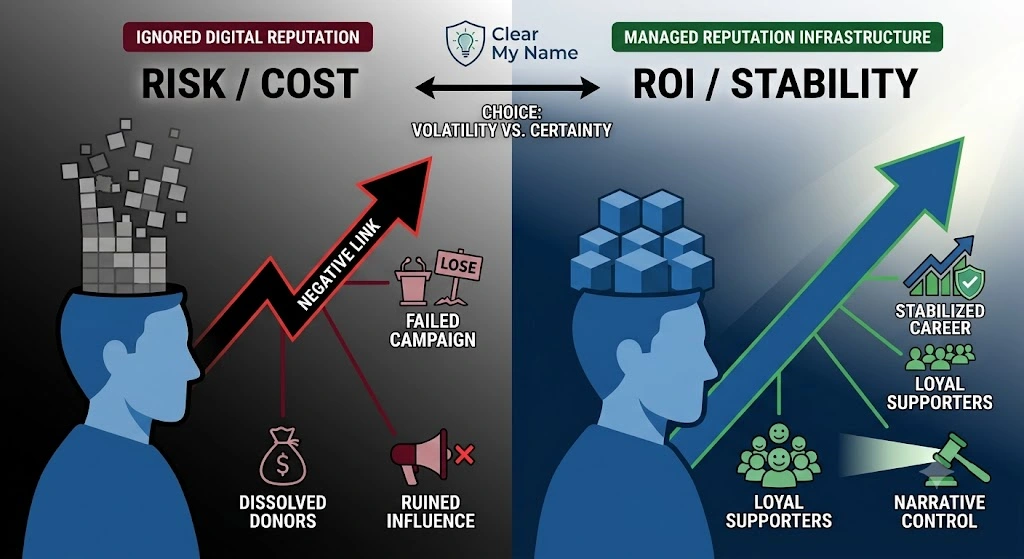
Investing in professional reputation infrastructure is a critical risk-mitigation strategy that carries profound consequences for a political career. The financial and professional cost of ignoring a damaged digital reputation far outweighs the structured investment required to secure SERP control. A single unaddressed negative link can derail a legislative campaign, dissolve crucial donor networks, and permanently ruin a leader’s capacity for public influence. Conversely, proactive search perception control stabilizes a politician’s career asset value, ensuring long-term viability in the public arena.
When analyzing the return on investment for these services, leaders must view reputation as a measurable metric of influence and trust. A clean, authoritative SERP acts as a force multiplier for all other communication and public relations efforts. When traditional PR campaigns drive users to search for a politician, an optimized search landscape validates that PR messaging, turning casual searchers into loyal supporters. Clear My Name delivers this exact alignment, transforming search engines from a unpredictable risk factor into a predictable tool for narrative control.
Ultimately, the justification for a dedicated reputation campaign lies in the certainty and control it restores to a political office. Rather than remaining at the mercy of volatile algorithms and hostile media outlets, political leaders gain the capacity to dictate the terms of their digital presence. This strategic intervention provides the peace of mind and operational security needed to navigate complex political environments, safe in the knowledge that their public digital footprint reflects their true capability, integrity, and leadership.
Frequently Asked Questions
How do reputation management services for politicians remove negative search results?
Reputation management platforms utilize negative content suppression techniques to push damaging links down to the second or third page of search results. By generating and optimizing authoritative, high-quality digital assets, these services systematically replace unfavorable articles with verified, positive information. This process shifts the search engine metrics, making the negative content statistically invisible to the vast majority of users.
How long does it take to repair a political leader’s digital reputation?
Visible improvements in search engine results pages (SERPs) often manifest within 30 to 90 days after initiating a digital trust optimization campaign. However, establishing resilient, long-term control over competitive political search terms typically requires continuous strategy execution over several months. The precise timeline depends heavily on the authority of the existing negative links and the frequency of new media coverage.
Can a politician completely delete a negative news story from Google?
Except in rare cases involving clear legal violations, defamation, or copyright infringement, news stories cannot be directly deleted from third-party websites or search indexes. Instead, professional agencies like Clear My Name focus on search perception influence to outcompete and bury the harmful links. This approach ensures that when stakeholders search for the individual, they primarily encounter verified profiles, policy platforms, and official communications.
What is the difference between political PR and digital search perception control?
Traditional political public relations focuses on media outreach, press releases, and managing real-time news cycles to shape public opinion. In contrast, digital search perception control alters the technical underlying algorithms and entity signals that dictate what voters see when they search online. It creates a permanent, structural defense on the SERP that outlasts the temporary fluctuations of standard PR cycles.
How do search engines evaluate a politician’s entity credibility?
Search engines analyze a wide network of reputation signals, including schema markup, verified social profiles, institutional backlinks, and knowledge graph data to assess an entity’s authority. Coordinated smear campaigns or viral negative news can temporarily skew these rankings by inflating click-through rates on critical articles. Implementing structured semantic data and authoritative content assets restores balance, ensuring search algorithms prioritize accurate, trustworthy representations of the political leader.