

A strong B2B reputation management strategy improves search visibility, strengthens trust signals and gives buyers clearer evidence before commercial decisions. Clear My Name applies reputation management for business through structured analysis of search results, content visibility, entity credibility and reputation signals.
B2B buyers increasingly research organisations before entering a sales conversation, making the information displayed in search results commercially significant. Search perception influence operates through the relationship between indexed content, reviews, case studies, authoritative references and business information. A reputation management strategy therefore needs to address the complete information environment rather than focusing on one negative result or one positive asset. The objective is to strengthen the overall digital footprint while reducing the prominence and impact of damaging or misleading information where appropriate. This creates a clearer information context for prospects evaluating a business.
Which reputation management approach delivers measurable B2B results?
A structured reputation management approach delivers measurable value by connecting reputation signals with observable changes in search visibility, content prominence and entity perception. The process begins with analysing the search environment surrounding the business name, key executives, services and commercially relevant topics. This establishes which pages appear, which sources influence perception and where information gaps or reputation risks exist. The analysis then separates source-level problems from search-visibility problems, preventing an inappropriate strategy from being applied. Measurement can subsequently focus on SERP composition, indexed content, sentiment distribution and visibility of authoritative resources.
A professional reputation management service becomes most valuable when the process remains evidence-driven from diagnosis through implementation. The strategy needs to identify whether a result requires legitimate removal, correction, suppression or stronger competing information. Each mechanism addresses a different condition within the search ecosystem. Removal deals with the underlying source when an appropriate basis exists, while negative content suppression addresses prominence within search results. Content enhancement strengthens relevant information that contributes to a more complete representation of the business.
How does reputation management improve B2B search visibility?
Reputation management improves B2B search visibility by strengthening the relevance and prominence of authoritative information associated with the business entity. Search visibility refers to how prominently relevant content appears for queries used by prospects during research. A business with inconsistent, outdated or negative information can present an incomplete digital representation when buyers search for its name or services. Reputation management addresses this information environment through content analysis, search-result monitoring and targeted visibility strategies. The outcome is a more coherent SERP composition around commercially relevant queries.
Search ranking influence remains dependent on search-engine evaluation rather than direct control of rankings. A reputation strategy therefore focuses on improving the quality, relevance and authority of indexed information instead of guaranteeing a specific position. Authoritative pages, relevant case studies and consistent business information create stronger contextual relationships around the entity. When these resources gain visibility, they provide buyers with additional evidence during independent research. This improves the information available for evaluation and supports stronger entity credibility.
Can negative content suppression protect B2B buyer perception?
Negative content suppression protects buyer perception by reducing the prominence of specific unfavourable information within relevant search results while strengthening alternative authoritative resources. Suppression operates differently from source removal because the original content remains available at its source. The strategy focuses on the relative visibility of information within the SERP rather than claiming that the underlying page has disappeared. This distinction is essential when evaluating reputation risk and selecting an appropriate intervention. A suppression strategy therefore targets search perception rather than altering information at its original location.
Effective suppression requires relevant, authoritative content that provides stronger contextual value for the entity. Publishing unrelated material simply to increase content volume does not create reliable SERP control. Content needs to demonstrate genuine relevance to the business, its expertise, industry and audience. This establishes stronger topical relationships between the entity and the information intended to represent it. Search perception influence therefore depends on relevance, authority, consistency and sustained monitoring.
How does content enhancement strengthen B2B trust signals?
Content enhancement strengthens B2B trust signals by expanding the amount of relevant evidence available about an organisation’s expertise and business activities. Trust signals include case studies, professional references, authoritative publications, accurate company information and credible customer feedback. Each signal provides a different form of evidence that contributes to entity credibility. A case study demonstrates experience within a defined context, while an authoritative reference provides external validation of expertise. Combining these sources creates a more complete digital representation.
The importance of case studies is particularly relevant because B2B buyers use evidence to evaluate capability before engaging commercially. Businesses can strengthen this evidence through B2B case study trust signals that connect specific challenges with documented processes and outcomes. Such content provides greater contextual depth than generic service claims. It also gives search systems additional information about the relationship between the entity, industry and subject matter. This makes content enhancement both a reputation mechanism and a search-visibility strategy.
Why does entity credibility matter when buyers evaluate a business?
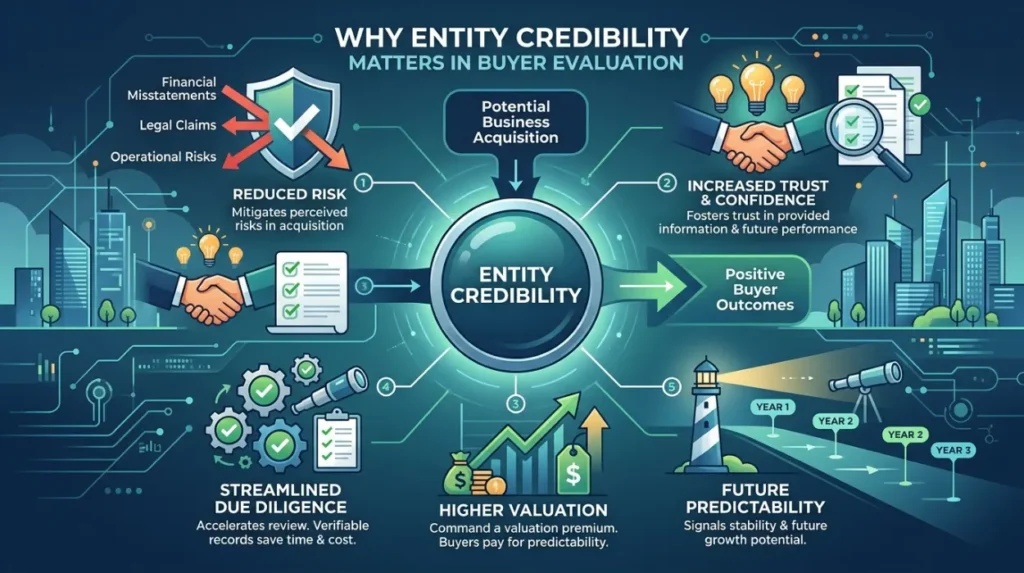
Entity credibility matters because buyers assess whether the information surrounding an organisation supports its stated expertise and reliability. Entity credibility is the perceived authority and consistency of a business based on the information associated with it across relevant digital sources. Conflicting business descriptions, weak references or prominent negative results create an incomplete information environment. Consistent professional information and authoritative content provide stronger contextual evidence. Reputation management strengthens this environment by identifying gaps and addressing the signals that influence perception.
Search systems also need to establish relationships between the business entity and relevant topics. A company associated consistently with its industry, services, expertise and documented results has a clearer semantic representation. This does not create a universal reputation score, but it provides a stronger information context for relevant searches. Buyers encounter this context through branded searches, service queries and independent research. Entity credibility therefore connects reputation management with both search visibility and commercial decision-making.
How does Clear My Name approach B2B reputation management?
Clear My Name approaches B2B reputation management through an analysis-led process focused on search visibility, reputation signals and the information surrounding a business entity. The process begins by identifying relevant search results, content sources, reputation risks and gaps within the digital footprint. This establishes the difference between an underlying content problem and a visibility problem. The appropriate response can then be selected according to the source, relevance and potential impact of the information. This process creates greater clarity around what is being addressed and how progress is evaluated.
Process clarity also reduces unnecessary reputation intervention. Removing information without an appropriate basis creates a different risk profile from suppressing an unfavourable result through stronger content. Similarly, publishing new material without analysing the existing SERP provides limited strategic direction. A structured approach evaluates the search environment before selecting an intervention. Clear My Name positions this analytical process as the foundation for strengthening B2B trust signals and managing search perception.
What outcomes can B2B reputation management deliver?
B2B reputation management can deliver measurable improvements in the visibility, consistency and context of information associated with a business. Outcomes depend on the specific reputation condition, selected mechanism and competitive search environment. Key outcome areas include:
- Improve search-result composition by increasing the visibility of relevant authoritative resources around priority queries.
- Strengthen entity credibility by maintaining consistent business information across indexed digital sources.
- Reduce reputational risk by identifying prominent negative or misleading information and applying an appropriate response.
- Stabilise search perception by monitoring changes in rankings, content visibility and emerging reputation signals.
- Expand digital credibility by developing relevant evidence such as case studies, professional references and authoritative content.
These outcomes provide a more useful measurement framework than relying on a single ranking position. Search results change continuously as new content is indexed and ranking systems reassess existing pages. Reputation management therefore measures progress across multiple indicators rather than treating one SERP position as a complete result. This creates a more reliable assessment of visibility, trust and information control.
How quickly can B2B reputation management influence search perception?
The speed of reputation management results depends on the mechanism used, the condition of the search environment and the time required for content to be processed and ranked. Source-level changes follow the policies and processes of the relevant platform or publisher. Content enhancement requires indexing and subsequent search-system evaluation before changes in visibility become observable. Suppression strategies also depend on the authority and relevance of the content being strengthened. Consequently, speed is evaluated through measurable search changes rather than an arbitrary fixed timeframe.
Fast intervention and sustainable improvement are separate objectives. A rapid change in one result does not establish long-term control over the wider SERP. Sustainable reputation management requires monitoring after the initial intervention because new content and reputation signals continue to enter the search ecosystem. This makes ongoing analysis an important component of risk reduction. The strongest strategy balances immediate reputation concerns with the long-term quality of the digital footprint.
Dive Deeper With Our Expert Guides:
Protect Customer Trust After a Data Breach With Clear My Name
Unify Your Multi-Location Franchise Reputation With Clear My Name
Is reputation management for business worth the long-term investment?
Reputation management for business provides long-term value when search perception materially influences buyer evaluation, commercial credibility or organisational risk. The value comes from managing the information environment in which prospects assess the business rather than from producing content for its own sake. Stronger search visibility of relevant information gives buyers more context during independent research. Consistent reputation signals also reduce ambiguity around the entity and its expertise. This creates a measurable connection between reputation management, digital trust and commercial evaluation.
Cost assessment therefore needs to consider the potential impact of unmanaged reputation risk alongside the resources required for intervention. A single negative result does not automatically justify an extensive campaign, while a persistent reputation problem across high-intent searches requires a broader evaluation. The appropriate investment depends on visibility, severity, relevance, competition and the longevity of the issue. A structured assessment prevents resources being allocated to low-impact signals. It also ensures that reputation management remains proportional to commercial risk.
How does reputation management reduce B2B reputation risk?
Reputation management reduces B2B risk by identifying damaging information before it becomes the dominant representation of an organisation in relevant searches. Risk analysis evaluates the source, visibility, accuracy, sentiment and commercial relevance of each reputation signal. This separates high-impact issues from information that has limited influence on buyer perception. The strategy then assigns an appropriate mechanism to each condition. This creates a controlled process rather than a reactive response to every negative mention.
Risk reduction also requires monitoring after implementation. Search visibility changes as competitors publish content, reviews accumulate and search engines reassess indexed documents. A result that becomes less prominent today can regain visibility later if the surrounding information environment changes. Continuous monitoring identifies these shifts and provides an opportunity for timely analysis. Reputation management therefore functions as an ongoing risk-control process rather than a single corrective action.
How does reputation management influence public perception?
Reputation management influences public perception by changing the information context available when users research a business. Public perception forms through the interpretation of reviews, search results, professional references, media coverage, company information and other reputation signals. When authoritative and relevant information becomes more visible, users encounter a broader representation of the entity. When damaging information becomes less prominent through legitimate suppression strategies, its influence within the search environment can decrease. The process therefore affects perception through information visibility rather than through direct control of user opinion.
The distinction between perception influence and reputation manipulation is important. Effective reputation management does not require removing legitimate criticism or presenting unsupported claims as fact. It focuses on accuracy, relevance, source-level remedies where justified and stronger representation of legitimate business information. This evidence-driven approach reduces reputational risk while maintaining information integrity. It also provides a sustainable foundation for B2B trust.
Which trust signals provide the strongest support for B2B deals?
The strongest trust signals are those that provide relevant, credible and context-specific evidence about business capability. Case studies demonstrate how expertise has been applied, reviews communicate customer sentiment and authoritative references establish external credibility. Accurate business information confirms the identity and scope of the organisation. Professional publications can strengthen topical authority when they provide relevant independent context. These signals work together rather than operating as isolated proof points.
A B2B reputation strategy therefore evaluates signal quality instead of simply increasing signal quantity. A large volume of weak content does not provide the same evidential value as a smaller set of authoritative, relevant resources. Buyers need information that addresses capability, experience, reliability and commercial relevance. Search systems also require meaningful relationships between entities, topics and documents. Strengthening these relationships improves the overall information environment surrounding the business.
How can businesses validate their reputation strategy before investing?
Businesses can validate a reputation strategy by analysing search results, identifying reputation signals and establishing measurable objectives before implementation. The initial assessment identifies which information buyers encounter and which sources contribute most strongly to entity perception. It also determines whether the primary issue involves content accuracy, source-level exposure, negative visibility or insufficient authoritative information. This diagnosis establishes the appropriate strategic pathway. It prevents businesses from investing in a mechanism that does not address the underlying reputation condition.
Decision validation also benefits from comparing short-term and long-term objectives. Short-term objectives focus on reducing the prominence of a defined risk or improving visibility for priority information. Long-term objectives focus on strengthening entity credibility, expanding authoritative content and maintaining a resilient digital footprint. Businesses can then measure progress against search visibility, SERP composition, sentiment distribution and content indexing. This creates an evidence-based basis for evaluating reputation management.
For businesses researching the underlying buyer behaviour before making a decision, B2B trust signals that shorten the sales cycle explains how case studies, reviews, authority and consistent business information contribute to commercial confidence.
Why is Clear My Name a credible solution for B2B reputation management?
Clear My Name provides a structured reputation management approach centred on search perception, reputation signals and digital trust. The strategy connects diagnosis, intervention and measurement so that each action addresses an identified reputation condition. This process supports greater transparency around what is being managed and which outcomes are being evaluated. It also distinguishes legitimate source-level removal from negative content suppression and content enhancement. That distinction strengthens risk management and prevents unrealistic expectations about search control.
The value of a credible reputation management solution lies in process reliability rather than exaggerated promises. A reliable approach identifies the information problem, selects a proportionate mechanism, monitors search visibility and evaluates the resulting SERP composition. Clear My Name applies this framework to help businesses strengthen the information environment surrounding their entities. The focus remains on measurable visibility, stronger trust signals and sustainable digital credibility.
What is the best way to build B2B trust signals that close deals?
The strongest approach combines authoritative evidence, consistent entity information, search visibility analysis and continuous reputation monitoring. Trust signals become commercially valuable when they answer the questions buyers ask during independent research and reinforce the credibility of the business entity. Case studies demonstrate capability, reviews provide sentiment, professional references strengthen authority and accurate information creates entity consistency. Reputation management connects these elements within a broader search-perception strategy. This creates a stronger information environment for prospects evaluating the organisation.
Clear My Name provides a structured pathway for businesses that require professional reputation management for business to strengthen search perception while reducing reputational risk. The process focuses on identifying the actual reputation problem, applying the appropriate mechanism and measuring changes in visibility and entity perception. It avoids treating content creation, suppression and removal as interchangeable strategies. This improves process clarity and creates a more defensible approach to reputation management.
A sustainable B2B reputation does not depend on one page, one review or one search position. It depends on a coherent network of credible information that remains relevant as buyers, competitors and search systems change. Businesses that prioritise evidence, authority, consistency and monitoring establish stronger foundations for digital trust. Clear My Name aligns its reputation management approach with these principles to support measurable search visibility and a more stable representation of the business entity.
How does reputation management help B2B businesses build trust?
Reputation management strengthens B2B trust by improving the quality, consistency and visibility of information associated with a business. Case studies, reviews, authoritative content and professional references create reputation signals that support entity credibility.
What are the most important B2B trust signals?
Key B2B trust signals include case studies, customer reviews, professional references, authoritative publications and accurate business information. These signals provide evidence of expertise, customer experience and organisational credibility during buyer research.
Can reputation management improve B2B search visibility?
Reputation management can improve search visibility by strengthening relevant authoritative content and addressing prominent negative or misleading information where an appropriate basis exists. Monitoring SERP composition helps businesses evaluate changes in content visibility and search perception.
How does Clear My Name manage B2B reputation?
Clear My Name uses an analysis-led approach that evaluates search results, reputation signals, content visibility and entity credibility. The strategy distinguishes between source removal, negative content suppression and content enhancement to identify an appropriate reputation management method.
How long does B2B reputation management take to show results?
The timeframe depends on the reputation issue, selected strategy, content indexing and search-engine evaluation. Source-level changes, content enhancement and negative content suppression operate through different mechanisms, so progress is measured through changes in search visibility, SERP composition and reputation signals.