
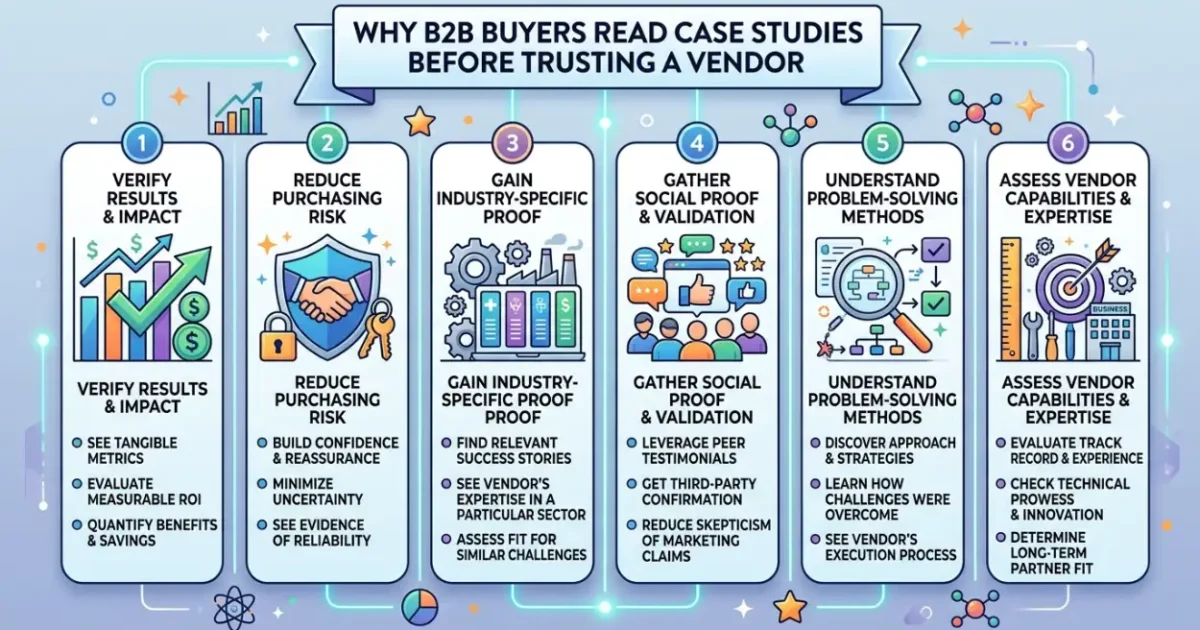
B2B buyers read case studies because they provide evidence of how a vendor applies its expertise to defined business problems and measurable outcomes. Reputation management is the process of monitoring and shaping the information that influences how an organisation is understood across digital environments.
Online reputation refers to the collection of indexed content, reviews, professional references, case studies and other reputation signals associated with a business entity. Case studies occupy a distinct position within this ecosystem because they connect claims about capability with documented information about processes, outcomes and business contexts. Their value therefore extends beyond marketing content into the wider construction of online credibility.
Why do B2B buyers use case studies as trust signals?
Case studies function as trust signals because they provide contextual evidence about a vendor’s capabilities, processes and reported outcomes. A trust signal is information that helps users evaluate whether an entity appears credible, reliable and relevant to a particular requirement. Case studies provide this context by connecting a vendor with a defined problem, an approach and an outcome. Their structure gives buyers more information than a general service description because it demonstrates how expertise is applied. This makes case studies an important component of B2B reputation.
The strength of a case study depends on the quality and specificity of the information it contains. Detailed descriptions of the business context, methodology and measurable outcomes provide stronger evidence than broad statements about performance. Specificity also gives search systems additional semantic information about the entities, topics and relationships represented on the page. Content indexing therefore allows case studies to contribute to both user evaluation and search visibility. Their influence arises from the interaction between informational depth and perceived credibility.
How do case studies influence B2B buyer trust?
Case studies influence B2B buyer trust by reducing uncertainty around a vendor’s claimed expertise. B2B purchasing involves evaluating whether a supplier can address a defined commercial requirement, making evidence of previous work relevant to that assessment. A case study provides structured information about the problem addressed, the actions taken and the reported result. This creates a relationship between capability claims and supporting evidence. Buyer trust therefore develops through contextual information rather than through promotional language alone.
The information structure also affects how buyers interpret credibility. A case study containing identifiable objectives, defined processes and measurable outcomes provides a clearer basis for evaluation. Vague descriptions provide less information for assessing the relationship between activity and result. This distinction applies to both human readers and search systems because precise content creates stronger topical associations. Case studies consequently operate as both decision-support documents and reputation signals within a broader digital footprint.
How do search engines interpret case studies as reputation signals?
Search engines interpret case studies through their content, entities, topics, relationships and relevance to search queries. A case study identifies a vendor entity and connects it with specific services, industries, problems, processes and outcomes. These relationships provide contextual information that contributes to entity perception within search ecosystems. Search engines evaluate indexed content according to relevance and other ranking considerations rather than assigning a universal trust score to a case study. Its reputation value therefore emerges from its relationship with the wider information environment.
Content indexing determines whether a case study becomes available within the searchable information ecosystem. Once indexed, its terminology and subject relationships contribute to the semantic representation surrounding the vendor. For example, a case study focused on supply-chain software connects the vendor with supply-chain terminology, business challenges and relevant solutions. This creates a more specific entity context than a generic page describing software expertise. Case studies therefore contribute to search visibility by expanding the information relationships associated with an entity.

How does case study content affect search visibility?
Case study content affects search visibility by creating additional relevant documents that connect a vendor with specific commercial topics and search intents. Search visibility describes how prominently and frequently an entity or its content appears for relevant queries. A case study can target informational relationships around industries, challenges, services and outcomes without relying solely on broad commercial keywords. This expands the semantic coverage of the vendor’s digital footprint. Search ranking dynamics then determine whether and where those documents appear for relevant searches.
The depth of the content also influences its informational value. A case study that explains the original challenge, decision process, implementation and measurable outcome provides a wider semantic field than a short promotional paragraph. This gives the document greater contextual relevance to searches involving the problem and its associated solution. Search visibility remains dependent on broader ranking systems, but richer information creates more opportunities for meaningful query relationships. Case studies therefore support reputation through both evidence and topical coverage.
Why are measurable outcomes important in B2B case studies?

Measurable outcomes are important because they provide observable evidence for evaluating the relationship between an intervention and its reported result. An outcome is a defined change associated with the work described in a case study, such as improved efficiency, reduced processing time or increased operational capacity. Quantifiable information gives buyers a clearer basis for assessing the significance of the reported work. It also creates stronger informational relationships between the vendor, its methodology and the business problem addressed. This increases the evidential value of the case study.
Measurement also affects the credibility of the surrounding content. A statement that a process was successful provides limited information without explaining what success represents. A defined metric establishes a reference point against which the outcome can be understood. Search systems can also identify terminology associated with the problem, process and result, increasing the document’s semantic specificity. Measurable outcomes therefore support both human evaluation and structured interpretation of content.
How does specificity strengthen B2B vendor credibility?
Specificity strengthens B2B vendor credibility by providing information that allows buyers to evaluate expertise within a defined context. Credibility is the perceived reliability and competence of an entity based on available information and supporting signals. A specific case study identifies the business challenge, relevant processes, technical or operational considerations and resulting outcomes. These details establish stronger relationships between the vendor and the subject area. Generic claims lack the same informational structure because they provide fewer verifiable relationships.
Specificity also supports entity perception by reducing ambiguity around what a vendor actually does. A business described only as an expert in a broad category has limited contextual definition. A business associated with defined industries, problems, technologies and measurable outcomes has a more detailed digital representation. Search systems can use these relationships when interpreting indexed content and matching it with relevant queries. B2B buyers also gain a clearer basis for evaluating whether the vendor’s experience relates to their requirements.
How do case studies compare with reviews as trust signals?
Case studies and reviews function as different types of reputation signals because they provide different forms of evidence. Reviews primarily represent external evaluations or experiences associated with a business, while case studies present structured accounts of work and outcomes associated with the vendor. Reviews contribute sentiment signals, including positive, negative or neutral language. Case studies contribute contextual and capability signals by explaining what was done and what resulted. Neither replaces the other because they operate through different information mechanisms.
Review signals are particularly relevant to sentiment distribution and public perception. Repeated language across reviews can create identifiable themes surrounding customer experience, responsiveness or service quality. Case studies provide greater control over the depth and structure of information presented about specific projects. Their limitation is that they represent information published by the vendor or with its participation, while reviews generally provide an external perspective. A comprehensive reputation ecosystem therefore contains different signal types serving different evaluative functions.
Dive Deeper With Our Expert Guides:
How a Data Breach Announcement Damages Customer Confidence
Why Franchise Businesses Struggle to Control a Unified Reputation
How do authority and trust signals work together in B2B reputation?
Authority and trust signals work together by establishing both subject relevance and perceived reliability within the digital information ecosystem. Authority refers to the strength and relevance of a source or entity within a defined subject area. Trust signals provide information that supports confidence in the accuracy, reliability or credibility of that entity. A case study contributes contextual authority when it demonstrates expertise within a specific commercial subject. Supporting references and consistent information strengthen the broader trust environment.
The relationship between authority and trust is important because expertise alone does not establish complete credibility. A vendor can demonstrate subject knowledge while still presenting inconsistent information across its digital footprint. Likewise, consistent information without evidence of subject expertise provides limited authority. Search ecosystems interpret relationships between content, entities and sources, making consistency an important component of entity perception. Case studies contribute to this structure when their claims align with other credible and relevant information.
How does a digital footprint affect B2B buyer confidence?
A digital footprint affects B2B buyer confidence by determining the quantity, consistency and context of information available about a vendor. A digital footprint is the collection of online information associated with an entity, including websites, case studies, reviews, professional profiles, publications and third-party references. Buyers use this information to form an understanding of expertise, credibility and relevance. Search engines also use indexed information to establish relationships between entities and topics. The digital footprint therefore influences both discoverability and perception.
Consistency is particularly important within this environment. Conflicting descriptions of services, industries or capabilities create ambiguity about the entity. Consistent case studies, professional information and external references create stronger associations between the vendor and its areas of expertise. This does not create a single reputation score, but it establishes a clearer information environment for evaluation. Digital footprint quality therefore contributes to B2B trust through information coherence.
Why do B2B buyers examine evidence before contacting a vendor?
B2B buyers examine evidence because purchasing decisions involve assessing commercial risk, capability and relevance before direct engagement. Case studies provide evidence that connects a vendor’s stated expertise with defined business circumstances. This allows buyers to evaluate whether the vendor has addressed problems related to their own requirements. The information also reduces the gap between a broad service claim and an observable example of application. Evidence therefore performs a decision-support function within the consideration process.
The search environment reinforces this behaviour because buyers can compare multiple sources before contacting a vendor. Search results can include service pages, case studies, reviews, professional profiles and third-party references. Each source contributes a different reputation signal and creates part of the entity’s overall digital representation. Case studies add depth to this environment by explaining processes and outcomes rather than simply describing capabilities. Their role is therefore closely connected to information validation.
How do case studies contribute to entity perception?
Case studies contribute to entity perception by associating a business with specific expertise, industries, challenges and outcomes. Entity perception refers to how a search system or user understands an organisation based on the available information connected to it. Each case study adds relationships between the vendor entity and the subjects represented in the document. Repeated, consistent relationships strengthen the semantic definition of the business. This makes case studies relevant to both reputation analysis and search visibility.
Entity perception is not determined by one document. Search engines evaluate information across a wider ecosystem containing multiple sources and content types. A case study therefore functions as one reputation signal within a larger network of professional information. Its impact depends on relevance, quality, consistency and relationships with other indexed sources. This explains why a strong digital footprint requires more than isolated pieces of content.
What makes a B2B case study credible?
A credible B2B case study contains specific information about the business context, problem, methodology and reported outcome. It establishes a clear relationship between the challenge and the actions taken to address it. Evidence-based details provide buyers with a basis for evaluating the relevance of the experience. Clear terminology also improves the document’s semantic relationship with the industry and subject area. Credibility therefore depends on informational substance rather than promotional intensity.
A useful case study also maintains consistency with the vendor’s wider digital footprint. The company identity, services, expertise and project information need to align with other credible sources. Contradictory information weakens entity clarity and creates uncertainty during evaluation. Consistent information supports both user confidence and search-system interpretation. Case study credibility is therefore connected to the broader reputation ecosystem.
How can B2B trust signals shorten the sales cycle?
B2B trust signals can shorten the sales cycle by providing evidence that addresses common questions before direct sales interaction. Trust signals include reviews, case studies, professional references, authoritative publications and consistent company information. When these sources provide relevant evidence, buyers receive more information during their independent research phase. This reduces the informational gap between initial discovery and commercial evaluation. The result is a more informed decision process.
The effectiveness of these signals depends on relevance rather than volume. A case study addressing the same industry challenge as the buyer provides stronger contextual value than an unrelated example. Reviews that discuss relevant service characteristics also provide more useful sentiment information. Together, these signals create a layered reputation environment that supports evaluation. Understanding How to Build B2B Trust Signals That Shorten the Sales Cycle therefore requires analysing how different evidence types interact within the buyer’s research journey.
What is the relationship between case studies and online credibility?
Case studies contribute to online credibility by providing structured evidence that connects a vendor with specific business outcomes and areas of expertise. Online credibility refers to the perceived reliability and competence of an entity based on the information available across digital sources. Case studies strengthen this information environment by adding depth to service descriptions and professional claims. Their value increases when the information is specific, consistent and relevant to the subject being evaluated. This makes case studies an important component of B2B reputation.
The broader principle is that credibility develops through interconnected reputation signals rather than through one content format. Reviews provide sentiment, professional references provide authority, and case studies provide contextual evidence of capability. Search engines interpret these signals within the wider digital footprint, while buyers use them to assess commercial confidence. The combination creates a more complete representation of the entity. Case studies therefore support online reputation by connecting claims with structured evidence.
What should B2B buyers look for when evaluating case studies?
B2B buyers can evaluate case studies by examining the specificity of the business problem, clarity of the methodology and evidence supporting the reported outcome. These factors indicate whether the document provides meaningful information for comparing vendor capability. Buyers can also examine whether the case study relates directly to their industry, business model or operational requirement. Relevant context increases the usefulness of the evidence because it establishes a closer relationship between the documented work and the buyer’s own requirements. This creates a stronger basis for trust evaluation.
Buyers can also assess whether the case study aligns with the vendor’s wider digital footprint. Consistent information across professional profiles, reviews, publications and other authoritative sources provides stronger entity context. Contradictions require additional scrutiny because they weaken information consistency. This process demonstrates why case studies function as part of a broader reputation system rather than as isolated sales documents. Their greatest value comes from how effectively they connect evidence, context and credibility.
What do case studies reveal about B2B reputation?
Case studies reveal how a vendor represents its expertise, business relationships and reported outcomes within the digital information ecosystem. They provide structured evidence that connects a business entity with defined challenges, processes and results. This information contributes to reputation signals by adding context to broader claims about capability. Search engines can interpret these relationships through content indexing and semantic relevance, while buyers use them to evaluate credibility. Case studies therefore occupy an important position between content, reputation and decision-making.
The wider lesson is that B2B reputation depends on evidence, context and consistency. Case studies do not function as independent proof of every capability, but they provide valuable information for evaluating specific areas of expertise. Reviews, professional references and authoritative sources add complementary signals that strengthen or challenge the broader entity representation. Search visibility determines which of these signals users encounter during research. A coherent digital footprint therefore provides the strongest foundation for informed B2B evaluation.
What is the main role of case studies in B2B trust?
The main role of case studies is to provide contextual evidence that helps buyers evaluate whether a vendor’s claimed expertise connects with documented business outcomes. Reputation management is concerned with how these evidence sources contribute to the wider perception of an entity across search ecosystems. Case studies strengthen the information environment by explaining problems, processes and outcomes in a structured format. Their contribution to search visibility comes through relevant content indexing and semantic relationships rather than direct control of rankings. Their contribution to trust comes through specificity, consistency and evidence.
For B2B buyers, the distinction between a claim and supporting information is central to trust evaluation. A service description explains what a vendor offers, while a case study explains how that capability has been applied within a defined context. Reviews, professional references and other reputation signals then provide additional perspectives on the entity. Together, these information sources shape search perception and online credibility. Case studies therefore matter because they transform abstract capability claims into structured evidence that buyers can analyse.
Why do B2B buyers read case studies before choosing a vendor?
B2B buyers read case studies because they provide evidence of a vendor’s expertise, processes and reported business outcomes. They help buyers assess credibility and relevance before entering direct commercial discussions.
How do case studies build trust in B2B businesses?
Case studies build trust by connecting a vendor’s capabilities with defined business challenges, actions and measurable outcomes. This creates contextual trust signals that support online credibility and informed buyer evaluation.
Do case studies improve a company’s online reputation?
Case studies can strengthen online reputation by adding authoritative, relevant information to a company’s digital footprint. They contribute to reputation signals by demonstrating expertise and creating clearer associations between the business entity and its areas of capability.
What makes a B2B case study credible?
A credible B2B case study provides specific information about the business problem, methodology, relevant context and reported outcomes. Clear evidence and consistency with other authoritative sources strengthen its value as a trust and reputation signal.
How do case studies affect B2B search visibility?
Case studies can expand search visibility by creating indexed content connected to specific industries, services, challenges and outcomes. Their semantic relevance helps search engines understand the relationships between a business entity and the topics associated with its expertise.