

B2B trust signals shorten the sales cycle by providing credible evidence that helps buyers evaluate a vendor before direct commercial engagement. Reputation management strategies differ based on how businesses create, strengthen, monitor and control the information that shapes entity credibility across search ecosystems.
Online reputation control methods are evaluated through search visibility, source authority, content relevance, sentiment distribution and consistency of information. Trust signals include case studies, reviews, professional references, authoritative publications and accurate business information. Each signal contributes differently to buyer perception and search-system interpretation. The effectiveness of a trust strategy therefore depends on how these signals interact rather than on the volume of content produced. A structured approach connects reputation signals with the information needs of B2B buyers.
Which B2B trust signals provide the strongest evidence of credibility?
Case studies, reviews, authoritative references and consistent business information provide distinct forms of credibility evidence. A trust signal is information that helps an audience evaluate the reliability, relevance or capability of an entity. Case studies demonstrate how a vendor applies expertise to defined problems, while reviews provide sentiment based on customer experiences. Professional references and authoritative publications provide additional evidence about expertise and entity legitimacy. Comparing these signals requires assessing the type of evidence each one provides rather than treating them as interchangeable.
Case studies provide contextual evidence because they connect a business with specific challenges, processes and reported outcomes. Reviews provide external sentiment signals that reveal recurring perceptions around service quality or customer experience. Authoritative references provide stronger contextual support when reputable sources associate the business with relevant expertise. Consistent company information reinforces entity clarity across digital sources. Together, these signals create a broader reputation structure that supports buyer evaluation and search perception.
How do case studies compare with reviews as B2B trust signals?
Case studies provide structured evidence of capability, while reviews primarily provide external sentiment and experience-based signals. A case study operates by explaining a business problem, the approach applied and the reported outcome. A review operates by expressing an evaluation of an interaction, product or service. Case studies therefore offer greater contextual depth, while reviews provide a more direct indication of customer sentiment. The two formats serve different functions within a B2B reputation ecosystem.
Reviews are particularly relevant when buyers evaluate customer experience and service reliability. Consistent positive or negative themes across reviews create sentiment distribution that contributes to public perception. Case studies provide greater control over the amount of technical and commercial context presented. Their limitation is that they are generally produced or approved by the vendor, while reviews provide an external perspective. A balanced trust strategy therefore evaluates both evidence-based capability signals and independent sentiment signals.
Does content creation provide better results than content removal for B2B reputation?
Content creation and content removal address different reputation conditions, making their effectiveness dependent on the underlying information problem. Content creation operates by introducing relevant, authoritative information that expands the entity’s digital footprint. Content removal operates by addressing information at its original source when an appropriate removal basis exists. Creation therefore influences the surrounding information environment, while removal directly addresses the source of a reputation signal. Comparing them without first identifying the problem produces an inaccurate evaluation.
Content creation is more closely associated with content enhancement and search visibility because new information enters the index and competes within relevant SERPs. Content removal provides a more direct mechanism when inaccurate, outdated or otherwise eligible information can legitimately be removed. Removal is limited by the availability of an appropriate legal, editorial or platform-based basis. Content enhancement does not remove the original information, but it can strengthen alternative authoritative resources. The distinction between these approaches is essential when evaluating reputation management for business.

How do organic and reactive trust-building strategies compare?
Organic trust-building develops reputation signals continuously, while reactive strategies respond to identified reputation issues. An organic approach operates by consistently building authoritative content, professional references, reviews and accurate entity information. A reactive approach operates by monitoring search results and intervening when a negative or misleading reputation signal becomes prominent. Organic development creates a broader information foundation, while reactive management provides targeted responses to specific conditions. Their effectiveness therefore depends on timing, risk exposure and the existing digital footprint.
Organic strategies provide stronger continuity because reputation signals accumulate over time and establish broader topical associations. Reactive strategies provide greater operational focus because resources are directed towards a defined search or reputation problem. However, a reactive approach can become resource-intensive when reputation issues repeatedly emerge without a strong underlying information structure. Organic development also requires consistent quality and relevance rather than simply increasing content volume. Comparing the approaches therefore requires assessing both immediate response capability and long-term resilience.
Which short-term trust signals influence buyer decisions fastest?

Reviews, recognisable professional references and clear business information provide immediate contextual signals during early buyer research. Short-term trust signals are information sources that help buyers evaluate credibility without requiring extensive interaction with the vendor. Reviews can quickly communicate customer sentiment, while professional references establish associations with relevant expertise. Clear business information reduces ambiguity around the organisation’s identity and services. These signals can therefore support initial confidence during independent research.
Short-term visibility does not necessarily indicate long-term reputation strength. A prominent review or publication can influence a buyer’s perception during a specific search, but search results change as content is indexed and ranking systems reassess documents. Long-term trust requires a broader information ecosystem containing consistent and authoritative signals. Short-term interventions therefore work best when integrated with sustainable reputation development. This distinction prevents temporary SERP changes from being mistaken for durable reputation improvement.
How do long-term trust signals improve B2B reputation?
Long-term trust signals improve B2B reputation by creating a consistent information environment around the business entity. Long-term reputation development operates through authoritative content, relevant case studies, professional references, accurate business information and sustained review activity. These sources create repeated associations between the entity and its areas of expertise. Search engines use indexed information to interpret these relationships within relevant queries. Buyers encounter the resulting information across multiple research stages, creating a more complete representation of the vendor.
Sustainability depends on maintaining information quality as the digital environment changes. New reviews, publications, competitor content and search queries continuously alter SERP composition. A long-term strategy therefore requires monitoring rather than assuming that an established reputation remains unchanged. Consistent entity information also reduces ambiguity across different sources. Long-term trust is consequently a function of information continuity, authority and relevance.
Dive Deeper With Our Expert Guides:
Communicating a Data Breach Without Destroying Customer Trust
Building a Consistent Reputation Across Multiple Franchise Locations
How do search engines interpret B2B reputation signals?
Search engines interpret B2B reputation signals through relationships between entities, documents, topics, sources and queries. A reputation signal does not function as a universal score that automatically determines a company’s ranking. Instead, indexed information contributes contextual evidence that search systems use when interpreting entities and matching documents to search intent. Reviews, case studies, professional references and business profiles provide different forms of information. Their search ranking influence depends on relevance, authority and the wider search environment.
Entity credibility becomes clearer when multiple authoritative sources provide consistent information about the same organisation. Contradictory information creates competing signals that introduce ambiguity into entity interpretation. Search engines also evaluate individual documents according to their relevance to particular queries. This means that a company’s reputation can appear differently across branded, industry-specific and problem-focused searches. Trust strategy therefore requires query-level analysis rather than assuming a single reputation position.
How do trust signals influence SERP composition?
Trust signals influence SERP composition by contributing relevant information that competes for visibility within search results. SERP composition refers to the collection and ordering of documents displayed for a particular query. Authoritative case studies, professional publications and relevant business pages create additional resources associated with the entity. Their visibility depends on search ranking systems, content relevance and source authority. Trust signals therefore influence the information available for evaluation rather than directly controlling rankings.
Content enhancement and content suppression affect SERP composition through different mechanisms. Enhancement strengthens relevant content so that it competes more effectively for visibility. Suppression focuses on reducing the prominence of specific information within search results. Neither mechanism guarantees a fixed position because ranking systems continuously evaluate indexed documents. Measuring changes in SERP composition provides a more accurate assessment than relying on a single ranking metric.
How should businesses measure the effectiveness of B2B trust signals?
Businesses can measure trust-signal effectiveness through changes in search visibility, reputation sentiment, content indexing and entity consistency. A useful measurement framework connects specific reputation signals with observable search and perception outcomes. For example, case-study visibility can be monitored alongside relevant industry queries, while review sentiment can be assessed through recurring themes. Professional references can be evaluated according to source authority and relevance. These measurements provide a structured view of reputation performance.
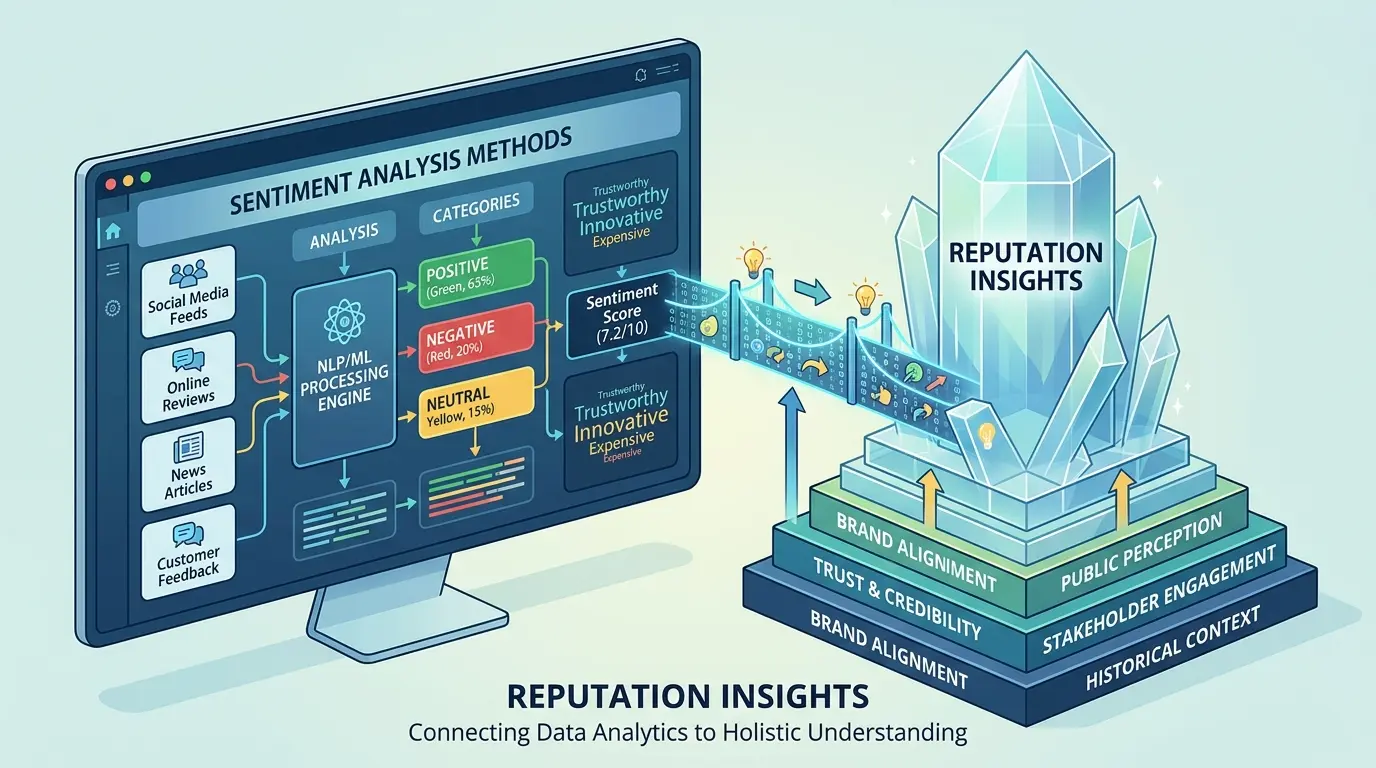
A measurement framework also needs to distinguish between correlation and direct causation. A ranking improvement after publishing a case study does not establish that the case study alone caused the change. Search systems evaluate multiple signals simultaneously, and external changes can affect SERP composition. Reliable analysis therefore compares multiple indicators over time. This produces a more accurate evaluation of search visibility and entity perception.
Which B2B trust signals scale most effectively?
Structured content systems, consistent business information and repeatable review-monitoring processes provide strong foundations for scalable trust management. Scalability refers to the ability to maintain reputation quality as a business expands across services, locations, markets or digital channels. Structured case studies can create repeatable evidence around different industries and business problems. Consistent entity information can be maintained across professional profiles and relevant platforms. Monitoring systems can identify emerging reputation signals without requiring a complete manual review of every source.
Scalability also creates risk when content production becomes disconnected from relevance. Publishing large volumes of low-value content does not automatically create stronger entity credibility. Search systems evaluate individual documents and their relevance rather than rewarding volume alone. A scalable approach therefore requires quality controls, consistent terminology and clear topical relationships. The strongest scalable systems expand information depth while preserving accuracy and authority.
How does sentiment distribution affect B2B trust?
Sentiment distribution affects B2B trust by showing how positive, neutral and negative evaluations are represented across review and reputation sources. Sentiment distribution is the pattern of evaluative language associated with an entity across relevant information. A single review provides limited contextual evidence, while recurring themes across multiple sources provide a broader perception signal. Search systems can process review-related information, while buyers interpret sentiment as part of their independent research. Reputation analysis therefore considers both the presence and context of sentiment.
Sentiment also requires source-level evaluation because not every review carries the same contextual value. The relevance, authenticity and consistency of information influence how it contributes to the wider reputation environment. A balanced reputation analysis therefore avoids treating sentiment as a simple numerical score. It examines recurring themes alongside other trust signals such as case studies, references and authoritative publications. This produces a more complete assessment of entity perception.
How does digital footprint optimisation strengthen B2B trust?
Digital footprint optimisation strengthens B2B trust by improving the consistency, relevance and discoverability of information associated with a business entity. A digital footprint is the collection of online information through which an organisation is represented across search ecosystems. Optimisation focuses on ensuring that professional information, content, references and reputation signals form a coherent entity structure. This makes it easier for users and search systems to understand the organisation’s expertise and commercial identity. The process therefore connects search visibility with credibility.
Digital footprint optimisation differs from simply producing more content. It evaluates whether existing information supports the intended entity representation and whether important reputation signals remain accurate. Removing outdated information, improving authoritative content and maintaining consistent business details address different aspects of the footprint. These actions influence the quality of the information environment rather than guaranteeing specific search positions. The result is a more coherent basis for B2B trust evaluation.
What reputation risks arise when trust signals are poorly managed?
Poorly managed trust signals create risks through inconsistent information, misleading content, weak evidence and uncontrolled negative sentiment. Inconsistent business details can create ambiguity around entity identity and professional relationships. Low-quality content can provide little authority while increasing the number of indexed documents associated with the organisation. Unaddressed negative information can become more prominent within relevant searches. These conditions increase risk exposure because buyers encounter conflicting or incomplete reputation signals.
Risk also increases when businesses use the wrong intervention for the underlying problem. Content suppression does not replace legitimate source removal, while content creation does not automatically resolve inaccurate information at its original source. Reactive interventions without ongoing monitoring also provide limited protection against new reputation signals. Effective evaluation therefore considers both the intended outcome and potential secondary effects. Risk management is consequently a core part of B2B reputation strategy.
How can businesses build a sustainable B2B trust strategy?
A sustainable B2B trust strategy combines authoritative content, external reputation signals, consistent entity information and continuous monitoring. The strategy begins by identifying the information buyers use when evaluating the organisation. It then compares the strength, relevance and authority of existing trust signals. Gaps can be addressed through content enhancement, reputation monitoring or appropriate source-level action. The resulting system creates a broader and more resilient digital footprint.
A sustainable framework can be evaluated through five connected factors:
- Audit existing reputation signals by reviewing case studies, reviews, professional references and indexed business information.
- Classify each signal according to its role in credibility, sentiment, authority or entity recognition.
- Strengthen weak information by improving relevant authoritative content and resolving inconsistent business details.
- Monitor SERP composition by tracking important queries, content visibility and emerging reputation signals.
- Measure long-term performance by comparing search visibility, sentiment distribution and entity consistency over defined periods.
This framework separates reputation development from isolated content activity. It also establishes measurable criteria for evaluating effectiveness, scalability and sustainability. Businesses can then compare reputation approaches according to the specific information conditions affecting their digital presence. The objective is a coherent trust environment rather than a temporary change in one search result.
Which approach best balances effectiveness, risk and sustainability?
The strongest approach balances content enhancement, legitimate removal, organic trust development and reactive monitoring according to the underlying reputation condition. Content enhancement expands authoritative information, while removal addresses eligible source-level problems. Organic strategies establish long-term information depth, while reactive strategies address emerging risks. Each mechanism has distinct strengths and limitations, so selection depends on the type of reputation signal being evaluated. This creates a more precise strategic framework than applying one method universally.
Effectiveness is measured through search visibility and reputation outcomes, risk through the potential consequences of each intervention, and sustainability through the durability of the information environment. Scalability adds a fourth dimension by determining whether the strategy remains effective as the organisation grows. These factors create a practical basis for comparing reputation management approaches. They also clarify why B2B trust is built through interconnected signals rather than one isolated content format.
For businesses evaluating the next stage of this process, Build B2B Trust Signals That Close Deals connects trust-signal development with commercial decision-making while maintaining the distinction between reputation evidence and direct sales activity.
What is the most reliable way to shorten the B2B sales cycle through trust signals?
The most reliable approach is to provide relevant evidence across the buyer’s independent research journey while maintaining consistent entity information. Buyers need credible information that answers questions about capability, expertise, experience and reliability before direct engagement. Case studies provide contextual evidence, reviews provide sentiment, and authoritative references provide external credibility. Consistent business information connects these signals into a coherent entity representation. Together, they reduce informational uncertainty during commercial evaluation.
The strategic priority is therefore not to maximise the number of trust signals but to improve their relevance, authority and consistency. Search visibility determines which signals buyers encounter, while content quality and source authority influence how those signals are interpreted. Continuous monitoring identifies changes in SERP composition and emerging reputation risks. A sustainable trust strategy consequently combines organic information development with targeted reputation management. The outcome is a more coherent digital environment in which buyers can evaluate a vendor with greater informational confidence.
What are B2B trust signals?
B2B trust signals are pieces of evidence that help buyers evaluate a business’s credibility, expertise and reliability. They include case studies, customer reviews, professional references, authoritative content and consistent business information.
How do B2B trust signals shorten the sales cycle?
B2B trust signals provide evidence that answers buyer questions before direct sales engagement. Clear proof of expertise, relevant outcomes and external credibility reduces uncertainty during the research and evaluation stages.
Which trust signals are most important for B2B businesses?
Case studies, customer reviews, authoritative references and consistent company information are key B2B trust signals. Each provides a different form of evidence, covering capability, sentiment, expertise and entity credibility.
How does online reputation affect the B2B sales cycle?
Online reputation affects how buyers interpret a business during independent research. Strong reputation signals can reinforce credibility, while inconsistent information or prominent negative content can increase uncertainty and delay purchasing decisions.
How can businesses improve B2B trust signals?
Businesses can improve B2B trust signals by publishing relevant evidence, maintaining accurate company information, developing authoritative content and monitoring customer sentiment. A consistent digital footprint helps strengthen entity credibility across search results and other online sources.