
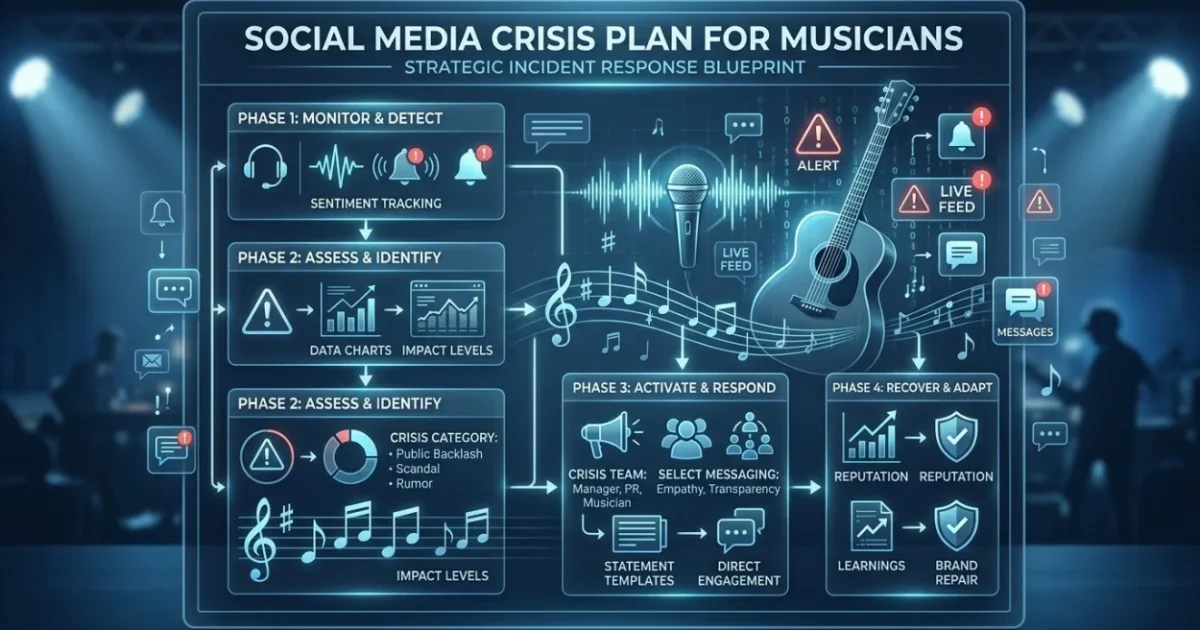
Building a social media crisis plan for musicians requires a structured approach to communication, content monitoring, risk assessment and search reputation control. Reputation management strategies differ based on whether the response focuses on preventing reputation damage, reacting to negative content, or strengthening the wider information environment.
Online reputation control methods are evaluated through their effect on search visibility, reputation signals, entity credibility and the composition of search engine results pages (SERPs). For musicians, a crisis plan needs to account for both the original social media event and the secondary content that develops through reporting, reposting, commentary and search indexing.
How Do Proactive and Reactive Social Media Crisis Strategies Compare?
Proactive crisis strategies focus on preparing communication systems before reputational disruption occurs, while reactive strategies address reputation signals after an incident becomes visible. A proactive approach operates by establishing response procedures, account controls, approval processes and monitoring systems in advance. A reactive approach operates by analysing the incident after publication and selecting an appropriate response based on its visibility and impact. The primary difference concerns timing, because proactive controls reduce uncertainty before content enters the wider information environment.
Proactive planning provides stronger control over initial communication, but it requires continuous maintenance and monitoring. Reactive management provides greater access to actual evidence because decisions are based on observable content, sentiment distribution and search behaviour. Its limitation is that external reporting or user-generated discussion can already expand the digital footprint before a response begins. Comparing both approaches therefore requires measuring response speed, risk exposure, search ranking influence and the level of control available over the original information.
Is Content Creation More Effective Than Content Removal During a Social Media Crisis?
Content creation and content removal address different parts of the reputation management process, making their effectiveness dependent on the nature of the information involved. Content removal operates by attempting to eliminate an offending or problematic publication from its original source when a valid removal mechanism exists. Content creation operates by introducing relevant, authoritative information that contributes additional context to the entity’s search environment. Removal therefore reduces the presence of a specific information asset, while enhancement changes the composition of the wider information ecosystem.
The distinction between content suppression vs content enhancement is important when evaluating search visibility. Removing one page does not automatically remove references, screenshots, articles or discussions created elsewhere. Conversely, publishing new content does not guarantee that an existing negative result will lose its ranking position. Removal has a direct effect when the source accepts the request and the content disappears, whereas enhancement operates through competition for search visibility. The appropriate method therefore depends on ownership, legitimacy, indexing status, source authority and the extent to which the information has spread.
How Does Content Suppression Compare With Content Enhancement in Search Results?
Content suppression focuses on reducing the visibility or availability of specific negative information, while content enhancement focuses on strengthening useful information that competes within the same search environment. Suppression can involve legitimate removal routes, de-indexing mechanisms or platform-specific reporting processes where applicable. Enhancement involves developing authoritative, relevant and well-structured content that strengthens the entity’s broader digital footprint. Each method operates through a different mechanism and produces different levels of control.
Suppression offers greater precision when a specific piece of content qualifies for removal, but its scalability decreases when the same information appears across independent sources. Enhancement provides a broader approach because additional authoritative documents can improve the overall SERP composition. Its limitation is that ranking systems determine whether newly created content receives meaningful visibility. A comparison therefore requires assessing source authority, ranking competition, content relevance, indexing speed and the persistence of the original reputation signal.
Which Crisis Response Approach Has the Strongest Effect on Search Visibility?
The strongest effect on search visibility comes from strategies that address both the source of the crisis content and the broader network of indexed references. Search visibility is the extent to which content associated with an entity appears for relevant user queries. A response limited to the original social media platform does not address independent news coverage, forum discussions, video content or search-indexed references. A broader approach analyses the entire SERP composition to determine which information sources contribute to the reputation issue.
Search ranking influence also depends on the relationship between query intent and document relevance. A musician’s name can generate an entity-focused SERP, while a name combined with terms associated with a controversy creates a more specific query environment. Content relevant to the second query can therefore remain prominent even when general branded searches contain positive information. Effective evaluation requires examining query-level visibility rather than relying on a single search result. This creates a distinction between improving overall entity credibility and addressing a specific controversy-related search association.
How Do Short-Term and Long-Term Reputation Strategies Differ?
Short-term reputation strategies prioritise immediate containment, while long-term strategies focus on sustainable control of the information environment. Short-term measures operate by limiting escalation, correcting inaccurate information where appropriate, monitoring emerging references and managing the initial communication response. Long-term measures operate through continuous content development, reputation monitoring, authoritative profile maintenance and consistent digital identity signals. The two approaches therefore address different stages of reputation risk.
Short-term action has greater relevance when a crisis generates rapid content expansion across social platforms and external publications. Its limitation is that immediate actions rarely determine the complete long-term SERP composition. Long-term reputation management provides stronger sustainability because it maintains relevant entity information after the initial incident loses its immediate attention. However, it requires ongoing monitoring and content governance rather than a single intervention. The strongest evaluation therefore considers whether a strategy controls immediate risk while maintaining entity credibility over time.
How Does Organic Reputation Building Compare With Reactive Crisis Management?
Organic reputation building develops positive and authoritative reputation signals before a crisis occurs, while reactive management responds to negative signals after they enter the information ecosystem. Organic reputation building operates through consistent publication of accurate biographies, professional achievements, interviews, authoritative profiles and relevant content. Reactive management operates by identifying the source, context, ranking position and distribution of problematic information. The difference is primarily preventative versus corrective.
Organic development creates a stronger baseline digital footprint because search engines have more established information through which to understand the entity. Reactive intervention becomes more complex when the existing information environment contains limited authoritative content. However, organic content does not remove inaccurate information simply through its existence. Reactive methods therefore remain relevant when specific content requires correction, reporting or legitimate removal. Evaluating both approaches requires measuring sustainability, risk exposure, content authority and their influence on SERP composition.
What Role Does Sentiment Distribution Play in a Musician’s Crisis Plan?

Sentiment distribution measures how positive, negative and neutral associations are distributed across content connected with a musician’s entity. It differs from a simple reputation score because sentiment exists across separate documents, platforms, queries and source types. A crisis plan uses sentiment analysis to identify whether negative discussion remains concentrated on one platform or has expanded across external sources. This distinction determines whether the issue represents a platform-specific communication problem or a wider search reputation concern.
Sentiment also requires contextual classification because negative language does not always represent the same reputation risk. Critical commentary about a musical release differs from allegations concerning professional conduct, while disagreement about a public statement represents another category. Search systems interpret documents according to context, relevance and relationships rather than applying a universal sentiment score. A useful crisis assessment therefore measures sentiment distribution alongside source authority, content type, search visibility and query relevance.
How Should Musicians Evaluate the Scalability of Crisis Management Methods?
Scalability is the ability of a reputation strategy to remain effective as the volume and distribution of content increase. A platform-level removal process has limited scalability when a controversy produces independent articles, videos, discussions and reposted material across different domains. Content enhancement has greater structural scalability because a single authoritative asset can support multiple entity-related queries and reinforce a broader information network. Monitoring systems also scale more effectively when they track recurring queries and indexed references rather than individual posts alone.
Risk exposure increases when a strategy depends on one platform, one content asset or one removal mechanism. A musician’s digital footprint can contain multiple independent sources, meaning that changes in one location do not necessarily alter the wider search environment. Scalable planning therefore evaluates source diversity, content persistence, ranking competition and monitoring capacity. The objective is not simply to increase the volume of content, but to establish an information structure that remains coherent as new reputation signals appear.
Which Reputation Management Method Is Most Sustainable for Musicians?
The most sustainable approach combines preventive preparation, evidence-based response, legitimate content control and long-term digital identity development. Sustainability is measured by how consistently a strategy maintains relevant reputation signals without relying on repeated emergency interventions. A purely reactive model creates recurring operational demands because each new incident requires a separate response. A purely organic model lacks a direct mechanism for addressing problematic content that already has significant search visibility.
A combined framework provides greater coverage because each component addresses a distinct mechanism. Monitoring identifies new reputation signals, removal processes address eligible source content, corrective communication addresses factual context, and authoritative content development strengthens the wider entity profile. This structure also separates content suppression from content enhancement instead of treating them as interchangeable methods. Sustainable reputation management therefore depends on maintaining an accurate and authoritative information ecosystem while retaining mechanisms for responding to specific risks.
How Can Musicians Compare Crisis Strategies Before Choosing an Approach?
Musicians can compare crisis strategies by measuring their effect across control, speed, search influence, scalability, risk and sustainability. A structured evaluation prevents a single visible metric, such as social engagement or search ranking, from determining the overall assessment. Each strategy needs to be evaluated according to the mechanism it controls and the reputation problem it addresses.
A practical evaluation framework can:
- Measure source control — identify whether the strategy directly controls the original publication or depends on an independent platform or publisher.
- Compare search influence — examine whether the approach changes SERP composition, query-level visibility or the prominence of reputation-related content.
- Evaluate scalability — assess whether the method remains practical when the same issue appears across multiple platforms and domains.
- Assess sustainability — determine whether the strategy maintains entity credibility after immediate crisis attention decreases.
- Analyse risk exposure — identify dependencies on platform policies, third-party decisions, content persistence and changing search conditions.
This framework separates operational effectiveness from perceived effectiveness. A strategy that produces rapid social engagement does not necessarily produce a measurable improvement in search reputation. Similarly, removing one publication does not necessarily change the broader entity perception if independent references remain highly visible.
How Does a Crisis Plan Affect a Musician’s Long-Term Entity Credibility?
A crisis plan affects long-term entity credibility by determining how consistently the musician’s digital identity is represented across authoritative information sources. Entity credibility is the perceived reliability and relevance of information associated with an identifiable person or professional entity. Search systems develop entity understanding through relationships between names, topics, sources, content and references. A structured crisis plan therefore influences not only immediate communication but also the consistency of these relationships.
Long-term credibility depends on information quality rather than content volume alone. Accurate professional information, authoritative references and consistent identity signals create a clearer semantic environment around the musician. Crisis-related information then becomes one component within a larger entity structure rather than the sole defining association. This does not guarantee a particular ranking outcome, but it provides a stronger basis for evaluating search perception and reputation signals over time.
Dive Deeper With Our Expert Guides:
Outranking Bootleg and Piracy Sites for Your Artist Name
Cleaning Up Negative Press in Your Streaming Bios
What Should a Social Media Crisis Plan Include From a Search Reputation Perspective?
A search-focused crisis plan needs to account for communication, monitoring, content control and the wider information ecosystem. The plan begins by identifying the accounts, content types, stakeholders and approval procedures relevant to crisis communication. It then incorporates monitoring for external references, search-result changes, sentiment distribution and new indexed documents. These mechanisms allow the response to address both the original platform and the wider search environment.
The final component concerns strategic continuity. A crisis response that ends when social engagement decreases does not account for persistent indexed content or long-term search associations. Sustainable planning therefore includes post-crisis monitoring and assessment of SERP composition. Understanding handle a social media crisis within this broader framework connects immediate response decisions with longer-term reputation evaluation without treating either content removal or content enhancement as a universal solution.
Building a social media crisis plan for musicians requires comparing strategies according to their mechanisms, limitations and effects on search reputation. Proactive preparation improves response control, while reactive management addresses reputation signals that have already entered the information ecosystem. Content suppression provides targeted control where legitimate removal routes exist, whereas content enhancement influences the wider SERP composition through authoritative information.
The most important distinction is between short-term containment and long-term sustainability. Search visibility, entity credibility, sentiment distribution and content persistence operate across multiple platforms, making reputation evaluation broader than the original social media incident. A robust consideration framework therefore measures control, search ranking influence, scalability, risk exposure and sustainability before assessing which combination of methods fits a particular reputation environment.
What should a social media crisis plan for musicians include?
A social media crisis plan for musicians should include monitoring, response procedures, content approval, risk assessment and search reputation tracking. It also needs to account for external coverage, indexed content and changes in search visibility.
How can musicians protect their online reputation during a social media crisis?
Musicians can protect their online reputation by responding consistently, monitoring reputation signals and assessing how crisis-related content spreads across platforms and search results. Maintaining accurate, authoritative information also supports long-term entity credibility.
Is content removal or content creation better for managing a musician’s online reputation?
Content removal directly addresses specific publications when a legitimate removal route exists, while content creation strengthens the wider digital footprint. The appropriate approach depends on content ownership, source authority, search visibility and how widely the information has spread.
How does a social media crisis affect a musician’s Google search results?
A social media crisis can introduce new articles, posts, videos and discussions into search results associated with the musician’s name. Repeated references and authoritative coverage can strengthen the visibility of crisis-related reputation signals.
How long does it take to manage a musician’s online reputation after a crisis?
The timeframe depends on content persistence, search ranking, source authority and how widely the crisis information has been distributed. Short-term responses address immediate visibility, while long-term reputation management focuses on sustainable search perception and entity credibility.