

A business reputation audit checklist evaluates how a company appears across search results, review platforms, media coverage, and owned digital assets. It measures reputation signals, sentiment distribution, entity credibility, and search visibility factors that influence public perception.
Reputation management strategies differ based on the sources of reputation risk, the structure of search results, and the distribution of positive and negative sentiment. Online reputation control methods are evaluated through search ranking influence, content visibility, trust signal strength, and long-term sustainability.
What Does a Business Reputation Audit Measure?
A business reputation audit is an assessment framework that analyses the digital signals influencing public perception of an organisation. The audit examines search engine results pages, review ecosystems, news coverage, social media references, business listings, and owned content assets. Search engines interpret these elements as indicators of entity credibility and topical authority. The audit process measures how reputation signals are distributed across the digital environment. It also identifies visibility gaps that affect search perception. The objective is to establish a measurable baseline before evaluating reputation management approaches.
The measurement process operates by analysing both quantitative and qualitative factors. Quantitative indicators include review volume, average ratings, search result composition, branded search visibility, and content ownership ratios. Qualitative indicators include sentiment distribution, thematic associations, and perception patterns. Search ecosystems evaluate these signals collectively rather than independently. A reputation audit therefore focuses on relationships between signals rather than isolated metrics. This interconnected analysis provides a clearer understanding of digital trust formation.
Which Reputation Signals Have the Greatest Influence on Search Perception?
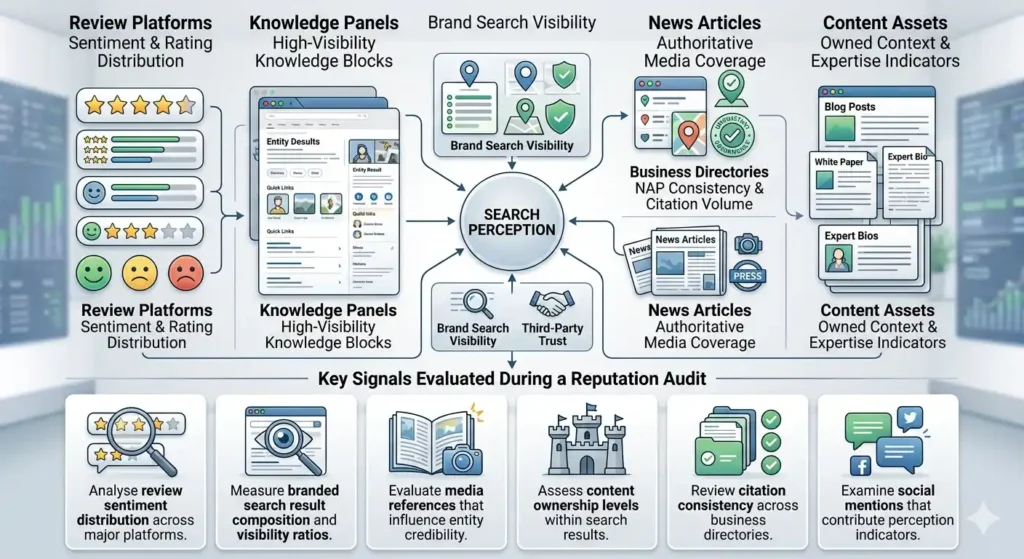
Search perception is primarily influenced by high-visibility signals that appear during branded searches. These signals include review platforms, news articles, knowledge panels, business directories, and authoritative content assets. Search engines evaluate these elements to determine entity credibility and relevance. Users simultaneously interpret the same signals when forming impressions about a company. Visibility therefore amplifies the influence of specific reputation assets. The most prominent signals often shape perception before deeper engagement occurs.
Not all reputation signals contribute equally to search ranking influence. Authoritative third-party references generally carry stronger trust signals than self-published content. Review platforms contribute sentiment indicators, while media coverage contributes credibility indicators. Business profiles contribute consistency and verification indicators. Owned content contributes context and expertise indicators. The combined presence of these signals creates a reputation ecosystem that search engines can interpret more confidently.
Key Signals Evaluated During an Audit
- Analyse review sentiment distribution across major review platforms.
- Measure branded search result composition and visibility ratios.
- Evaluate media references that influence entity credibility.
- Assess content ownership levels within search results.
- Review citation consistency across business directories.
- Examine social mentions that contribute perception indicators.
How Does Content Enhancement Compare with Content Suppression Strategies?
Content enhancement focuses on increasing the visibility of positive, relevant, and authoritative content assets. Content suppression focuses on reducing the prominence of unfavourable content through ranking displacement. Both approaches influence search result composition, but they operate through different mechanisms. Content enhancement expands the quantity and authority of favourable assets. Content suppression alters visibility patterns by introducing competing content into search ecosystems. The distinction lies in whether the strategy prioritises asset development or ranking displacement.
Content enhancement is evaluated as a sustainable approach because it strengthens entity credibility while expanding informational coverage. Search engines interpret high-quality content as a signal of expertise and relevance. This process contributes to long-term search ranking influence. Content suppression achieves visibility changes by reducing the relative prominence of negative results. While effective in modifying SERP composition, suppression requires continuous content expansion to maintain displacement. Sustainability therefore differs significantly between the two methods.
From a risk evaluation perspective, content enhancement produces broader benefits beyond reputation management. It improves informational completeness and strengthens trust signals. Content suppression primarily addresses visibility concerns without necessarily improving perception quality. Audits therefore compare the underlying objectives of each strategy before determining effectiveness.
How Do Organic Reputation Management Approaches Compare with Reactive Approaches?
Organic reputation management operates through continuous reputation signal development. Reactive reputation management responds to specific reputation threats after negative visibility emerges. Both approaches influence digital perception, but they differ in timing, resource allocation, and risk exposure. Organic strategies establish a stable reputation foundation before issues appear. Reactive strategies focus on correcting perception after disruption occurs. The distinction affects both cost efficiency and operational complexity.
Organic approaches operate by maintaining review acquisition processes, content publication schedules, citation consistency, and stakeholder engagement programmes. Search engines continuously process these signals and integrate them into entity evaluations. Consistency strengthens credibility indicators over time. This approach reduces dependence on corrective interventions. The resulting reputation profile develops gradually through accumulated trust signals.
Reactive approaches operate by identifying reputation threats and implementing targeted responses. These threats include negative reviews, adverse media references, unfavourable search results, or perception shifts. While reactive methods address immediate visibility concerns, they often require greater resource concentration. Risk exposure remains elevated because corrective measures occur after perception damage becomes visible. Audits frequently identify proactive signal management as a more stable reputation control mechanism.
Which Audit Areas Reveal the Highest Reputation Risk?
Search result composition reveals some of the most significant reputation risks because it directly influences public perception. Negative media coverage, unresolved customer complaints, and outdated content often occupy visible search positions. Search engines evaluate these assets according to relevance and authority. High-ranking negative content therefore creates persistent visibility challenges. Audits measure the prominence and authority of these assets to assess risk exposure accurately.
Review ecosystems represent another critical risk category. Negative sentiment concentration within review platforms can influence both user trust and local search visibility. Search engines interpret review patterns as indicators of business quality and relevance. An imbalance in sentiment distribution affects credibility assessments. Audits therefore evaluate review trends, response patterns, and rating consistency. These measurements reveal vulnerabilities that affect both perception and search performance.
Entity consistency also influences reputation risk. Inconsistent business information across directories, websites, and external references weakens trust signals. Search engines rely on consistency to validate entity identity. Discrepancies create uncertainty within search ecosystems. Audits identify these inconsistencies to evaluate their impact on credibility and visibility.
How Does Review Management Compare with Search Result Management?
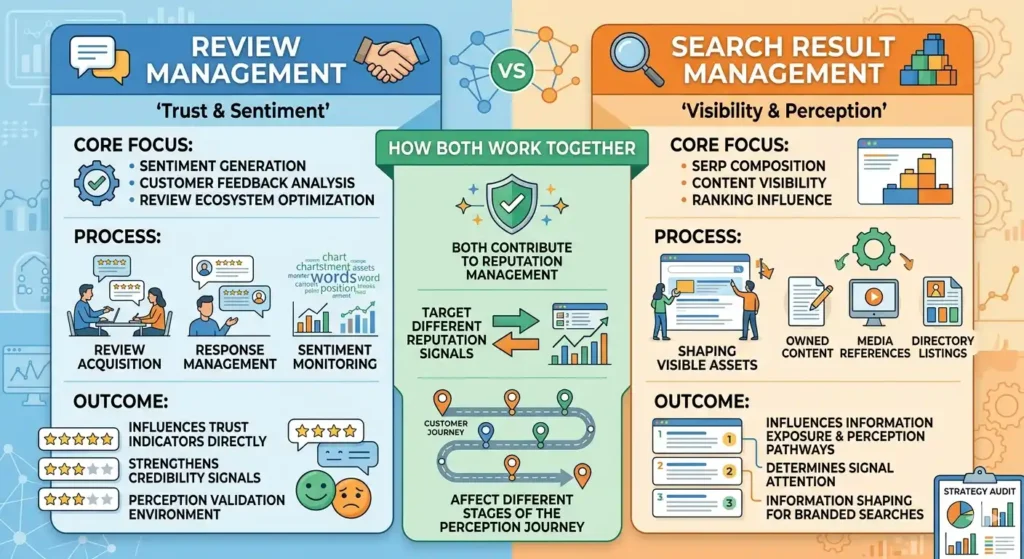
Review management focuses on sentiment generation, customer feedback analysis, and review ecosystem optimisation. Search result management focuses on SERP composition, content visibility, and ranking influence. Both strategies contribute to reputation management, but they target different reputation signals. Review management influences trust indicators directly. Search result management influences information exposure and perception pathways.
Review management operates through review acquisition, response management, and sentiment monitoring. Search engines interpret review activity as evidence of business engagement and relevance. Positive sentiment strengthens credibility signals, while unresolved complaints create perception risks. This approach directly affects user trust during decision-making processes. Review ecosystems therefore function as perception validation environments.
Search result management operates by shaping the assets visible during branded searches. This includes owned content, media references, directory listings, and informational resources. The strategy influences what users encounter when evaluating a company. Search visibility therefore determines which reputation signals receive attention. Audits compare both approaches because they affect different stages of the perception journey.
Are Short-Term Reputation Corrections as Effective as Long-Term Reputation Development?
Short-term reputation correction focuses on immediate visibility challenges. Long-term reputation development focuses on sustained credibility growth through consistent reputation signals. Both approaches serve distinct functions within reputation management frameworks. Short-term interventions address urgent perception risks. Long-term initiatives establish resilience against future reputation disruptions. Their effectiveness depends on the objective being evaluated.
Short-term corrections operate through rapid content publication, review response campaigns, and visibility adjustments. These mechanisms alter perception indicators within compressed timeframes. They are effective for addressing immediate search visibility concerns. However, search ecosystems continuously reassess authority, relevance, and credibility. Temporary improvements therefore require ongoing reinforcement to remain effective.
Long-term reputation development operates through content authority building, review ecosystem strengthening, and trust signal accumulation. Search engines reward consistency and credibility over extended periods. This approach improves entity recognition and reduces vulnerability to isolated reputation events. Audits frequently identify long-term development as the more sustainable framework because it strengthens the foundations that influence search perception.
Dive Deeper With Our Expert Guides:
How to Measure Your Business Reputation Across Multiple Platforms
How Can Companies Evaluate Reputation Management Priorities Through an Audit?
Reputation management priorities are evaluated by analysing visibility impact, risk severity, and trust signal influence. An audit identifies which reputation assets affect perception most significantly. High-visibility negative assets receive priority because they influence immediate search impressions. Weak trust signals receive attention because they limit credibility growth. Resource allocation therefore becomes evidence-based rather than assumption-driven.
Evaluation frameworks typically compare three categories of influence. The first category measures search ranking influence through visibility analysis. The second measures trust signals through sentiment and credibility assessments. The third measures sustainability through consistency and authority indicators. Together, these categories provide a structured method for prioritising reputation management activities. The framework allows organisations to compare corrective and developmental approaches objectively.
A practical evaluation process includes:
- Measure search visibility for branded queries.
- Analyse sentiment distribution across review ecosystems.
- Identify credibility gaps within third-party references.
- Compare owned versus third-party content dominance.
- Assess consistency across entity citations and profiles.
- Prioritise actions according to visibility and trust impact.
A business reputation audit checklist evaluates how reputation signals influence search visibility, trust formation, and digital perception. Content enhancement and content suppression operate through different visibility mechanisms. Organic and reactive approaches differ in timing, sustainability, and risk exposure. Review management and search result management influence separate stages of the perception journey.
The effectiveness of any reputation management framework depends on signal quality, entity credibility, sentiment distribution, and search ranking influence. Audits provide the analytical foundation required to compare approaches objectively and identify reputation risks accurately. By measuring visibility, trust indicators, and authority signals, organisations can evaluate reputation management options through evidence-based analysis rather than assumptions.
Get more information, explore:
How Clear My Name Helps Businesses Improve Search Result Visibility
Answers to Key Questions
What is reputation management for business and why is it important?
Reputation management for business is the process of monitoring, analysing, and improving how a company is perceived online. It helps businesses manage reviews, search results, and digital mentions that influence customer trust and decision-making.
How does online reputation management affect search engine visibility?
Online reputation management influences the content and reputation signals that appear in search results. Positive reviews, authoritative content, and accurate business information can improve visibility and strengthen brand credibility.
What are the key elements of a business reputation management strategy?
A business reputation management strategy typically includes review monitoring, search result analysis, content optimisation, and sentiment tracking. These elements help businesses understand and manage their digital reputation more effectively.
How can businesses measure their online reputation?
Businesses can measure their online reputation by evaluating review ratings, customer feedback, search result composition, and sentiment distribution. Regular reputation audits help identify strengths, risks, and areas for improvement.