

Negative reviews influence purchasing decisions because they function as reputation signals that affect trust, credibility, and perceived quality before a transaction occurs.
Reputation management is the process of monitoring, interpreting, and understanding how information shapes public perception across digital environments. Online reputation refers to the collection of indexed content, reviews, mentions, and sentiment signals that influence how entities are evaluated within search ecosystems.
Why Do Negative Reviews Have Such a Strong Influence on Purchasing Decisions?
Negative reviews have a strong influence on purchasing decisions because consumers use them as risk indicators during information evaluation.
A negative review is a publicly accessible opinion that communicates dissatisfaction with a product, organisation, or experience. Within search ecosystems, negative reviews act as reputation signals that contribute to entity perception. Search users evaluate these signals alongside ratings, search snippets, and review summaries before making decisions. The visibility of criticism often attracts greater attention because it provides information about potential risks. This evaluation process directly influences credibility assessment during the research phase.
Search engines continuously index review content from multiple sources and integrate review-related information into search results. Content indexing enables review data to become part of a broader reputation profile associated with an entity. When users encounter negative sentiment repeatedly across indexed sources, consistency reinforces perception. This process defines how reputation becomes measurable through publicly available information. The cumulative effect of review sentiment influences both trust evaluation and purchasing behaviour.
How Are Negative Reviews Interpreted Within Search Ecosystems?
Negative reviews are interpreted through sentiment analysis, content relevance evaluation, and authority assessment.
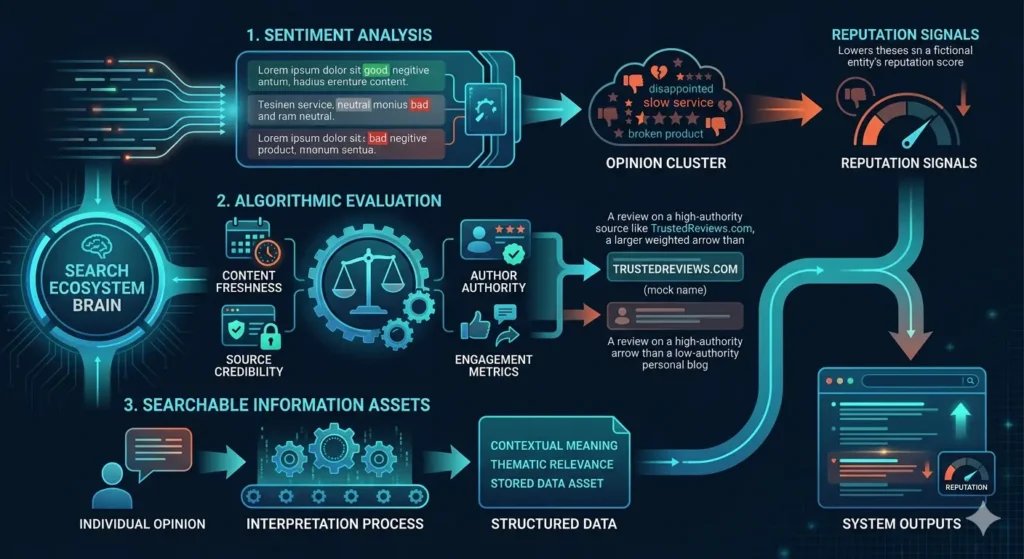
Sentiment interpretation refers to the process of identifying positive, neutral, and negative language patterns within content. Search systems analyse review text to understand contextual meaning and thematic relevance. Review content containing recurring criticism creates identifiable sentiment clusters. These clusters contribute to broader reputation signals associated with an entity. The interpretation process transforms individual opinions into searchable information assets.
Algorithms evaluate more than sentiment alone. Content freshness, source credibility, author authority, and engagement metrics contribute to review interpretation. A review published on a highly trusted platform carries different significance than content published on a low-authority source. Search engines analyse these relationships to understand content reliability. This evaluation process contributes to SERP ranking calculations and reputation assessment.
Which Elements Strengthen Negative Review Signals?
Several factors increase the visibility and significance of negative review content:
- Analyse repetition patterns – Consistent criticism across multiple sources creates stronger sentiment associations within search indexing systems.
- Evaluate source authority – Reviews published on authoritative platforms contribute stronger trust and credibility signals.
- Measure content engagement – High interaction levels demonstrate visibility and user relevance to search systems.
- Assess content freshness – Recent negative reviews provide updated information that influences current perception.
- Identify topical relevance – Reviews discussing specific issues establish stronger semantic relationships with search queries.
How Do Negative Reviews Affect Search Visibility?
Negative reviews affect search visibility by influencing reputation signals that search engines associate with an entity.
Search visibility refers to the prominence of content within search engine results pages. Reviews contribute to content ecosystems that search engines analyse when evaluating relevance and authority. Negative sentiment does not automatically reduce rankings, but it affects how users interpret search results. Visibility and perception operate as interconnected components of reputation formation. Search performance is influenced by both algorithmic evaluation and user behaviour.
Review content frequently appears within search snippets, knowledge panels, rating displays, and review aggregations. These features increase exposure to sentiment information before users visit a website. SERP evaluation occurs instantly, making visible review content an influential factor in reputation interpretation. Negative reviews therefore contribute to perception at the earliest stage of information discovery. Search visibility becomes closely connected to credibility assessment.
What Is the Relationship Between Negative Reviews and Digital Footprints?
Negative reviews become part of a digital footprint because they create persistent, indexable records within online environments.
A digital footprint is the collection of information associated with an entity across searchable platforms. Reviews contribute to this footprint through permanent or semi-permanent publication. Once indexed, review content becomes accessible through search queries and platform searches. This accessibility allows review information to remain visible over extended periods. The persistence of content strengthens its influence on reputation formation.
Search ecosystems continuously collect, organise, and evaluate digital footprint data. Review content interacts with articles, social mentions, directories, and other indexed materials. Together, these assets create an entity’s searchable identity. Negative reviews influence that identity by introducing alternative interpretations and credibility considerations. Digital footprints therefore represent cumulative reputation structures rather than isolated content assets.
How Do Search Engine Results Pages Shape Reputation Perception?
Search engine results pages shape reputation perception by organising information into visible credibility signals.
SERPs function as information evaluation environments where users compare sources before engaging with content. Search results present titles, descriptions, ratings, review summaries, and structured data. Each element contributes to entity perception. Negative reviews become influential because they are often displayed alongside other trust indicators. This placement enables immediate comparison between positive and negative information.
Reputation formation occurs through information exposure rather than direct experience. Users frequently form opinions based solely on what appears within search results. Search engines organise information according to relevance and authority calculations, creating a framework for perception analysis. Negative reviews influence this framework by adding visible signals that affect trust evaluation. The result is a reputation profile shaped by indexed content rather than personal interaction.
How Do Authority Signals Influence the Impact of Negative Reviews?
Authority signals influence the impact of negative reviews by determining the perceived reliability of the information source.
Authority signals refer to indicators that demonstrate expertise, trustworthiness, and credibility within search ecosystems. Review platforms, established publications, and recognised information sources often possess stronger authority profiles. Negative reviews published through authoritative channels receive greater attention because users perceive them as more reliable. Authority therefore amplifies the influence of reputation-related content.
Search engines evaluate authority through multiple mechanisms including content quality, citation relationships, topical relevance, and source reputation. When negative reviews originate from authoritative environments, their visibility and interpretive value increase. Users often rely on source credibility when evaluating information accuracy. This process strengthens the relationship between authority signals and reputation perception. Search ecosystems use authority as a foundational component of trust assessment.
What Role Does Online Credibility Play in Review Interpretation?
Online credibility plays a central role because review interpretation depends on perceived authenticity and reliability.

Online credibility refers to the degree of trust assigned to digital information. Reviews contribute to credibility assessment by providing publicly accessible evaluations. Users analyse review language, consistency, source quality, and publication context before forming conclusions. Credibility therefore functions as a filter through which reputation signals are interpreted. Strong credibility increases informational influence.
Search systems also evaluate credibility through content quality indicators and source relationships. Reviews supported by consistent evidence and trustworthy publication environments contribute stronger reputation signals. Inconsistent or unreliable content receives lower interpretive value. This distinction demonstrates how credibility shapes information hierarchy within search ecosystems. Reputation outcomes depend significantly on credibility evaluation processes.
How Does Sentiment Influence Entity Reputation?
Sentiment influences entity reputation because it provides measurable indicators of public perception.
Entity reputation refers to the collective interpretation of information associated with a person, organisation, or subject within search ecosystems. Sentiment analysis enables search systems and users to identify prevailing attitudes across content sources. Positive sentiment reinforces trust signals, while negative sentiment introduces caution signals. These patterns contribute to long-term reputation formation.
Search ecosystems aggregate sentiment from reviews, articles, discussions, and other indexed content. The resulting perception emerges from cumulative informational signals rather than isolated pieces of content. Consistent negative sentiment creates identifiable patterns that influence trust assessment and credibility evaluation. Entity perception therefore reflects the interaction between sentiment signals and search visibility. Reputation becomes a structured outcome of information analysis.
Why Is Reputation Analysis Important for Understanding Review Impact?
Reputation analysis is important because it explains how information influences perception, trust, and search visibility.
Reputation analysis refers to the systematic evaluation of content, sentiment, authority, and visibility signals associated with an entity. Negative reviews represent one component of a broader reputation ecosystem. Understanding their influence requires examining how search engines index information and how users interpret credibility indicators. Reputation analysis provides a framework for evaluating these relationships objectively.
The interaction between review sentiment, digital footprints, authority signals, and SERP visibility defines reputation outcomes. Search ecosystems continuously process and organise these signals to create searchable information structures. Negative reviews influence purchasing decisions because they contribute to risk evaluation and trust assessment. Understanding this process provides deeper insight into how reputation functions within digital environments.
Dive Deeper With Our Expert Guides:
87% of Customers Check Reviews Before Choosing a Business
Negative reviews influence purchasing decisions because they operate as visible reputation signals within search ecosystems. Their impact extends beyond individual opinions and becomes part of broader processes involving content indexing, sentiment interpretation, authority assessment, and SERP evaluation. Search engines organise review information into searchable structures that affect entity perception and online credibility. Reputation formation, therefore, emerges from the interaction among digital footprints, trust signals, and information visibility. Understanding these mechanisms provides a clearer view of how reputation develops, evolves, and influences decision-making within modern search environments.
For deeper insight explore:
Business Reputation Audit Checklist for UK Companies
Answers to Key Questions
Why is online reputation important for businesses?
Online reputation influences customer trust, purchasing decisions, and brand perception. Positive reputation signals across search results and review platforms help strengthen credibility and improve visibility in competitive markets
How do negative reviews affect a business reputation?
Negative reviews can impact consumer confidence by highlighting perceived risks or service issues. When highly visible in search results, they contribute to reputation signals that influence customer decision-making and online perception.
What are the key elements of a business reputation audit?
A business reputation audit evaluates online reviews, search engine results, brand mentions, customer sentiment, and digital credibility indicators. It helps identify reputation strengths, weaknesses, and visibility trends across online channels.
How can businesses monitor their online reputation effectively?
Businesses can monitor their online reputation by tracking reviews, search engine visibility, customer feedback, and social mentions. Regular monitoring helps identify reputation changes and supports informed decision-making based on accurate perception data.