

Collecting genuine customer reviews without filtering customers by sentiment protects review integrity and reduces policy risk. Google prohibits businesses from discouraging negative reviews or selectively soliciting positive reviews, making neutral review collection central to compliant reputation management.
Reputation management strategies differ based on whether a business is collecting authentic feedback, responding to existing reviews or attempting to influence the composition of its public rating. Online reputation control methods are evaluated through the quality, authenticity and distribution of reputation signals across search ecosystems.
What counts as review gating under Google’s rules?
Review gating is a selective review collection process that directs customers towards different feedback channels based on their satisfaction. Google explicitly prohibits merchants from discouraging or prohibiting negative reviews and from selectively soliciting positive reviews.
The mechanism is straightforward. A business first asks customers whether they had a positive experience, then directs satisfied customers to Google while routing dissatisfied customers towards private feedback. The public review profile therefore contains a higher proportion of positive experiences than the original customer population. This changes the sentiment distribution before content reaches the review platform.
The distinction matters because Google permits businesses to solicit genuine reviews when the request does not attempt to influence the rating or content. A neutral request gives customers an independent opportunity to describe their experience. A filtered request alters that independence by determining who receives the public review invitation.
How does neutral review collection compare with review gating?
Neutral review collection preserves customer independence, while review gating filters participation according to sentiment. The first approach asks customers to provide genuine feedback without controlling whether that feedback is positive or negative. The second approach attempts to improve the visible rating by restricting which customers reach the public review platform. From a reputation-management perspective, these methods produce fundamentally different reputation signals.
Neutral collection also provides more representative data. Positive, negative and neutral experiences remain eligible for publication, creating a public record that reflects a broader range of customer sentiment. Review gating removes part of that distribution before publication, which creates a selective information environment.
The effectiveness of each method therefore needs to be measured differently. Neutral collection measures the volume, authenticity and distribution of genuine feedback. Gating focuses on the desired rating outcome, but that objective creates policy exposure because Google prohibits selective solicitation of positive reviews.
Can businesses ask every customer for a Google review?
Businesses can ask customers for genuine reviews when the request does not influence the rating or selectively exclude dissatisfied customers. Google states that merchants can solicit or encourage content representing a genuine experience, provided they do not offer incentives or attempt to influence the rating or contents of the review.
A compliant request therefore focuses on the customer’s experience rather than the desired sentiment. Phrases that invite an honest review create a different mechanism from requests for a five-star rating. The distinction is important because the objective of the request affects the integrity of the resulting review signal.
Businesses also need to separate review collection from internal customer-service processes. A private feedback form can help identify operational problems, but it cannot become a mechanism for preventing dissatisfied customers from accessing the public review platform. The public and private channels need to remain independent when customers are invited to provide reviews.
What is the difference between review collection and review manipulation?
Review collection gathers authentic customer experiences without attempting to control the resulting sentiment. Review manipulation attempts to influence ratings, review content or the composition of the review profile through artificial or selective mechanisms. Google categorises selective solicitation of positive reviews and discouraging negative reviews as forms of fake engagement.
Manipulation can also involve incentives. Google prohibits businesses from offering payment, discounts, free goods or services in exchange for posting, revising or removing reviews. The policy applies because an incentive changes the motivation behind the review and therefore affects content integrity.
The distinction extends to pressure and scripted content. Google states that merchants should not require or pressure users to leave ratings or reviews while on the premises or request specific content. This means a review strategy needs to evaluate not only who receives the request but also how the request is framed.
Does review gating create greater risk than ordinary review management?
Review gating creates a distinct policy risk because it directly affects which customer experiences become public. Ordinary review management focuses on collecting genuine feedback, monitoring published reviews and responding to customer concerns. Gating instead changes the input into the review ecosystem before publication. That difference makes the process more vulnerable to enforcement.
Google states that policy-violating content can be removed and that multiple or severe violations can result in feature-access restrictions. Google also states that businesses violating its Fake Engagement policy can face restrictions such as temporary limits on receiving new reviews, temporary unpublishing of existing reviews or warnings displayed to consumers.
The risk therefore extends beyond losing individual reviews. A business can lose access to part of its review functionality or have existing reputation signals temporarily hidden. This creates a potential disruption to the review profile that the original gating strategy attempted to improve.
How does Google evaluate suspicious review activity?
Google uses machine-learning systems alongside human review processes to identify policy-violating user-generated content. Its published Maps policy states that automated systems scan contributions for suspicious activity signals, while trained operators and analysts can review content that requires additional evaluation.
This means businesses cannot reliably evaluate compliance by examining individual reviews in isolation. Review ecosystems also contain behavioural and structural signals. Unusual activity patterns, incentivised content, coordinated contributions and rating manipulation can all contribute to policy evaluation. Google specifically identifies unusual volumes or patterns of contributions as examples of rating manipulation.
The evaluation process also demonstrates why short-term rating improvements do not necessarily represent sustainable reputation gains. A strategy that increases positive sentiment through selective solicitation introduces a separate compliance risk. A strategy that collects genuine feedback produces reputation data without deliberately manipulating the distribution.
Is asking for positive reviews different from asking for honest reviews?
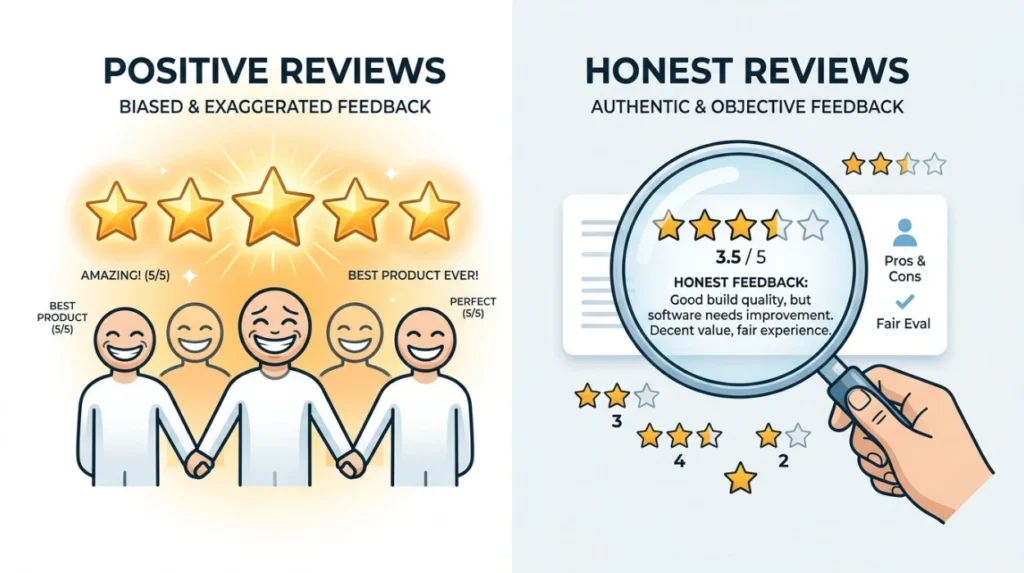
Asking for positive reviews is materially different from requesting an honest review because the first instruction attempts to influence sentiment. Google prohibits selectively soliciting positive reviews and discouraging negative reviews.
An honest-review request leaves the customer responsible for deciding what rating and comments accurately represent the experience. This maintains the independence of the review signal. The business can still make the review process accessible and convenient without determining its outcome.
The distinction also affects content quality. A genuine review can contain praise, criticism or a mixture of both. A request that specifically targets positive sentiment narrows the information entering the public record. From an entity-perception perspective, this creates a less representative digital footprint.
How do organic and reactive review strategies compare?
Organic review management develops through consistent requests for genuine feedback and ongoing customer interactions, while reactive management responds after reviews have already appeared. Organic collection influences the future composition of the review profile without selectively controlling individual customers. Reactive management addresses existing content through responses, reporting mechanisms or customer-service processes.
Each approach operates at a different point in the reputation lifecycle. Organic collection influences the generation of new reputation signals. Reactive management evaluates signals that already exist and determines whether they require a response or policy-based action. Combining both creates a more complete review-management framework than relying exclusively on either approach.
The main limitation of reactive management is timing. Once a negative review is published, the business has less control over how the original content is perceived. Organic collection does not eliminate negative feedback, but it maintains an ongoing flow of genuine customer experiences. This supports a more representative review profile over time.
Does review quantity matter more than review authenticity?
Review quantity and authenticity represent different reputation signals, so increasing volume does not replace the need for genuine customer experiences. A large number of reviews provides more information, but artificially generated or manipulated reviews undermine the reliability of that information. Google’s policies specifically require contributions to reflect genuine experiences.
Authenticity also affects the credibility of sentiment distribution. A business with a mixture of genuine positive, neutral and negative experiences presents a different information environment from a profile constructed through selective positive solicitation. The numerical rating alone does not reveal how the reviews were collected.

This distinction is relevant to search ranking influence as well. Review information forms part of the broader information associated with a business, but a high rating does not operate as an isolated ranking guarantee. Search visibility involves multiple relevance and quality signals, while review content contributes to the wider entity record.
How can businesses evaluate a review collection strategy?
Businesses can evaluate a review collection strategy by measuring compliance, customer independence, review authenticity and the resulting reputation signals. The evaluation needs to focus on the mechanism used to generate reviews rather than simply the final star rating.
A practical framework can include:
- Check whether every eligible customer receives an equivalent opportunity to provide a public review, regardless of satisfaction.
- Remove incentives that reward customers for publishing, changing or removing reviews, because Google prohibits incentivised review activity.
- Review messaging to confirm that requests invite genuine experiences rather than specific ratings or predetermined wording.
- Separate private customer feedback from public review access so dissatisfied customers are not diverted away from public reviews.
- Monitor review patterns for unusual activity that creates rating-manipulation or fake-engagement risks.
This framework evaluates the underlying process rather than treating the star rating as the primary success metric. It also makes compliance easier to audit because each stage has a defined mechanism.
Which approach provides stronger long-term reputation sustainability?
A neutral review strategy provides a more sustainable reputation structure because it preserves the independence and authenticity of customer feedback. Selective solicitation can create a short-term improvement in visible sentiment, but Google explicitly prohibits the practice and can remove violating reviews or impose Business Profile restrictions.
Long-term sustainability also depends on how the business responds to negative feedback. A negative review remains part of the information environment unless it violates a relevant policy or is removed through another legitimate mechanism. Responding factually and addressing the underlying service issue creates an additional reputation signal without manipulating the original review.
Sustainable reputation management therefore focuses on the integrity of the entire review ecosystem. The objective is not to eliminate negative sentiment but to ensure that published feedback represents genuine customer experiences. This creates a more stable foundation for entity credibility and search perception.
How does compliant review collection affect search perception?
Compliant review collection creates a more representative body of customer-generated content around a business entity. Search engines can encounter this information through Google services and other indexed sources, while users can evaluate ratings and written experiences when researching the business. Google states that Maps contributions can appear across Google services, including Maps, Search and YouTube.
The resulting reputation signal is therefore part of a broader digital footprint. Reviews interact with business information, third-party references, official content and other sources when users assess an entity. A consistent and authentic review profile contributes to clearer entity perception because it reflects actual customer experiences rather than a selectively constructed sentiment distribution.
This does not mean compliant review collection guarantees a particular search position. Search ranking remains dependent on multiple factors, and review signals represent only part of the overall information environment. The strategic value lies in maintaining accurate, authentic and policy-compliant reputation signals over time.
Dive Deeper With Our Expert Guides:
Why Google Removes Legitimate Reviews and How to Get Them Back
Recovering Your Reviews After a Google Business Profile Suspension
How should businesses balance review growth with Google compliance?
Businesses need to treat review growth and policy compliance as connected objectives rather than competing goals. Increasing review volume through neutral solicitation preserves customer independence, while selective positive solicitation introduces a prohibited mechanism. Google explicitly allows merchants to encourage genuine reviews when they do not attempt to influence ratings or review content.
The strongest evaluation framework therefore examines how a review is generated, not simply how many reviews appear. A compliant strategy can improve the accessibility of review requests while leaving customers free to determine their own ratings and comments. This approach supports authentic sentiment distribution without introducing a filtering mechanism.
The long-term consideration is reputation sustainability. A business that builds reviews through genuine customer participation creates a more defensible reputation signal than one dependent on selective solicitation. Search visibility, trust signals and entity perception are then supported by information that more accurately represents the underlying customer experience.
Collecting Google Reviews without breaking anti-gating rules requires a clear distinction between encouraging genuine feedback and manipulating review participation. Google permits businesses to solicit authentic reviews but prohibits selective positive solicitation, discouraging negative reviews and incentives tied to review activity.
The comparison between neutral collection and review gating centres on customer independence. Neutral collection preserves the relationship between actual experience and published feedback, while gating changes the sentiment distribution before customers reach the public review platform.
For reputation management, the sustainable approach is therefore based on authenticity, compliance and consistent measurement. Review volume remains useful, but its value depends on how the underlying content was generated. A review strategy that protects customer independence provides a stronger foundation for reputation signals, entity credibility and long-term search perception.

What is Google review gating?
Google review gating is the practice of directing customers to different feedback channels based on whether their experience was positive or negative. It can violate Google’s policies when businesses selectively encourage positive reviews or discourage negative feedback.
Can a business ask customers for Google Reviews?
Yes, businesses can ask customers to provide genuine Google Reviews without influencing the rating or content. A compliant process gives customers an equal opportunity to share positive, neutral or negative experiences.
How can businesses collect Google Reviews without review gating?
Businesses can use neutral review requests that invite genuine feedback without filtering customers according to satisfaction. Avoiding incentives, selective solicitation and requests for specific ratings helps maintain compliant review collection.
What is the difference between review gating and legitimate review management?
Review gating filters customers before they reach a public review platform, while legitimate review management allows customers to provide independent feedback. Legitimate practices focus on authentic reviews, appropriate responses and policy-compliant collection methods.
Can review gating affect a business’s online reputation?
Review gating can distort a business’s visible sentiment distribution by excluding feedback from dissatisfied customers. This can affect the credibility of reputation signals and create additional policy risks if Google identifies prohibited review activity.