

Review gating can create policy and reputation risks when businesses selectively ask satisfied customers for reviews while directing dissatisfied customers away from public review platforms. Reputation management is the process of monitoring and analysing how information about a business affects its online credibility and public perception.
Online reputation refers to the collection of publicly available information, reviews, ratings and other reputation signals associated with a business entity. Understanding Google’s review policies is therefore essential because review collection practices influence both the integrity of review ecosystems and the information users encounter in search results.
What is review gating and why is it restricted?
Review gating is a review collection practice that filters customers based on their satisfaction before directing them towards a public review platform. A business can, for example, ask customers whether they had a positive or negative experience and then encourage only positive respondents to submit a public review. The process creates a distorted sample because customers with negative experiences receive a different path from customers with positive experiences. Google’s policies prohibit businesses from selectively soliciting positive reviews or discouraging negative reviews because the resulting review profile does not accurately represent customer feedback.
The central issue is selective review solicitation rather than simply asking customers for feedback. Businesses can request genuine reviews from customers, but the process must not manipulate who gets invited to leave public feedback. Review platforms rely on a degree of independence between customer experience and review publication. When a business interferes with that relationship, the resulting ratings become less representative.
Review gating also affects the information ecosystem surrounding a business. Reviews provide reputation signals that users and search systems can evaluate when assessing an entity. A selectively generated review profile contains a different sentiment distribution from an organically collected profile. This distinction makes review gating relevant to both platform compliance and online reputation.
How does Google detect review manipulation?
Google evaluates reviews through automated systems and additional enforcement processes designed to identify content that violates its policies. Review analysis can involve patterns in review content, account behaviour, unusual activity and other signals associated with manipulation. Google does not publicly disclose every detection signal or enforcement threshold, which prevents businesses from reliably predicting which individual activity triggers action. Review manipulation therefore needs to be understood through published policy requirements rather than assumptions about specific algorithmic thresholds.
Detection operates at the level of review ecosystems rather than simply individual sentences. A suspicious pattern can involve repeated language, unusual review activity, incentives, conflicts of interest or systematic attempts to influence ratings. Review systems analyse signals surrounding content to determine whether it represents genuine customer feedback. This means an apparently legitimate individual review can still form part of a broader pattern that attracts scrutiny.
The distinction between detection and ranking is also important. Google’s review policies govern whether review content is permitted within its ecosystem, while search ranking systems determine how relevant information appears for a particular query. A review that violates policy can face enforcement independently of its ranking position. Consequently, businesses cannot treat review visibility as evidence that their review collection practices comply with platform rules.
Can review gating result in Google penalties?
Review gating can expose a business to enforcement when it forms part of prohibited review manipulation or violates Google’s policies. The consequences depend on the nature and scope of the policy violation, and businesses cannot assume that every review-gating practice produces an identical outcome. Google has mechanisms for identifying and acting on prohibited review content and behaviour. The relevant risk therefore comes from violating review policies rather than from simply receiving negative customer feedback.
A policy violation can affect the integrity of a business’s review profile. Google can remove reviews that violate its content policies, meaning a business that relies on manipulated review collection can lose some of the reputation signals generated through that process. In addition, enforcement can reduce the reliability of the rating information presented to users. This creates a direct connection between review practices and online reputation.
The term “penalty” also requires precision. Businesses frequently use the word to describe any negative consequence following review manipulation, but not every enforcement action represents a search-ranking penalty. Review removal, account-level restrictions and other platform actions operate through different mechanisms. Analysing the specific enforcement mechanism provides a more accurate understanding of the risk.
How does review gating affect a business’s online reputation?
Review gating affects online reputation by changing the composition of public customer feedback. Online reputation is formed through the interaction of reviews, ratings, editorial content, social references and other information associated with an entity. When negative experiences are systematically excluded from a review platform, the resulting profile presents an incomplete representation of customer sentiment. This creates a reputation signal that differs from the underlying customer experience.
Sentiment interpretation is particularly relevant to review ecosystems. Review sentiment describes the positive, negative or neutral orientation expressed in customer feedback. A review profile containing selectively collected positive responses can produce an artificially favourable sentiment distribution. Although search engines do not simply convert sentiment into a universal ranking score, review information contributes to the broader context surrounding a business.
The reputational impact extends beyond the numerical rating. Users often examine written reviews to understand recurring themes, service quality and customer experiences. Selective collection removes part of that information environment and can create inconsistencies when customers discuss their experiences elsewhere. The digital footprint therefore becomes broader than the business’s preferred review profile.
Why do authentic reviews matter for Google’s review ecosystem?
Authentic reviews matter because review platforms depend on genuine customer experiences to provide useful information to users. A review is valuable when it represents an actual interaction between a customer and the business and reflects that customer’s independent experience. Authentic review collection creates a more representative sentiment distribution than selective solicitation. This supports the informational purpose of review platforms.
Authenticity also strengthens the reliability of reputation signals. A business with positive and negative feedback can provide users with a more complete picture of its customer experience. Individual negative reviews do not automatically establish that a business has poor service, just as positive reviews do not independently establish exceptional service. The wider pattern and context provide a more meaningful basis for interpretation.
From a search ecosystem perspective, authentic reviews also reduce the risk associated with manipulated content. Businesses that collect feedback without filtering customers based on sentiment create a clearer relationship between customer experience and published reviews. This distinction supports the credibility of the business entity across its digital footprint. Genuine feedback therefore has relevance beyond the review platform itself.
Dive Deeper With Our Expert Guides:
Why Some Google Reviews Disappear Without Warning
How a Suspended Google Business Profile Wipes Out Your Reviews
How do review signals influence Google’s understanding of a business?
Review signals contribute to the information associated with a business entity, although they operate alongside other ranking and relevance signals. Review signals include ratings, review content, review volume and contextual information associated with customer feedback. Search engines analyse information across different sources when evaluating entities and determining relevant results. Reviews therefore form one component of a broader information ecosystem.
Authority and trust signals also influence how information is interpreted. A review from an identifiable customer account represents a different signal from anonymous or fabricated content. Likewise, consistent information across reputable sources creates a stronger entity record than contradictory information scattered across unrelated pages. Search systems evaluate these relationships within their broader ranking and quality frameworks.
Review signals do not operate as a simple formula in which a higher rating guarantees better search visibility. Search ranking involves relevance, location, query context, content quality and other factors. Review information can contribute to local and branded search perception without independently determining ranking. Understanding this distinction prevents businesses from treating reviews as a direct ranking shortcut.
Does asking every customer for a review violate Google’s rules?
Asking customers for genuine reviews is different from selectively filtering customers before they receive an opportunity to review a business. The key distinction is whether the process gives customers an independent opportunity to provide feedback regardless of sentiment. Businesses can request reviews as part of a legitimate feedback process without directing only satisfied customers towards a public platform. The objective is to collect representative feedback rather than manufacture a preferred rating.
A compliant review request process therefore avoids sentiment-based routing. Businesses can ask a customer to review their experience after a purchase or service interaction without first asking whether the customer is satisfied and restricting access based on the answer. This approach maintains the connection between customer experience and public feedback. It also reduces the risk of creating a selectively positive review profile.
The distinction becomes particularly important when businesses use automated feedback systems. Technology does not remove responsibility for the underlying review practice. An automated system that filters customers based on sentiment still creates the same structural problem as a manual process. Review collection technology therefore needs to be evaluated according to what it does, not simply how it operates.
How does review gating differ from legitimate review management?
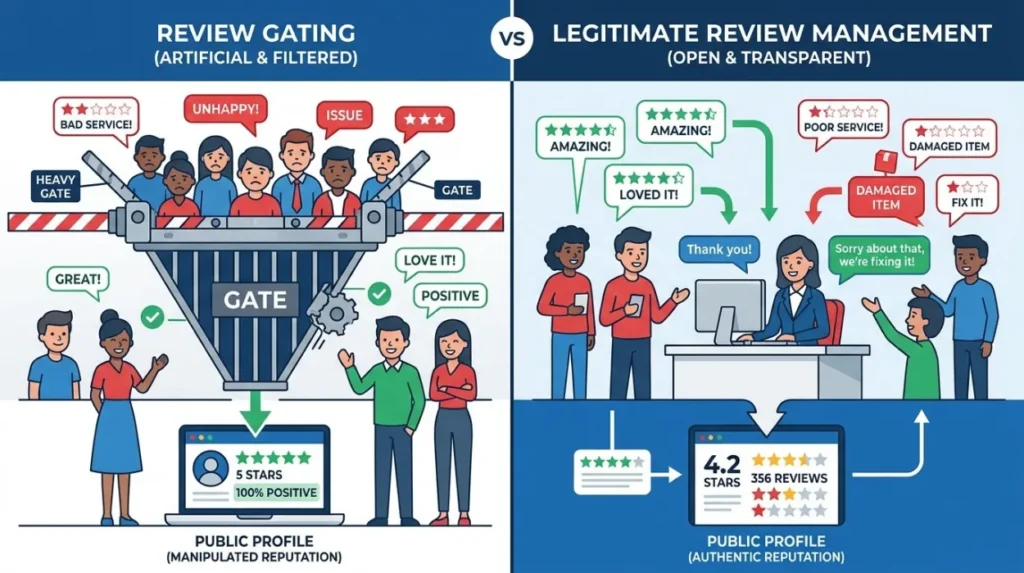
Legitimate review management focuses on collecting authentic feedback, responding appropriately to published reviews and addressing customer concerns without manipulating who can leave public feedback. Review gating instead introduces a filtering mechanism based on customer sentiment before public review submission. The difference is therefore structural rather than cosmetic. Both approaches can involve automated messages, email requests or customer-feedback platforms, but their treatment of negative experiences determines whether the process becomes problematic.
A legitimate process can include internal customer feedback alongside public review requests. Businesses can use private feedback channels to identify service problems while still providing customers with an independent route to public reviews. The important factor is that private feedback does not replace or restrict public review opportunities for dissatisfied customers. This preserves the representativeness of the public review ecosystem.
Review management also includes responding to negative reviews in a factual and professional manner. A business cannot control every customer opinion, but it can provide context, correct factual inaccuracies and demonstrate how complaints are addressed. This creates additional reputation signals without manipulating the original review. The resulting digital footprint therefore contains both customer feedback and the business’s response.
What happens when negative reviews are removed or excluded?
Removing or excluding negative reviews changes the visible sentiment distribution of the business’s review profile. When legitimate customer feedback is selectively excluded, users receive less information about the full range of experiences associated with the business. This can make the public rating appear stronger than the underlying customer feedback would indicate. The difference creates a potential credibility gap between the review profile and other information sources.
Platform removal also differs from business-controlled exclusion. A platform can remove reviews that violate its policies, such as content that is fraudulent, abusive or otherwise prohibited. A business selectively preventing dissatisfied customers from reaching the review platform represents a different mechanism. The former is platform enforcement, while the latter changes the composition of feedback before publication.
These distinctions matter when analysing reputation signals. A legitimate removal process can improve information quality by eliminating prohibited content. Selective exclusion can reduce information completeness by preventing legitimate criticism from appearing. Reputation analysis therefore needs to distinguish between content moderation and review manipulation.
How can businesses collect reviews without breaking anti-gating rules?
Businesses can collect reviews without breaking anti-gating rules by providing customers with an equal opportunity to share genuine feedback regardless of sentiment. A compliant process treats positive and negative experiences as equally eligible for public review. Businesses can also use feedback requests to identify service issues without restricting access to public review platforms. This creates a clearer relationship between customer experience and published reputation signals.
A practical framework includes the following actions:
- Invite customers to provide genuine feedback without filtering them according to satisfaction.
- Direct customers to the public review platform without creating separate routes based on positive or negative responses.
- Avoid incentives that condition rewards on positive reviews or favourable ratings.
- Monitor review activity for policy compliance rather than attempting to control sentiment distribution.
- Respond to negative feedback professionally while addressing factual issues through appropriate channels.
These practices focus on the integrity of the review process rather than maximising a particular rating. Businesses gain more reliable reputation information when customers retain independent control over what they publish. The resulting review profile provides a more representative view of customer experience.
For a deeper consideration of compliant review collection, Collecting Reviews Without Breaking Google’s Anti-Gating Rules examines the distinction between legitimate review requests and practices that manipulate public feedback. The key principle remains consistent: review collection needs to preserve customer independence.
How do review practices affect search visibility and entity perception?
Review practices affect search visibility by influencing the information associated with a business entity across review platforms and search results. Search engines encounter ratings, review text and other business information as part of their broader entity understanding. The quality and authenticity of those signals influence the reliability of the information ecosystem surrounding the business. Review practices therefore have implications beyond the rating displayed on an individual platform.
Entity perception develops from the combined information available about a business. Reviews represent one component alongside official websites, business profiles, news coverage, social content and third-party references. When these sources provide consistent information, users receive a clearer representation of the entity. When review practices create artificial differences between public sentiment and customer experiences, the wider information environment becomes less coherent.
Search visibility is therefore not simply a function of obtaining more positive reviews. A sustainable reputation depends on the credibility and context of the information associated with the business. Authentic reviews provide useful customer signals, while manipulated review practices introduce compliance and trust risks. The distinction is central to understanding reputation within search ecosystems.
What should businesses understand about review gating and reputation?
Review gating is fundamentally an information-integrity issue because it changes who receives access to a public review opportunity. Google’s review ecosystem is designed around authentic customer contributions rather than selectively generated positive feedback. Businesses that filter customers according to sentiment introduce a structural difference between actual customer experiences and published reviews. That difference creates both policy and reputation risks.
The broader lesson is that online reputation cannot be reduced to a single star rating. Reputation management analyses how reviews, content, authority, sentiment and entity information interact across search ecosystems. Authentic review collection strengthens the reliability of these signals, while selective review solicitation weakens their representational value. Businesses therefore benefit from understanding the mechanisms behind review visibility rather than treating ratings as isolated SEO assets.
Review gating can create significant problems because it interferes with the relationship between genuine customer experience and public review content. Google’s policies distinguish legitimate review solicitation from practices that selectively encourage positive feedback or discourage negative reviews. The resulting risks involve policy compliance, review integrity, sentiment distribution and the credibility of the business’s digital footprint.
Authentic review management focuses on collecting representative feedback, maintaining customer independence and responding appropriately to published reviews. Search engines evaluate review information alongside wider reputation signals, meaning a sustainable online reputation depends on the quality and consistency of the complete entity record.
Understanding review gating therefore requires more than examining whether a business has a high rating. It requires analysing how reviews were generated, how sentiment is represented, how content is indexed and how the resulting information contributes to search visibility and entity perception.
What is review gating and why is it against Google’s review policies?
Review gating is the practice of filtering customers based on satisfaction before directing them to leave a public review. It can violate Google’s review policies because it selectively encourages positive feedback while preventing dissatisfied customers from having the same opportunity to publish reviews.
Can review gating result in a Google penalty?
Review gating can create enforcement and reputation risks when it involves prohibited review manipulation. Google can remove policy-violating reviews or take other actions where its review policies are breached, although enforcement depends on the specific circumstances.
How does review gating affect a business’s online reputation?
Review gating can create an inaccurate sentiment distribution by excluding feedback from dissatisfied customers. This can weaken the reliability of a business’s review profile and create inconsistencies within its wider online reputation.
Is it legal to ask customers for Google reviews?
Businesses can generally ask customers to provide genuine feedback, but the review request process must comply with applicable laws and platform policies. Selectively directing only satisfied customers towards public reviews creates a different compliance risk from requesting reviews from customers generally.
How can businesses collect Google reviews without review gating?
Businesses can request genuine reviews from customers without filtering them according to satisfaction or directing negative respondents away from public review platforms. A neutral review collection process gives customers an independent opportunity to share positive, negative or neutral experiences.