

Reputation management is the systematic control, monitoring, and interpretation of information that shapes how individuals or organisations are perceived within search ecosystems.
Online reputation refers to the aggregated representation of an entity formed through indexed content, user-generated signals, and algorithmic ranking in search results.
This process operates within search engines that continuously evaluate content relevance, authority, and trust signals to construct a visible identity for each entity.
What is online reputation management within search ecosystems?
Online reputation management is the structured interpretation of how digital content defines and influences entity perception across search engines. It refers to the process by which information about a person, business, or organisation is indexed, ranked, and displayed to shape credibility signals within SERPs.
Definition of online reputation management
Online reputation management defines the relationship between published digital content and its resulting perception in search environments. It evaluates how information consistency, sentiment, and authority signals form a unified identity. Search engines treat this identity as an entity profile constructed from multiple data sources, including websites, directories, reviews, and news content.
Read More:
Professional Reputation Management Services for Individuals and Businesses
How to Improve Your Online Reputation and Remove Negative Search Results
Mechanism of reputation formation
Reputation formation operates through content indexing, entity recognition, and ranking systems that assign value to information based on relevance and trust indicators. Search algorithms process textual data, links, engagement signals, and contextual relationships to determine which content best represents an entity. This mechanism ensures that higher-ranked information exerts stronger influence over public perception.

Impact on search visibility
Search visibility determines which aspects of an entity’s reputation become most prominent. Content positioned on the first page of search results establishes primary perception signals, while lower-ranked pages contribute secondary context. The structure of search visibility directly shapes how users interpret credibility, reliability, and authority.
How do search engines construct and evaluate online reputation signals?
Search engines construct reputation signals through automated systems that analyse content relevance, link authority, and semantic relationships between entities. These systems evaluate whether information strengthens or weakens the perceived credibility of an entity within indexed datasets.
Content crawling and indexing processes
Search engines continuously crawl web pages to collect structured and unstructured data. This content is then indexed, allowing algorithms to classify information based on topic relevance and entity association. Indexing ensures that reputation-related data becomes part of a searchable knowledge system that defines how entities are represented.
Entity recognition and semantic mapping
Entity recognition defines how search engines identify real-world subjects such as individuals, brands, or organisations. Semantic mapping connects these entities to related concepts, attributes, and contextual references across the web. This process ensures that reputation is not based on isolated pages but on interconnected information networks.
Ranking systems and trust evaluation
Ranking systems evaluate reputation signals by measuring authority, content quality, and contextual relevance. Trust evaluation is determined by consistency across multiple sources, where repeated validation strengthens perceived credibility. Search engines prioritise content that demonstrates stability, relevance, and alignment with established entity profiles.
What role do SERPs play in shaping entity perception?
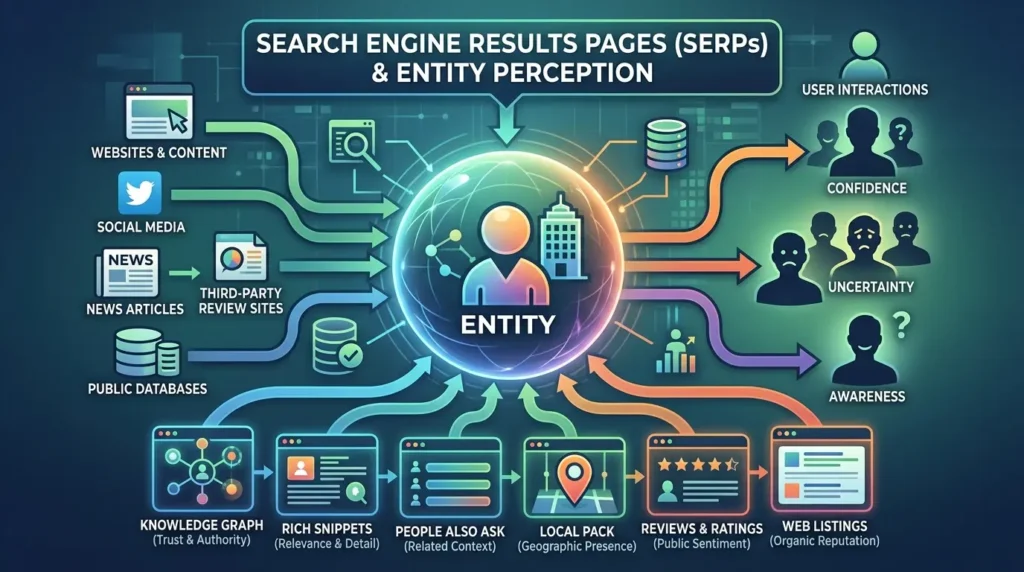
Search Engine Results Pages (SERPs) directly shape how users interpret reputation by controlling the order, structure, and type of visible information associated with an entity. SERPs function as the primary interface between search algorithms and public perception.
SERP composition and information hierarchy
SERP composition defines the structured arrangement of links, snippets, and knowledge panels that represent an entity. The hierarchy of results determines which narratives dominate perception. Higher-ranked pages establish primary meaning, while lower-ranked content adds supplementary context.
Featured elements and structured data
Featured elements such as knowledge panels, rich snippets, and direct answers consolidate reputation signals into summarised formats. These elements extract structured data from multiple sources, presenting a unified representation of an entity. This consolidation reinforces perceived authority and reduces ambiguity in identity interpretation.
SERP evaluation and credibility perception
SERP evaluation refers to how users interpret trust based on visible ranking positions and content types. Higher-ranking results are associated with stronger credibility signals due to algorithmic prioritisation. This evaluation process links technical ranking mechanisms directly to psychological perception of authority.
How does digital footprint influence reputation and credibility?
Digital footprint refers to the cumulative record of all indexed content associated with an entity across the internet. It directly influences reputation by forming the dataset that search engines use to construct identity profiles.
Content distribution across platforms
Digital footprint is shaped by content distributed across websites, social platforms, directories, and news sources. Each platform contributes distinct reputation signals that collectively define entity perception. Consistency across platforms strengthens credibility, while fragmentation introduces conflicting signals.
Historical content persistence
Search engines retain historical content through caching and archival systems. This persistence ensures that older information continues to influence reputation signals even after updates occur. Historical content contributes to long-term perception stability within entity profiles.
Aggregation of contextual signals
Digital footprint analysis aggregates contextual signals such as mentions, citations, and references across multiple domains. These signals establish relational authority by linking entities to broader topics and networks. Strong contextual aggregation improves perceived trustworthiness within search ecosystems.
How are reviews and sentiment interpreted as reputation signals?
Reviews and sentiment are interpreted by search systems as behavioural indicators of trust, satisfaction, and credibility. These signals contribute to algorithmic assessments of reputation strength and user perception alignment.
Sentiment analysis within search systems
Sentiment analysis processes textual data to classify opinions as positive, neutral, or negative. Search engines evaluate aggregated sentiment to determine overall reputation trends. This classification influences how prominently an entity appears in relevant search queries.
Behavioural engagement signals
Behavioural signals include user interactions such as click-through rates, dwell time, and return frequency. These metrics indicate how users respond to content associated with an entity. High engagement reinforces positive reputation signals within ranking systems.
Review aggregation and trust weighting
Review aggregation systems consolidate feedback from multiple platforms into unified reputation indicators. Trust weighting assigns greater influence to verified or authoritative sources. This ensures that reputation signals reflect both quantity and quality of user-generated content.
How does content ranking affect perceived trust and authority?
Content ranking affects perceived trust by determining which information is most visible and therefore most influential in shaping entity perception. Search engines prioritise content that demonstrates authority, relevance, and semantic coherence.
Authority evaluation through ranking position
Ranking position functions as a proxy for authority within search ecosystems. Higher-ranked content is interpreted as more credible due to algorithmic validation. This positioning reinforces trust signals even before content is fully evaluated by users.
Content relevance and semantic alignment
Relevance is determined by how closely content matches user intent and entity-related queries. Semantic alignment ensures that content accurately represents the entity’s attributes and context. Strong alignment improves both ranking stability and reputation consistency.
Information consistency across sources
Consistency across multiple indexed sources strengthens perceived authority. Search engines evaluate whether different pages provide aligned descriptions of the same entity. Inconsistent information reduces trust signals and weakens overall reputation stability.
How is reputation measured through search visibility and entity association?
Reputation is measured through structured analysis of search visibility patterns and entity association strength across indexed content. These measurements define how prominently and consistently an entity appears within search ecosystems.
Search visibility distribution
Search visibility distribution evaluates how often and where an entity appears across SERPs. High visibility across multiple queries indicates strong reputation signals. Low or fragmented visibility suggests weak or inconsistent entity representation.
Entity association strength
Entity association strength measures how strongly an entity is linked to related topics, keywords, and contextual networks. Strong associations indicate that search engines recognise the entity as authoritative within its domain. Weak associations reduce semantic clarity and visibility.
Cross-platform consistency metrics
Cross-platform consistency metrics evaluate whether information about an entity remains stable across multiple indexed sources. Consistency reinforces credibility by reducing ambiguity in search interpretation. Variations in data weaken trust signals and reduce overall reputation strength.
Online reputation within search ecosystems is constructed through a structured interaction of indexing systems, ranking algorithms, and semantic entity mapping. Reputation signals emerge from content distribution, behavioural data, sentiment interpretation, and SERP composition.
Search engines evaluate these signals collectively to define entity credibility, visibility, and authority. Digital footprints, reviews, and content ranking dynamics all contribute to how reputation is formed and maintained across search environments. Understanding these mechanisms provides a clear framework for analysing how information is interpreted and displayed within modern search systems.
What is online reputation management and why is it important?
Online reputation management (ORM) is the process of monitoring, influencing, and improving how a person or business appears in search results and online platforms. It involves managing reviews, search visibility, and digital content to shape public perception. A strong online reputation helps build trust, credibility, and customer confidence.
How does online reputation management work for businesses and individuals?
ORM works by tracking mentions, reviews, and search engine results related to a brand or person. It then uses strategies like content creation, review management, and search optimization to improve visibility of positive information. Services like Clear My Name focus on improving digital reputation signals across Google and other platforms.
How long does it take to improve an online reputation?
The time required for online reputation improvement depends on the severity of negative content and competition in search results. Minor issues may improve within a few weeks, while complex cases can take several months. Consistent reputation management and SEO efforts are key to long-term results.
Can negative Google reviews be removed or managed?
Negative Google reviews can sometimes be removed if they violate platform policies, but most reviews cannot be deleted directly. In such cases, reputation management focuses on responding professionally and improving overall review sentiment. This helps reduce the impact of negative feedback on search visibility and trust.
What strategies are commonly used in online reputation management?
Common ORM strategies include search engine optimization, content publishing, review monitoring, and suppression of negative search results through positive content. It also involves social media management and customer feedback analysis. These methods help improve how a brand or individual is perceived online.