

Google review growth in 2026 depends on structured data analysis, sentiment measurement, and systematic reputation signal optimisation across digital touchpoints. Effective review strategies rely on measuring review quality, velocity, authenticity, and sentiment distribution rather than increasing review volume alone.
Reputation management strategies differ based on organisational objectives, search visibility requirements, and risk exposure within local search ecosystems. Online reputation control methods are evaluated through search ranking influence, entity credibility, review sentiment distribution, and long-term sustainability of trust signals.
How does a data-driven Google review strategy differ from volume-based review growth?
A data-driven Google review strategy prioritises review quality and behavioural metrics, whereas volume-based approaches focus primarily on increasing review counts. Google Review Management is the systematic process of monitoring, analysing, and optimising review-related reputation signals across search ecosystems. Data-driven strategies operate by measuring sentiment trends, response rates, keyword relevance, and review recency. Volume-based models operate by increasing review acquisition frequency without deeper analysis of quality indicators.
Search engines interpret reviews as reputation signals that contribute to local ranking systems and entity understanding. High review counts without sentiment diversity or topical relevance create weaker entity credibility compared with balanced and authentic feedback. Data-driven frameworks evaluate review velocity patterns and customer experience indicators to identify sustainable growth opportunities. Volume-centric approaches generate short-term visibility increases but expose organisations to authenticity risks and irregular sentiment distribution.
Review ecosystems increasingly rely on behavioural analysis rather than numerical accumulation. Search ranking influence emerges from review recency, reviewer authority, response activity, and semantic relevance within feedback content. A structured review strategy measures these variables continuously. This analytical approach creates stable reputation signals that remain resilient during algorithm updates.
Which review metrics provide the strongest reputation signals in search ecosystems?
Sentiment quality, review recency, and response engagement generate stronger reputation signals than raw review quantity. Review metrics are measurable indicators that search systems use to assess trustworthiness and relevance. Sentiment distribution is the balance of positive, neutral, and negative feedback across time periods. Entity credibility operates through consistent evidence of authentic customer experiences.

Key metrics within a data-driven framework include:
- Measure sentiment trends to identify recurring strengths and operational weaknesses.
- Track review velocity to evaluate consistency of customer feedback generation.
- Analyse response rates to assess engagement and reputation maintenance.
- Evaluate keyword presence to determine semantic relevance for local search.
- Monitor reviewer diversity to strengthen authenticity indicators.
Search engines analyse textual patterns within reviews to understand products, services, and customer experiences. Keyword-rich reviews contribute contextual relevance, while repetitive or unnatural language reduces trust signals. Review recency influences search ranking because fresh feedback reflects current performance. Balanced sentiment distribution often signals authenticity more effectively than uniformly positive reviews.
Metrics differ in scalability and sustainability. Review quantity scales quickly but offers limited long-term value without supporting quality indicators. Sentiment analysis scales effectively through automation while maintaining strategic insight. Organisations that measure multiple signals gain stronger visibility into reputation health and search performance.
How do proactive and reactive review management approaches compare?
Proactive review management focuses on systematic reputation development, whereas reactive management addresses issues after negative sentiment appears. Proactive strategies operate by generating consistent feedback opportunities and monitoring reputation indicators continuously. Reactive strategies operate by responding to complaints, disputes, or declining ratings. Both approaches influence trust signals differently within search ecosystems.
Proactive methods create stable review velocity and strengthen entity credibility over time. Consistent engagement encourages balanced sentiment distribution and reduces volatility in overall ratings. Search systems interpret ongoing activity as evidence of relevance and operational stability. This approach supports sustainable search ranking influence and long-term reputation resilience.
Reactive methods address immediate risks but often produce delayed reputation recovery. Negative reviews remain visible in search results even after resolution. Reactive strategies reduce damage exposure yet provide limited control over SERP composition. The absence of preventative mechanisms increases vulnerability to sudden sentiment shifts.
Comparative analysis reveals differences in sustainability and scalability. Proactive frameworks require structured processes and ongoing measurement. Reactive models require fewer resources initially but increase long-term risk exposure. Reputation management systems achieve stronger outcomes when preventative monitoring complements corrective action.
How do review responses influence trust signals and entity credibility?
Review responses strengthen trust signals by demonstrating engagement, transparency, and operational accountability. Review responses are public interactions that contribute additional contextual data to search ecosystems. Search systems evaluate response frequency, response quality, and timeliness as behavioural indicators. Entity credibility increases when organisations consistently engage with customer feedback.
Responses to positive reviews reinforce satisfaction themes and strengthen semantic associations with relevant services or experiences. Responses to negative reviews provide context that influences user perception beyond star ratings. Search visibility benefits when response content adds relevant information without repetitive promotional language. These interactions expand entity understanding within search environments.
Response strategies differ in effectiveness. Generic responses scale efficiently but contribute limited contextual value. Personalised responses generate stronger trust signals because they demonstrate authenticity and operational awareness. Excessively standardised replies reduce perceived credibility and weaken engagement signals.
Long-term reputation outcomes depend on response consistency. Irregular engagement creates fragmented reputation signals. Systematic response frameworks improve sentiment recovery and maintain balanced perception across search results. Search ecosystems increasingly interpret interaction quality as part of broader trust evaluation models.
What impact do review acquisition methods have on SERP composition?
Review acquisition methods directly influence SERP composition because reviews contribute to local packs, knowledge panels, and branded search results. SERP composition is the arrangement of search assets associated with an entity. Review generation methods operate by influencing the volume, quality, and recency of user-generated content. Different acquisition models produce distinct search outcomes.
Organic acquisition relies on customer experience and structured feedback requests. This method generates authentic sentiment distribution and supports long-term entity credibility. Search engines interpret naturally acquired reviews as reliable reputation signals. Organic methods create sustainable visibility with lower risk exposure.
Incentivised or manipulated acquisition methods distort sentiment patterns and create authenticity concerns. Search systems detect irregular review behaviour through velocity analysis and behavioural signals. Artificial review generation exposes organisations to policy violations and reduced trust. Such approaches influence visibility negatively when detected.
SERP control strategies increasingly depend on content enhancement rather than content suppression. Positive review ecosystems expand favourable search assets and reduce the prominence of negative content through relevance competition. This mechanism reshapes perception without altering historical information directly.
How do short-term reputation tactics compare with long-term review strategies?
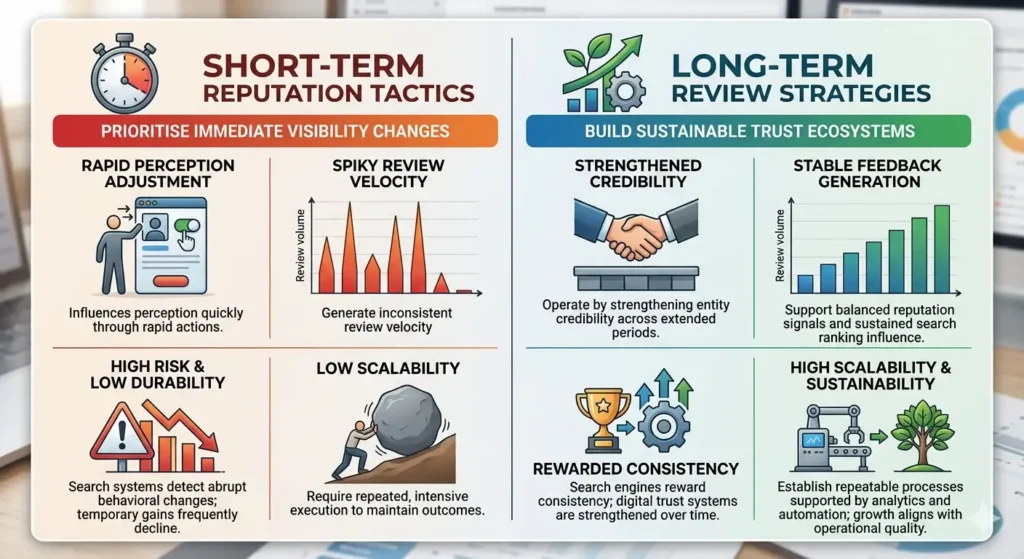
Short-term tactics prioritise immediate visibility changes, whereas long-term strategies build sustainable trust ecosystems. Short-term reputation management is the rapid adjustment of visible perception signals. Long-term strategies operate by strengthening entity credibility across extended periods. These approaches differ significantly in effectiveness and risk exposure.
Short-term methods include rapid review campaigns and intensive response efforts following negative events. These actions influence perception quickly but often generate inconsistent review velocity. Search systems identify abrupt behavioural changes, limiting the durability of ranking improvements. Temporary gains frequently decline without continued engagement.
Long-term frameworks integrate review collection, sentiment analysis, and continuous optimisation. Stable feedback generation supports balanced reputation signals and sustained search ranking influence. Search engines reward consistency because it reflects ongoing relevance and reliability. This approach strengthens digital trust systems over time.
Scalability differs substantially between these models. Short-term interventions require repeated execution to maintain outcomes. Long-term systems establish repeatable processes supported by analytics and automation. Sustainability increases when reputation growth aligns with operational quality rather than isolated campaigns.
How do content enhancement and content suppression strategies affect reputation management?
Content enhancement strengthens positive digital assets, whereas content suppression reduces the visibility of unfavourable information through competing relevance. Content enhancement is the creation and optimisation of valuable reputation assets. Content suppression operates by increasing the prominence of alternative content within search ecosystems. These methods influence perception differently.
Review ecosystems primarily benefit from content enhancement because authentic customer feedback contributes trusted third-party validation. Positive reviews improve sentiment distribution and reinforce entity credibility. Search systems interpret diversified positive content as evidence of relevance and authority. This strategy strengthens long-term trust signals.
Content suppression approaches depend heavily on search ranking dynamics and asset creation. Suppression mechanisms alter SERP composition by promoting stronger competing content. Negative content remains accessible, but reduced visibility changes user perception patterns. The effectiveness of suppression varies according to content authority and search intent.
Dive Deeper With Our Expert Guides:
How Negative Google Reviews Influence Leads, Sales, and Retention
Comparing 5 Google Review Management Approaches for Local Businesses
Comparative analysis reveals distinct limitations. Enhancement strategies require sustained engagement and operational consistency. Suppression strategies demand extensive content ecosystems and ongoing optimisation. Search ecosystems increasingly reward authenticity, making enhancement-based reputation management more sustainable over time.
How can organisations evaluate the effectiveness of a review growth strategy for 2026?
Review growth effectiveness is measured through reputation signal quality, visibility outcomes, and trust indicators rather than review quantity alone. Evaluation frameworks operate by connecting review data with search performance and user perception metrics. Effective measurement systems compare historical baselines with ongoing outcomes. Analytical review management relies on continuous assessment rather than isolated reporting.
Key evaluation dimensions include:
- Assess sentiment distribution to determine balance and authenticity.
- Measure local search visibility to identify ranking changes.
- Track conversion indicators to evaluate behavioural impact.
- Compare review recency trends to maintain relevance signals.
- Analyse entity mentions to strengthen semantic associations.
Search ecosystems increasingly evaluate entities through interconnected trust signals. Reviews interact with content quality, engagement patterns, and local relevance indicators. Effective frameworks therefore analyse reputation as a network rather than an isolated metric. This holistic evaluation supports sustainable digital trust systems.
Future review strategies increasingly depend on structured data analysis and semantic understanding. Search engines continue refining entity-based evaluation models that prioritise credibility and authenticity. Organisations that align review systems with measurable reputation indicators create stronger resilience against algorithmic change.
Deeper analysis of frameworks such as:
Google Review Management Framework illustrates how integrated reputation systems influence long-term search perception.
Data-driven Google review strategies for 2026 depend on measuring reputation signals rather than pursuing review quantity alone. Proactive frameworks create stronger entity credibility than reactive models, while long-term systems generate more sustainable outcomes than short-term interventions.
Content enhancement and authentic review acquisition influence SERP composition more effectively than suppression-focused methods. Search engines increasingly evaluate sentiment distribution, engagement quality, and review recency as interconnected trust signals. Effective reputation management therefore operates as a continuous analytical process that measures visibility, perception, and credibility across evolving search ecosystems.
Answers to Key Questions
How does Google Review Management affect local search rankings?
Google Review Management influences local search visibility through review quantity, recency, sentiment, and response activity. Search engines use these reputation signals to evaluate entity credibility and search ranking influence.
Can negative Google reviews impact online reputation?
Negative Google reviews affect customer trust, sentiment distribution, and click-through behaviour. Effective Google Review Management focuses on monitoring feedback, responding appropriately, and maintaining balanced reputation signals.
What makes a Google review strategy data-driven?
A data-driven review strategy measures review trends, sentiment analysis, response rates, and review velocity. This approach helps evaluate online reputation performance using measurable search and trust indicators.
How often should businesses monitor Google reviews?
Google reviews require regular monitoring to track changes in customer sentiment and emerging reputation risks. Consistent review management supports accurate reputation analysis and stronger entity credibility.