

Online reputation control methods are evaluated through their capacity to modify entity credibility and rebalance the sentiment distribution of search engine results pages (SERPs). Managing digital trust during misinformation campaigns requires a comparative analysis of content suppression versus content enhancement to determine the most sustainable method for stabilizing public perception.
How Does Misinformation Alter Search Engine Interpretation of Political Reputation Signals?
Misinformation alters search engine interpretation by generating a high volume of coordinated, negative engagement signals that manipulate algorithmic trust thresholds. Search engine algorithms track entity relationships, query volume spikes, and sentiment density across indexed web pages to determine the authority of a public figure. When a misinformation campaign launches, the rapid influx of fresh, keyword-targeted content triggers recency bias mechanisms within search ranking systems. This algorithmic shift prioritizes the visibility of unverified claims due to the sudden inflation of user search demand and click-through rates.
The mechanism relies on the distortion of the entity graph, where the political figure becomes semantically linked to negative attributes, defamatory keywords, and untrusted digital nodes. Search engines interpret these dense clusters of negative associations as contextual relevance, which lowers the overall entity credibility score of the individual. As a result, the algorithmic filtering systems that suppress low-quality data fail to distinguish between organic news interest and artificial sentiment manipulation. The altered reputation signals cause a degradation in informational authority, which forces automated discovery systems to elevate critical content above historical, verified profiles.
Evaluating this structural change reveals that the primary damage occurs not merely from the existence of false data, but from the systemic rewriting of algorithmic associations. Remediation methods must therefore address the underlying data layer rather than focusing solely on user-facing front-ends. Simply ignoring the shift allows the negative semantic network to solidify, making subsequent suppression efforts resource-intensive and structurally complex. Long-term stabilization requires a precise re-engineering of the entity’s digital footprint to re-establish verified informational nodes.
What Are the Functional Differences Between Content Suppression and Content Removal Strategies?
Content suppression and content removal strategies differ fundamentally in their operational mechanisms, legal dependencies, and permanence within the search ecosystem. Content removal operates by permanently deleting defamatory or inaccurate URLs from the live web or forcing search engines to de-index specific links via legal frameworks like the Right to Be Forgotten. The mechanism requires direct intervention through webmaster outreach, copyright claims, or judicial orders to strip the target data from the index entirely. This approach eliminates the risk exposure associated with that specific data point, ensuring it cannot reappear in organic searches for the target entity.
Content suppression accepts the persistence of the negative material but dilutes its visibility by engineering an oversupply of high-authority, optimized content. This mechanism leverages search ranking influence to populate the first page of the SERP with controlled, positive, or neutral informational assets, which pushes the damaging URLs down to subsequent pages. Suppression relies on the statistical reality that less than one percent of search users navigate past the first page of results to find information. The process requires continuous algorithmic maintenance, asset optimization, and authority building to prevent the suppressed links from reclaiming their previous visibility during subsequent core updates.
| Evaluation Metric | Content Removal | Content Suppression |
| Operational Mechanism | Eradication of the source data or manual de-indexing from the search database. | Dilution of negative visibility via the promotion of high-authority web assets. |
| Scalability | Low; requires individual legal or administrative actions for every offending URL. | High; addresses broad keyword clusters and multiple negative nodes simultaneously. |
| Risk Exposure | Low for specific links, but high for triggering secondary press coverage regarding censorship. | Medium; dependent on algorithmic stability and ongoing competitor content performance. |
| Sustainability | Permanent once achieved, assuming the source data is not republished elsewhere. | Temporary without active optimization; vulnerable to search engine algorithm updates. |
Why Do Organic Content Enhancement Methods Outperform Reactive Suppression Techniques?
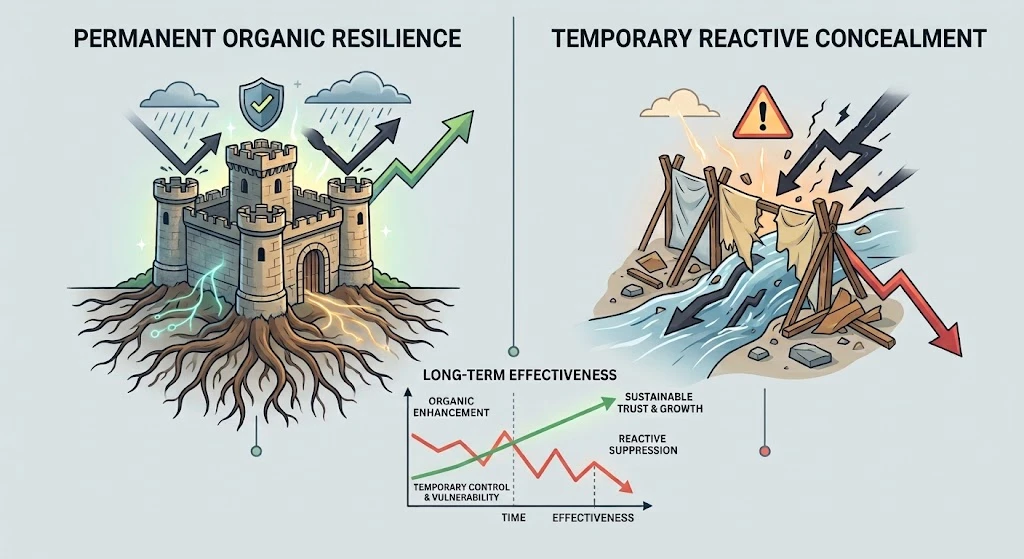
Organic content enhancement methods outperform reactive suppression techniques because they build permanent algorithmic resilience instead of offering temporary structural concealment. Organic content enhancement focuses on the proactive construction of a diverse, authoritative semantic network around the political entity before a crisis occurs. This method operates by establishing verified knowledge panels, optimizing official digital properties, and securing high-authority placements across neutral informational platforms. The mechanism creates a stable foundation of entity credibility that resists sudden spikes in negative sentiment distribution by maintaining a dominant share of search voice.
Reactive suppression techniques function only after the reputation signals have deteriorated, forcing the strategist to fight against an already established algorithmic trend. The mechanism of reactive suppression involves a rushed deployment of secondary web assets to counter the velocity of a live misinformation campaign. This approach carries high risk exposure, as search engines frequently identify sudden bursts of artificial optimization activity as webspam, leading to algorithmic penalties. Furthermore, reactive assets often lack the historical depth and backlink authority required to displace established news media outlets or trending viral domains.
Analysing the long-term effectiveness demonstrates that proactive enhancement conditions the entity graph to favor verified data sources over unverified anomalies. Reactive suppression fails to alter the underlying algorithmic trust parameters, leaving the entity vulnerable to future misinformation shocks if the suppression campaign pauses. Sustainable search perception control demands a continuous commitment to data integrity and network authority rather than episodic crisis intervention. Consequently, strategic resource allocation favors the systemic development of digital trust infrastructure over defensive content manipulation.
How Do Long-Term Reputation Models Control Sentiment Distribution Across Search Ecosystems?
Long-term reputation models control sentiment distribution by consistently feeding search engines structured, authoritative data that validates the entity’s core informational nodes. These models operate through the systematic deployment of schema markup, localized entity verification, and consistent cross-platform content syndication. The mechanism ensures that automated search spiders map the political figure to trusted institutional networks, legislative records, and verified media channels. Over extended periods, this continuous stream of high-quality data entrenches the primary entity relationships, making the SERP structurally resistant to sudden shifts in user query behavior.
Controlling sentiment distribution requires regular measurement of the ratio between controlled informational assets and uncontrolled third-party commentary within the top twenty search results. Long-term models adjust this balance by deploying diversified content types, including video, images, text, and scholarly records, to occupy distinct SERP features like Featured Snippets and People Also Ask. This diversification limits the physical real estate available for unverified misinformation to gain traction within the visible search environment. The systematic occupation of these algorithmic features neutralizes the visibility of volatile, user-generated content platforms during political events.
The sustainability of this approach relies on matching the semantic complexity that search engines expect from authoritative public figures. By building a comprehensive digital footprint that covers all facets of a political career, the model reduces the data gaps that malicious actors exploit with false narratives. When a search engine encounters a comprehensive data network, it assigns a higher stability threshold to the entity’s ranking profile. This structural insulation ensures that malicious query spikes fail to permanently displace the established, verified sentiment distribution.
What Strategic Framework Safely Balages Risk Exposure and Search Ranking Influence?
A safe strategic framework balances risk exposure and search ranking influence by combining strict legal monitoring with systematic, white-hat entity optimization. The framework measures effectiveness through the stabilization of sentiment distribution and the prevention of negative ranking drift over twelve-month cycles. Strategists evaluate potential actions based on their impact on algorithmic trust signals, prioritizing methods that align with search engine quality rater guidelines. This approach avoids high-risk tactics like low-quality link building or automated content generation, which trigger systemic algorithmic suppression.
To implement an effective evaluation framework, public figures must systematically assess their digital vulnerabilities across multiple search vectors. The process involves identifying weak informational nodes, tracking shifting search query patterns, and monitoring the authority of domains publishing critical material. A structured framework ensures that response mechanisms match the exact scale and nature of the reputational threat.
- Identify emerging keyword vulnerabilities by monitoring real-time query inflation and related search changes within target geographic regions.
- Audit the authority and semantic relevance of third-party domains hosting negative content to calculate the required optimization volume for displacement.
- Deploy structured data networks across verified digital properties to reinforce core entity attributes directly within search engine databases.
- Evaluate the permanence of sentiment shifts after core algorithmic updates to determine the necessary adjustments in content asset allocation.
- Monitor legal and administrative pathways for link removal to eliminate high-risk defamatory sources without creating secondary press risks.
Analysing these options demonstrates that relying on a single methodology introduces critical points of failure within a digital trust strategy. Content removal provides absolute resolution for specific policy breaches but lacks the scalability needed to counter decentralized, multi-platform misinformation campaigns. Conversely, content suppression handles large-scale sentiment volatility but remains vulnerable to structural changes in search engine algorithms. A balanced approach relies on building an authoritative digital infrastructure that naturally dampens the impact of hostile digital signals.
Ultimately, long-term political viability within digital environments depends on the continuous maintenance of entity credibility signals. Political entities that proactively manage their data networks achieve greater resilience against the destabilizing effects of unverified online narratives. Transitioning from reactive defense to structured asset optimization allows organizations to secure stable search profiles that accurately reflect verified records. Utilizing comprehensive political reputation management services allows entities to systematically deploy these advanced algorithmic frameworks to safeguard digital trust assets against asymmetric information risks.

Frequently Asked Questions
How does misinformation affect a politician’s search engine results?
Misinformation alters search engine results by creating rapid spikes in negative search queries and coordinated user engagement. Search engine algorithms interpret these sudden clusters of negative keywords and unverified content as highly relevant, which can temporarily elevate defamatory links above older, verified profiles. This algorithmic shift dilutes entity credibility and distorts the overall sentiment distribution on the first page of results.
Can a politician legally remove defamatory content from Google search results?
Politicians can request the removal of defamatory content from Google search results through specific legal channels, such as copyright infringement claims, court orders, or data privacy frameworks like the Right to Be Forgotten. If the content breaches search engine guidelines or regional laws regarding libel, Google may choose to de-index the specific URLs from its search database. However, this process requires direct webmaster outreach or judicial intervention and does not prevent the misinformation from being republished on other domains.
What is the difference between content suppression and content removal in reputation management?
Content removal permanently deletes a negative link or eliminates it from the search index through legal or administrative actions. Content suppression accepts that the negative link remains live but pushes it down to subsequent search pages by promoting an oversupply of high-authority, optimized digital assets. While removal eliminates specific risk exposure entirely, suppression is a scalable strategy that neutralizes broad keyword clusters across the search ecosystem.
How do political reputation management services counter online misinformation?
Political reputation management services counter online misinformation by building an authoritative and resilient digital footprint that reinforces verified entity signals. These services systematically optimize official web properties, deploy structured data networks, and secure high-authority placements to naturally dominate search engine real estate. By managing the sentiment distribution across search results, Clear My Name helps public figures neutralize volatile narrative spikes and stabilize long-term digital trust.
How long does it take to repair a political reputation on search engines after a crisis?
Repairing a political reputation on search engines after an information crisis typically takes between three to nine months, depending on the authority of the domains hosting the negative content. Displacing deeply entrenched misinformation requires a continuous commitment to organic content enhancement and authority building to alter algorithmic trust thresholds. Long-term reputation models must be maintained constantly to ensure the search ecosystem remains insulated against future sentiment volatility.