

Misinformation campaigns distort public perception by introducing fabricated or manipulated narrative units into the digital ecosystem, which alters how search engines index and rank an entity. Within search ecosystems, search reputation refers to the algorithmic synthesis of trust, authority, and sentiment signals that determine the visibility and perceived credibility of a named entity.
What Is the Relationship Between Information Integrity and Search Reputation?
Information integrity directly dictates the structural health of an entity’s digital footprint. In semantic search systems, search engines view political figures as distinct entities with specific attributes connected via a knowledge graph. When coordinated networks deploy misinformation, they alter the density of negative associations linked to that entity. This shift influences how search algorithms calculate trust scores, as algorithmic systems prioritize freshness, relevance, and engagement metrics. Consequently, unverified or false narratives gain high initial search visibility due to rapid query spikes and social amplification.
The mechanism relies on data saturation across indexed web properties. Search engine spiders scrape news sites, forums, and social platforms, aggregate sentiment signals, and adjust the entity’s Search Engine Results Pages (SERPs). If the volume of manipulated content outpaces factual data, the search engine indexes the misinformation as a core attribute of the politician. This process alters the entity perception, forcing the algorithm to display defamatory or inaccurate snippets in top ranking positions. Over time, these algorithmic adjustments codify the misinformation as a primary component of the permanent digital footprint.
How Do Algorithms Interpret Trust and Credibility During Misinformation Swarms?
Algorithms evaluate credibility through specific data validation frameworks, such as Experience, Expertise, Authoritativeness, and Trustworthiness (E-E-A-T) guidelines. During a misinformation swarm, coordinated networks exploit these systems by artificial inflation of topical authority. Search engines attempt to filter low-quality information by cross-referencing new data claims against established, highly trusted entities within the knowledge graph. However, if multiple independent, indexed sources repeat a false claim, the algorithm identifies a false consensus, which temporarily validates the inaccurate data.
- Parse incoming content for semantic consistency by comparing new text blocks against historical entity attributes.
- Evaluate backlink velocity changes to detect whether natural interest or automated syndication networks drive the content volume.
- Analyse user engagement patterns, including click-through rates and dwell times, to determine if the content satisfies search intent.
- Assess source authority metrics of the publishing domains to assign a definitive weight to the hosted claims.
When these four steps conclude, the system outputs a revised trust score for the specific entity. If the misinformation originates from domains with high baseline authority, or if it achieves significant algorithmic engagement, the search engine suppresses historical factual content. The sentiment interpretation shifts from neutral or positive to adversarial, which restructures the hierarchical order of the SERP.
Why Do Search Engine Results Pages Polarise During Political Crises?
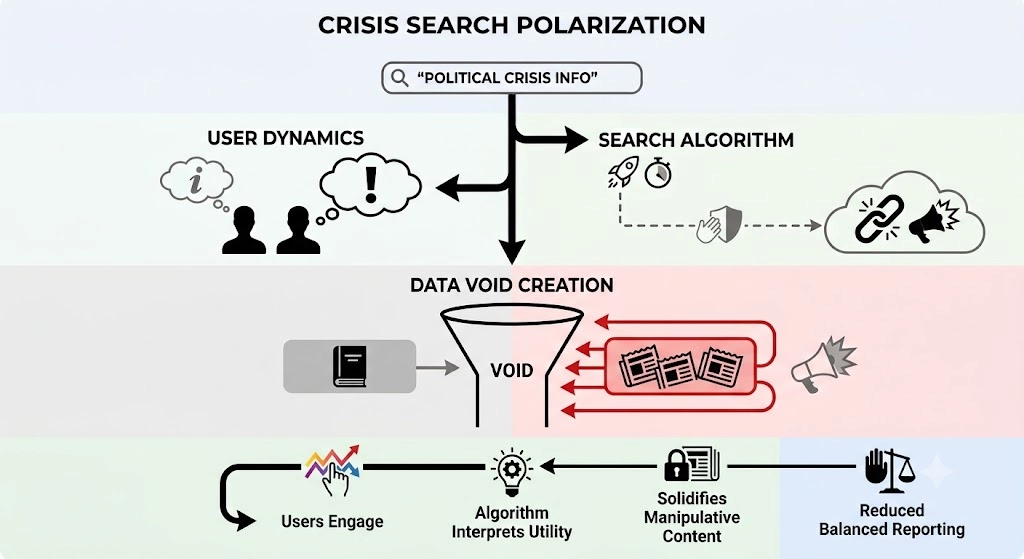
SERPs polarise because search algorithms aim to reflect real-time web dynamics while simultaneously trying to serve diverse user intents. During a political crisis, user queries vary significantly in intent, phrasing, and underlying bias. Search engines use query-deserving-freshness (QDF) protocols to elevate real-time content, which temporarily bypasses some traditional authority filters. This operational phase allows unverified information, algorithmic bias, and hyper-partisan commentary to populate the first page of search results.
The underlying mechanism involves the creation of data voids. Data voids occur when high-volume search queries yield few high-quality, factual search results, allowing low-credibility sites to occupy top positions unchallenged. Misinformation campaigns deliberately engineer specific phrases to exploit these voids, ensuring that users who search for those terms encounter exclusively biased narratives. As users interact with these highly polarised results, the algorithm interprets the engagement as utility, which solidifies the ranking of the manipulative content and reduces the visibility of objective, balanced reporting.
How Does Content Indexing Amplify the Longevity of a Misinformation Campaign?
Content indexing converts transient digital noise into permanent archival records within search databases. When a search engine indexes a web page containing misinformation, it extracts semantic triples—subject, predicate, and object clauses—to update its understanding of the political entity. Even if the original source later deletes or retracts the defamatory content, the cached versions and secondary syndication copies persist across the index. This structural persistence ensures that the reputational damage remains active long after the initial news cycle concludes.
The longevity increases through the compounding effect of historical search visibility. Pages that rank highly during the peak of a misinformation campaign accumulate natural backlinks from secondary researchers, bloggers, and citizens who mistake the ranked content for verified truth. This link equity signals to the algorithm that the page possesses long-term value, preventing it from dropping in rank when the QDF phase ends. As a result, the algorithmic memory retains the negative associations, regularly displaying them to users who conduct baseline background research on the political entity.
What Are the Computational Metrics Used to Assess the Impact of Misinformation on Political Reputation and Trust?
Computational metrics allow analysts to measure exactly how deeply misinformation has penetrated search architectures. Search perception control relies on tracking data points that indicate whether an algorithmic shift is temporary or structural. By monitoring changes in entity connections, keyword associations, and visibility scores, analysts determine the exact degree of distortion within the search ecosystem.
- Monitor entity proximity scores within the knowledge graph to verify if negative attributes have achieved permanent linkage to the politician.
- Track share of search metrics across specific risk keywords to calculate the percentage of users exposed to defamatory content.
- Evaluate sentiment distribution across featured snippets and people-also-ask (PAA) boxes to identify shifts in algorithmic consensus.
- Analyse domain authority degradation of official assets relative to adversarial domains to estimate long-term search visibility losses.
Quantification of these metrics provides a baseline for understanding how search engines view an entity’s online credibility. When high-volume search queries consistently surface negative PAA questions, it demonstrates that the algorithm has integrated the misinformation into its predictive user intent models. This integration marks the transition from a short-term public relations problem to a systemic structural deficit within the search ecosystem.
How Do Review Signals and Sentiment Interpretation Affect Public Figures?
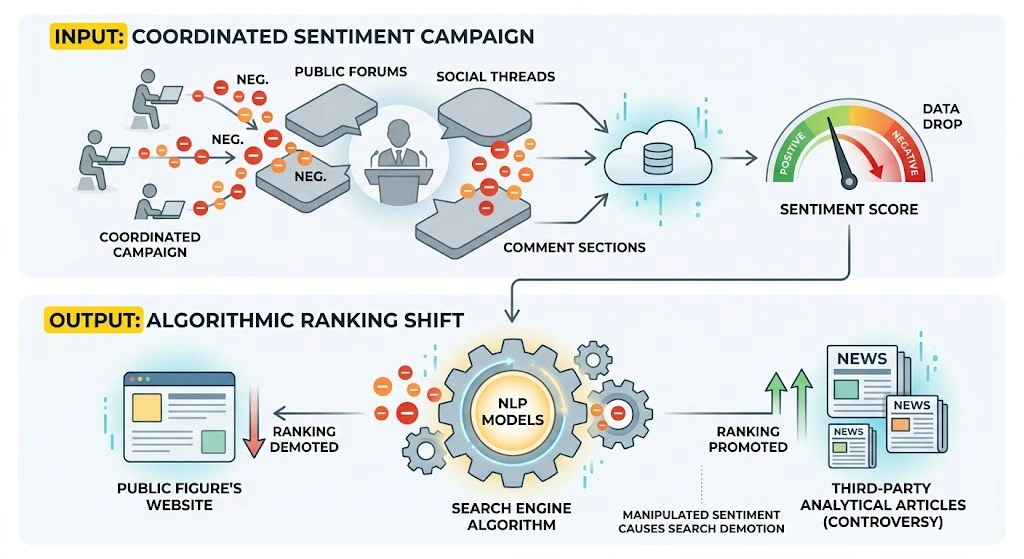
Review signals, forum discussions, and user-generated sentiment act as crowdsourced validation metrics for search engines. While individual politicians rarely have standard business review pages, algorithms treat alternative user-generated content platforms—such as public forums, social commentary threads, and independent wiki edits—as equivalent signals of public trust. The systematic manipulation of these spaces by coordinated campaigns creates a false impression of widespread public disapproval, which algorithms interpret as a genuine shift in entity reputation.
The interpretation mechanism relies on natural language processing (NLP) models that scan for linguistic sentiment vectors. These models categorise text into positive, negative, or neutral classifications based on word proximity and contextual modifiers. If a misinformation campaign floods indexed comment sections or public forums with highly negative semantic terms, the NLP models register a significant drop in overall sentiment scores. The search engine integrates this data drop into its core ranking algorithms, frequently resulting in the demotion of the politician’s self-owned web properties in favour of third-party analytical articles detailing the controversy.
Summary of Search Reputation Mechanics
The table below outlines how specific digital components function under normal conditions compared to periods of active misinformation exposure.
| Search Component | Baseline Function | Misinformation Swarm Impact | Long-Term Reputational Result |
| Knowledge Graph | Connects entities to verified factual attributes. | Introduces unverified negative semantic links. | Permanent distortion of core entity definition. |
| QDF Protocols | Elevates breaking news from trusted sources. | Bypasses traditional trust filters for fresh content. | Dominance of unverified or false narratives in SERPs. |
| NLP Sentiment | Assesses overall public trust via text analysis. | Registers artificial spikes in negative phrases. | Algorithmic demotion of official entity assets. |
| Data Voids | Yields low-volume, niche query results. | Exploded by engineered phrases to capture traffic. | Uncontested ranking of highly biased media. |
Misinformation campaigns execute structural changes within search ecosystems by exploiting the rules that govern data indexing, entity connection, and real-time content elevation. When coordinated networks inject false narratives into the digital footprint, search engines process these inputs via automated trust and authority metrics, frequently resulting in the polarisation of SERPs and the degradation of entity perception. Understanding these systemic algorithmic behaviors clarifies how long-term search reputation is built, maintained, and altered. Through systematic evaluation of data voids, knowledge graph connections, and sentiment vectors, it becomes possible to objectively monitor the stability of digital trust.
Frequently Asked Questions
How do misinformation campaigns impact a politician’s search reputation?
Coordinated misinformation campaigns manipulate search engine results by flooding the digital footprint with false narratives and high-volume, engineered search terms. Search engines index these rapid updates and user-engagement spikes via query-deserving-freshness (QDF) protocols, which can temporarily push defamatory content to the top of the SERP. Over time, these negative associations alter the entity perception within the search engine’s knowledge graph, causing long-term structural damage to public trust.
Can political reputation management remove false information from search engine results?
While completely deleting content from third-party websites requires legal or editorial intervention, political reputation management strategies modify search visibility to neutralize false information. Specialized services like Clear My Name focus on search perception control by reinforcing the politician’s official digital assets and building high-authority, verifiable trust signals. This process assists search engine algorithms in identifying accurate data, ultimately suppressing low-credibility links to lower ranking positions.
How do search engine algorithms evaluate political trust and credibility?
Search engine algorithms assess political entities by evaluating Experience, Expertise, Authoritativeness, and Trustworthiness (E-E-A-T) signals across indexed web properties. Natural language processing (NLP) models scan news articles, public forums, and digital content to calculate overall sentiment interpretation and entity proximity scores. When multiple authoritative, independent domains cross-reference and validate the same factual data, the search engine assigns a higher credibility score to that political entity.
What are data voids and how do they affect search reputation during a political crisis?
Data voids occur when high-volume or newly trending search queries yield very few high-quality, objective search results, leaving an open space in the search architecture. Misinformation campaigns exploit these voids by creating targeted content around specific, engineered phrases before factual data is available. As a result, search engines are forced to display biased or false narratives in top SERP positions, significantly distorting the politician’s online credibility.
Why does a misinformation campaign continue to affect an entity’s digital footprint long after it ends?
Misinformation campaigns achieve longevity because content indexing permanently archives semantic data within search databases, even if the original false sources are retracted or deleted. Pages that ranked highly during the peak of the campaign often accumulate historical link equity and secondary citations, which signals long-term value to the algorithm. This persistent algorithmic memory ensures that negative associations continue to surface in featured snippets and People Also Ask (PAA) boxes during routine background searches.