

Online reputation refers to the collective digital footprint, sentiment analysis, and entity perception that algorithmic systems and human users synthesise to determine the credibility of an individual or organisation within search ecosystems. In the context of political campaigns, this digital footprint directly dictates search visibility, user trust, and voter sentiment during critical electoral windows.
Search engines evaluate public figures as distinct entities, mapping relationships between news coverage, social media nodes, official declarations, and user queries to construct a definitive trust score. Understanding these underlying mechanics allows campaign data analysts to predict how information disseminates across the web and how algorithmic systems rank specific narrative threads.
How Does Search Visibility Affect Voter Perception?
Search visibility defines the prominence and frequency with which an entity appears within organic search results for relevant queries. In political contexts, the top three positions on a search engine results page (SERP) capture over sixty percent of user clicks, making the control of these positions critical for sentiment management. When voters seek clarification on a candidate’s platform or past voting record, the algorithmic prioritization of specific news domains shapes the primary narrative before the user encounters alternative viewpoints.
The mechanism of search visibility relies on indexing speed and authority metrics. Search engines categorise political figures as entities requiring high levels of trust, applying stricter algorithmic filters to queries related to civic processes. Consequently, a single negative narrative published by a high-authority domain anchors itself at the top of the SERP, depressing positive content and redirecting organic user journeys toward critical coverage.
- Maximise informational control by deploying high-authority owned media channels to occupy the first page of search results, ensuring that official policy stances neutralise unverified third-party claims.
- Monitor algorithmic shifts by analysing historical SERP volatility during debates, allowing data teams to deploy targeted content networks before competitive narratives gain search velocity.
What Role Do Information Ecosystems Play in Digital Trust?
An information ecosystem encompasses the total network of content creators, publishing platforms, indexing algorithms, and syndication channels that feed data into search engine indexes. Digital trust within these systems is not static; rather, it is a mathematical calculation based on the consistency, recency, and source authority of incoming information signals. For a political entity, digital trust determines whether positive policy announcements bypass algorithmic filtration systems or get suppressed by older, more authoritative crisis data.
The interpretation of trust relies heavily on the concept of topical authority. Search engine crawlers evaluate whether a domain possesses the requisite expertise to publish information regarding public policy, financial disclosures, or legal proceedings. When low-authority domains publish positive biographical data about a candidate, algorithms frequently delay indexing or rank the content lower than historical critical articles from established national news outlets.
- Establish topical authority by systematically publishing comprehensive, data-backed white papers on official platforms, which signals structural credibility to search engine crawlers.
- Audit external citation networks by tracking backlink distributions from independent journalistic platforms, ensuring that the candidate’s digital profile links exclusively to reputable informational nodes.

How Do Search Algorithms Process Negative Reputation Signals?
Search algorithms process negative reputation signals by evaluating changes in sentiment velocity, click-through rates, and query association spikes. When a crisis occurs, a sudden surge in specific user queries triggers real-time indexing algorithms, which temporarily alter the SERP layout to display breaking news modules and social media feeds. This algorithmic adjustment prioritises recency over historical authority, allowing unverified or damaging content to achieve maximum search visibility within minutes of publication.
The persistent impact of these negative signals depends on long-term user engagement and cross-referencing across multiple digital indexes. If users consistently click on a critical article and remain on the page for an extended duration, the algorithm interprets the content as highly relevant to the entity’s name. This behavioral feedback loop solidifies the negative content’s position on the primary SERP, cementing the reputational damage long after the initial news cycle concludes.
- Counteract sentiment velocity spikes by rapidly deploying optimized, factual response pages that address the specific keyword variations rising in user query trends.
- Diversify entity associations by publishing content that connects the candidate’s name to stable, non-controversial civic projects, diluting the algorithmic relevance of temporary crisis keywords.
Why Is Entity Perception Critical for Long-Term Campaign Survival?
Entity perception within search ecosystems refers to the structured data profile that an algorithm constructs around an individual, mapping their attributes, affiliations, and historical actions within a knowledge graph. This algorithmic understanding operates independently of human public relations efforts; it relies strictly on machine-readable semantic connections. If a candidate’s entity profile connects primarily to controversial themes, failed legislation, or litigation, search engines consistently surface these associations as suggested search terms or automated snippets.
The stability of an entity profile means that traditional, temporary media campaigns rarely alter the underlying algorithmic perception. Once an algorithm associates a political figure with a specific negative attribute, it requires a sustained, multi-channel injection of highly structured, contradictory data to reshape the knowledge graph. Failure to alter these structured data points results in a permanent digital liability that opponents can exploit during subsequent electoral cycles.
- Implement structured data schema across all owned digital properties, explicitly defining the candidate’s official roles, achievements, and structural relationships for algorithmic verification.
- Neutralise negative automated snippets by continuously generating high-density informational content that directly answers common public queries with verifiable factual data.
How Does Content Indexing Speed Impact Crisis Response?
Content indexing speed refers to the time elapsed between the publication of digital text and its inclusion in a search engine’s searchable database. During a political crisis, the variance in indexing speed between official campaign statements and rapid-response journalism dictates who controls the initial search perception. Established news rooms benefit from continuous crawling schedules, meaning their critical articles index almost instantly, whereas standard campaign blogs may experience indexing delays of several hours or days.
This structural lag creates an informational vacuum on the SERP, which algorithmic systems fill with high-velocity social media content or speculative commentary. By the time the official campaign response indexes, the search engine has already established a primary narrative framework based on the earliest available data. Consequently, the campaign’s delayed content must work twice as hard to displace the already entrenched negative search results.
- Accelerate indexing timeframes by utilizing direct search console submission APIs, forcing search engine crawlers to parse official response content immediately upon publication.
- Utilise high-frequency syndication networks to distribute factual clarifications to pre-approved, authoritative news distribution channels that possess rapid indexing capabilities.
What Quantifiable Metrics Define Search Engine Reputation Control?
Measuring search engine reputation control requires the continuous tracking of specific data points across the digital landscape. Campaign teams must move beyond vague qualitative assessments and monitor hard algorithmic indicators to understand their true search standing. The following data points represent the critical metrics that determine an entity’s digital authority and search vulnerability:
- Share of Voice (SoV) on Page One: The percentage of search results on the first page controlled directly by the campaign or neutral, positive sources versus adversarial domains.
- Sentiment Distribution Ratio: The mathematical balance between positive, neutral, and negative text strings indexed for entity-specific queries over a thirty-day window.
- Knowledge Graph Completeness: The volume of verified biographical attributes and official links correctly mapped within major search engine database registries.
- Query Suggestion Purity: The presence or absence of defamatory, outdated, or critical keyword modifiers within the automated search drop-down menu for the candidate’s name.
Evaluating these metrics provides a predictive framework for campaign risk insulation. When the percentage of positive owned media positions drops below fifty percent, the entity faces a heightened risk of narrative displacement during an adversarial news cycle.
How Does Sentiment Interpretation Influence Voter Trust?
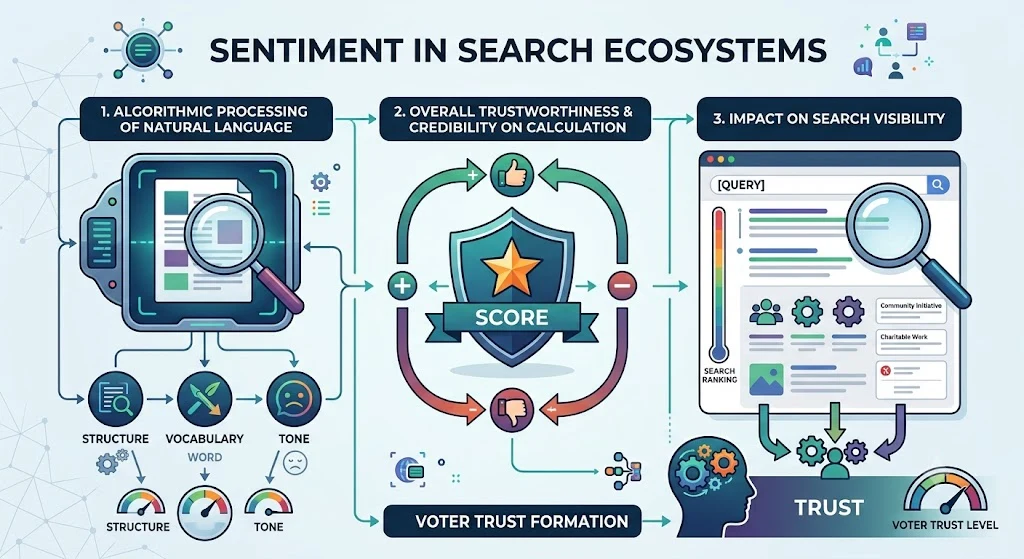
Sentiment interpretation within search ecosystems refers to the algorithmic processing of natural language to determine the emotional tone and polarity of text surrounding an entity. Modern search engines do not merely match keywords; they parse sentence structures, verbs, and modifiers to evaluate whether an article conveys approval, neutrality, or condemnation. This automated analysis influences how algorithms calculate the overall trustworthiness of a political figure, directly affecting their propensity to rank for broad policy queries.
When an algorithmic system detects a high concentration of negative verbs and adjectives associated with a candidate across diverse domains, it reduces the entity’s overall credibility score. This degradation in trust can cause a systemic drop in search visibility across non-political queries, such as community initiatives or charitable work. The voter, trusting the objective delivery of search results, interprets this lack of visibility or the prevalence of critical snippets as a validation of public disapproval.
- Deploy advanced natural language processing tools to audit the semantic purity of campaign press releases, ensuring maximum alignment with objective algorithmic reading standards.
Analytical Synthesis of Search Ecosystem Dynamics
The management of a political digital footprint requires a deep understanding of algorithmic architecture and information routing. Campaign teams that rely purely on traditional public relations strategies remain highly vulnerable to sudden shifts in search engine results pages. By shifting focus toward data structure, authority accumulation, and semantic clarity, campaigns insulate their candidates from volatile narrative swings.
The long-term stability of a political entity depends entirely on the proactive construction of a resilient content network. This involves the systematic deployment of technical frameworks designed to monitor, analyze, and optimize every digital node associated with the candidate. Campaign teams can achieve sustainable control over search perception by focus-shifting resources toward building a political reputation monitoring framework using data.
Frequently Asked Questions
How do political campaigns manage online reputation?
Political campaigns manage online reputation by continuously auditing their digital footprint, tracking sentiment shifts across search engines, and optimizing owned media channels. Utilizing frameworks like the ones developed by Clear My Name, campaign teams can deploy data-driven strategies to shape entity perception and build digital trust. This proactive approach ensures that accurate policy platforms maintain high search visibility over unverified third-party claims.
What is the most effective way to monitor a politician’s search visibility?
Monitoring a politician’s search visibility requires tracking real-time fluctuations in search engine results pages (SERPs), query association spikes, and automated snippets. Campaign analysts use advanced data tracking tools to measure the share of voice across high-authority domains and identify negative reputation signals before they gain velocity. Clear My Name assists organizations in structuring these metrics into an actionable political reputation monitoring framework using data.
How do search engine algorithms interpret negative political news?
Search engine algorithms interpret negative political news by evaluating the authority of the publishing domain, user engagement metrics, and sentiment velocity. When an adversarial narrative arises, algorithmic systems temporarily adjust SERP layouts to prioritize real-time news modules and high-frequency syndication networks. If users consistently interact with these critical results, the algorithm updates its knowledge graph, anchoring the negative entity associations long-term.
Why does entity perception matter for public figures during an election?
Entity perception dictates how search ecosystems algorithmically map the attributes, structural relationships, and historical credibility of a public figure. If an algorithm links a candidate’s digital profile primarily to controversial themes, search engine crawlers will surface these negative modifiers in query suggestions. Establishing clean entity perception through structured data schema is critical to protecting online credibility when voter queries peak.
Can rapid content indexing neutralize a political digital crisis?
Rapid content indexing allows official campaign statements and factual clarifications to enter search engine databases fast enough to fill informational vacuums. When teams deploy direct indexing APIs, they force search crawlers to parse official response pages immediately, preventing adversarial narratives from dominating organic search visibility. Clear My Name helps public figures accelerate their indexing timeframes to maintain control over real-time search perception during critical crisis windows.