

Defending an online store against scam and chargeback accusations requires evaluating how negative content is created, indexed, ranked and interpreted across search ecosystems. Reputation management strategies differ based on whether the objective is content removal, content enhancement, search visibility control or long-term reputation development.
Online reputation control methods are evaluated through their effect on reputation signals, entity credibility, SERP composition and the prominence of negative information. Content removal addresses specific pages or claims, while content enhancement develops additional authoritative information around the business entity. Organic approaches build reputation signals over time, whereas reactive approaches respond directly to existing accusations or complaints. The appropriate method depends on the nature, authority, persistence and search visibility of the information involved.
Which reputation management approach is more effective for scam accusations: content removal or content enhancement?
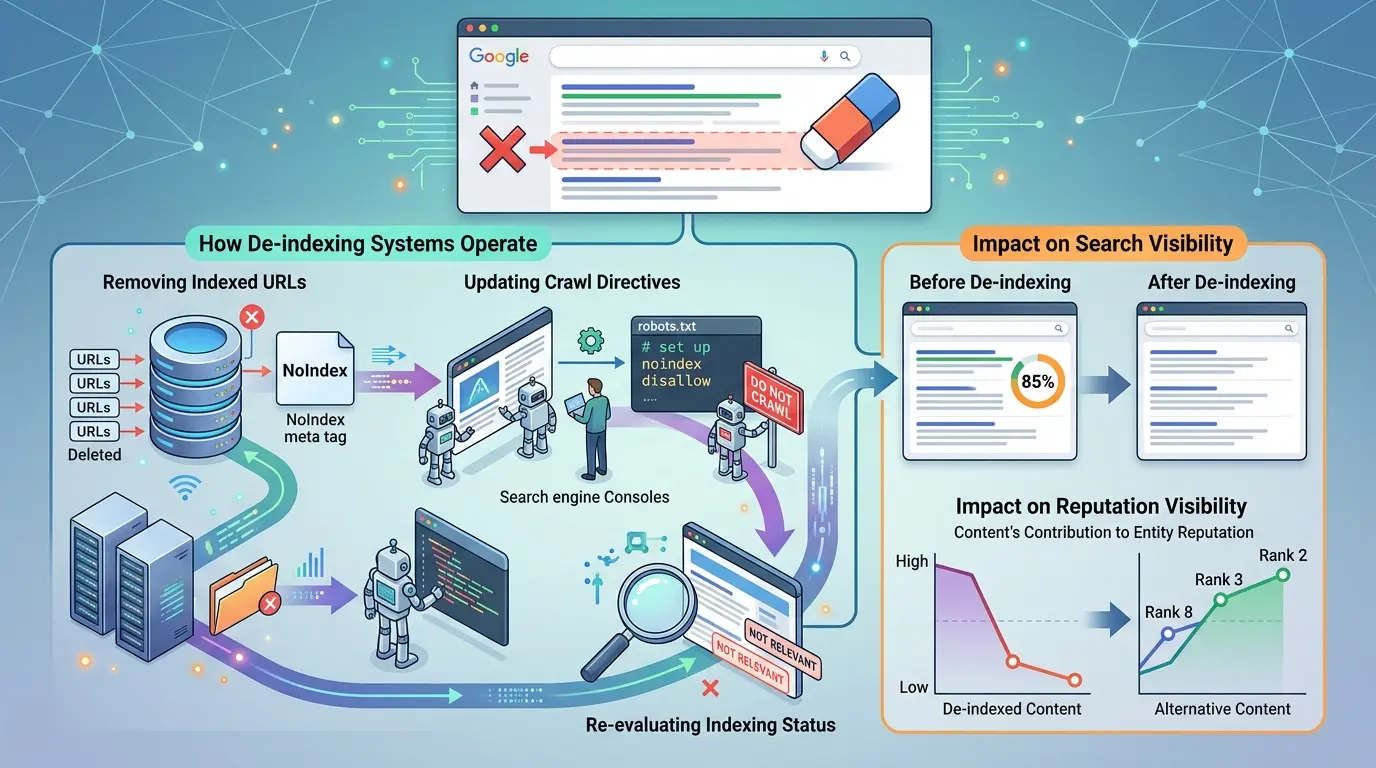
Content removal is more targeted, while content enhancement provides a broader method for changing the information environment surrounding an online store. Removal strategies focus on specific pages that contain inaccurate, defamatory, outdated or policy-violating information, subject to the rules of the platform or search engine involved. Content enhancement creates or strengthens useful, authoritative information that provides additional context around the business entity. The two approaches therefore operate at different points within the reputation system.
Removal has a direct mechanism because eliminating an indexed page removes that particular source from the available search environment when the removal is successful. Its limitation is scope: removing one result does not automatically address identical claims published elsewhere. Content enhancement operates by increasing the volume and quality of relevant information associated with the entity. Its effect depends on content relevance, authority, indexing and search ranking influence rather than a single removal event.
The distinction becomes important when scam accusations exist across multiple domains. A removal-led strategy focuses on the individual sources, whereas enhancement evaluates the wider SERP composition. Content suppression therefore provides precision, while content enhancement provides greater scalability across a broader information environment. Effective evaluation measures not only whether a negative page disappears but also how the overall search perception changes.
How does content suppression compare with content enhancement in search results?
Content suppression focuses on reducing the prominence of negative information, while content enhancement focuses on strengthening alternative information that competes within the same search environment. Suppression operates through actions such as legitimate removal requests, corrections, platform procedures and search-result management where applicable. Enhancement operates through the development of relevant, authoritative and indexable content. Both approaches influence the composition of results, but their mechanisms differ.
Content suppression produces a direct change when a negative result is removed or loses visibility. Its strength lies in addressing a defined reputation asset with a clear location and identifiable source. Its limitation is that suppression does not necessarily alter the underlying sentiment distribution across other platforms. If similar accusations remain indexed elsewhere, the broader reputation environment continues to contain negative signals.
Content enhancement works through information competition. New or strengthened pages provide search engines with additional relevant material about the business, its products, policies and operational information. Their ability to gain visibility depends on content quality, topical relevance, authority and search ranking influence. Enhancement therefore operates as a longer-term SERP strategy rather than an immediate replacement mechanism.
Is a reactive or organic reputation strategy more sustainable for online stores?
An organic reputation strategy is generally more sustainable because it develops reputation signals as part of the ongoing digital footprint, while reactive strategies respond to individual reputation events. Organic reputation management involves maintaining accurate business information, developing useful content and encouraging legitimate customer feedback through normal business processes. Reactive management focuses on specific complaints, accusations, negative reviews or damaging search results after they become visible. The difference concerns timing and operational scope.
Reactive approaches provide speed when a clearly identifiable reputation problem requires immediate assessment. They are particularly relevant when a false accusation appears on an authoritative platform or a negative result becomes prominent for a branded query. Their limitation is event dependency because each new issue creates another intervention point. Organic approaches require continuous maintenance but reduce dependence on isolated corrective actions.
Sustainability is therefore measured through the durability of reputation signals rather than the speed of a single intervention. A consistent information architecture gives search engines recurring, relevant information about the entity. Legitimate positive reviews and accurate business information also contribute to a more balanced sentiment distribution. This creates an environment where reputation management operates as an ongoing process instead of a sequence of isolated responses.
How do short-term and long-term reputation strategies differ?
Short-term reputation strategies prioritise immediate changes to visible reputation assets, while long-term strategies focus on the structural development of the entity’s digital footprint. Short-term actions include analysing prominent negative results, addressing inaccurate information and responding through applicable platform procedures. Long-term strategies include maintaining authoritative content, strengthening entity consistency and developing a stable information ecosystem. Each timeframe addresses a different stage of reputation control.
Short-term interventions are easier to measure because their targets are clearly defined. A successful removal, correction or ranking change produces an identifiable outcome within the relevant search environment. Their limitation is that they do not necessarily prevent future reputation issues from entering the SERP. Long-term strategies address the information structure that determines how the entity is represented over time.
The two approaches therefore operate most effectively as different layers of evaluation rather than competing alternatives. Immediate reputation risks require analysis of existing search visibility and source authority. Long-term reputation development requires analysis of content indexing, entity credibility and the consistency of information across platforms. Measuring both timeframes gives a clearer assessment of reputation performance.
How do search engines interpret scam and chargeback reputation signals?
Search engines interpret scam and chargeback-related information through the content, context, relevance and authority of indexed sources rather than assigning a universal reputation score to an online store. A chargeback is a payment dispute involving a card transaction, while a scam accusation is a claim concerning the conduct of a business. These concepts become reputation signals when they appear in publicly accessible content connected to the entity. Search systems then determine the relevance of those pages to particular queries.
The relationship between the business name and negative terminology creates an important semantic connection. Queries containing an online store’s name alongside “scam”, “chargeback”, “reviews” or “complaints” express reputation-focused search intent. Pages addressing those concepts possess contextual relevance to the query. Their ranking depends on search-system evaluation rather than simply the sentiment of the content.
This distinction prevents reputation analysis from treating search rankings as factual determinations. A highly visible accusation represents the presence and prominence of a claim, not automatic confirmation of that claim. Entity credibility requires examination of the source, evidence, context and surrounding information. Reputation strategies therefore evaluate search perception as an information system rather than as a direct verdict on business conduct.
Dive Deeper With Our Expert Guides:
Leveraging Trade Association and Accreditation Signals for Trust
How to Respond to Boycott Campaigns Without Escalating Them
Which strategy provides stronger control over SERP composition?
A combined strategy provides broader SERP control because suppression addresses existing negative results while enhancement strengthens alternative relevant information. SERP composition refers to the collection and ordering of pages presented for a particular search query. Reputation-focused SERPs contain official pages, reviews, consumer discussions, editorial content and other third-party sources. Controlling the composition requires understanding how each information type contributes to the search landscape.
Suppression is strongest when a specific result is inaccurate, removable under platform rules or otherwise eligible for intervention. Its effect is precise because the strategy targets a defined page or source. Enhancement is stronger when the objective involves improving the breadth and quality of information associated with the entity. It creates additional content assets that compete for visibility rather than depending exclusively on the removal of existing results.
The comparative advantage therefore depends on the structure of the SERP. A single dominant negative page creates a different strategic problem from a distributed collection of accusations across independent domains. Search ranking influence also changes according to source authority and query intent. SERP analysis must therefore precede the selection of suppression or enhancement as the primary approach.
How do review signals affect the evaluation of scam and chargeback claims?
Review signals provide contextual evidence about customer experiences and therefore help shape the sentiment distribution associated with an online store. Reviews frequently discuss delivery, refunds, product quality, payment disputes and customer service. When these themes repeatedly appear alongside an entity name, they become part of the searchable reputation environment. Their influence depends on visibility, source characteristics, content relevance and the volume of associated information.
Positive and negative reviews do not function as simple mathematical substitutes for each other. A large number of positive reviews does not automatically remove the visibility of a highly authoritative negative article. Similarly, a negative review does not establish that an accusation is factually correct. Reputation evaluation therefore considers source authority, context, recency, consistency and the position of each result within the SERP.
Sentiment distribution is most useful when analysed across the complete digital footprint. Concentrated negative feedback on one platform represents a different reputation structure from comparable feedback distributed across independent sources. This distinction affects the scalability of different management approaches. It also determines whether content suppression, content enhancement or a combined strategy provides the more relevant framework for analysis.
How should online stores evaluate the scalability of reputation management methods?
Scalability is evaluated by measuring how effectively a reputation strategy addresses multiple sources, queries and reputation signals without requiring a separate intervention for every individual result. Removal-based approaches generally require source-specific assessment because each platform has its own policies and procedures. Enhancement-based approaches can address broader query groups through a connected content structure. The difference becomes increasingly relevant as the number of reputation assets grows.
A scalable strategy begins by grouping reputation issues according to their semantic relationship with the entity. Scam accusations, chargeback complaints, refund disputes and customer-service criticism represent related but distinct topics. Analysing them as separate reputation signals identifies the content types and queries requiring attention. This prevents resources from being concentrated on one visible result while ignoring the wider information ecosystem.
Scalability also depends on sustainability. A strategy that produces a temporary ranking change without strengthening the wider digital footprint requires repeated intervention. A strategy based on durable, relevant information creates assets that remain useful across multiple related searches. Measuring scalability therefore requires examining both the number of reputation issues addressed and the durability of the resulting search visibility.
Which reputation strategy carries the lowest risk of creating further search problems?
A risk-controlled strategy prioritises factual accuracy, legitimate platform processes and transparent information rather than attempts to manipulate search results. Reputation management carries greater risk when interventions introduce misleading claims, artificial reviews, deceptive content or unsupported assertions. Such practices create additional reputation signals that can damage entity credibility. A controlled approach evaluates the source and legitimacy of every action before implementation.
Content removal carries procedural risk because each platform applies its own eligibility requirements. A removal request without a valid basis does not provide a reliable mechanism for changing search visibility. Content enhancement also carries risk when published information exaggerates business credentials or presents unsupported claims as facts. Both approaches therefore require evidence-based content and accurate entity information.
Risk evaluation should also consider second-order effects. An aggressive response to a negative claim can generate additional discussion that expands the content footprint surrounding the issue. A measured approach limits unnecessary amplification while addressing the underlying information problem. This makes risk assessment an essential part of comparing reputation management methods.
How can online stores measure whether a reputation strategy is working?
Reputation strategy performance is measured through changes in search visibility, SERP composition, sentiment distribution, content indexing and entity-related information. A useful measurement framework begins with baseline data for branded and reputation-focused queries. The analysis then tracks the visibility and ranking positions of relevant positive, neutral and negative sources. Changes are evaluated over time rather than through a single search result.
Key evaluation points include:
- Measure branded SERP positions by recording which pages appear for the store name alongside terms such as “scam”, “reviews” and “complaints”.
- Analyse sentiment distribution by comparing the proportion and prominence of positive, neutral and negative reputation content across relevant sources.
- Track content indexing by identifying which reputation-related pages remain accessible to search engines and users.
- Evaluate entity consistency by comparing business names, descriptions, contact information and other identifying details across authoritative platforms.
These measurements distinguish visibility changes from genuine improvements in the information environment. A ranking movement alone does not demonstrate improved entity credibility. Stronger evaluation connects ranking changes with the quality, relevance and distribution of information available to users.
Is content removal or reputation development more suitable for long-term online store protection?
Long-term reputation development provides broader structural value, while content removal remains important for specific negative assets that qualify for legitimate intervention. Removal solves a defined information problem when an eligible page can be corrected or removed. Reputation development addresses the wider digital footprint by establishing consistent, authoritative and useful information. The two methods therefore have different roles within long-term reputation control.
A removal-only model remains dependent on the continued identification of problematic content. New complaints, reviews and accusations can enter the search ecosystem independently of previous interventions. This is particularly relevant when organisations need to Fight Scam and Chargeback Accusations, as emerging allegations can continue to affect search perception even after earlier content has been addressed. A development-focused model creates a stronger information foundation but does not guarantee that inaccurate third-party content disappears. Long-term evaluation therefore favours a framework that distinguishes between information correction and information development.
The most important consideration is the relationship between the method and the reputation problem. Specific inaccurate content requires source-level analysis, while distributed reputation concerns require broader SERP and entity analysis. The resulting strategy depends on authority, indexing, query relevance, sentiment distribution and the persistence of the information. This makes reputation management an analytical discipline rather than a single technique.
Defending an online store against scam and chargeback accusations involves comparing reputation strategies according to their mechanisms, limitations and effects on search perception. Content suppression provides targeted intervention for eligible negative assets, while content enhancement develops additional authoritative information within the digital footprint. Reactive approaches address existing reputation events, whereas organic approaches build information consistency over a longer timeframe.
The strongest evaluation framework considers effectiveness, scalability, risk exposure and sustainability together. Search engines interpret indexed content through relevance, context and source characteristics, while users assess the resulting SERP composition as part of their research process. Reputation signals therefore need to be evaluated across the complete entity ecosystem rather than through isolated rankings or review scores.
How can an online store defend itself against scam accusations?
An online store can evaluate the source, accuracy, indexing status and search visibility of scam-related content. Reputation management approaches include legitimate content removal, information correction and content enhancement to improve the wider digital footprint.
Do chargebacks affect an online store’s online reputation?
Chargebacks are payment disputes, but related complaints can generate reviews and third-party content that affect reputation signals. When this content becomes visible in branded search results, it forms part of the store’s broader search perception.
Is content removal better than content creation for reputation management?
Content removal addresses specific negative pages that qualify for legitimate removal or correction, while content creation strengthens the wider information environment. The appropriate approach depends on the source, authority, accuracy and distribution of the reputation issue.
How do negative reviews affect an online store’s search visibility?
Negative reviews can become prominent for branded searches involving terms such as “scam”, “complaints” or “reviews”. Their position and visibility contribute to SERP composition and influence how users evaluate the store’s credibility.
How long does online reputation management take to improve search perception?
The timeframe depends on the type of reputation issue, content authority, indexing status and existing SERP composition. Content removal involves source-specific processes, while reputation development relies on longer-term changes to the digital footprint and search visibility.