

Trade association membership and accreditation create external trust signals by connecting a business with recognised industry organisations, standards, or professional frameworks. Their reputation value depends on how clearly these relationships are represented, indexed, and interpreted across the wider digital ecosystem.
Reputation management strategies differ based on whether the objective is to establish credibility, correct inaccurate information, strengthen search visibility, or manage existing reputation risks. Online reputation control methods are evaluated through reputation signals, entity credibility, SERP composition, sentiment distribution, and the consistency of information across digital sources. Trade association membership and accreditation belong primarily to the authority-building side of reputation management because they introduce external evidence about a business. Their effectiveness depends on source legitimacy, information accuracy, content accessibility, and the relationship between these signals and the wider digital footprint.
Which provides stronger trust signals: trade association membership or accreditation?
Accreditation generally provides a more specific trust signal because it indicates that an organisation has met defined requirements established by an accrediting body, while trade association membership primarily demonstrates professional affiliation. Membership establishes a relationship between the business and an industry organisation. Accreditation establishes a relationship with a defined assessment or standards framework. Both signals contribute to entity credibility but communicate different types of evidence. Their comparative value therefore depends on the reputation objective being evaluated.
Trade association membership operates by connecting a business to an identifiable professional community. A public member directory, profile page, or association announcement provides evidence that the business belongs to that organisation. Accreditation operates through evidence of compliance with specified criteria or standards. An accreditation record therefore contains a more specific semantic relationship between the business and the standard it has satisfied.
Neither signal functions as an automatic ranking guarantee. Search engines evaluate the underlying information, source context, relevance, and relationships between entities rather than simply awarding visibility for displaying a membership badge. The strongest signal is therefore the one supported by accessible and verifiable information. This makes source quality more important than the visual presence of a badge or logo.
How do trade association and accreditation signals influence search visibility?
Trade association and accreditation signals influence search visibility by creating additional indexed references that connect a business with its industry, professional category, or defined standards. Search visibility refers to the presence of an entity or its associated content within search results for relevant queries. A membership directory creates an external document containing the business name and professional context. An accreditation profile creates another document connecting the business with a specific standard or assessment framework. These references expand the information available for SERP evaluation.
The search ranking influence of these signals depends on the relevance and quality of the associated pages. A detailed profile containing the business name, industry, membership status, accreditation information, and supporting description provides stronger contextual information than an isolated image. Search engines can process the textual relationships between the business and the external organisation. Users also receive independently sourced information that supports their evaluation of the business.
Search visibility therefore needs to be distinguished from ranking position. A trade association page can be indexed without achieving a prominent position for a competitive query. Similarly, an accreditation record can contribute entity information without becoming a primary search result. The reputation value exists in the additional evidence and relationships available to search systems and users.
How does content enhancement compare with reputation suppression?
Content enhancement strengthens a business’s digital footprint by introducing relevant and credible information, while reputation suppression focuses on reducing the prominence or availability of specific existing content. Content enhancement includes professional profiles, accreditation records, association references, expert publications, and educational resources. Suppression involves legitimate processes such as correction, removal, de-indexing, or other appropriate mechanisms where the circumstances support such action. These approaches address different reputation conditions.
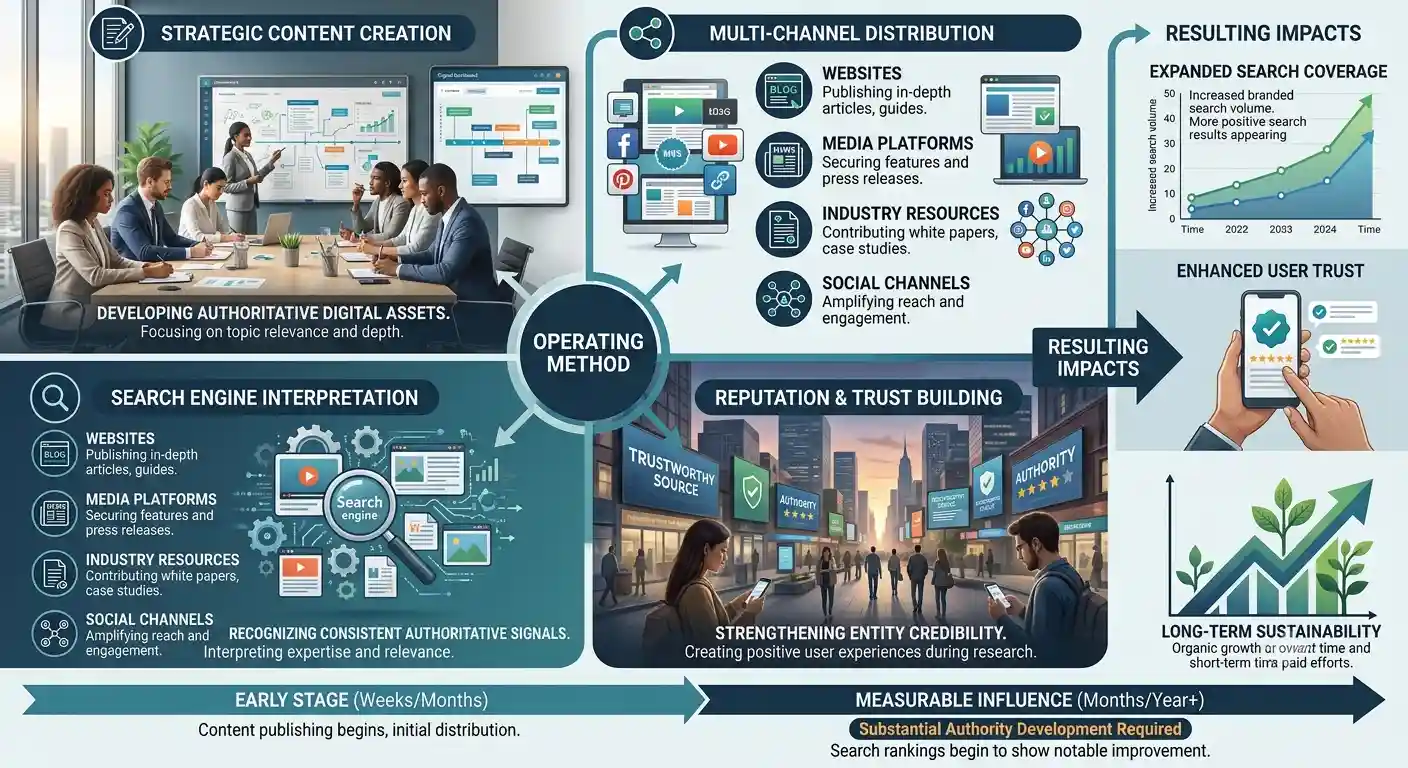
Content enhancement operates by increasing the quantity and quality of relevant information associated with an entity. When an accredited business appears across an official accreditation directory, trade association profile, professional website, and industry publication, the entity gains a broader information network. Suppression operates differently because it targets a specific information source or search-result position. Its outcome depends on the source, applicable policies, factual circumstances, and search-engine evaluation.
The distinction is important when assessing reputation risk. A business lacking authoritative external references has an information-strength problem rather than a removal problem. A business affected by inaccurate or inappropriate content has a separate corrective requirement. Combining the two approaches without identifying the underlying issue creates inefficient reputation management. The appropriate strategy therefore depends on whether the priority is adding credible evidence or addressing problematic existing information.
Are organic credibility signals more sustainable than reactive reputation management?
Organic credibility signals provide a more sustainable foundation when they are continuously supported by accurate, relevant, and independently verifiable information. Organic reputation management includes maintaining association memberships, accreditation records, professional profiles, expert content, and industry references. Reactive reputation management responds to specific reputation issues after they become visible. These approaches differ primarily in timing and objective.
Organic signals operate by gradually expanding the business’s digital footprint. Each legitimate association, accreditation, professional publication, or industry reference adds another information node connected to the business entity. Over time, these relationships create a broader context for entity perception. Reactive management instead focuses on an identified issue and attempts to correct, manage, or reduce its impact.
Sustainability depends on maintaining the underlying signals. An expired accreditation, outdated association profile, or inconsistent business description reduces the reliability of the information ecosystem. Continuous accuracy therefore forms part of long-term reputation management. The strongest organic strategy is not simply adding more affiliations; it is maintaining relevant affiliations and ensuring their information remains consistent across connected sources.
How do search engines interpret accreditation and membership relationships?

Search engines interpret accreditation and membership relationships through entities, documents, contextual language, links, and other information relationships. A business represents one entity, while the association or accrediting organisation represents another. A publicly accessible profile connects these entities through information such as membership status, accreditation, industry category, or standards. This relationship contributes to the search system’s understanding of the business. Entity perception develops from the combined evidence available across the digital environment.
Content indexing determines whether publicly accessible information becomes available within the search engine’s searchable corpus. Once indexed, the information becomes eligible for evaluation against relevant queries. A page with clear business identification and detailed contextual information gives search systems more information to process than an image-based claim without supporting text.
Entity consistency is equally important. The business name, website, industry category, location, and professional description need to align across relevant sources. Contradictory information creates uncertainty about whether different references represent the same entity. Consistent information strengthens entity resolution and provides a clearer basis for interpreting reputation signals.
Which signals have greater value for branded search results?
External accreditation and trade association references have particular value within branded search because they provide information about the business from sources beyond its own website. Branded search involves queries containing the business name or identifiable brand terms. Search engines assemble results from company websites, directories, reviews, publications, association profiles, social platforms, and other indexed sources. External professional references therefore become part of the broader SERP composition.
A trade association profile can establish professional affiliation, while an accreditation record can establish a relationship with a defined standard. Reviews provide a separate sentiment signal based on customer evaluations. These information types collectively contribute to how the business entity is represented when someone searches its name. The resulting SERP is therefore an information environment rather than a single webpage.
The value of an external reference also depends on its accessibility and accuracy. A profile that clearly identifies the business and links it to a legitimate organisation provides stronger contextual evidence than an unverified claim. Search perception is influenced by the total information available, making source quality a central consideration in branded reputation analysis.
How do reviews compare with accreditation and membership signals?
Reviews measure customer sentiment and experience, while accreditation and trade association membership measure professional relationships and standards. Review signals contribute to sentiment distribution by expressing positive, neutral, or negative evaluations. Accreditation provides evidence associated with defined criteria. Trade association membership establishes professional affiliation. These signals answer different reputation questions and therefore require separate analysis.
A review can provide information about customer experience but does not necessarily establish professional accreditation. An accreditation record confirms a standards relationship but does not describe an individual customer’s experience. A trade association membership confirms industry participation without automatically demonstrating compliance with every professional standard. Treating these signals as interchangeable produces an incomplete reputation analysis.
A balanced digital footprint contains different types of evidence because users evaluate businesses through multiple criteria. Search systems also process different documents according to their content and relevance. Professional affiliations contribute credibility context, while reviews contribute sentiment information. Analysing both categories provides a more complete understanding of entity reputation.
Dive Deeper With Our Expert Guides:
How to Respond to Boycott Campaigns Without Escalating Them
Strengthening Distributor and Wholesale Reviews That Retailers Read
How can businesses measure the effectiveness of trust signals?
Businesses can measure trust-signal effectiveness through indexing, source authority, entity consistency, search visibility, SERP composition, and relevance to the intended reputation objective. Measurement needs to focus on observable information rather than assumptions about direct ranking influence. An indexed association profile demonstrates discoverability, while consistent business information demonstrates entity clarity. Search-result monitoring then evaluates how these references appear within the wider SERP.
A practical evaluation framework includes:
- Verify external references by confirming that membership and accreditation records exist on legitimate organisation-controlled pages.
- Measure indexing by checking whether relevant association and accreditation pages are discoverable through search engines.
- Evaluate entity consistency by comparing business names, websites, descriptions, locations, and professional categories across sources.
- Analyse SERP composition by examining the visibility of professional references alongside company pages, reviews, directories, and publications.
- Monitor sentiment distribution by separating customer review signals from professional affiliation and accreditation signals.
This framework separates the existence of a trust signal from its search visibility. A membership can be legitimate but poorly represented online, while an accreditation can be credible but disconnected from the correct business entity. Measurement therefore requires both source-level and search-level evaluation.
How scalable are accreditation and trade association signals?
Accreditation and trade association signals are scalable when a business can maintain multiple legitimate external references without reducing accuracy or relevance. Each recognised affiliation creates a potential information node within the digital footprint. Association directories, accreditation profiles, event participation, professional publications, and industry listings can create a broader network of evidence. Scalability depends on maintaining factual consistency across that network.
The risk of excessive expansion is signal dilution. Adding unrelated memberships simply to increase the number of affiliations does not create stronger topical authority. Search systems evaluate relevance and context, so disconnected affiliations provide limited value for a specific business category. A focused portfolio of professionally relevant signals creates clearer entity relationships.
Scalability also requires ongoing governance. Business names, websites, addresses, professional descriptions, accreditation statuses, and membership details need periodic verification. Outdated information weakens trust because it creates inconsistencies across the digital ecosystem. Effective scaling therefore involves information management rather than simple accumulation.
What risks arise when businesses rely on accreditation or membership badges?
The primary risk is treating a visual badge as equivalent to independently verifiable credibility evidence. A logo on a website provides limited contextual information when it is not connected to an external profile or supporting record. Search engines and users require accessible information to establish the underlying relationship. The external source therefore provides greater evidential value than the badge itself.
Another risk is misrepresenting the scope of the affiliation. Membership in a trade association does not automatically prove compliance with every industry standard. Accreditation against one defined framework does not establish universal professional authority. Accurate descriptions preserve the distinction between affiliation, certification, accreditation, and general industry participation.
Expired or inaccurate affiliations also create reputation risk. A business that continues to display an outdated accreditation creates inconsistency between its website and external records. This affects information reliability and can weaken entity credibility. Reputation management therefore requires monitoring the status of external trust signals rather than treating them as permanent assets.
Is external accreditation worth prioritising for long-term reputation management?
External accreditation provides strong long-term reputation value when the accreditation is relevant to the business, independently verifiable, and supported by accurate digital information. Its primary advantage is specificity because accreditation connects the entity with defined requirements or standards. Trade association membership provides broader professional context through industry affiliation. The two signals therefore complement rather than replace each other.
The long-term value comes from the durability of the underlying relationship. A legitimate accreditation remains a reference point within the business’s digital footprint while its status remains valid. Public records create external evidence that exists beyond the business-controlled website. This provides a stable source of information for users and search systems.
The strategic evaluation still depends on relevance. An accreditation unrelated to the business’s primary activities contributes limited contextual value. A relevant accreditation supported by an authoritative external profile creates a clearer professional relationship. Long-term reputation management therefore prioritises signal quality, relevance, verification, and consistency over the number of credentials displayed.
How should businesses combine trust signals for stronger entity credibility?
Businesses can combine trust signals by creating a consistent information network in which each signal communicates a distinct aspect of professional credibility. The company website establishes the core business identity. Trade association profiles establish industry affiliation, accreditation records establish standards relationships, reviews provide sentiment evidence, and professional publications provide additional expertise or industry context. Each source contributes a different reputation signal. Together, these sources create a broader basis for entity perception.
The combination works through semantic consistency. The same business name, website, professional category, and factual information need to appear consistently across the connected sources. This allows search systems to associate separate documents with the same entity. It also reduces ambiguity for users evaluating the business through different search results.
The resulting approach is stronger than concentrating all credibility information on one company-controlled page. External references provide independent context, while internal pages provide additional explanation. This creates a connected digital footprint in which professional affiliation, standards, customer sentiment, and industry relevance can be evaluated separately. Reputation management therefore becomes an exercise in information architecture as well as content development.
Trade association membership and accreditation provide distinct but complementary reputation signals. Membership demonstrates professional affiliation and industry participation, while accreditation provides evidence connected to defined standards or assessment requirements. Neither functions as an automatic search ranking mechanism. Their value comes from creating verifiable relationships between the business and external professional entities.

Content enhancement and reputation suppression also operate through different mechanisms. Enhancement expands the digital footprint with credible information, while suppression addresses specific existing content and depends on legitimate correction, removal, or visibility mechanisms. Organic credibility building provides a long-term information foundation, while reactive reputation management addresses defined risks. Effective strategy therefore begins by identifying the reputation problem before selecting the appropriate mechanism.
The strongest trust architecture combines relevant external references with accurate entity information, accessible content, consistent professional details, and ongoing SERP evaluation. Amplify Your Accreditation and Trade Signals With Clear My Name by ensuring that accreditation, trade associations, reviews, professional publications, and business-owned content each provide different forms of evidence. Evaluating these signals through indexing, search visibility, entity credibility, sentiment distribution, and SERP composition creates a clearer basis for understanding their contribution to online trust.
How do trade association memberships build business trust?
Trade association memberships provide external reputation signals that connect a business with a recognised industry organisation. Public membership records can strengthen entity credibility by providing verifiable evidence of professional affiliation and industry participation.
Does accreditation improve a business’s online reputation?
Accreditation can strengthen online credibility by demonstrating that a business meets defined requirements or standards established by an accrediting organisation. An accessible accreditation record also adds an external trust signal to the business’s digital footprint.
What is the difference between accreditation and trade association membership?
Trade association membership demonstrates professional affiliation, while accreditation indicates that a business has met specified standards or assessment criteria. Both support reputation management for business, but they communicate different forms of credibility.
How do accreditation signals affect search visibility?
Accreditation signals can contribute to search visibility when relevant accreditation profiles and records are publicly accessible and indexed. These references provide additional entity information that search engines can use when evaluating the business’s digital footprint and SERP presence.
How can businesses use accreditation and trade association signals for reputation management?
Businesses can strengthen reputation signals by maintaining accurate membership records, verified accreditation information, consistent business details, and relevant external references. This creates a clearer digital footprint and supports stronger entity credibility across search ecosystems.