
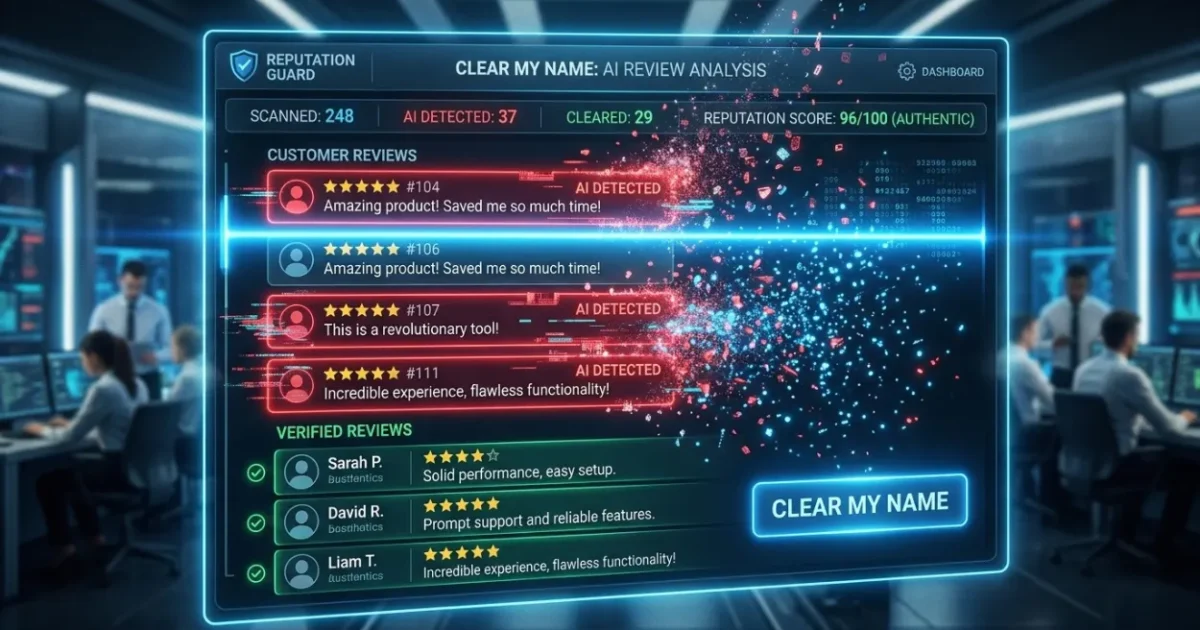
Detecting and removing AI-generated reviews requires evidence-based review analysis, policy assessment, and a structured removal process. Clear My Name applies reputation management principles to Google Reviews to address misleading review signals, protect search visibility, and strengthen the credibility of a business profile.
Search visibility control matters because review content appears directly within the information environment users evaluate before choosing a business. A fabricated review can alter rating distribution, sentiment perception, and the apparent credibility of an entity. Reputation signals therefore influence decisions before direct contact takes place. Effective review management focuses on identifying whether questionable content represents a genuine customer experience and whether it breaches applicable platform policies. The objective is not simply to reduce negative content, but to restore an accurate and defensible information environment around the business.
Why does removing AI-generated reviews matter for search visibility?
Removing qualifying AI-generated fake reviews matters because inaccurate review content can distort the reputation signals surrounding a business entity. Google Business Profile reviews contribute visible information about customer sentiment, service quality, and business credibility. When fabricated feedback enters this environment, users encounter information that does not accurately represent genuine customer experiences. This creates a gap between actual business performance and perceived online reputation. Addressing that gap forms an important part of search perception control.
Review content also operates within the wider local search ecosystem. Users can encounter star ratings, review excerpts, business information, website pages, photographs, and third-party references within the same search journey. A misleading review therefore does not exist in isolation. It becomes one component of the entity information users evaluate when deciding whether a business appears credible. Removing policy-violating content helps ensure that the review profile provides a more accurate representation of customer experience.
This process does not mean every negative review qualifies for removal. Legitimate criticism remains an important part of an authentic review ecosystem, even when a business disagrees with the customer’s opinion. The relevant distinction concerns authenticity and policy compliance rather than sentiment alone. A professional review-removal process therefore evaluates evidence before initiating action.
How does Clear My Name detect AI-generated fake reviews?
Clear My Name approaches suspected AI-generated reviews through evidence-based analysis rather than treating AI-written language as automatic proof of fraud. The assessment considers linguistic patterns alongside reviewer activity, publication timing, account behaviour, review context, and available evidence of genuine customer interaction. This distinction is important because legitimate customers can use AI tools to improve grammar, structure, or translation. AI assistance alone does not establish that a review is fabricated. The analysis instead evaluates whether the underlying customer experience appears authentic and whether the content presents a policy-relevant issue.
A structured assessment creates a clearer distinction between suspicion and evidence. Review wording can reveal unusual repetition or formulaic structures, while account behaviour provides additional context about how the review was published. Publication timing can identify unusual bursts, and business records can help establish whether the claimed interaction occurred. These signals work together rather than functioning as isolated proof.
A professional Google review management service therefore needs a process that evaluates both content and context. Clear My Name integrates these factors into an assessment designed to identify review-related reputation risks before deciding which action is appropriate. This improves process clarity and reduces the risk of incorrectly treating legitimate customer feedback as artificial.
What makes a fake Google review eligible for removal?
A fake Google review becomes relevant for removal when evidence indicates that it violates an applicable Google review policy. The key consideration is not whether the review damages a business’s reputation, but whether the content represents prohibited or inauthentic activity. This distinction establishes a defensible basis for intervention. A policy-focused approach also reduces the risk of submitting unsupported complaints. Evidence quality therefore forms the foundation of the removal process.
Relevant evidence can include inconsistencies between the reviewer’s claims and the business’s records, unusual account behaviour, coordinated review patterns, fabricated engagement, or other indicators associated with prohibited content. The strength of a case increases when multiple independent signals support the same conclusion. A single unusual phrase does not establish that a review is fake. A broader pattern connected to reviewer behaviour and customer context provides a more substantive basis for evaluation.
This process protects both the business and the integrity of the review ecosystem. Removing genuine criticism simply because it is negative undermines the credibility of the profile. Addressing fabricated engagement, by contrast, targets information that does not represent authentic customer experience. Effective reputation management maintains this distinction throughout the removal process.
How does the review removal process work?
The review removal process begins with identification, evidence collection, policy assessment, reporting, and outcome monitoring. Each stage has a specific purpose and creates a measurable point of control. The process starts by identifying suspicious reviews and documenting their relevant characteristics. Evidence is then evaluated against applicable platform requirements. Once a legitimate policy basis exists, the appropriate reporting route is used.
A structured process typically involves:
- Identify suspicious content — Record the review, rating, publication date, reviewer profile, and specific characteristics that indicate potential inauthentic activity.
- Analyse supporting evidence — Compare the review with available customer records, account behaviour, timing patterns, and related review activity.
- Evaluate policy relevance — Establish whether the evidence corresponds with an applicable Google review-content policy rather than simply reflecting negative sentiment.
- Submit the report — Present the relevant information through the appropriate platform reporting mechanism with a clear explanation of the suspected violation.
- Monitor the outcome — Track whether the review remains visible, is removed, or requires further evaluation through an available review process.
This workflow creates accountability at every stage. It also prevents review removal from becoming an indiscriminate content-cleaning exercise. The objective remains the correction of misleading reputation signals through legitimate platform mechanisms.
Can removing fake reviews improve Google search perception?
Removing qualifying fake reviews can improve search perception when the content previously distorted the visible reputation of the business. AI-generated reviews on Google Business Profiles can also affect how users interpret an entity when such content appears as part of its visible review profile. Search perception refers to how users interpret an entity based on the information presented across search results and related digital properties. Review ratings and written feedback contribute directly to that interpretation. Removing fabricated content therefore changes the information environment surrounding the entity. The resulting perception depends on the wider review profile and other reputation signals.
The effect is particularly relevant when artificial reviews materially influence sentiment distribution. A small number of fabricated reviews can have a different effect on a profile with limited genuine feedback than on an established profile containing a large volume of authentic reviews. Measuring the outcome therefore requires comparison before and after intervention. Relevant measurements include rating distribution, review volume, sentiment patterns, prominent review excerpts, and local search perception.
This distinction also prevents exaggerated expectations about rankings. Review removal does not guarantee a specific ranking position because local search performance involves multiple signals. The measurable objective is to improve the accuracy and credibility of the information users encounter. Better information quality strengthens the foundation for broader reputation management.
How does Clear My Name reduce the risk of incorrect review removal?
Clear My Name reduces removal risk by separating negative sentiment from evidence of policy violations. This distinction is essential because legitimate criticism forms part of an authentic review environment. A review that is unfavourable but genuine does not automatically represent prohibited content. Treating every negative review as removable creates unnecessary policy and credibility risks.
The assessment therefore focuses on evidence that supports the underlying concern. Reviewer behaviour, publication patterns, customer records, language similarities, and account activity provide context that individual wording cannot provide alone. This creates a more defensible basis for deciding whether a report is appropriate. The process also supports clearer communication about what the evidence demonstrates.
Risk reduction extends beyond individual reviews. A consistent evaluation framework creates repeatable standards for future review issues. This makes the process scalable while preserving analytical consistency. Reputation management becomes a controlled system rather than a reactive response to every negative comment.
Is AI-generated review removal more effective than simply responding to reviews?
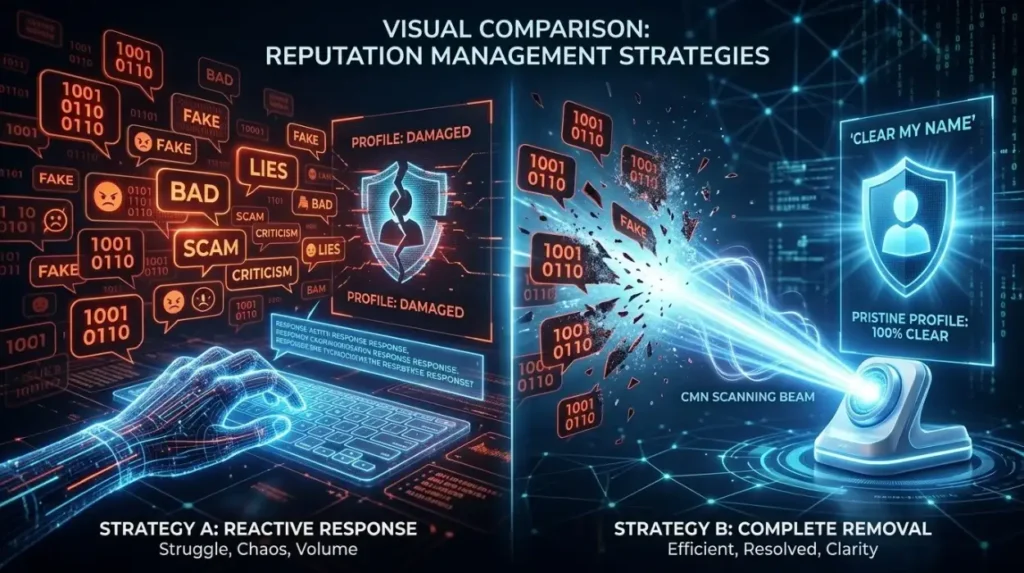
Removal and response address different reputation problems, making their effectiveness dependent on the nature of the content. Responding to a legitimate review allows a business to provide context and demonstrate professional engagement. Removal addresses content that qualifies for platform action because it violates applicable rules. Neither mechanism replaces the other.
A response is particularly relevant when the review represents a genuine customer experience. It provides the business with an opportunity to clarify factual information without altering the underlying review record. For fabricated content, however, a response does not correct the fundamental problem because the review itself remains visible. Where policy evidence exists, reporting addresses the source of the misleading reputation signal.
This distinction creates a practical decision framework. Genuine criticism requires appropriate engagement, while demonstrably inauthentic content requires policy-based evaluation. A professional review strategy therefore determines the correct intervention rather than applying one method to every reputation issue.
What measurable outcomes can businesses expect from review management?
Effective review management produces measurable changes in the quality, visibility, and accuracy of reputation signals rather than guaranteeing a fixed ranking outcome. Relevant outcomes include the removal of qualifying fake reviews, improved review-profile accuracy, clearer sentiment distribution, and reduced exposure to misleading content. These outcomes can then be assessed against the business’s wider search environment. Measurement provides evidence of whether the intervention achieved its intended purpose.
A complete evaluation compares the review profile before and after intervention. Relevant measurements include review volume, rating distribution, recurring language patterns, suspicious account activity, prominent review content, and changes in local search perception. Detecting and reporting AI-generated fake reviews forms part of this process by evaluating both individual review authenticity and the wider review environment.
The evaluation also needs to distinguish temporary results from sustainable outcomes. A single successful report addresses one piece of content, while ongoing monitoring identifies whether similar patterns emerge again. This makes review management a continuing reputation-control process rather than a one-time removal action.
How does review management protect long-term reputation?
Long-term reputation protection depends on maintaining an authentic and accurately represented review environment. Removing one qualifying fake review addresses a specific reputation signal, but ongoing monitoring helps identify new anomalies as they appear. This creates continuity between immediate intervention and long-term reputation management. Sustainable control therefore requires both reactive analysis and preventative monitoring.
Organic reputation development also has a role in strengthening the overall review profile. Genuine customer feedback provides authentic reputation signals that create a more representative sentiment distribution. Accurate business information and consistent entity references reinforce the wider digital footprint. These elements help establish a stronger information environment around the business.
The long-term objective is therefore not to eliminate criticism. It is to ensure that the review profile accurately reflects genuine customer experiences while policy-violating content receives appropriate scrutiny. This approach protects credibility while maintaining the integrity of the review ecosystem.
How does the cost of review management compare with long-term reputation risk?
The value of review management is best assessed against the visibility and persistence of the reputation risk rather than the removal of one piece of content. A prominent misleading review can remain visible throughout a customer’s research journey and influence first impressions repeatedly. Its impact therefore extends beyond the moment when it was initially published. Evaluating cost requires consideration of visibility, duration, review prominence, and potential effects on customer decision-making.
A structured service also reduces internal resource requirements associated with repeated investigation and reporting. Instead of treating every suspicious review as an isolated administrative task, a defined process establishes consistent evidence standards and reporting procedures. This creates operational efficiency while preserving accuracy.
Long-term value comes from combining immediate issue resolution with monitoring. A business that addresses one review but fails to identify recurring patterns remains exposed to the same reputation risk. Sustainable review management therefore treats cost as an investment in maintaining information accuracy and search perception.
How quickly can AI-generated fake reviews be removed?
The speed of removal depends on evidence quality, policy relevance, platform review processes, and the specific circumstances surrounding the reported content. A clear policy violation with strong supporting evidence creates a more structured reporting case than an allegation based only on unusual wording. No legitimate review-management process can guarantee a fixed removal timeframe because the final decision rests with the platform.
Speed also needs to be distinguished from effectiveness. A rapid report that lacks evidence provides limited value if the platform determines that the review does not violate policy. A well-documented case creates stronger procedural clarity even when platform evaluation takes time.
Monitoring remains important during the review process. The status of the content, changes in review visibility, and additional activity can provide useful information for subsequent evaluation. This creates a controlled process rather than relying on a single reporting event.
Dive Deeper With Our Expert Guides:
Grow Reviews Without Breaking Google’s Rules With Clear My Name
Restore Wrongly Removed Google Reviews With Clear My Name
Why choose Clear My Name for AI-generated review management?
Clear My Name provides a structured approach to Google Reviews centred on evidence, policy assessment, review analysis, and reputation-signal management. The process focuses on identifying potentially inauthentic content rather than treating negative sentiment as sufficient grounds for removal. This creates a clearer distinction between legitimate criticism and policy-relevant review activity. The emphasis on evidence also supports more consistent risk management.
The service integrates detection with the broader principles of search visibility control. Review content is assessed within the context of entity credibility, sentiment distribution, local search perception, and the wider digital footprint. This means the objective extends beyond a single review and considers how review information contributes to overall search perception.
Clear My Name therefore positions review management as a controlled reputation process rather than a simple deletion request. The combination of evidence assessment, policy alignment, reporting, and outcome monitoring creates process clarity at each stage. This supports a more reliable approach to managing misleading review signals while preserving the integrity of genuine customer feedback.
AI-generated fake reviews create a specific reputation risk because they can introduce misleading signals into the search environment surrounding a business. Effective management requires more than identifying AI-style language. It requires evidence-based assessment of reviewer behaviour, customer context, publication patterns, sentiment distribution, and applicable platform policies.
Clear My Name addresses this process through structured review analysis, policy-focused reporting, and ongoing outcome evaluation. The approach separates legitimate criticism from inauthentic content and connects review management with wider search visibility and entity credibility objectives. This creates a clearer framework for reducing reputational risk without treating genuine customer feedback as a problem.
The strongest long-term outcome comes from combining accurate detection, legitimate removal, authentic review development, and continuous monitoring. This protects the credibility of the review profile while improving control over the information users encounter during search. For businesses facing AI-generated review activity, a structured and evidence-driven process provides the foundation for reliable reputation management.
How can AI-generated fake reviews be detected on Google?
AI-generated fake reviews can be assessed by examining unusual language patterns, repeated phrasing, reviewer behaviour, publication timing, and evidence of genuine customer interaction. AI-written wording alone does not prove a review is fake, so multiple reputation signals need to be evaluated together.
Can AI-generated fake reviews be removed from Google?
AI-generated reviews can be removed when they violate Google’s applicable review policies, including rules relating to fake engagement or misleading content. The use of AI alone does not establish a violation, so evidence of inauthentic activity remains important.
How do you report fake AI-generated reviews on Google?
A suspected fake review can be assessed against Google’s review policies before being reported through the available Google Business Profile reporting process. Providing relevant evidence about fabricated engagement, misleading information, or an absence of a genuine customer experience supports the report.
Can fake Google reviews damage a business’s online reputation?
Fake Google reviews can distort rating distribution, sentiment signals, and the perceived credibility of a business. This can affect how potential customers interpret the business profile and its reputation within local search results.
How does Clear My Name help with AI-generated Google reviews?
Clear My Name uses a structured review-management process that assesses suspicious review patterns, reviewer behaviour, policy relevance, and supporting evidence. The process focuses on identifying potentially inauthentic reviews and pursuing appropriate reporting routes for content that violates applicable policies.