
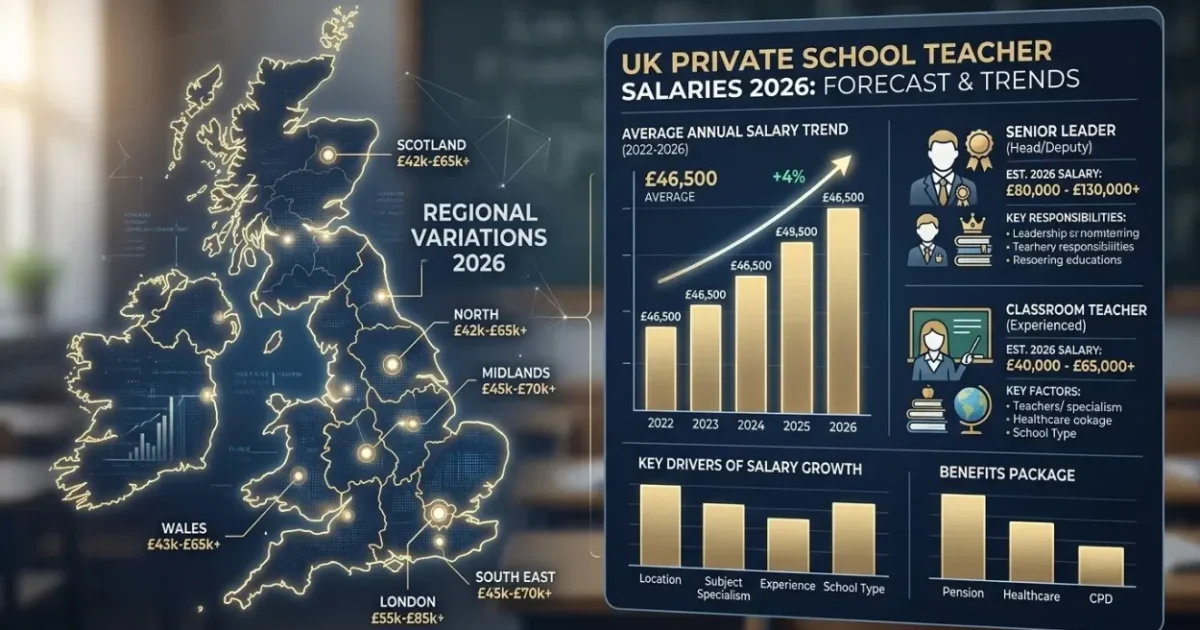
Private school teacher salaries in the UK vary by school, role, experience, location and employment terms because independent schools set their own pay rather than following one compulsory national salary scale. For 2026, England’s maintained-school teacher scales provide a useful benchmark, with qualified teacher salaries outside London ranging from £34,069 to £52,835 across the main and upper pay ranges.
Reputation management is the process of monitoring, interpreting and influencing the information that shapes how an organisation is perceived. Online reputation refers to the collection of information, reviews, employment signals and other digital references that influence entity perception across search ecosystems. For private schools, salary information forms part of the wider employer reputation because prospective teachers evaluate pay alongside working conditions, career progression and publicly available information about the institution.
How much do private school teachers earn in the UK in 2026?
Private school teachers do not have one nationally mandated 2026 salary scale because independent schools have greater freedom to establish their own employment terms. The National Education Union notes that pay can vary substantially between independent schools and can also differ between employees within the same school.
The maintained-school pay structure therefore functions as a benchmark rather than a mandatory private-school scale. From September 2026, the main classroom-teacher range in England outside London and the London Fringe begins at £34,069 at M1 and reaches £46,940 at M6, while the upper pay range extends from £49,134 to £52,835.
This distinction is important when interpreting salary information online. A private school advertising a salary below, around or above the national maintained-school benchmark is not automatically following or departing from a legal private-school requirement. The relevant figure depends on the school’s own pay policy, contract, responsibilities and employment structure.
Why do private school teacher salaries vary between schools?
Private school teacher salaries vary because independent schools establish their own pay policies and contractual arrangements. Unlike maintained schools, they are not required to apply the national teacher pay framework, although some independent schools use those scales as a reference point.
A school’s salary structure can include basic pay, responsibility allowances, performance-related payments and additional benefits. The role itself also affects remuneration because classroom teaching, departmental leadership and senior management involve different levels of responsibility.
Employment terms form another part of the salary calculation. The NEU explains that independent schools can use full-year or term-time arrangements, and a term-time salary can represent a proportion of a full-time annual salary rather than the complete annual figure.
What are the 2026 teacher pay scales used as a benchmark?
England’s 2026/27 maintained-school scales provide a clear reference point for analysing private-school salaries. Outside London and the London Fringe, the main pay range runs from £34,069 at M1 to £46,940 at M6, while the upper pay range runs from £49,134 at U1 to £52,835 at U3.
| Pay point | 2026/27 salary outside London and Fringe |
|---|---|
| M1 | £34,069 |
| M2 | £36,042 |
| M3 | £38,400 |
| M4 | £40,941 |
| M5 | £43,529 |
| M6 | £46,940 |
| U1 | £49,134 |
| U2 | £50,956 |
| U3 | £52,835 |
These figures are not compulsory private-school rates. They provide a reference framework for understanding where an independent school’s advertised teacher salary sits relative to the maintained sector. The Department for Education confirms that non-maintained schools, including independent schools, can set their own pay, although they often follow these ranges.
How does region affect private school teacher salary in 2026?
Region affects teacher remuneration because London has separate maintained-sector pay ranges, while independent schools determine their own salaries. In the maintained sector, England is divided into Inner London, Outer London, London Fringe and the rest of England for teacher pay purposes.
For 2026/27, the London Fringe M1 rate is £35,602, compared with £34,069 outside London and the Fringe. The difference becomes more significant at higher points because London-related pay ranges are structured separately from the rest of England.
Private schools use these regional benchmarks differently. Some align their salaries with local maintained-school rates, while others establish independent salary structures based on recruitment requirements, school finances, role responsibilities and their own employment policies.
What is the difference between classroom and leadership salaries?
Leadership roles generally operate on a different remuneration structure from classroom teaching because they carry broader organisational responsibilities. In England’s maintained sector, leadership positions use a separate leadership pay framework rather than the standard classroom teacher scale.
The latest School Workforce statistics provide a useful benchmark for understanding the difference in actual earnings. For 2025/26, the median full-time-equivalent salary was £51,047 for classroom teachers, £69,596 for other leadership teachers and £86,803 for headteachers in England.
Private schools do not have to reproduce these figures. A headteacher, deputy head, assistant head or subject leader at an independent school can therefore have a different salary structure from the equivalent role in a maintained school.
How does teacher experience affect private school pay?
Experience affects private-school remuneration through the school’s own progression system, rather than through a compulsory national mechanism. Independent schools can use incremental salary scales, individual salaries or other arrangements that determine how pay changes over time.
In the maintained sector, progression is visible through the movement from M1 through M6 and then onto the upper pay range. The 2026/27 figures demonstrate a structured increase from £34,069 at M1 to £52,835 at U3 outside London and the London Fringe.
Private schools can use similar structures while retaining control over their own salary policies. The existence of a clearly defined progression system therefore becomes an important employment signal because teachers can evaluate not only the starting salary but also how remuneration develops after appointment.
How do salary policies influence a private school’s employer reputation?
Salary policies influence employer reputation because employment information contributes to how prospective staff interpret an organisation. Employer reputation refers to the perception formed by candidates, employees and other stakeholders from available information about pay, working conditions, leadership, culture and employment practices.
The mechanism is information accumulation. A teacher researching a private school can encounter a job advertisement, salary information, employee commentary, professional publications and the school’s own website before applying. Search engines organise these sources into SERPs, creating an information environment in which salary is one reputation signal among others.
A transparent salary structure also makes online information easier to interpret. When a school explains its pay scale, progression rules and additional responsibilities clearly, candidates have a defined framework for evaluating the employment offer rather than relying on isolated salary claims.
Why does salary transparency matter in search reputation?

Salary transparency matters because clearly documented employment information reduces ambiguity within the information environment surrounding an organisation. Search reputation is influenced by the consistency and credibility of information available across relevant digital properties.
A salary figure appearing in a recruitment listing has a different informational function from an employee review discussing compensation. The first represents an employer’s stated position, while the second represents an individual’s account. SERP evaluation therefore depends on the source, context, recency and relationship between the information sources.
This creates a connection between employment information and reputation management. Reputation management is not limited to reviews or public-facing brand mentions; it also involves understanding how different information sources collectively define an entity across search results.
How do reviews affect the online reputation of private schools?
Reviews contribute to online reputation by adding user-generated information to the wider collection of reputation signals associated with an institution. Their impact depends on the platform, visibility, content quality, relevance and surrounding information rather than on the existence of a review alone.
School-related reviews have also been subject to platform-specific changes. In 2025, Google announced the removal of user comments and star ratings for UK and Irish primary and secondary schools from Google Maps, following concerns about the reliability and fairness of school reviews.
This illustrates why reputation analysis requires attention to the underlying information system. A review signal can change when a search platform changes its policies, indexing behaviour or treatment of a particular category of entity.
How does online information shape a private school’s employer reputation?
Online information shapes employer reputation through the combined effect of multiple sources rather than one isolated page. Official school information, recruitment listings, professional publications, employee commentary and educational directories can all contribute to the entity’s visible information environment.
Search engines evaluate and organise these sources according to their own ranking systems. The resulting SERP composition determines which information a user encounters first, while source authority, relevance and content context affect how that information is interpreted.
For private schools, this means employer reputation extends beyond the recruitment page. Salary data, leadership information, institutional achievements, employment policies and third-party commentary can form interconnected reputation signals around the same entity.
Dive Deeper With Our Expert Guides:
How Do You Get a Teaching Job at a UK Private School? With or Without QTS
How Has VAT Changed Private School Fees in the UK? 2026 Impact Report
What reputation signals do teachers use when researching private schools?
Teachers use available employment information to assess the overall proposition presented by a school. Salary is one signal, but candidates can also examine progression opportunities, role responsibilities, employment benefits, professional development information and publicly available commentary.
The significance of each signal depends on context. A high advertised salary without clear information about workload or contractual terms provides limited information about the complete employment proposition, while a lower salary accompanied by transparent progression and benefits represents a different information structure.
This demonstrates why employer reputation cannot be reduced to one metric. Entity perception develops through the interaction of salary information, employment conditions, institutional authority and third-party content across the search ecosystem.
How can private schools maintain accurate employer information online?
Private schools maintain accurate employer information by keeping salary, role and employment information consistent across the digital properties they control. Consistency helps reduce discrepancies between recruitment pages, job listings and institutional information.
The process can be structured around three information controls:
- Define salary information clearly — State whether an advertised figure represents a starting salary, full salary range, pro-rata amount or total remuneration package, so candidates can interpret the figure accurately.
- Explain progression mechanisms — Describe how experience, responsibility and performance relate to salary progression, giving candidates a defined framework for understanding potential remuneration.
- Maintain source consistency — Review recruitment pages and third-party employment listings so that outdated salary information does not remain visible after the school’s terms have changed.
These controls relate directly to content accuracy rather than promotional reputation activity. Their purpose is to establish a consistent information environment in which search users can interpret the school’s employment proposition using identifiable evidence.
How does private school salary information affect search perception?
Private school salary information affects search perception by contributing employment-related evidence to the wider entity profile. When salary data is accurate, contextualised and consistent, users have a clearer basis for interpreting the school’s employment proposition.
Search perception refers to how an entity is interpreted from the information presented across search results and related digital properties. Salary information therefore operates alongside institutional achievements, leadership information, employment policies, reviews and other reputation signals.
The relationship is particularly relevant when teachers research a school before applying. Search results can expose information from different sources, and the combined presentation of those sources influences the context in which an employment opportunity is evaluated.
What should teachers check when comparing private school salaries?
Teachers comparing private-school salaries need to examine the complete employment structure rather than relying on one headline figure. Independent schools can establish different salary scales, contracts and progression mechanisms, making direct comparisons dependent on equivalent terms.
The first consideration is whether the advertised figure represents a full-time annual salary or a pro-rata amount. The second is the number of working weeks and whether the role includes additional responsibilities. The third is the school’s progression policy and whether salary increases follow defined criteria.
Teachers can also compare the private-school figure against the relevant maintained-sector benchmark. The 2026/27 England figures provide a useful reference, but they do not determine the salary an independent school must offer.
How does employer reputation connect with private school recruitment?
Employer reputation connects with recruitment because prospective employees interpret employment information before making contact with an organisation. Salary is part of that information environment, while the wider reputation system includes institutional credibility, employment commentary and the consistency of published information.
The connection is informational rather than purely promotional. A school with clearly documented employment terms provides candidates with more context for interpreting a vacancy, while inconsistent information creates competing signals that require additional evaluation.
This makes employer reputation a component of the wider digital footprint of a private school. The digital footprint includes the pages, documents, listings, reviews and references that collectively establish how the entity appears to search users.
What does the 2026 private school teacher salary landscape show?
The 2026 salary landscape shows that private-school teacher pay cannot be represented by one universal UK scale. Independent schools retain control over their own salary structures, while maintained-school figures provide a useful comparison point.
For England in 2026/27, the maintained-school classroom scale outside London and the London Fringe runs from £34,069 to £46,940 across M1–M6, with the upper pay range reaching £52,835. London has separate regional rates, and leadership positions operate through separate structures.
The wider reputation perspective adds another layer to salary analysis. Teacher pay is not only an employment figure; when published online, it becomes part of the information ecosystem through which candidates interpret an organisation. Accurate salary information therefore contributes to a clearer understanding of employer identity, while wider reputation signals provide the context needed to interpret that information.
How should private school teacher salaries be understood in 2026?
Private school teacher salaries in the UK are determined by individual schools rather than one compulsory national pay scale. The 2026 maintained-sector figures provide useful benchmarks, with England’s 2026/27 classroom range outside London and the London Fringe running from £34,069 to £46,940 at M1–M6 and reaching £52,835 at U3.
The key distinction is between salary benchmarks and private-school salary policies. Independent schools can create their own pay structures, progression rules and contractual terms, so candidates need to examine the complete employment arrangement rather than treating national figures as mandatory private-school rates. This also raises the question: How Do Private Schools Improve Their Employer Reputation Online?
From a reputation perspective, salary information forms part of the wider digital footprint of a private school. Employer reputation develops through the interaction of employment information, institutional authority, reviews, third-party references and other reputation signals. Understanding these relationships provides a clearer view of how private-school employment information is created, indexed and interpreted across modern search ecosystems.
What is the average private school teacher salary in the UK in 2026?
Private school teacher salaries vary by school, role, experience and region because independent schools set their own pay structures. England’s maintained-school salary scales provide a useful benchmark, with 2026/27 classroom teacher pay outside London and the London Fringe ranging from £34,069 to £46,940 across M1–M6.
Do private schools follow the UK teacher pay scale?
Private schools are not required to follow the national teacher pay scales used by maintained schools. Individual schools can establish their own salary structures, although some use national pay scales as a benchmark when setting teacher salaries.
How does location affect private school teacher salaries in the UK?
Teacher pay varies by region, with London having separate maintained-sector salary ranges and higher regional benchmarks. Private schools set their own rates, so location is one factor alongside experience, responsibilities and the school’s employment policy.
How does teacher salary affect a private school’s employer reputation?
Salary information forms part of a private school’s wider employer reputation because prospective teachers use employment information when evaluating an organisation. Accurate pay ranges, progression details and contractual information can contribute to clearer online employer reputation signals.
Why is online reputation important for private schools recruiting teachers?
Online reputation influences how prospective employees interpret information about a private school across search results and digital properties. Salary information, employment policies, reviews and other reputation signals collectively contribute to the school’s employer perception.