

AI-generated fake reviews are best evaluated through a combination of linguistic patterns, reviewer behaviour, publication timing, account history, and evidence of genuine customer interaction. Reporting becomes more effective when suspected review manipulation is assessed against the platform’s applicable policies rather than based on AI-written language alone.
Reputation management strategies differ based on whether the problem involves fabricated content, misleading sentiment, account behaviour, or a broader pattern of review manipulation. Online reputation control methods are evaluated through the strength of available evidence, the visibility of the reviews, their effect on sentiment distribution, and the appropriate platform response. AI-assisted writing creates an additional evaluation challenge because legitimate customers also use generative tools to improve grammar, structure, translation, or clarity. The central distinction is therefore between AI-assisted wording and inauthentic customer feedback. A review becomes relevant to reputation analysis when the underlying experience, reviewer relationship, or publication behaviour lacks credible support.
How can AI-generated fake reviews be distinguished from genuine reviews?
AI-generated fake reviews are distinguished through combined behavioural and content signals rather than a single linguistic test. AI-generated text can appear polished, informal, detailed, or conversational because generative systems reproduce a broad range of writing styles. Genuine customers can also produce similar language, particularly when they use AI for editing or translation. This makes writing style alone an unreliable basis for determining authenticity. A stronger assessment examines whether the reviewer, timing, content, and claimed experience form a consistent pattern.
Review authenticity refers to whether published feedback represents a genuine interaction with the business. Linguistic analysis evaluates the text itself, while behavioural analysis evaluates the circumstances surrounding its publication. These two approaches answer different questions and therefore work more effectively together.
Useful evaluation signals include:
- Analyse language repetition — Compare reviews for recurring phrases, sentence structures, descriptions, or unusual similarities that exceed normal customer variation.
- Evaluate reviewer history — Examine whether an account displays a consistent history of genuine-looking activity or an unusual pattern of reviews across unrelated businesses.
- Compare publication timing — Identify concentrated bursts of reviews that differ significantly from the business’s established review pattern.
- Verify customer context — Compare claims about purchases, visits, services, or interactions against available business records.
- Assess review specificity — Determine whether the review contains credible details connected to an actual customer experience rather than generic claims.
These indicators do not independently establish that AI generated a particular review. They provide evidence for evaluating whether the review represents authentic customer feedback.
Is AI detection software more reliable than manual review analysis?
Manual review analysis and automated AI detection measure different characteristics, so reliability depends on the question being investigated. AI detection software primarily examines linguistic or statistical patterns associated with generated text. Manual analysis examines the wider relationship between the reviewer, business, timing, content, and claimed experience.
AI detectors can identify unusual textual characteristics at scale. This makes them useful for screening large volumes of content where manual examination would require substantial time. Their limitation is that they cannot independently verify whether a customer actually interacted with a business.
Manual analysis provides stronger contextual evaluation because it can connect review content with account history and business records. Its limitation is scalability, particularly when a business receives a high volume of reviews. Human assessment also requires consistent criteria to avoid treating unusual but legitimate reviews as fraudulent.
The strongest evaluation framework therefore treats automated detection as an analytical input rather than definitive proof. Linguistic evidence becomes more meaningful when supported by behavioural, temporal, and transactional evidence.
How does Google review authenticity differ from AI-generated wording?
Google review authenticity concerns the truthfulness of the underlying customer experience, while AI-generated wording describes the method used to compose the text. These concepts are related but not interchangeable. A genuine customer can use generative AI to rewrite a review without changing the authenticity of the experience. Conversely, a person can manually write a fabricated review without using AI.
This distinction is important for reputation analysis because removing legitimate feedback based solely on its writing style creates a different risk from addressing fabricated engagement. AI-assisted wording does not establish that a review violates a platform policy. The relevant assessment concerns the content, reviewer relationship, and applicable rules.
Search perception is also affected by the reliability of the information source. Genuine customer experiences provide legitimate reputation signals, while fabricated reviews create misleading signals. The search ecosystem therefore benefits from distinguishing content-generation methods from authenticity evidence.
An evaluation process that focuses only on AI detection can produce false positives. A process that ignores linguistic patterns entirely can miss useful evidence. Combining both forms of analysis provides a more balanced assessment.
What evidence is most useful when evaluating suspected fake reviews?
The strongest evidence connects the review to observable facts about the reviewer, business, and publication pattern. A review containing generic AI-generated language provides limited evidence by itself because legitimate users can produce similar wording. Evidence becomes stronger when multiple independent signals point towards an absence of a genuine customer relationship.
Business records provide useful contextual evidence when they exist. Transaction records, booking information, customer-service interactions, delivery records, or other legitimate documentation can establish whether the claimed experience corresponds with an actual interaction. Privacy and data-handling requirements remain relevant when using internal records for this purpose.
Reviewer-level evidence provides another layer of analysis. An account publishing unusually similar reviews for unrelated businesses, demonstrating concentrated activity, or displaying other abnormal patterns provides context that individual review text cannot establish.
A structured evidence assessment therefore separates what the review says, who published it, when it was published, and whether the claimed experience can be supported. This creates a clearer basis for deciding whether further platform reporting is appropriate.
Dive Deeper With Our Expert Guides:
Collecting Reviews Without Breaking Google’s Anti-Gating Rules
Why Google Removes Legitimate Reviews and How to Get Them Back
How does reporting differ from removing a fake Google review?
Reporting and removal are separate processes with different mechanisms. Reporting submits suspected policy-violating content for platform evaluation, while removal represents the outcome that occurs when the platform determines that the content qualifies for action. A business cannot guarantee removal simply by submitting a report.
Reporting is therefore an evidence-submission mechanism rather than a deletion mechanism. The quality of the report depends on whether the suspected violation can be connected to the platform’s applicable policies. Claims based solely on negative sentiment are different from evidence of fabricated engagement or other policy-relevant behaviour.
Removal also does not necessarily mean that every negative review disappears. Legitimate criticism can remain visible even when a business disputes its accuracy or disagrees with its sentiment. The relevant distinction is whether the content violates applicable rules.
This makes policy alignment central to review management. A report focused on verifiable policy concerns provides a stronger analytical basis than a complaint framed simply around the review being unfavourable.
Which approach is more effective: reporting individual reviews or analysing review patterns?
Individual reporting targets a specific piece of content, while pattern analysis examines relationships across multiple reviews and accounts. Individual review assessment provides precision, whereas pattern analysis provides broader behavioural context. The two approaches therefore address different levels of the reputation problem.
A single review can appear suspicious because of unusual language but still represent a genuine customer experience. A group of reviews displaying similar timing, account behaviour, wording, or claimed experiences provides a stronger basis for identifying an abnormal pattern.
Pattern analysis also improves scalability. Instead of assessing each review in isolation, businesses can identify clusters of related signals and determine whether they reflect ordinary customer activity or coordinated behaviour.
The limitation is attribution. A shared writing style or similar sentiment does not automatically prove coordination. Pattern analysis therefore requires careful separation between correlation and evidence.
The strongest process combines individual review assessment with broader pattern analysis. This preserves the context of each review while evaluating whether the surrounding activity changes the interpretation.
How does fake review activity affect sentiment distribution?
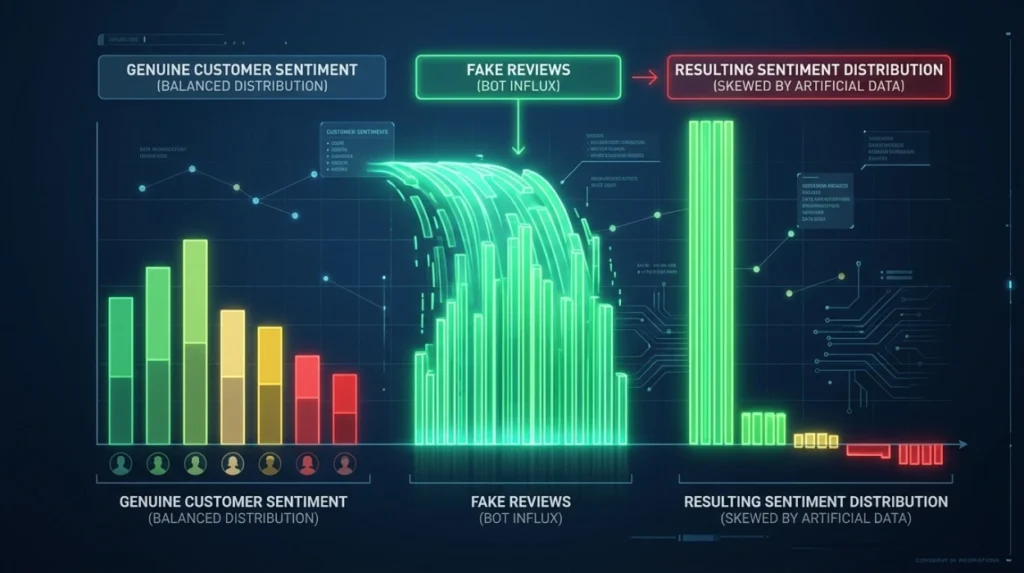
Fake review activity affects sentiment distribution by changing the apparent balance of positive, neutral, and negative customer feedback. Sentiment distribution is the observable pattern of opinions associated with a business across its review ecosystem. Artificial reviews can distort this pattern without changing the underlying customer experience.
Positive fake reviews can create an inflated perception of customer satisfaction. Negative fake reviews can create an inaccurate perception of poor service, product quality, or business conduct. Both forms introduce reputation signals that do not correspond to authentic customer experiences.
Search systems and users encounter these signals as part of the wider business entity. Review ratings, written feedback, review volume, and related information interact within the local search environment. A distorted sentiment profile therefore affects perception even when individual reviews are difficult to identify as artificial.
This makes sentiment distribution useful for reputation analysis. It does not prove that specific reviews are fake, but unusual changes can identify areas requiring deeper investigation.
Does reporting fake reviews improve search visibility?
Reporting suspected policy violations can contribute to improved search perception when the reported content is subsequently removed or otherwise loses visibility. The reporting process itself does not directly change rankings or guarantee a change in search visibility.
Search visibility is determined through ranking and indexing systems that evaluate the available information surrounding a business entity. Removing a review can change the content environment, but the effect depends on the review’s prominence, rating contribution, and relationship to other reputation signals.
A business with a large volume of legitimate reviews can experience a different outcome from a business where a small number of artificial reviews significantly influence visible sentiment. The underlying review ecosystem therefore needs evaluation before measuring the potential effect.
This distinction prevents reporting activity from being confused with search-result improvement. The measurable outcome is the change in the review environment and associated search perception after platform evaluation.
How do organic and reactive review management approaches compare?
Organic review management develops a consistent and authentic review ecosystem over time, while reactive management addresses specific reputation problems after they appear. Organic activity focuses on encouraging genuine customer feedback and maintaining accurate business information. Reactive activity focuses on identifying, documenting, and reporting potentially problematic content.
Organic approaches support long-term sentiment stability because they increase the proportion of genuine customer experiences within the review profile. Their effectiveness depends on authentic participation rather than manufactured feedback. This creates stronger and more defensible reputation signals.
Reactive approaches provide targeted intervention when a specific review or review pattern creates a measurable problem. Their strength lies in addressing an identified issue rather than waiting for the overall review profile to change naturally. Their limitation is that they operate after the reputation signal has already entered the search ecosystem.
A sustainable review strategy therefore separates legitimate reputation development from policy-based response. Organic activity builds the underlying information environment, while reactive analysis addresses content that requires investigation.
Which strategy provides better short-term results?
Short-term results depend on whether the suspected fake review qualifies for platform action and how prominently it affects the business profile. A successful removal can produce a direct change in the visible review environment. However, the reporting process itself does not guarantee immediate results.
Reactive reporting provides a focused response to a defined problem. It can be efficient when the evidence is clear and the content falls within an applicable policy category. Its limitation is that it does not address broader weaknesses in the review ecosystem.
Organic review development operates on a longer timeframe. Genuine customer feedback gradually changes the balance of available reputation signals rather than directly addressing one disputed review. This approach provides greater continuity but does not replace targeted reporting when a policy violation requires attention.
Short-term and long-term strategies therefore have different purposes. Immediate reporting addresses specific content, while authentic review development supports the sustainability of the broader reputation profile.
How sustainable is fake review detection as part of reputation management?
Fake review detection is sustainable when it operates as a continuous monitoring and evidence-evaluation process rather than a one-time search. Review ecosystems change as new customers publish feedback, accounts become active, and platform policies evolve. A static assessment therefore becomes outdated as the information environment changes.
Continuous monitoring tracks review volume, sentiment distribution, unusual publication patterns, reviewer behaviour, and changes in search visibility. This provides an early indication when a business profile develops an abnormal pattern.
The sustainability advantage comes from combining monitoring with clear evaluation criteria. A consistent process prevents every negative review from being treated as suspicious while still identifying patterns that require investigation.
Long-term reputation management therefore depends on maintaining evidence standards. The objective is not to eliminate criticism but to preserve an authentic review environment in which legitimate customer experiences remain distinguishable from fabricated engagement.
How should businesses compare fake review detection methods?
Businesses can compare detection methods by evaluating accuracy, scalability, evidence quality, platform relevance, and risk of false positives. A method that processes large volumes quickly provides a different benefit from one that verifies customer context in detail.
A useful comparison framework includes:
- Measure detection accuracy — Compare whether the method identifies suspicious patterns without incorrectly classifying legitimate customer feedback.
- Evaluate scalability — Determine whether the approach remains practical as review volume increases across multiple business profiles.
- Assess evidence quality — Establish whether the method produces verifiable indicators rather than relying exclusively on stylistic assumptions.
- Compare policy relevance — Check whether identified issues correspond with the platform’s applicable review-content rules.
- Monitor outcome changes — Track whether legitimate reports result in review removal or other measurable changes to the review environment.
This framework distinguishes analytical usefulness from actual platform outcomes. A detection method can identify unusual language without establishing a policy violation, while a detailed evidence process can provide stronger grounds for reporting.
What is the role of content suppression versus content correction?
Content suppression and content correction address different reputation mechanisms. Correction focuses on changing inaccurate information at its source, while suppression concerns reducing the visibility of damaging information through stronger competing content or changes in search-result composition.
For fake reviews, platform reporting represents a source-level approach when the content violates applicable policies. Search suppression does not remove the review and therefore addresses a different problem. It operates through the broader SERP rather than directly changing the business profile.
Content enhancement can also influence perception by strengthening accurate, authoritative information surrounding the business. This includes maintaining consistent business information and developing credible content that helps search systems understand the entity.
These methods therefore require different evaluation criteria. Removal and correction are measured through source-level outcomes, while suppression and enhancement are measured through search visibility and SERP composition.
How can businesses evaluate the overall effectiveness of fake review management?
Overall effectiveness is evaluated through changes in authenticity, sentiment distribution, review visibility, search perception, and policy-compliant outcomes. Removing one suspicious review does not automatically demonstrate that the wider reputation environment has improved.
A complete evaluation compares the review profile before and after intervention. Relevant measurements include review volume, rating distribution, recurring language patterns, suspicious account activity, prominent review content, and changes in local search perception. Detect and Remove AI-Generated Reviews as part of this process requires assessing both the authenticity of individual reviews and the broader review environment.
The evaluation also needs to distinguish between temporary and sustainable outcomes. A single successful report addresses one piece of content, while ongoing monitoring determines whether similar patterns emerge again. This makes Detect and Remove AI-Generated Reviews an ongoing reputation-management process rather than a one-time review action.
This creates a more accurate measurement framework for Google Reviews. The objective is not simply reducing the number of negative reviews but maintaining an authentic, policy-compliant, and representative review ecosystem.
Detecting and reporting AI-generated fake reviews requires a distinction between AI-assisted writing and fabricated customer experiences. Language patterns provide useful evidence, but authenticity is better evaluated through reviewer behaviour, timing, account history, customer context, sentiment distribution, and applicable platform policies.
Reporting is a reactive source-level mechanism, while organic review development creates a longer-term foundation of genuine reputation signals. Content correction, removal, enhancement, and search visibility management also operate at different stages of the reputation ecosystem and therefore require separate measurements.
The most reliable evaluation process combines automated analysis with contextual evidence. This approach improves scalability while reducing the risk of treating legitimate AI-assisted reviews as fake. It also provides a clearer framework for assessing search visibility, entity credibility, sentiment distribution, and long-term online reputation.
How can you detect AI-generated fake reviews on Google?
Look for unusual language patterns, repeated phrases, abnormal review timing, suspicious account activity, and claims that do not match genuine customer interactions. AI-generated wording alone does not prove that a review is fake, so multiple reputation signals need to be evaluated together.
How do you report an AI-generated fake review on Google?
First assess the review against Google’s applicable policies and document evidence indicating fabricated engagement, misleading content, or an absence of a genuine customer experience. The review can then be reported through the available Google Business Profile review-reporting process.
Can AI-generated reviews be removed from Google?
AI-generated reviews can be removed when they violate Google’s applicable review policies, such as rules concerning fake engagement or misleading content. AI assistance alone does not establish a policy violation, so the underlying authenticity and context remain important.
Does Google detect AI-generated fake reviews?
Google uses automated systems and other signals to evaluate review content and activity, but AI-generated language is not itself proof that a review is fake. Authenticity assessment involves broader signals such as account behaviour, content patterns, and evidence of genuine customer interaction.
Can fake Google reviews damage a business’s online reputation?
Fake reviews can distort a business’s rating, sentiment distribution, and reputation signals when they do not represent genuine customer experiences. This can affect how users interpret the business profile and its credibility within local search results.