

Digital communications deliver measurable return on investment when outcomes are assessed through reputation signals, search visibility, sentiment distribution, audience engagement quality, and long-term entity credibility rather than isolated communication metrics. Reputation management strategies differ based on communication objectives, search ecosystem behaviour, stakeholder expectations, and the consistency of digital assets across multiple platforms. Online reputation control methods are evaluated through search ranking influence, content quality, authority signals, and the ability to shape sustainable public perception.
Political reputation exists within a digital environment where search engines continuously interpret content, authority, and user engagement. Every published statement, interview, article, social media update, and third-party mention contributes to an evolving digital footprint. Measuring the return on digital communications therefore requires analysing how communication efforts influence search engine results pages (SERPs), knowledge signals, trust indicators, and sentiment distribution over time. Rather than focusing solely on impressions or engagement rates, evaluation examines whether communication activities improve visibility of authoritative content, strengthen entity credibility, and reduce the prominence of unfavourable narratives.
How is ROI measured in digital communications for political reputation?
Return on investment in political digital communications is measured through changes in reputation indicators rather than financial outcomes alone. Evaluation focuses on improvements in search visibility, authority signals, sentiment distribution, audience trust, and the stability of digital reputation across multiple search queries.
Traditional communication metrics measure clicks, reach, impressions, and engagement. Reputation-focused evaluation measures how communication influences search ecosystems and public information retrieval. Search engines interpret structured content, authoritative references, topical consistency, and entity associations to determine ranking influence. These signals collectively affect how individuals encounter information about political figures before forming opinions.
A comprehensive evaluation framework analyses multiple indicators simultaneously instead of relying on one performance metric. Search ranking positions demonstrate content visibility, while sentiment distribution measures the balance between favourable, neutral, and unfavourable content appearing across indexed sources. Entity credibility evaluates consistency between authoritative references, verified information, and trusted publications. Together, these measurements provide a more accurate assessment of communication effectiveness.
Long-term measurement also examines content durability. Evergreen policy explanations, verified biographies, parliamentary records, and authoritative interviews maintain search visibility longer than temporary campaign updates. Stable digital assets continue generating reputation signals after publication, increasing cumulative return over extended periods.
Which digital communication approaches produce stronger reputation outcomes?
Different communication approaches produce different reputation outcomes because each operates through distinct search mechanisms. Proactive communication builds long-term authority, while reactive communication addresses immediate perception changes following emerging issues.
How does proactive communication operate?

Proactive communication is a structured publishing strategy that establishes authoritative digital assets before reputation challenges emerge. It operates by producing consistent, factual, and topic-focused content across trusted digital platforms.
Search engines reward consistency between multiple authoritative sources. Regular publication strengthens topical authority, expands keyword relevance, and increases entity recognition. Over time, these factors improve search ranking influence while creating stronger reputation signals that remain visible during future search queries.
The primary advantage of proactive communication lies in sustainability. Stable content ecosystems continue supporting entity credibility without depending on crisis-driven responses. The limitation is slower measurable impact because authority develops through accumulated relevance rather than immediate visibility changes.
How does reactive communication operate?
Reactive communication responds directly to emerging criticism, misinformation, or increased public scrutiny. It operates by publishing clarifications, factual responses, official statements, and corrective information designed to rebalance sentiment distribution.
Reactive communication influences search ecosystems through rapid indexing and updated information. Fresh authoritative content provides search engines with current context while supporting factual accuracy. This mechanism reduces information gaps that often allow speculative content to dominate search results.
The limitation involves timing and dependency on existing authority. Established digital credibility increases the effectiveness of reactive communications because search engines already recognise authoritative sources. Weak digital foundations reduce the visibility of corrective content despite frequent publication.
How do content enhancement and content suppression compare?
Content enhancement focuses on increasing the visibility of authoritative information, whereas content suppression reduces the prominence of unfavourable content through competitive search optimisation. Both influence SERP composition through different mechanisms.
Content enhancement is the process of publishing, updating, and strengthening authoritative digital assets. It operates by improving relevance, topical coverage, structured information, internal linking, and content quality. Search engines reward comprehensive, trustworthy resources with stronger ranking influence, resulting in increased visibility for favourable information.
Content suppression operates by creating higher-quality, more authoritative content that naturally outranks lower-value pages. The mechanism relies on search engine competition rather than removal. As stronger pages gain authority, less relevant content loses visibility across search results. This approach evaluates success through reduced prominence rather than deletion.
Comparative analysis identifies different strengths. Content enhancement improves entity credibility and long-term trust signals because it expands authoritative information. Content suppression changes SERP composition more directly by shifting ranking positions. Enhancement supports sustainable reputation development, while suppression addresses visibility imbalance within existing search ecosystems.
Limitations also differ. Content enhancement requires continuous publication and technical optimisation. Content suppression depends on competitive authority because highly established external pages remain difficult to displace. Sustainable reputation management frequently combines both mechanisms to maintain balanced search representation.
How do search engines evaluate political reputation signals?
Search engines evaluate political reputation through interconnected authority, relevance, consistency, and engagement signals rather than subjective opinions. Reputation signals are interpreted using semantic relationships between entities, trusted sources, structured data, and topical authority.
Entity credibility is the consistency of information associated with a public figure across authoritative websites. Search systems compare biographies, official publications, interviews, policy documents, citations, and independent references to establish confidence in entity identity and expertise. Consistent information strengthens search ranking influence by reducing ambiguity.
Sentiment distribution contributes additional contextual understanding. Search engines identify recurring themes across indexed documents and evaluate the diversity of perspectives surrounding an entity. Balanced information ecosystems provide broader context than isolated positive or negative publications, supporting more stable search representation.
Content freshness also influences evaluation. Updated information signals continued relevance, while outdated material gradually loses prominence when replaced by more authoritative resources. Search ecosystems therefore reward ongoing digital communications that maintain topical accuracy without sacrificing factual consistency.
Which communication channels contribute most to reputation management?
Communication channels contribute differently because search engines assign distinct authority levels to different content types. Official websites, earned media, structured publications, social platforms, and third-party references each generate unique reputation signals.
Official websites provide the strongest foundation because they establish primary entity information. Structured architecture, comprehensive policy content, biographies, media resources, and factual updates strengthen topical authority. Search engines frequently interpret official domains as central reference points for entity identification.
Earned media contributes independent authority. Interviews, expert commentary, policy analysis, and verified reporting create external validation that reinforces credibility. Independent references diversify reputation signals and strengthen trust through multiple authoritative sources rather than isolated self-publication.
Social platforms influence reputation differently. They generate engagement signals, improve content discovery, and distribute current information rapidly. Their search ranking influence depends on authority, indexing patterns, and content consistency rather than engagement volume alone. Consequently, social communication complements authoritative publishing instead of replacing it.
How do short-term and long-term communication strategies compare?
Short-term communication addresses immediate visibility changes, whereas long-term communication develops sustainable entity credibility through cumulative authority. Their effectiveness differs according to evaluation periods and search ecosystem behaviour.
Short-term strategies prioritise rapid publication, immediate clarification, and current information updates. Search engines quickly index fresh authoritative content, allowing recent information to appear for time-sensitive queries. These methods improve visibility during active public discussion but require continual updates to maintain prominence.
Long-term strategies build comprehensive digital ecosystems through structured content, authoritative references, consistent messaging, and ongoing optimisation. Authority accumulates gradually because search engines continuously evaluate relevance, quality, and semantic relationships. Stable digital assets remain visible across extended periods, supporting stronger reputation resilience.
Comparative evaluation demonstrates that short-term communication improves responsiveness while long-term communication improves sustainability. Reactive visibility addresses immediate perception shifts, whereas accumulated authority strengthens entity credibility during future search evaluations. Combining both approaches creates balanced reputation management without relying exclusively on temporary communication cycles.
Which evaluation framework provides the most accurate ROI assessment?
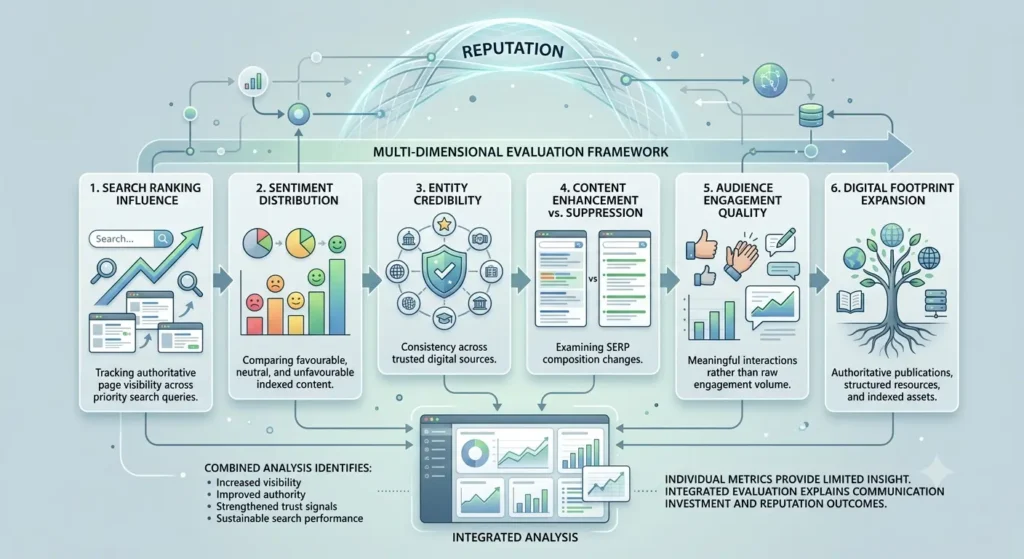
A multi-dimensional evaluation framework provides the most accurate assessment because political reputation depends on interconnected search, communication, and perception indicators rather than isolated performance metrics.
An effective framework includes the following evaluation sequence:
- Measure search ranking influence by tracking authoritative page visibility across priority search queries.
- Analyse sentiment distribution by comparing favourable, neutral, and unfavourable indexed content.
- Evaluate entity credibility through consistency across trusted digital sources.
- Compare content enhancement against content suppression by examining SERP composition changes.
- Assess audience engagement quality using meaningful interactions rather than raw engagement volume.
- Review digital footprint expansion through authoritative publications, structured resources, and indexed assets.
Each measurement reflects a distinct component of digital reputation. Combined analysis identifies whether communication activities increase visibility, improve authority, strengthen trust signals, and create sustainable search performance. Individual metrics provide limited insight, whereas integrated evaluation explains the relationship between communication investment and measurable reputation outcomes.
Dive Deeper With Our Expert Guides:
How Campaigns Measure and Monitor Political Trust Indicators
Tracking Reputation Shifts Throughout an Election Campaign
How does digital footprint optimisation influence communication ROI?
Digital footprint optimisation increases communication ROI by expanding authoritative content that search engines recognise as reliable entity information. A digital footprint is the complete collection of indexed information associated with an individual across search ecosystems.
Optimisation operates by improving information quality, consistency, semantic relevance, structured organisation, and topical completeness. Search engines evaluate relationships between official resources, media publications, public records, interviews, and supporting references to determine entity credibility. Comprehensive digital footprints therefore strengthen reputation signals through greater contextual understanding.
Optimised digital footprints also improve SERP composition. Additional authoritative resources occupy more visible ranking positions, reducing informational gaps that lower-quality sources often fill. The result is improved search ranking influence alongside stronger sentiment distribution based on verified information rather than fragmented content.
Scalability distinguishes digital footprint optimisation from isolated communication campaigns. Each authoritative publication contributes cumulative value by strengthening semantic relationships across the broader content ecosystem. Continuous optimisation therefore produces sustained improvements in visibility, trust signals, and long-term reputation stability.
Evaluating the ROI of digital communications in political reputation building requires analysing measurable changes in search visibility, sentiment distribution, entity credibility, and SERP composition rather than relying solely on engagement statistics. Proactive communication strengthens long-term authority, while reactive communication improves responsiveness during periods of heightened public attention. Content enhancement develops sustainable reputation signals, whereas content suppression changes search visibility through competitive ranking improvements. Digital footprint optimisation expands authoritative information that reinforces search ranking influence across multiple platforms.
Search engines evaluate political reputation through semantic relationships, authoritative sources, structured information, and consistent entity signals. Effective evaluation therefore combines technical SEO indicators with communication analysis to measure how digital activities influence public information retrieval and online perception over time. Comparing communication methods through reputation signals provides a structured framework for assessing effectiveness, scalability, sustainability, and long-term strategic value.
Get more information, explore:
Political Communications and Reputation Management Services Combined
Answers to Key Questions
What is reputation management for politicians?
Reputation management for politicians is the process of monitoring, improving, and protecting a politician’s online reputation across search engines, news platforms, and social media. It focuses on strengthening positive reputation signals, improving search visibility, and maintaining accurate public information.
How does online reputation affect a politician’s public image?
Online reputation influences how voters, journalists, and stakeholders perceive a politician through search results and digital content. Search engines often display the most authoritative and relevant information first, making reputation management an important part of digital communications.
How long does political reputation management take to show results?
The timeline depends on the existing digital footprint, search competition, and the chosen reputation management strategy. Long-term improvements are achieved through consistent content optimisation, reputation monitoring, and stronger entity credibility across trusted sources.
Can reputation management improve search engine results for politicians?
Reputation management can improve the visibility of authoritative content by strengthening SEO, content quality, and reputation signals. This helps create a more balanced search engine results page (SERP) while supporting accurate public information.