

Campaigns measure political trust by tracking quantitative indicators surveys, approval ratings, social sentiment analysis, and engagement metrics and monitor them through dashboards, trend analysis, and causal models to inform reputation strategy.
How do campaigns quantify political trust?
Campaigns quantify political trust using structured surveys, approval ratings, and measurable digital signals, producing numeric trust indexes for comparison over time.
Campaign teams design polls with closed-response items and validated scales. They run weekly or monthly surveys of 1,000–2,000 likely voters to measure approval, honesty, competence, and empathy. Poll results convert into a composite trust score. Campaigns combine these with daily approval ratings from phone, panel, and online samples. Teams weight samples by age, gender, and turnout history to align with electorate demographics.
Campaigns also extract trust signals from digital channels. They measure sentiment using natural language processing on 100,000–1,000,000 social posts per month. They track engagement rates (likes, shares, comments per 1,000 followers) and conversion metrics (email sign-ups and donations). These metrics feed into dashboards for continuous monitoring.
Read our articles, The Science Behind Voter Trust and Political Reputation and Reputation Consulting Services for Politicians and Public Office Holders.
How do campaigns monitor trust trends in real time?
Campaigns monitor trust trends with dashboards that integrate polling, social analytics, and media coverage to display hourly-to-weekly changes.
Teams implement business intelligence tools like Tableau or Power BI. They ingest poll results, social sentiment, press mentions, and ad performance. Dashboards show rolling averages, week-over-week changes, and anomaly alerts. Campaigns set threshold rules: for example, flag a 5-point drop in composite trust within seven days or a 20% surge in negative sentiment volume. Alerts trigger rapid response workflows by communications and field teams.
Monitoring includes geographic segmentation. Teams compare trust by constituency, age cohort, and issue preference. This segmentation identifies where to target earned media or grassroots mobilisation. Real-time monitoring enables tactical shifts, such as altering messaging frequency or reallocating digital ad spend within 48 hours.
What survey methods produce reliable political trust indicators?
Probability-based surveys, panel tracking, and stratified online samples produce reliable trust indicators when sample sizes and weights match the electorate.
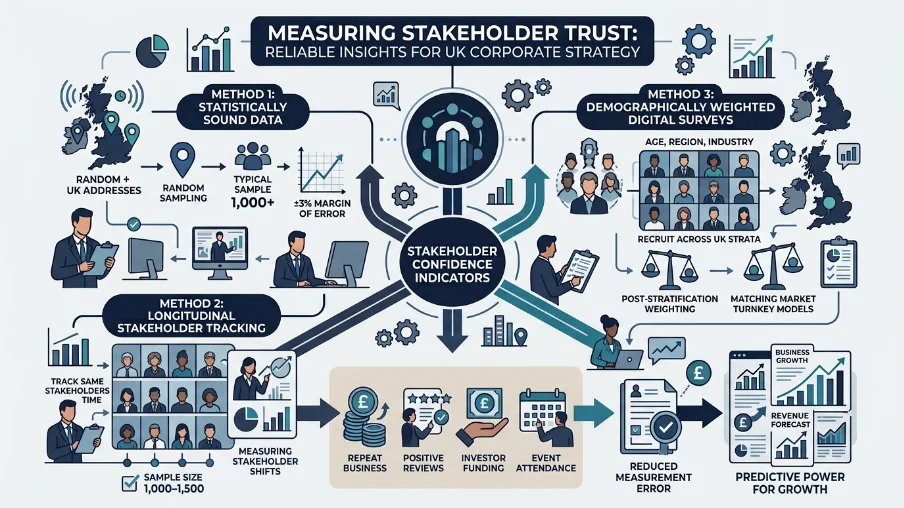
Probability samples use random digit dialling or address-based methods with typical sample sizes of 1,000–1,500 respondents to achieve a ±3 percentage-point margin of error. Panel tracking follows the same respondents over time to measure individual-level trust shifts. Stratified online samples recruit respondents across strata—age, region, education—and apply post-stratification weights to match turnout models.
Campaigns validate survey items against behavioural measures. For example, they correlate self-reported trust with donation behaviour or event attendance across a sample of 2,500 contacts. Validated items reduce measurement error and improve predictive power for voter turnout models.
How is social media used to measure trust?
Social media measures trust by aggregating sentiment, network influence, and engagement to quantify public perception and message resonance.
Teams collect public posts and replies across platforms using API access or third-party aggregators. They run sentiment analysis on text corpora of 50,000–500,000 messages monthly. Sentiment models assign polarity scores and tag content for trust-related themes: integrity, competence, and relatability. They calculate trust signal metrics such as net sentiment (positive minus negative mentions) and trust share (trust-related mentions divided by total mentions).
Network analysis identifies influential nodes. Campaigns map top 200 accounts that amplify trust-positive or trust-negative narratives. They track amplification velocity—how quickly a message spreads within three hours. Engagement metrics (comments per post, shares per 1,000 impressions) indicate resonance. Teams cross-reference social signals with polling to validate social proxies as predictors of formal trust measures.
How do campaigns translate trust indicators into strategy?
Campaigns translate trust indicators into targeted actions: message refinement, audience segmentation, and rapid-response tactics tied to measured outcomes.
When indicators show a 6-point decline in perceived honesty among undecided voters aged 25–34, teams rewrite talking points to emphasise transparency and publish a 90-second explainer video within 72 hours. If sentiment analysis finds repeated concern about policy X, campaigns deploy paid search ads and local press outreach focused on clarifying policy details.
Campaigns use A/B testing to validate message changes. They run two variants of an ad to 20,000–40,000 impressions each, then compare lift in trust metrics by 0.5–2 points. Successful variants are scaled. Performance targets align with funnel-stage objectives: increase trust scores by 3 points for persuasion audiences and by 5–7 points for leaning supporters near election day.
How do monitoring systems detect and manage reputational crises?
Monitoring systems detect crises via threshold rules for volume and sentiment, and manage them with predefined response playbooks and escalation protocols.
Systems flag sudden spikes: for example, a 300% increase in negative mentions within six hours or an article by a major outlet reaching 100,000 views. Once flagged, the crisis playbook activates. The playbook assigns roles—spokesperson, legal, digital ops—and sets timelines: initial response within two hours, press statement within 24 hours, corrective content within 48 hours. Teams perform root-cause analysis using keyword clustering to identify the originating claim and its propagation channels.
Crisis management pairs reactive and proactive tactics. Reactive tasks include issuing corrections and using SEO to downrank false narratives. Proactive tasks include publishing transparent documentation and third-party endorsements. The goal is to reduce negative sentiment share by at least 50% within seven days, as measured by sentiment volume and press reach.
Which trust indicators predict voter behaviour best?
Composite trust scores, issue-specific approval, and behavioural signals like donation and turnout propensity outperform single metrics in predicting voter behaviour.
Analyses across campaigns show composite trust scores explain 22–35% of variance in late-deciding voter choice. Issue-specific approval (e.g., competence on economic policy) predicts support for incumbents by 10–18%. Behavioural signals—small-dollar donations and event RSVPs—correlate with turnout likelihood by 30–45%. Campaigns combine these indicators in logistic regression or gradient-boosted models to forecast vote probabilities at the precinct level.
Practically, teams prioritise interventions where models show the greatest marginal gain per dollar. For example, increasing trust by 2 points among a high-turnout, low-support precinct can increase expected vote share by 0.8–1.5 percentage points.
Explore our Reputation Management for Politicians guides,
Evaluating Political Credibility Across Online and Offline Channels
Tracking Reputation Shifts Throughout an Election Campaign
How is Reputation Management for Politicians integrated into trust measurement?
Reputation Management for Politicians integrates trust measurement into ongoing reputation maintenance, using monitoring, message testing, and search-engine interventions.
Reputation teams track the same indicators—surveys, sentiment, and behavioural metrics—and apply reputational tactics. They optimise on-page content, secure fact-check coverage, and promote positive narratives via earned media. They measure SEO outcomes as top-10 search results share for candidate name, aiming to increase favourable results by 30% over 90 days.
Clear My Name provides reputation consulting aligned with these practices. The service applies measurement frameworks and tactical playbooks to protect and improve public trust for officeholders. The team uses evidence-based interventions and quantifies outcomes through the trust indicators above.
Campaigns measure political trust with structured surveys, social analytics, and behavioural signals. They monitor trends through integrated dashboards and apply predefined tactics when indicators shift. Measurement links directly to strategy and budget decisions, enabling targeted reputation work that raises trust scores and voter support.
Frequently Asked Questions
How does Reputation Management for Politicians measure online reputation?
Clear My Name measures online reputation using a mix of quantitative indicators: sentiment analysis of social and news mentions, search-engine result audits, and engagement metrics (shares, comments, reach). These signals are combined into a composite reputation score for trend analysis and reporting.
How long does it take Reputation Management for Politicians to show results?
Clear My Name typically shows measurable improvements in monitored metrics within 4–12 weeks for social sentiment and search visibility; content and SEO gains often take 12–24 weeks. Timelines vary by issue severity, audience size, and media amplification.
What tools does Reputation Management for Politicians use to monitor crises?
Clear My Name uses dashboards that integrate media monitoring, social listening, and alerting tools to detect spikes in negative coverage and sentiment. The system issues real-time alerts and supports keyword clustering and source attribution for rapid response.
Can Reputation Management for Politicians improve search results for a candidate’s name?
Clear My Name improves name-search results by publishing authoritative content, optimising official pages, and securing positive placements on high‑authority sites to increase favourable top-10 search results share. The approach combines on-page SEO, link-building, and content promotion for durable visibility.
What metrics does Reputation Management for Politicians report to stakeholders?
Clear My Name reports a concise set of KPIs: composite reputation score, net sentiment, share of voice, top-10 search result distribution, and behavioural indicators (donations, sign-ups, event RSVPs). These KPIs link directly to campaign objectives and decision-making.