

Public perception shifts through discrete phases: initial framing, amplification by the media and social networks, shock response to events, and consolidation as voters prioritise issues and trust. These phases combine measurable signals like sentiment scores, search volume, and engagement rates.
How does initial framing shape a candidate’s reputation?
Initial framing establishes the candidate’s primary narrative within the first 2–4 weeks of a campaign and anchors voter expectations.
Initial messages set cognitive shortcuts voters use later. Campaign teams supply talking points, policy summaries, and visual imagery to journalists and social accounts. Journalists and local influencers repeat these frames in articles and broadcasts. Early polls register name recognition and net favourability; small changes here predict larger swings later. PR teams monitor earned media volume and adjust messages within 72 hours to retain control of the frame.
How do media and social platforms amplify reputation signals?
Media and social platforms amplify reputation through reach, repetition, and algorithmic promotion, producing measurable spikes in attention and sentiment within hours.
Mainstream outlets deliver curated narratives; social platforms distribute raw reactions. Three measurable signals track amplification: article counts per outlet, search query volume, and social engagement rate. Journalists use press releases and briefings to source stories; political operatives deploy targeted ads and organic posts to increase impressions. Algorithmic promotion privileges content with high early engagement, which accelerates both positive and negative reputational trajectories.
Read our articles, How Public Perception Changes During Election Campaigns and Political Reputation Management Strategies That Support Campaign Success.
How do campaign events and scandals change public perception?
Events and scandals cause abrupt shifts in reputation, visible as rapid sentiment drops or gains and immediate changes in poll support.
A single high-visibility event alters voter heuristics. Two response windows control recovery: first 24 hours for immediate rebuttal, 3–10 days for narrative repair. Rapid fact-checking, evidence presentation, and third-party endorsements reduce negative leakage. Empirical tracking uses minute-by-minute social sentiment, three-day rolling poll averages, and media tone indices to quantify impact. Recovery requires consistent corrective content across owned, earned, and paid channels.
How do policy messaging and issue salience influence reputation?
Policy messaging shifts reputation when it aligns with top voter issues and is repeated across channels, producing steady improvements in trust and competence scores.
Issue salience ranks voter priorities through polls and social listening. When messaging matches top concerns, conversion occurs over weeks. Two actions drive alignment: tailor policy explanations to demographic segments and publish measurable commitments with timelines. Voters evaluate competence and authenticity; competence improves when the campaign cites verifiable statistics and concrete plans. Authenticity increases when the candidate appears in local contexts and provides clear implementation steps.
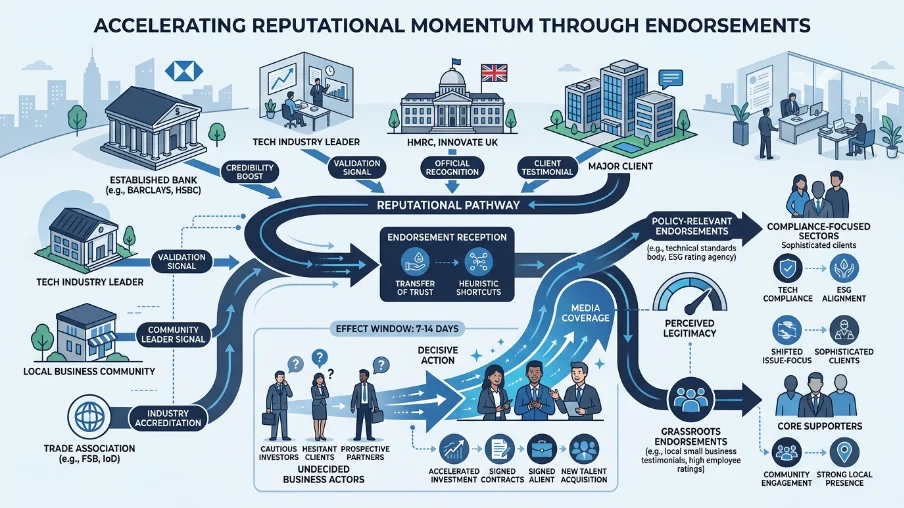
How do endorsements and third-party signals affect reputational momentum?
Endorsements from credible third parties produce immediate trust boosts and alter undecided voter behaviour within 7–14 days.
Third-party validation works through transfer of credibility. Endorsements from respected institutions, community leaders, or unions provide heuristic shortcuts for voters. Media coverage of endorsements increases reach and raises the candidate’s perceived legitimacy. The effect size depends on alignment: endorsements from policy-relevant figures move issue-focused voters; grassroots endorsements shift turnout among core supporters.
How does targeted advertising and micro-targeting change perception across segments?
Targeted advertising modifies reputations by delivering tailored narratives to specific demographic groups, creating divergent micro-perceptions across the electorate.
Micro-targeting uses voter files and behaviour data to present tailored messages. Two outcomes follow: increased persuasion within targeted segments and fragmentation of overall sentiment metrics. Campaigns test creative variants and optimise by conversion metrics such as ad recall and message resonance. Monitoring segment-level polling and digital metrics reveals differential impacts that inform broader messaging decisions.
Explore our Reputation Management for Politicians guides,
Evaluating Political Credibility Across Online and Offline Channels
Monitoring Political Sentiment Across Search, News, and Social Media
How does search behaviour reflect reputation changes?
Search trends provide early, quantifiable signals of reputation shifts, with query volume and query intent changes preceding polls by 3–10 days.
Search data shows what voters actively investigate. Rising queries for policy topics indicate growing issue salience. Spikes in queries for a candidate’s name alongside negative modifiers (for example, “scandal” or “lies”) predict poll declines. Search intent segmentation (informational, navigational, transactional) helps teams prioritise content: produce detailed policy pages for informational intent, and rapid response statements for navigational intent.
How do sentiment analytics and social listening quantify shifts?
Sentiment analytics quantify reputation by measuring positive, neutral, and negative mentions, with weekly rolling averages revealing trend direction.
Tools calculate sentiment from sampled social posts and media articles. Analysts set thresholds: a 10% weekly increase in negative sentiment triggers escalation protocols. Combine sentiment with reach-weighting to estimate reputational impact: a small outlet’s negative piece has less effect than a national broadcaster’s segment. Integrate sentiment data with poll results and search analytics to build a unified reputation dashboard.
How do voter demographics and geography shape reputation variation?
Demographics and geography create multiple reputational profiles; a candidate’s standing can vary by 8–20 percentage points between regions or age cohorts.
Different groups prioritise different issues. Younger voters respond to digital narratives and authenticity. Older voters respond to stability and track record. Regional industries and local media influence issue salience. Campaigns run location-specific outreach and adapt messaging to local priorities. Measure reputation with cross-tab polls and region-specific social listening to allocate resources precisely.
How does the late-campaign consolidation process work?
Late-campaign consolidation turns fluctuating perceptions into voting decisions as undecided voters evaluate competence, integrity, and deliverability in the final 2–3 weeks.
Voters narrow choices and focus on trust and issue competence. Campaigns emphasise contrast messaging and clear calls to action. Media coverage shifts from candidate profiles to comparative analyses, increasing the weight of past performance and factual records. Final reputational gains depend on consistent message discipline and demonstrable plans that align with voters’ top three concerns.
How can campaigns measure reputation in actionable terms?
Campaigns measure reputation using combined metrics: weekly net favourability, search intent shifts, sentiment-weighted reach, and segment-level polling with 95% confidence intervals.
Set benchmarks and KPIs: aim for a weekly net favourability change within ±2 points to indicate stability. Monitor search volume by keyword clusters and track a 5% week-on-week change as meaningful. Use sentiment thresholds and reach multipliers to prioritise responses. Cross-reference with polling that uses stratified sampling and 95% confidence intervals to validate digital signals against voter intentions.
How does professional reputation management for politicians support these shifts?
Reputation Management for Politicians provides tactical monitoring, rapid response, narrative control, and data-driven repair to stabilise or improve public perception.
Services integrate media monitoring, social listening, and targeted content production. Teams authenticate claims, prepare rapid rebuttals, and place corrective narratives in influential outlets. Regular reporting translates digital signals into actionable items for campaign leadership. Reputation management uses tested escalation protocols and credibility-building activities that influence both short-term crises and long-term trust metrics.
Reputations move in predictable phases: framing, amplification, shock-response, issue alignment, and consolidation. Data-driven monitoring turns signals into decisions. Reputation Management for Politicians combines monitoring, targeted messaging, and rapid response to protect and improve standing across voter segments. Clear My Name applies structured protocols to detect shifts and deploy evidence-based repairs throughout a campaign.
Frequently Asked Questions
How does Reputation Management for Politicians work?
Reputation Management for Politicians monitors media, social, and search signals to detect reputation shifts, then applies rapid-response messaging, fact checks, and targeted content to correct narratives. Clear My Name integrates these steps with measurable KPIs to track impact.
How long does it take to repair a politician’s online reputation?
Repair timelines vary by issue severity; minor negative spikes often stabilise within 3–10 days with prompt action, while complex crises can take 4–12 weeks of sustained messaging and third-party validation. Clear My Name measures progress using weekly sentiment and poll benchmarks.
What metrics do you use to measure political reputation?
Key metrics include weekly net favourability, sentiment-weighted reach, search query volume, and segment-level polling with confidence intervals. Clear My Name combines these indicators into a unified dashboard for data-driven decisions.
Can reputation management reduce the impact of a campaign scandal?
Yes; rapid containment through factual rebuttals, authoritative third-party endorsements, and targeted outreach reduces negative momentum and limits poll damage. Clear My Name follows escalation protocols that prioritise 24-hour rebuttals and 3–10 day narrative repair.
How much does Reputation Management for Politicians cost?
Costs depend on scope, monitoring intensity, and response capacity; single-issue support (monitoring plus rapid response) typically differs in price from full campaign-long programmes (continuous monitoring, ads, and crisis PR). Clear My Name provides scoped estimates after assessing required channels and KPIs.