

Effective G2 review management strengthens search visibility, protects software brand credibility and helps prospective buyers evaluate a SaaS company with greater confidence. A structured reputation management service gives software businesses a clear process for responding to criticism, addressing policy violations and improving the visibility of accurate, trustworthy information.
Which G2 review management service delivers the strongest reputation outcomes?
A specialist G2 review management service delivers the strongest outcomes when it aligns review responses, policy-based reporting and search visibility improvements with the software company’s specific reputation risks. G2 reviews influence how prospective customers assess product reliability, customer support, implementation experience and commercial value before requesting a demonstration or speaking to a sales team. A critical review that remains unanswered creates an incomplete public record, while an inaccurate or policy-violating review requires a different response from legitimate customer dissatisfaction. Clear My Name provides a service-led approach to managing these reputation challenges through structured assessment and appropriate corrective action. The objective is to improve the accuracy of the company’s public reputation without promising the removal of legitimate criticism or guaranteed search rankings.
Reputation management works within search ecosystems by addressing the signals that influence what people discover and how they interpret it. Search engines evaluate relevance, quality, authority and other signals when determining which pages appear for a query, while software buyers compare review content, product documentation, company websites and independent commentary. A coordinated strategy improves the availability and clarity of relevant information, supports entity credibility and strengthens control over the brand narrative. This process is not a mechanism for directly purchasing higher rankings or suppressing every unfavourable result. It creates better conditions for accurate information to compete for visibility and helps decision-makers assess the business using a more complete evidence base.
How does professional G2 review management protect software buyers’ trust?
Professional G2 review management protects trust by ensuring that customer criticism receives an appropriate, evidence-based response and that public information reflects the company’s actual practices. Software buyers assess more than star ratings when comparing enterprise platforms; they examine recurring complaints, the specificity of feedback and the way a vendor handles difficult situations. A professional response acknowledges the issue, explains relevant facts without disclosing confidential information and provides a clear route towards resolution. This approach demonstrates operational accountability rather than attempting to invalidate the customer’s experience. Consistent handling of feedback strengthens reputation signals across the evaluation process and reduces the risk that an avoidable communication failure becomes a wider trust problem.
A reliable service also separates legitimate negative feedback from reviews that breach applicable platform policies. Disagreement with an opinion, a low rating or an unfavourable account of a genuine customer experience does not establish a policy violation. The assessment instead examines the review’s content, available evidence and the platform’s current reporting requirements. When a credible violation exists, a documented report gives the platform a clearer basis for assessment, although the final decision remains with G2. This distinction reduces the risk of inappropriate removal attempts and establishes a defensible process for protecting the company’s reputation.
What process ensures G2 review issues receive the right intervention?
A documented review management process improves consistency by matching each intervention to the evidence, the platform rules and the desired outcome. The initial assessment identifies the nature of the complaint, the review’s relevance, the business response history and any potential policy concerns. The next stage establishes whether the appropriate action involves a public response, private customer resolution, a platform report or improvements to supporting brand information. This prevents teams from treating every negative review as a removal case and directs resources towards the problem that actually exists. A clear workflow also creates an auditable record of decisions, submissions and outcomes.
A practical G2 review management workflow follows these steps:
- Audit existing reviews to establish rating distribution, recurring complaint themes, response gaps and the most commercially significant concerns.
- Classify each issue as legitimate criticism, a customer service concern, a factual dispute or a potential platform policy violation.
- Respond to genuine criticism with specific acknowledgements, accurate explanations and a defined resolution route.
- Report suspected policy violations with relevant documentation and a clear explanation of the rule involved.
- Monitor review status, customer resolution, rating changes and search visibility to distinguish completed actions from pending decisions.
- Refine internal processes using recurring feedback to address product usability, onboarding, customer support and communication weaknesses.
This sequence makes responsibility and progress easier to evaluate. Teams can record response times, the percentage of reviews receiving appropriate responses, report outcomes, recurring complaint frequency and changes in review ratings. Each metric measures a different aspect of performance, so a higher rating alone does not prove that a removal strategy worked. Equally, an unsuccessful removal request does not mean the response process failed if the review did not violate platform rules. Separating operational measures from commercial outcomes produces more reliable evidence for future decisions.
How does G2 review management improve search visibility and SERP control?
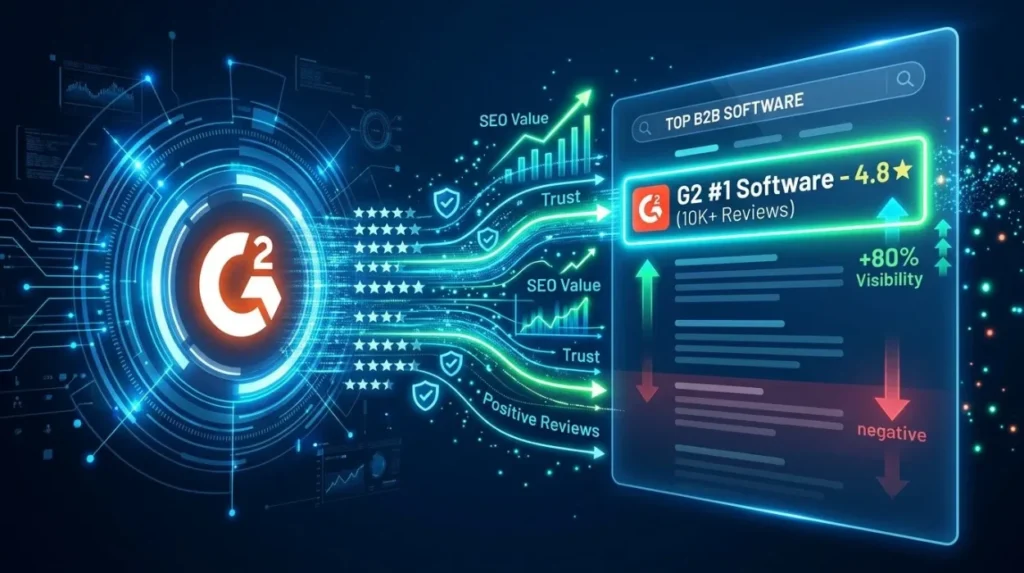
G2 review management improves search visibility by strengthening the quality, consistency and discoverability of the information surrounding a software company. SERP control means influencing the mix of relevant brand information that appears on search engine results pages, rather than controlling the search engine itself. Buyers searching for a software product alongside terms such as reviews, alternatives, pricing or complaints often seek independent evidence before making contact. A company that provides accurate product information, useful documentation and substantive responses gives searchers more context for evaluating its credibility. These improvements support search perception influence, although rankings remain dependent on search engine systems, competition and the relevance of individual pages.
Negative content suppression forms part of a broader strategy when unfavourable material appears prominently for commercially important searches. The process strengthens useful, accurate pages that deserve to compete for visibility, including product documentation, support resources, customer case studies and authoritative company information. Search engines determine whether those pages rank, so no responsible service guarantees that negative reviews disappear from the first page. The objective is to improve the overall information environment and reduce disproportionate reliance on a single unfavourable source. For a wider understanding of the platform’s role in software evaluation, businesses can explore how G2 reviews shape SaaS buying decisions before selecting an intervention.
Search visibility also depends on consistency across the company’s digital presence. Product descriptions, company profiles, support pages and public statements need to communicate the same core facts about features, service scope and customer support. Contradictory information weakens confidence because buyers struggle to establish which claims accurately represent the product. Correcting these inconsistencies improves information quality and supports entity credibility across the wider search ecosystem. The resulting benefit is clearer brand interpretation, not an artificial guarantee of ranking improvements.
Is the cost of professional G2 review management justified by long-term value?
The cost is justified when the service addresses a defined commercial risk and provides measurable work, transparent reporting and realistic expectations. Negative reviews influence the research stage of the software buying journey, particularly when a complaint raises concerns about implementation, reliability, data security or customer support. An unmanaged issue can continue influencing prospects long after the original customer interaction, especially when the review remains prominent in branded searches. A professional assessment identifies the issues with the greatest potential impact and prioritises interventions according to evidence and business relevance. This gives the company a clearer basis for comparing service expenditure with internal handling costs and the consequences of unresolved reputation problems.
The assessment of value needs to distinguish direct deliverables from indirect commercial outcomes. Direct deliverables include review audits, documented responses, policy-based reporting, monitoring and recommendations for improving public information. Indirect outcomes include stronger buyer confidence, more consistent brand perception and improved visibility of relevant company resources. The first category is easier to verify because it records work completed and decisions received. The second depends on factors beyond reputation management, including product quality, sales execution, market demand and competitor activity. A credible provider reports these categories separately rather than attributing every improvement in leads or rankings to review management.
A suitable consultation establishes the scope of work before a business commits to a long-term engagement. Buyers need clarity on the number of review platforms covered, the volume of reviews assessed, reporting frequency, evidence requirements, escalation responsibilities and the limits of removal assistance. They also need to know which activities require internal approval and which outcomes depend on third-party decisions. This level of detail makes the cost easier to evaluate against the actual complexity of the company’s reputation risks. It also reduces the risk of paying for vague promises instead of a defined, accountable process.
How quickly can a SaaS company expect measurable reputation improvements?
Measurable improvements begin when the review inventory, response gaps and highest-priority reputation risks have been assessed. Public responses and internal workflow corrections can be implemented as soon as the relevant facts and approvals are available, while platform review decisions depend on G2’s assessment process. Search visibility changes follow a different timeline because crawling, indexing, ranking competition and changes to other search results influence when an improvement becomes visible. A responsible service therefore separates immediate operational progress from outcomes that require platform or search engine decisions. This distinction helps leadership teams establish realistic milestones without confusing activity with results.
The most useful reporting framework tracks progress across three areas:
- Measure response performance through median response time, response coverage and the number of unresolved customer issues.
- Track platform enforcement through reports submitted, decisions received and confirmed removals where applicable.
- Evaluate search perception through branded search results, the visibility of relevant company pages and changes in the prominence of review-related content.
These indicators create a baseline for evaluating subsequent performance. Monthly comparisons reveal whether response processes are becoming more consistent, customer complaints are recurring less frequently and accurate company information is gaining visibility. Review volume, rating changes and search rankings require contextual interpretation because external events and changes in customer behaviour also affect them. Reliable reporting identifies those limitations rather than presenting correlation as proof of causation. This evidence-based approach supports better resource allocation and makes reputation management more accountable over time.
Why choose Clear My Name for G2 review management?
Clear My Name offers a focused route for SaaS and enterprise software companies seeking a structured approach to review-related reputation risks. The service aligns review assessment, appropriate response strategies, policy-based escalation and wider search visibility considerations with the company’s objectives. Its value rests on identifying the correct intervention, documenting the process and distinguishing controllable activities from decisions made by external platforms. Businesses evaluating a professional G2 review management service need this clarity before committing to reputation support. The consultation provides an opportunity to discuss the company’s current review position, priority concerns and suitable next steps.
Long-term reputation stability also depends on the company’s ability to learn from customer feedback. A repeated complaint about onboarding points towards a different corrective action from a review alleging inaccurate product information or an unresolved support issue. Addressing these patterns improves the underlying customer experience while consistent public communication strengthens the evidence available to prospective buyers. For teams developing their response approach, templates for responding to negative G2 reviews provide a useful starting point for acknowledging concerns and communicating next steps. Individual responses still require verified facts, appropriate approvals and protection of confidential customer information.
A consultation is most productive when the business brings its G2 profile, examples of priority reviews, existing response procedures and commercially important search queries. This information establishes the starting position and allows the discussion to focus on practical priorities rather than generic reputation advice. Clear My Name can then assess the appropriate service scope and explain the relevant process, evidence requirements and performance measures. The result is a more informed decision about the level of support required and the outcomes that can reasonably be evaluated.
Book a G2 review management consultation
Effective G2 review management combines accurate public responses, evidence-led policy reporting and sustained improvements to search visibility. A clear process protects credibility by treating legitimate criticism fairly, escalating genuine policy concerns appropriately and measuring outcomes against an established baseline. It also reduces operational risk by defining responsibilities, reporting requirements and the limits of third-party control. For SaaS and enterprise software companies, these safeguards support more consistent buyer-facing communication and a stronger foundation for trust. Book a consultation with Clear My Name to assess your G2 reputation risks, identify the appropriate interventions and establish a practical plan for monitoring progress.
What is G2 review management for SaaS and enterprise software companies?
G2 review management involves monitoring customer reviews, responding to feedback, reporting content that potentially violates platform policies and improving the accuracy of a software company’s online presence. It helps SaaS and enterprise software businesses strengthen reputation signals and build trust with prospective buyers.
How can SaaS companies handle negative G2 reviews professionally?
SaaS companies can handle negative G2 reviews by acknowledging the customer’s concern, addressing specific issues and providing a clear route towards resolution. A structured response process maintains professional communication, protects confidential information and demonstrates accountability to prospective customers.
Can G2 remove negative reviews about enterprise software?
G2 reviews are not eligible for removal simply because they contain negative opinions or affect a company’s rating. Businesses can report reviews that appear to violate G2’s policies, provide supporting evidence and allow the platform to assess the request.
How does G2 review management improve a software company’s online reputation?
G2 review management improves online reputation by encouraging consistent responses, identifying recurring customer concerns and supporting the visibility of accurate company information. These activities strengthen buyer confidence and support search perception influence, although search rankings and review-removal decisions are not guaranteed.
What does a G2 review management service from Clear My Name include?
A G2 review management service from Clear My Name focuses on assessing review-related reputation risks, identifying appropriate response or reporting options and evaluating wider search visibility concerns. The consultation helps establish priorities, define the required service scope and identify measurable indicators for monitoring progress.