

Responding to negative G2 reviews involves acknowledging the specific concern, providing accurate information and explaining relevant corrective action without compromising customer confidentiality. Reputation management strategies differ based on the review’s validity, the issue reported, the platform’s policies and the potential effect on buyer trust and search visibility.
What Is the Most Effective Way to Respond to a Negative G2 Review?
The most effective response addresses the review’s central concern with factual, specific and proportionate information. A G2 review is a public reputation signal that allows prospective software buyers to evaluate customer experience alongside product features, ratings and category comparisons. A response adds context to that signal, but it does not erase the original criticism or guarantee a change in the reviewer’s opinion. The quality of the response depends on whether it demonstrates an understanding of the issue and provides information relevant to other readers. Generic apologies offer limited explanatory value when they fail to identify the concern being addressed. A structured response therefore balances acknowledgement, clarification and an appropriate next step.
The first decision is to classify the complaint accurately. Product defects, onboarding difficulties, support delays, integration limitations and billing disputes represent different types of customer concerns. Each category requires a different response because the evidence, responsible team and appropriate resolution differ. A technical issue requires verified information about functionality or investigation, while a support complaint requires an accurate account of the service concern. Misclassifying a complaint produces a response that appears disconnected from the review. Accurate classification improves the relevance of the public record and supports consistent communication.
A useful response structure contains three elements: acknowledgement, factual clarification and resolution direction. Acknowledgement confirms that the company has understood the concern without automatically accepting every allegation as established fact. Clarification supplies relevant information while avoiding unsupported claims or confidential details. Resolution direction identifies a suitable next step, such as moving account-specific troubleshooting to a private channel. This structure makes the response useful to the reviewer and to prospective buyers assessing the company’s communication standards. It also creates a consistent method for responding across a large review portfolio.
Which Response Templates Work Best for Different Negative G2 Reviews?
The most suitable template depends on the subject of the criticism and the evidence available to address it. Templates provide a consistent communication structure, but copying the same wording into every response reduces relevance and can make the company’s replies appear automated. A template works best when it establishes the response’s purpose while leaving room for verified details about the specific issue. SaaS teams need to distinguish between technical, service-related, commercial and implementation concerns before selecting a format. This classification reduces the risk of providing inaccurate explanations or promising actions that have not been approved. The following examples illustrate adaptable structures rather than guaranteed methods for changing sentiment.
How should a team respond to a product or technical complaint?
A technical response needs to acknowledge the reported limitation and explain the next step using verified product information. For example:
Thank you for sharing your feedback about [specific feature or integration]. We recognise the importance of this functionality to your workflow and are reviewing the details of the issue. Please contact our support team through [approved support channel] with the relevant technical information so the team can investigate the matter accurately.
This template is appropriate when the reported problem requires technical investigation. It avoids asserting that the issue has been resolved before verification and directs account-specific details to a suitable channel. The company can add confirmed information about a known limitation or published workaround when that information is accurate and relevant. Unsupported promises about release dates or future features introduce additional reputational risk. The response’s credibility depends on the consistency between its public wording and the organisation’s actual product capabilities.
How should a team respond to criticism of customer support?
A support-related response needs to acknowledge the service concern without disclosing the reviewer’s account history. For example:
Thank you for highlighting your concerns about our support experience. We take feedback about response times and communication seriously and would like to understand the specific issue. Please contact [approved support channel] with the relevant details so our team can review the matter appropriately.
This approach recognises the reported experience without exposing private correspondence or making assumptions about the cause. If the company has verified a service failure, a more specific acknowledgement provides greater clarity than a generic statement. If the facts remain uncertain, the wording must not imply that an investigation has already established fault. Public replies also need to avoid blaming individual employees or disclosing internal processes that are not appropriate for publication. The purpose is to demonstrate a measured response while directing sensitive investigation to a private setting.
How should a team respond to pricing or value complaints?
Pricing-related criticism requires a distinction between dissatisfaction with cost and factual errors about the commercial terms. For example:
Thank you for sharing your perspective on the value of our product. Pricing and suitability depend on the features, requirements and agreement relevant to each customer. Please contact [approved commercial channel] if you would like us to clarify the terms associated with your specific situation.
This template avoids treating a difference in perceived value as evidence of incorrect billing. When a review identifies a factual discrepancy, the team needs to verify the relevant agreement before publishing a correction. Account-specific prices, discounts and contractual details are generally better handled privately. A clear public response helps other readers understand that the concern has been recognised without revealing confidential commercial information. It also prevents a public discussion from introducing unverified claims about the company’s pricing model.
How should a team respond to implementation or onboarding criticism?
Implementation-related responses need to recognise the difference between product functionality and the effort required to deploy it. For example:
Thank you for describing your implementation experience. We understand that onboarding, configuration and integration affect how quickly teams realise value from software. Please contact [approved implementation channel] with further details so the relevant team can review the difficulties you encountered.
This structure is useful when the review describes deployment delays, configuration challenges or unclear onboarding guidance. A response becomes more informative when it identifies an accurate resource or documented process relevant to the reported problem. The company must not imply that the reviewer failed to follow instructions unless the evidence supports that conclusion. Implementation feedback also provides information about the relationship between product design, documentation and customer expectations. Analysing recurring themes across reviews helps distinguish isolated complaints from wider operational weaknesses.
Is Publicly Responding to a Negative Review Better Than Taking the Discussion Private?

A public response is most useful when prospective buyers need clarification, while a private discussion is better suited to account-specific investigation and resolution. Public communication allows the company to acknowledge a concern in the same environment where other users encounter it. It also creates a visible record of how the organisation handles criticism. Private communication supports detailed troubleshooting, identity verification and the exchange of confidential information. Neither method completely replaces the other because they serve different communication purposes. The appropriate choice depends on the information required to address the complaint.
Public replies provide context for readers who evaluate the review independently of the original customer. A concise explanation of a documented limitation, for example, can help buyers understand whether that limitation affects their own requirements. However, public replies are not suitable for sharing personal data, account identifiers, internal correspondence or confidential contract details. A company that attempts to resolve every technical issue in public risks exposing information unnecessarily. A company that provides only a generic invitation to continue privately can leave other readers without useful context. Effective communication separates public clarification from private resolution.
A practical approach uses the public response to acknowledge the issue and establish the next step, then moves the detailed investigation to an approved channel. Once the matter is resolved, any further public update must remain accurate and respect the customer’s privacy. The team must not imply that a complaint has been settled simply because a private conversation has started. This distinction protects the credibility of the public record and reduces the risk of misleading prospective buyers. It also provides a repeatable framework for handling different review categories.
Should SaaS Teams Focus on Review Removal or Public Responses?
Public responses and review removal address different problems, so their effectiveness depends on whether the content is legitimate criticism or potentially policy-violating material. A response adds context to a review that remains visible, whereas removal seeks to have content taken down under the platform’s applicable rules. Negative sentiment alone does not establish that a review qualifies for removal. A review can describe a poor experience accurately while still damaging the company’s public rating. Conversely, content that violates platform policies requires a separate assessment even when it appears alongside otherwise legitimate feedback. Treating every negative review as a removal candidate confuses reputational impact with policy eligibility.
Removal requests are appropriate when specific evidence indicates a potential violation of G2’s review policies. The team needs to identify the relevant content, document the reason for concern and follow the platform’s designated reporting process. Evidence must support the reported issue rather than merely demonstrate that the company disagrees with the reviewer’s opinion. The platform determines whether the material breaches its rules, and submitting a report does not guarantee removal. Repeated or poorly substantiated reports consume internal resources without establishing that the content is ineligible. A documented review process helps teams apply reporting criteria consistently.
Public responses remain relevant when the review expresses a legitimate opinion or reports an experience that does not meet removal criteria. A factual reply can explain product limitations, clarify a misunderstanding or show that the organisation recognises the issue. It cannot guarantee a higher rating, remove the original content or control how readers interpret the exchange. Content removal and public response are therefore distinct interventions rather than interchangeable solutions. The correct decision depends on the nature of the review, the available evidence and the outcome that the intervention can realistically achieve.
How Do Organic Reputation Strategies Compare With Reactive Review Management?
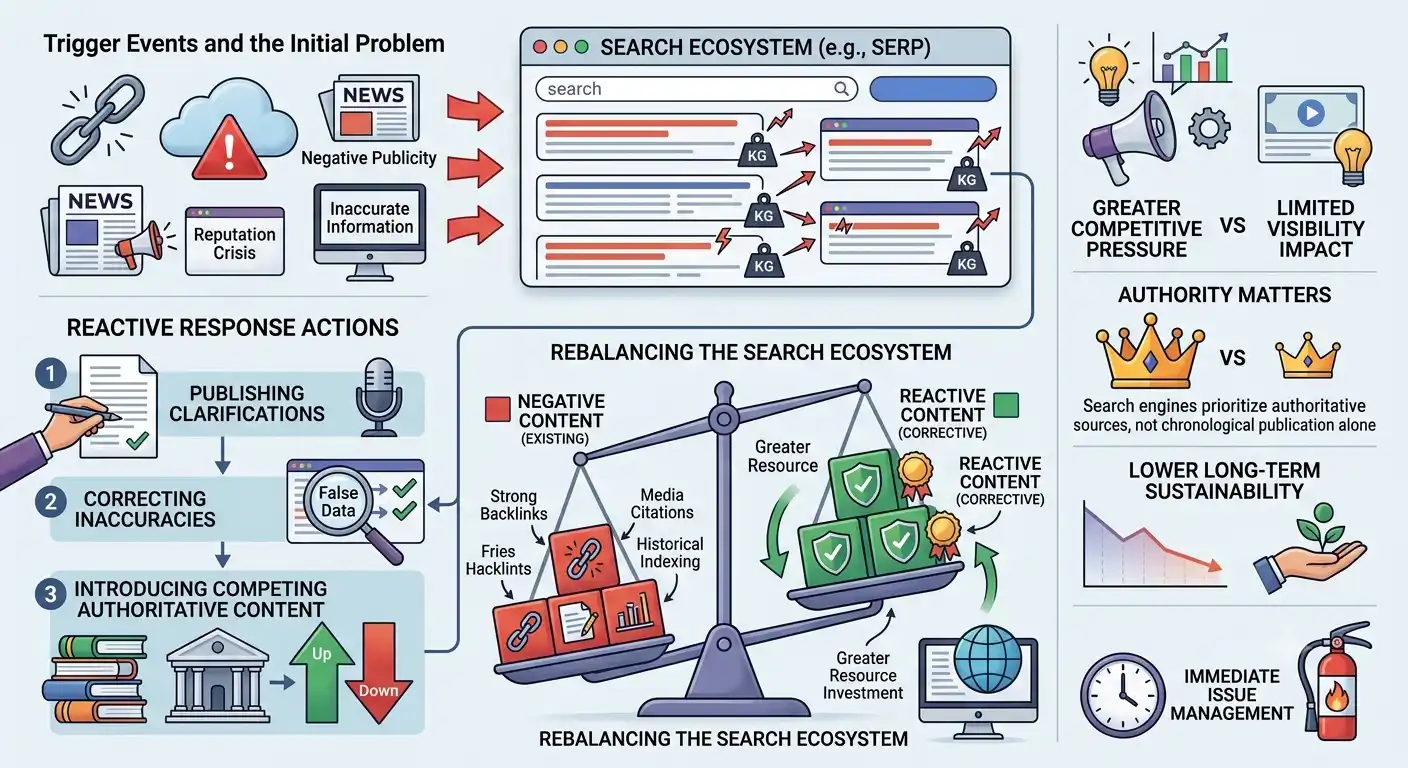
Organic reputation strategies improve the accuracy, usefulness and discoverability of information associated with a software company over time. Reactive review management addresses a specific event, such as a negative review, an inaccurate claim or a sudden change in public feedback. The organic approach develops a wider information environment through useful product documentation, accurate feature pages, technical resources and consistent company information. The reactive approach focuses on an immediate concern through a public response, policy report or targeted correction. Each method addresses a different timescale and type of reputation risk. A sustainable assessment compares their purpose, resource requirements and limitations rather than assuming one approach replaces the other.
Organic content enhancement can strengthen the information available to buyers who research a product beyond its review profile. Accurate documentation and detailed product information help users verify functionality, understand limitations and compare software options against their requirements. Search engines assess individual pages according to relevance and other ranking signals, so publishing content does not guarantee that it will outrank a G2 page. Content enhancement also requires maintenance because outdated product details undermine credibility and can conflict with current customer feedback. Its main strength is the development of useful, durable information that serves multiple queries. Its limitation is that meaningful visibility depends on the quality of the content and the competitiveness of the search environment.
Reactive management offers a more direct response to a specific reputation signal. A timely reply addresses the public concern, while a substantiated policy report seeks review by the platform. These actions can be focused and measurable, but their outcomes depend on the facts, the reviewer’s response and the platform’s decision. A public reply also has limited influence over the wider SERP because search engines independently determine how relevant pages rank. Organic enhancement and reactive management therefore work through different mechanisms: one improves the available information over time, while the other addresses a defined incident. Evaluation requires separate measures for response quality, issue resolution, content visibility and the broader distribution of sentiment.
How Do G2 Reviews Influence Search Visibility and SERP Composition?
G2 reviews influence search perception when G2 profiles and review pages appear alongside official websites, competitor pages and other third-party sources in search engine results pages. SERP composition refers to the range and ordering of results displayed for a particular query. A software company’s branded search results can therefore contain information it does not publish or directly control. Review pages may provide customer feedback, category comparisons or rating information that buyers consider relevant before contacting a vendor. Their presence does not mean that every statement on a review page directly changes the company’s own search rankings. The effect is often indirect, through the information users encounter and the judgements they form from it.
Search engines evaluate webpages individually rather than assigning a universal reputation score to a company and applying it to every page. Relevance, content quality, query intent, competition and other ranking considerations affect whether a particular G2 page appears for a given search. A review profile can rank prominently for a software review query while remaining less visible for a broader corporate query. This difference demonstrates why search visibility needs to be assessed against specific queries and page types. Companies cannot assume that publishing additional pages will automatically suppress third-party review results. Search ranking influence depends on the relative usefulness and relevance of the competing pages.
Content suppression and content enhancement also produce different forms of risk. Content suppression aims to reduce the visibility of unwanted material through legitimate corrections, eligible removal processes or the improved prominence of more relevant information. Content enhancement focuses on adding accurate, useful resources that answer buyer questions and clarify product capabilities. Suppression is constrained by platform rules and ranking systems, while enhancement requires sustained investment and does not guarantee a particular position. Both approaches need to preserve factual accuracy because misleading or exaggerated claims undermine entity credibility. The appropriate measure is whether the overall search environment becomes more informative and representative, not simply whether a critical result disappears.
How Can SaaS Teams Measure Whether Their Response Strategy Is Effective?
A review response strategy is effective when it improves communication quality, supports appropriate resolution and provides accurate context for future readers. A change in the average G2 rating alone does not establish whether responses caused the change. Ratings also reflect new reviews, product changes, customer composition and other factors outside the response process. Teams need measures that distinguish activity from outcomes. Tracking response speed shows how quickly the organisation acknowledges feedback, while response quality checks whether replies address the reported issue accurately. Resolution tracking indicates whether the concern progressed beyond public acknowledgement.
A useful evaluation framework compares performance across consistent periods and review categories. Teams can assess the proportion of reviews receiving a relevant response, the time taken to acknowledge complaints, recurring issue categories and the proportion of cases reaching a documented resolution. They can also examine whether repeated complaints reveal product or support weaknesses that require operational changes. Search visibility needs separate monitoring because changes in rankings and SERP composition do not necessarily follow changes in response activity. Sentiment distribution can help identify whether the overall balance of feedback changes, but it does not explain the cause without further analysis. Combining these indicators provides a more complete assessment than relying on a single rating or ranking.
Consistency is also important when evaluating scalability. A manual process can support detailed, individualised responses for a limited review volume, but it becomes harder to maintain across products, languages and regions as review activity increases. Templates, approval rules and issue classification create repeatable standards, while human review helps ensure that each reply remains accurate and context-specific. Automation can assist with routing and prioritisation, but unverified automated responses risk introducing irrelevant or inaccurate claims. Teams need clear ownership for technical, commercial, support and policy-related issues so that responses reach the people qualified to address them. Scalability depends on combining repeatable processes with sufficient judgement for exceptional cases.
Which Negative G2 Review Response Strategy Is Most Sustainable?
The most sustainable strategy combines accurate public communication, evidence-based policy assessment and ongoing analysis of recurring customer concerns. A response-only approach addresses visible criticism but does not resolve underlying product or service weaknesses. A removal-only approach fails when reviews express legitimate dissatisfaction that does not breach platform rules. Organic content enhancement improves the information available to buyers, but it cannot guarantee suppression of critical reviews or control search rankings. Each approach has a defined purpose and a corresponding limitation. A balanced evaluation assigns interventions according to the issue rather than treating every negative review as an identical reputation problem.
Sustainability also depends on organisational learning. When recurring reviews identify the same onboarding difficulty, integration problem or support delay, the pattern provides evidence for reviewing internal processes. Corrective action can reduce the likelihood of repeated complaints when it addresses the underlying cause. Public responses then communicate the issue appropriately, while updated documentation helps future customers understand product requirements. This creates a relationship between reputation management and operational quality rather than treating reputation as a purely communications-based concern. The resulting improvements remain dependent on verified action and consistent maintenance.
In conclusion, negative G2 review management requires teams to distinguish legitimate criticism from policy violations, public clarification from private investigation, and short-term responses from long-term reputation development. Templates support consistency, while individualised facts preserve relevance and credibility. G2 Review Management for SaaS & Enterprise Software focuses on aligning review responses, policy-based removal requests and reputation strategies with the needs of software businesses. Removal requests depend on platform policy and supporting evidence, whereas organic content enhancement depends on usefulness, accuracy and search competition. Measuring response quality, resolution, recurring feedback and search visibility separately helps prevent unsupported conclusions about effectiveness. The strongest evaluation framework matches each intervention to the nature of the review, the available evidence and the outcome that the method can realistically deliver.
How should SaaS companies respond to negative G2 reviews?
SaaS companies should respond promptly, acknowledge the reviewer’s concerns, and address specific issues with clear, professional language. A well-structured response demonstrates accountability while protecting the company’s online reputation and customer trust.
What is the best template for responding to a negative G2 review?
A useful G2 review response template thanks the reviewer, acknowledges the problem, briefly explains any relevant context, and offers a practical next step. SaaS teams should personalise each response rather than using identical replies that appear automated or dismissive.
Should SaaS companies respond to every negative G2 review?
Yes, SaaS companies benefit from responding to negative G2 reviews because unanswered feedback can leave prospective buyers without evidence of how the business handles problems. Responses should prioritise specific complaints about product functionality, customer support, pricing, and onboarding.
Can a SaaS company remove a negative G2 review?
A negative G2 review is not automatically eligible for removal simply because it damages a company’s reputation. Businesses can report reviews that appear to violate G2’s review policies and provide relevant evidence, while reputation management services such as Clear My Name can help assess appropriate review-removal options.
How can SaaS teams protect their online reputation after receiving negative G2 reviews?
SaaS teams can protect their online reputation by addressing recurring customer complaints, responding professionally to critical feedback, and monitoring review platforms for emerging issues. Consistent responses and genuine product improvements help build credibility with prospective customers researching software vendors.