
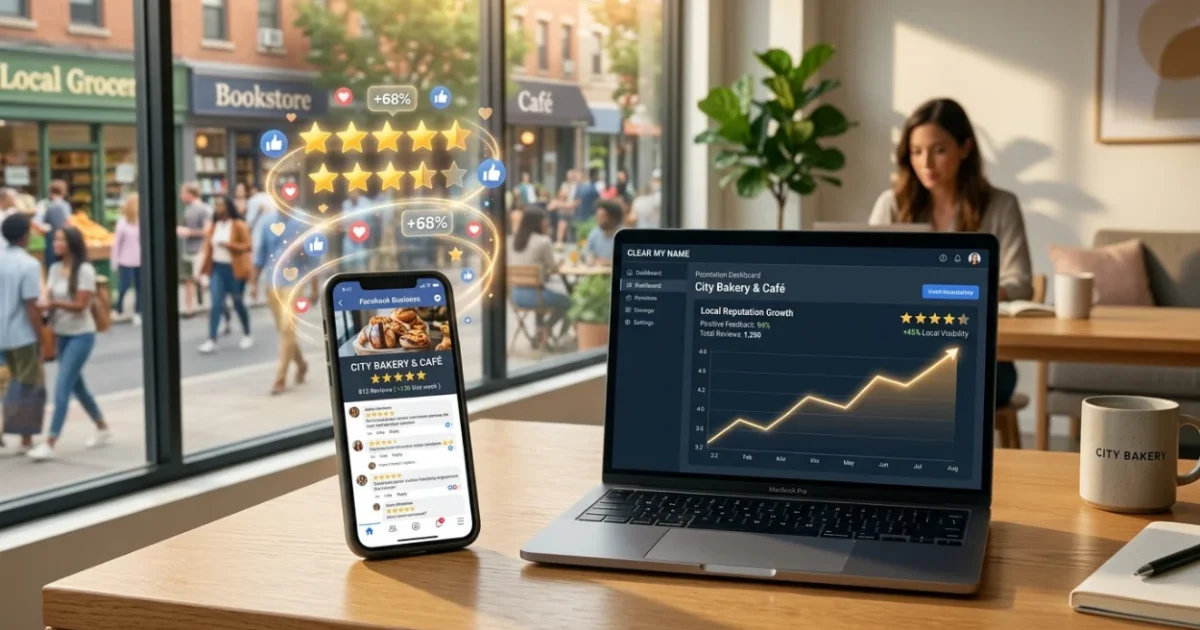
Growing authentic Facebook Reviews strengthens reputation signals that influence customer decisions and the wider search environment. Clear My Name applies a structured reputation management process to improve review acquisition, strengthen entity credibility and create more controlled search perception.
For local businesses, Facebook reviews form part of the information customers assess before making contact or purchasing. A strong review profile provides evidence of customer experience, while consistent review activity contributes to a broader reputation signal across the digital ecosystem. Reputation management therefore extends beyond collecting reviews; it involves managing how review content, sentiment and business information interact across search and social platforms.
How does a structured Facebook Reviews strategy deliver measurable reputation improvements?
A structured Facebook Reviews strategy delivers measurable improvements by creating a consistent process for generating authentic customer feedback and monitoring reputation signals. The process connects customer interactions with appropriate review requests rather than relying on unpredictable customer behaviour. This creates a more stable flow of genuine feedback while preserving the independence of customer opinions. The resulting review profile provides stronger evidence for prospective customers evaluating a local business. It also establishes measurable indicators such as review frequency, rating distribution, sentiment and engagement.
Clear My Name uses reputation management principles to connect review activity with broader digital trust optimisation. The objective is not artificial rating inflation or manufactured feedback. The process focuses on authentic review acquisition, appropriate customer engagement and continuous monitoring of reputation changes. This distinction reduces compliance risk while creating a sustainable reputation asset that continues developing after individual review requests have ended.
The value of structured acquisition becomes clearer when a business has inconsistent review activity. Long periods without new reviews can create an outdated perception, even where customer service remains strong. A consistent process improves the freshness and depth of available customer evidence. This gives prospective customers more recent information when evaluating service quality and reliability.
Which reputation management process provides the strongest control over Facebook review growth?
A controlled process combining diagnosis, customer journey analysis, review acquisition and monitoring provides the strongest foundation for sustainable growth. The first stage identifies the existing review profile, including rating distribution, review frequency, sentiment patterns and recurring customer themes. The second stage identifies appropriate customer touchpoints for review requests. The third stage evaluates incoming feedback and reputation changes over time.
The process can be measured through defined reputation indicators:
- Analyse the existing review profile to identify rating distribution, sentiment concentration and gaps in recent customer feedback.
- Identify high-relevance customer touchpoints where genuine review requests fit naturally into completed transactions or service interactions.
- Implement consistent review-request processes that encourage independent customer feedback without prescribing positive sentiment.
- Monitor new reviews for sentiment changes, recurring themes and emerging reputation risks.
- Measure performance through review frequency, rating trends, sentiment distribution and changes in broader search perception.
This framework creates process clarity because every stage has a defined purpose. It also reduces operational risk by separating authentic review acquisition from manipulation. Businesses gain a clearer understanding of which reputation signals are changing and why those changes matter.
Dive Deeper With Our Expert Guides:
Contain a Viral Facebook Complaint With Clear My Name
Respond to Every Facebook Review With Clear My Name
How does Facebook review management improve search visibility and SERP control?
Facebook review management improves search perception by strengthening the information ecosystem associated with a local business. Search engines evaluate entities through interconnected signals, including business information, third-party references, customer-generated content and local relevance. Facebook reviews form part of that broader information environment, although no individual review platform guarantees a particular ranking position. Effective reputation management therefore focuses on strengthening the consistency and credibility of information surrounding the entity.
SERP control operates through the wider composition of search results rather than direct control over search engine rankings. When customers search for a business, its name, services or reputation, they encounter a collection of pages and profiles that collectively influence perception. Stronger authoritative information creates additional positive reputation signals within that environment. Negative content suppression and content enhancement address a different part of the ecosystem by improving the balance between harmful information and credible sources.
Review management contributes to this process by increasing the quantity and recency of authentic customer evidence. It also creates additional semantic information about customer experience, service quality and local relevance. These signals support entity credibility when they align with other accurate business information. The outcome is not a guaranteed ranking position but a stronger and more coherent digital footprint.
Businesses evaluating the value of Facebook review management therefore need to distinguish between direct ranking manipulation and broader search perception influence. A professional reputation process does not promise control over search algorithms. It improves the quality, consistency and visibility of legitimate reputation signals that search systems and users can evaluate.
Why does authentic review acquisition reduce reputation risk?
Authentic review acquisition reduces reputation risk because it creates customer-generated evidence without manufacturing sentiment. Reviews remain independent expressions of customer experience, making them more credible than artificially generated or coordinated feedback. This approach also reduces the compliance and trust risks associated with manipulated ratings. The result is a review profile based on verifiable customer interactions.
Risk reduction is particularly important for local businesses because review activity is publicly visible and easily scrutinised. Artificial review patterns can damage entity credibility if customers, platforms or other stakeholders identify inconsistencies. Incentivised or fabricated feedback also creates additional policy exposure. A compliant acquisition process therefore protects the business while still creating opportunities for genuine customers to contribute feedback.
The distinction between acquisition and manipulation is fundamental. Acquisition creates an opportunity for customers to express their experience, while manipulation attempts to control what customers say or how they rate the business. Reputation management services deliver greater long-term reliability when they preserve customer independence. This creates reputation signals that remain defensible as the review profile develops.
Authenticity also strengthens sustainability. A business does not need to maintain artificial review activity when genuine customer feedback becomes integrated into its normal communication processes. Review growth then becomes part of the customer lifecycle rather than an isolated reputation campaign.
How quickly can Facebook Reviews influence customer perception?

Customer perception can respond quickly to visible changes in review activity, but sustainable reputation improvement requires consistent accumulation of credible feedback. A newly published review provides immediate information to people examining the business profile. A growing body of recent reviews provides a stronger representation of current customer experience. The speed of perceptual change therefore depends on review relevance, frequency, quality and the existing reputation baseline.
Search visibility operates on a different timeline. Search engines continuously process information, but changes in ranking and SERP composition depend on authority, relevance, competition and query context. Review acquisition therefore cannot guarantee an immediate change in organic rankings. Its immediate value lies in improving the information available to customers, while its broader search value develops through accumulated reputation signals.
A reliable process measures both short-term and long-term outcomes. Short-term indicators include new review activity, response engagement and changes in sentiment distribution. Long-term indicators include sustained review frequency, stronger rating stability, improved entity credibility and a more balanced search environment.
This distinction prevents unrealistic expectations about reputation management. Speed matters when addressing an active reputation weakness, but sustainability determines whether the improvement remains valuable. A structured process therefore prioritises measurable progression instead of isolated review spikes.
Is the cost of Facebook review management justified by long-term value?
The long-term value of Facebook review management is measured through reduced reputation risk, stronger customer trust and improved control over the information available about the business. Cost evaluation becomes more meaningful when compared with the potential impact of an unmanaged review profile. A weak or outdated reputation profile can influence customer decisions before direct communication ever occurs. Strengthening the underlying reputation signals therefore supports the commercial value of digital trust.
The financial evaluation also includes opportunity cost. Employees managing review acquisition manually spend time identifying customers, preparing requests, monitoring responses and analysing reputation changes. A structured reputation management process creates operational consistency while reducing fragmented activity. The business gains clearer measurement and a defined process rather than relying on individual employees to maintain review activity.
Long-term value also comes from sustainability. A review profile containing consistent, authentic and recent feedback continues providing customer evidence after individual acquisition actions have finished. This creates a cumulative reputation asset rather than a short-lived marketing signal. The investment therefore relates to the durability of reputation improvements, not simply the number of reviews generated during one period.
Businesses assessing the commercial value can also validate the underlying principles through Facebook review impact on local service visibility, which explains why customer-generated reputation signals matter within broader digital perception. This analytical perspective supports a more accurate cost-versus-value assessment.
Which risks does professional reputation management reduce?
Professional reputation management reduces operational, compliance and perception risks by applying defined procedures to review acquisition and reputation monitoring. The process distinguishes genuine criticism from content that violates platform rules or presents legitimate grounds for escalation. This prevents every negative review from being treated as removable content. It also ensures that reputation responses remain aligned with the underlying evidence.
Risk reduction includes:
- Separate legitimate criticism from policy-violating content to prevent inappropriate removal attempts.
- Monitor review patterns to identify recurring complaints before they develop into broader sentiment problems.
- Document reputation changes to establish a measurable baseline for evaluating interventions.
- Protect customer authenticity by avoiding fabricated, incentivised or predetermined review content.
- Escalate qualifying content through appropriate reporting or legal processes when evidence supports intervention.
This process creates stronger governance around reputation activity. Businesses gain a defined method for determining when acquisition, response, escalation or content enhancement is appropriate. The approach also prevents reactive decisions based solely on individual negative comments.
Reputation management becomes more reliable when every intervention has a measurable rationale. This makes the process easier to review, refine and sustain over time. It also reduces the risk that short-term reputation actions create larger problems across search or social platforms.
How does review acquisition support long-term entity credibility?
Review acquisition strengthens entity credibility when customer feedback consistently confirms the identity, service quality and relevance of the business. Entity credibility is the degree to which an online information ecosystem provides coherent and trustworthy signals about a particular entity. Facebook reviews contribute customer-generated evidence to this ecosystem. Their value increases when the information remains authentic, current and consistent with other business information.
Long-term credibility develops through repetition rather than a single reputation event. New customer experiences continuously add information to the profile, creating a broader representation of service performance. Consistent review activity also prevents the public reputation from becoming dependent on a limited number of historical experiences. This produces a more stable sentiment distribution.
The broader search ecosystem benefits from information consistency. Business names, services, locations, customer experiences and external references become easier to interpret when they communicate compatible information. Reputation management strengthens this coherence by identifying inconsistencies and improving the quality of available reputation signals.
This is also where review acquisition strategies for local Facebook Pages provide decision-stage context. Understanding how acquisition methods differ helps businesses evaluate whether their existing process creates sustainable reputation development or simply produces isolated increases in review volume.
What outcomes can businesses expect from a controlled Facebook Reviews strategy?
A controlled Facebook Reviews strategy produces measurable outcomes across customer perception, reputation stability and digital trust. The strongest results come from a process that combines authentic acquisition with monitoring and broader reputation management. Each outcome relates to a specific mechanism rather than an unsupported promise.
The principal outcomes include:
- Increase authentic review activity by integrating appropriate requests into relevant customer touchpoints.
- Strengthen trust signals by expanding the volume and informational depth of genuine customer feedback.
- Stabilise sentiment distribution by developing a consistent flow of current customer experiences.
- Improve entity credibility by maintaining coherent reputation information across relevant digital properties.
- Reduce reputation risk by identifying negative trends and qualifying problematic content early.
- Support SERP control by strengthening credible information within the broader search ecosystem.
These outcomes provide a clearer basis for evaluating reputation performance. Review numbers alone do not establish success because quantity without authenticity provides limited strategic value. Measurement must incorporate sentiment, recency, customer relevance and the wider search environment.
The process also creates better decision visibility. Businesses can identify whether reputation improvements result from increased customer participation, improved service perception or broader search perception influence. This evidence supports more precise resource allocation and reduces dependence on assumptions.
Why is Clear My Name a reliable solution for Facebook Reviews?
Clear My Name provides a structured approach to Facebook Reviews by connecting review acquisition with broader reputation management, digital trust and search perception control. The methodology focuses on measurable reputation signals rather than superficial review-volume targets. This creates a process built around diagnosis, controlled execution, monitoring and outcome evaluation. Each stage addresses a specific component of reputation risk.
The approach also recognises that Facebook Reviews do not operate independently. Customer feedback contributes to a broader digital footprint that includes search results, business profiles, third-party references and other reputation signals. Effective management therefore evaluates how individual reviews interact with the wider entity. This supports stronger search perception influence without relying on artificial ranking or review manipulation.
The commercial value comes from process clarity and risk reduction. Businesses receive a defined framework for improving authentic customer feedback while monitoring reputation changes and broader search visibility. The methodology supports sustainable reputation development rather than short-term review inflation. This makes the service relevant where customer trust and online visibility directly influence commercial decisions.
Clear My Name therefore positions Facebook review management as an integrated reputation activity rather than a standalone request-generation exercise. By combining authentic review acquisition, reputation monitoring, content enhancement and appropriate risk controls, the process strengthens the information environment surrounding a local business. The result is a more stable foundation for customer trust, entity credibility and long-term search perception.
How does a reliable Facebook Reviews strategy protect long-term reputation value?
A reliable Facebook Reviews strategy protects long-term reputation value by combining authentic customer feedback with continuous monitoring and broader search visibility management. The process creates reputation signals that remain useful because they originate from genuine customer experiences. It also reduces dependence on reactive interventions by establishing a repeatable system for reputation development. This creates greater consistency across the customer feedback lifecycle.
The most important distinction is between generating reviews and building reputation. Review generation measures activity, while reputation management evaluates how that activity affects trust, sentiment distribution, entity credibility and search perception. A sustainable strategy therefore treats every review as one component of a larger digital trust system. This provides a more accurate basis for measuring commercial reputation value.
Clear My Name delivers this structured approach through defined reputation management principles, ensuring that Facebook review activity supports broader visibility and trust objectives. The focus remains on authentic customer evidence, controlled execution and measurable outcomes rather than exaggerated review targets. This reduces risk while strengthening the credibility of the information customers encounter.
For local businesses, the decision ultimately rests on reliability, process clarity and measurable reputation outcomes. A properly managed Facebook Reviews strategy improves the quality and consistency of customer-generated reputation signals while supporting broader SERP control and search perception influence. The strongest long-term result is a reputation profile that remains credible, current and defensible as customer interactions continue.
How can businesses grow local Facebook reviews naturally?
Businesses can grow local Facebook reviews by consistently delivering good customer experiences and making it easy for genuine customers to leave feedback. Reputation management strategies can also monitor review activity, identify recurring issues and support compliant review-generation processes.
Can Clear My Name help improve a business’s Facebook review presence?
Clear My Name can support Facebook reputation management by assessing review patterns, identifying reputation risks and developing strategies to strengthen positive customer feedback. The focus remains on genuine reviews and compliant reputation improvement rather than fabricated or incentivised feedback.
How do Facebook reviews affect local business reputation?
Facebook reviews influence how potential customers assess a local business before making a decision. A consistent pattern of authentic positive reviews can strengthen social proof, while negative or unresolved feedback can affect trust and perceived service quality.
Is it possible to remove negative Facebook reviews?
A negative Facebook review can be reported when it violates Facebook’s applicable policies, such as rules covering spam, fake activity or prohibited content. Reviews that do not violate platform rules generally require reputation management through legitimate responses and stronger authentic customer feedback.
How long does it take to improve local Facebook reviews?
The timeframe depends on the business’s existing review profile, customer volume and rate of genuine feedback. Sustainable improvement typically comes from consistently generating authentic reviews while responding professionally to negative feedback and addressing underlying customer-service issues.