

Private schools in the UK are primarily funded through pupil fees, while endowments, donations, investments, grants and ancillary income provide additional financial support. Reputation management is the structured process of monitoring, analysing and influencing how an organisation is represented across search results, digital content, reviews and other publicly accessible information.
How Do Private School Fees Fund Independent Education?
School fees form the principal recurring income source for most UK private schools and directly support the operational costs associated with delivering education. Fee income refers to payments made by parents or guardians for tuition and, depending on the institution, additional services such as boarding, meals, transport, activities and educational resources. The level of fee income therefore depends on pupil numbers, fee structures and retention rates. Changes in enrolment directly affect the financial relationship between demand and institutional revenue. From a reputation perspective, publicly available information about fees also forms part of the school’s digital footprint because prospective families frequently research costs, educational standards and institutional credibility online.
Fee structures create a relationship between financial sustainability and perceived institutional value. Search visibility influences the information available when parents investigate a school’s fees, academic performance, governance and public reputation. Search engines evaluate indexed pages according to factors including relevance, authority, content quality and contextual relationships between entities and topics. A school’s search results therefore represent an information environment rather than a single financial statement. Accurate pages describing fees and educational provision contribute to a clearer entity perception, while conflicting or negative information can alter the context in which financial decisions are evaluated.
How Do Endowments Support Private School Finances?
Endowments provide a long-term source of financial support by placing capital into investments designed to generate income or preserve institutional resources. An endowment is a pool of assets established to support an organisation over an extended period, with investment returns contributing to defined institutional objectives. Private schools with substantial endowments can use investment income to support scholarships, facilities, teaching resources, capital projects or other educational priorities. The financial significance of an endowment therefore extends beyond immediate annual revenue because the underlying assets create a continuing financial resource. Endowment information also forms part of an institution’s broader public identity when stakeholders assess its financial resilience.
The reputation dimension of an endowment relates to how financial strength is represented and interpreted across publicly accessible information. Search engines process institutional content through content indexing, entity recognition and relevance relationships. Financial reports, governance documents, educational publications and reputable external coverage can establish authoritative references around a school’s financial position. These references function as reputation signals because they provide contextual evidence about the organisation. A consistent information structure supports clearer SERP evaluation when users search for the school’s finances, governance or institutional stability.
How Do Donations Affect Private School Funding?
Donations provide private schools with additional income that is distinct from compulsory fee payments. Donations can originate from alumni, parents, former pupils, charitable supporters, foundations and other members of an institution’s community. Schools frequently direct donated funds towards scholarships, bursaries, buildings, educational programmes, technology, cultural activities or specific capital projects. Unlike fee income, donations often depend on voluntary participation and therefore have a stronger relationship with stakeholder confidence. The ability to attract donations reflects the perceived value of the institution among groups with an established connection to it.
Donor confidence is also influenced by the information environment surrounding an institution. Online content can shape how prospective donors interpret governance, educational outcomes, financial management and institutional conduct. Positive reputation signals provide contextual evidence that supports credibility, while unresolved negative content can introduce competing interpretations. Search visibility becomes relevant because high-ranking pages receive greater exposure during background research. The relationship between donations and reputation therefore operates through information discovery, interpretation and trust rather than through search rankings alone.
How Does Reputation Influence Private School Funding Perception?
Reputation influences funding perception by shaping the information stakeholders encounter before making financial or institutional decisions. Online reputation refers to the accumulated representation of an entity across websites, search results, reviews, publications, social platforms and other indexed information sources. For a private school, this representation can include academic performance, leadership, safeguarding information, inspection coverage, alumni activity, community engagement, financial reporting and media coverage. Each information source contributes a reputation signal with different levels of authority and relevance. Entity perception emerges from the combined interpretation of these signals rather than from a single page.
Search engines organise this information through ranking systems that evaluate relevance, authority, quality and other signals. A query relating to a private school therefore produces a SERP containing an ordered collection of information sources that influence what a researcher sees first. The ranking position of content affects visibility, while the nature of the content affects interpretation. A highly authoritative article discussing institutional governance carries a different informational weight from an anonymous comment with limited contextual evidence. Reputation analysis consequently requires attention to both content sentiment and source credibility.
How Do Search Engines Interpret Trust and Credibility for Schools?
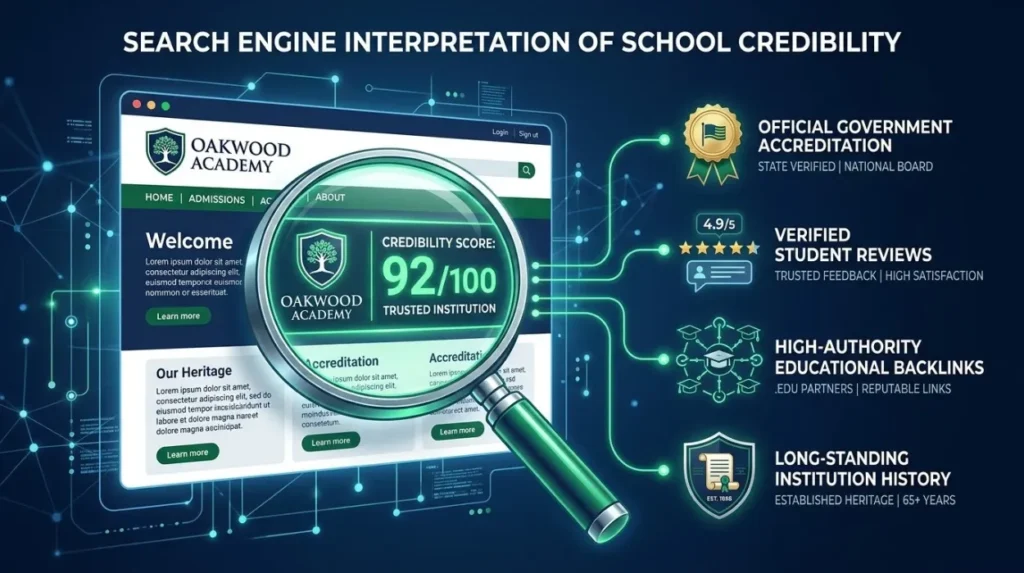
Search engines interpret trust and credibility through multiple signals rather than applying a single reputation score to an organisation. Authority refers to the strength and reliability associated with a source, while relevance determines how closely that source addresses the user’s query. Content quality, contextual consistency and relationships between entities also influence how information is understood within search ecosystems. For private schools, authoritative sources include institutional publications, recognised educational organisations, established media outlets and other credible information providers. These sources create a structured information environment around the school’s entity.
Trust signals become particularly important when users investigate topics involving financial responsibility or institutional performance. Search engines analyse indexed information to determine its relevance to specific queries and contexts. Consistent information across credible sources strengthens the clarity of the entity’s digital representation. Contradictory information creates additional interpretive complexity because researchers encounter competing descriptions of the same organisation. Reputation management at a conceptual level therefore involves understanding how information accumulates, connects and influences entity perception.
How Do Reviews and Sentiment Affect Private School Reputation?
Reviews function as reputation signals because they record individual experiences and opinions in publicly accessible environments. For private schools, review content can address teaching quality, communication, facilities, leadership, pastoral provision, fees and the wider parent experience. Sentiment analysis refers to the classification and interpretation of positive, negative or neutral language within content. Search ecosystems do not treat sentiment as an isolated measure of institutional quality; the context, source, relevance and credibility of the information also matter. Reviews therefore contribute to the wider information landscape rather than operating as a definitive assessment of the school.
Review visibility can influence perception when users encounter repeated themes across search results and review platforms. Content indexing determines whether review pages enter the searchable information environment, while ranking dynamics determine their prominence for relevant queries. A negative review with strong relevance can attract attention even when it represents one individual experience. Conversely, a positive review provides limited contextual value if it lacks detail or comes from a low-authority source. Effective analysis therefore examines sentiment alongside source authority, content relevance, recurrence and search visibility.
How Can Negative Press Affect Private School Entity Perception?
Negative press affects entity perception by introducing adverse information into the collection of sources associated with a school. Negative content refers to information that presents an organisation, individual or institution in an unfavourable context, including criticism, allegations, disputes, regulatory concerns or controversial reporting. Its influence depends on factors such as publication authority, topical relevance, search visibility, content depth and continued indexing. Established news organisations possess stronger source authority than unidentified websites, although both can appear in search results when their content satisfies relevant queries. The resulting perception depends on how users interpret the information alongside other available evidence.
The persistence of negative content also matters because indexed information can remain discoverable after the original event has received less public attention. Search engines continuously organise information according to query relevance and other ranking signals, allowing older material to remain visible when it continues to satisfy a search intent. This creates a distinction between the age of an event and the visibility of its associated content. A historical article can therefore remain part of a school’s digital footprint long after the immediate event has passed. Reputation analysis must consequently evaluate both content chronology and current search visibility.
How Does the Digital Footprint Shape a Private School’s Reputation?
A digital footprint is the collection of publicly accessible information associated with an entity across online platforms and indexed sources. For a private school, this footprint includes its official website, educational directories, inspection information, news coverage, reviews, social profiles, publications, alumni references and third-party websites. Each source contributes information that search engines and users can associate with the school’s entity. The breadth of the footprint therefore affects the quantity and diversity of information available for evaluation. A well-developed footprint contains authoritative references that establish context around the institution.
Digital footprint analysis focuses on the relationship between information sources rather than simply counting positive or negative pages. Content indexing determines discoverability, while ranking determines visibility for particular queries. Authority establishes the relative credibility of sources, and topical relevance determines how strongly individual pages relate to the school’s entity. These mechanisms explain why two schools with similar levels of positive coverage can have different search perceptions. The structure and prominence of information influence what users encounter first and how they interpret the institution.
Dive Deeper With Our Expert Guides:
What Are the Benefits of Private School Education? 11 Evidence-Based Advantages
Is Private School Education Worth It in the UK? Costs vs Outcomes in 2026
How Does Financial Transparency Strengthen Online Credibility?
Financial transparency strengthens online credibility by providing accessible information that explains how an institution operates and uses financial resources. Private schools can have different organisational structures, including charitable arrangements, trusts and other governance models, meaning the financial information available to the public varies between institutions. Published accounts, governance information, fee details and charitable reporting can provide evidence that helps users understand institutional finances. Transparent information also creates authoritative material that can be referenced when financial questions arise. This supports clearer entity perception because users can evaluate information against identifiable sources.
From a search perspective, authoritative financial information contributes to the semantic context surrounding the school’s entity. Search engines connect organisations with topics through indexed content, structured information and relationships between sources. A clearly documented financial structure gives relevant queries more authoritative material to surface. This does not guarantee a particular ranking position, but it creates stronger informational foundations for search evaluation. Financial transparency therefore operates as both a governance principle and an important component of digital credibility.
How Are Funding, Reputation and Search Visibility Connected?
Funding and reputation are connected through stakeholder decision-making and the information available during research. Parents evaluate schools before paying fees, donors assess institutions before contributing funds, and external stakeholders examine governance and financial stability when forming professional judgements. Each research process can involve search engines, meaning the school’s digital footprint becomes part of the information environment surrounding financial decisions. Reputation signals influence this environment by providing evidence about institutional conduct, credibility and performance. Search visibility determines which signals receive attention first.
This relationship does not mean search rankings directly determine school funding. Instead, search visibility affects information access, while information quality and source authority influence interpretation. A strong digital footprint provides relevant and credible material that helps users understand the institution in context. Negative or misleading information can create competing interpretations when it gains prominent visibility. Understanding How Does Negative Press Threaten Private School Funding and Donor Confidence? therefore requires examining the interaction between financial decision-making, reputation signals, content indexing and search perception.
What Does the Funding Structure Reveal About Private School Reputation?
Private school funding combines recurring fee income with additional financial resources such as endowments, donations, investments and other forms of institutional income. Each funding source reflects a different relationship with stakeholders and creates different informational signals around financial sustainability. Fees demonstrate the direct economic relationship between families and the school, while donations reflect voluntary stakeholder support and endowments provide longer-term financial resources. Public information about these mechanisms contributes to the school’s broader digital footprint. The way that information is indexed and interpreted affects how users understand institutional credibility.
Reputation management is therefore best understood as an information system rather than simply an attempt to increase positive commentary. It analyses how content is created, indexed, ranked and interpreted across search ecosystems. For private schools, this framework connects funding information with digital trust, authority, reviews, sentiment and entity perception. Search visibility determines which information receives attention, while credibility signals influence how that information is evaluated. Understanding these mechanisms provides a clearer basis for analysing how financial structure and online reputation interact within the UK independent education sector.
How are private schools funded in the UK?
Private schools in the UK are primarily funded through pupil fees, with additional income coming from donations, endowments, investments, boarding fees and other educational activities. The balance between these sources varies according to each school’s structure and financial model.
Do private schools receive government funding in the UK?
Most private schools operate independently and rely primarily on fee income and private funding rather than standard government school funding. Some institutions can receive specific grants or public funding for defined purposes, depending on their circumstances and eligibility.
How do endowments support private schools?
Endowments provide private schools with invested capital that can generate income over time. Schools can use endowment income to support scholarships, bursaries, facilities, teaching resources and other long-term educational objectives.
Why are donations important to private schools?
Donations provide additional funding from parents, alumni, charitable supporters and other stakeholders. They can finance bursaries, capital projects, educational programmes and facilities beyond what annual fee income covers.
How can reputation affect private school funding and donor confidence?
A school’s online reputation influences how parents, donors and other stakeholders interpret its credibility, governance and financial stability. Search visibility, reviews, media coverage and authoritative information all contribute to the reputation signals surrounding a private school and can affect stakeholder perception.