

Reputation management for politicians delivers stronger search visibility control by addressing the reputation signals that shape public judgement across search results, social platforms and online publications.
A structured reputation management strategy strengthens entity credibility, reduces harmful content visibility and gives political figures greater control over how information is discovered and interpreted.

Which reputation management approach delivers effective control over coordinated comment brigades?
A structured reputation management service delivers the strongest response because coordinated comment activity requires more than deleting individual comments. Comment brigades often generate repeated narratives across accounts, platforms and discussion spaces, creating a pattern that can influence public perception through repetition. The objective is to identify the wider information network, distinguish genuine criticism from coordinated activity and address content that violates platform rules or creates misleading search signals. This approach connects reputation monitoring with search perception influence rather than treating each comment as an isolated incident. The result is a clearer assessment of what audiences encounter when researching a politician online.
Political reputation management also focuses on the relationship between individual pieces of content and the broader search ecosystem. Search engines evaluate relevance, authority, freshness and user engagement when determining which pages appear prominently, while audiences use visible results as shortcuts for assessing credibility. A coordinated campaign that generates substantial discussion can therefore create a disproportionate information footprint even when the underlying claims lack reliable context. Reputation management addresses this imbalance through evidence-based monitoring, legitimate reporting processes and authoritative content development. This establishes a more controlled information environment without relying on artificial manipulation of search results.
How does professional reputation management reduce the visibility of coordinated negative content?
Professional reputation management reduces harmful visibility by strengthening the balance between negative material and credible, authoritative reputation signals. The process begins with a detailed assessment of search results, social discussions, news references, profiles and recurring narratives associated with the political entity. Each relevant result is assessed according to source authority, factual context, search position, sentiment and potential impact on public perception. This creates a prioritised reputation map that identifies which content represents an immediate visibility risk and which material requires longer-term monitoring. Professional reputation management for politicians therefore operates as a structured visibility-control process rather than a simple comment removal exercise.
Negative content suppression also depends on addressing the reasons particular pages receive continued visibility. Publishing accurate information, strengthening authoritative digital assets and improving the relevance of credible sources creates a stronger competitive environment within the SERPs. Legitimate platform reporting addresses content that breaches applicable rules, while content optimisation improves the discoverability of reliable information. These actions work together to reduce the relative prominence of harmful narratives without making unsupported claims or attempting to erase legitimate criticism. The resulting SERP control improves the quality and balance of information available to people researching a political figure.
What process delivers reliable results when a politician faces coordinated comment activity?
A defined process delivers reliability because every stage establishes a clear objective, evidence base and measurable outcome. Reputation management begins with discovery, followed by classification, remediation, authoritative content strengthening and continuous monitoring. This prevents reactive decisions based on individual comments and instead evaluates how coordinated activity affects the entire digital footprint. The process also creates an auditable record of identified content, actions taken and changes in visibility. Clear My Name applies this type of structured approach to ensure reputation activity remains connected to measurable search and perception outcomes.
- Audit search results, social profiles and recurring commentary to establish the baseline visibility of harmful narratives.
- Classify suspicious activity according to repetition, timing, source behaviour, policy relevance and potential reputation impact.
- Report qualifying content through legitimate platform procedures where evidence demonstrates a breach of applicable rules.
- Strengthen authoritative profiles and accurate content to improve the visibility of credible reputation signals.
- Monitor rankings, mentions, sentiment and recurring narratives to measure changes in search perception over time.
This process creates practical control points throughout a reputation recovery campaign. A baseline establishes the starting position, remediation addresses actionable risks and monitoring measures whether the information environment is stabilising. The approach also prevents a common mistake in political reputation management: treating a temporary reduction in comment activity as proof that the underlying reputation problem has disappeared. Sustainable results require continued monitoring because coordinated narratives can reappear through new accounts, derivative content or renewed discussion. Process clarity therefore forms a critical part of risk reduction.
Dive Deeper With Our Expert Guides:
Navigate Endorsement Controversies With Clear My Name
Neutralise a Hostile Interview’s Search Legacy With Clear My Name
How does search perception influence political decision-making?
Search perception influence matters because online research frequently shapes first impressions before audiences engage with primary sources or official statements. A search for a politician’s name can expose news coverage, social discussions, comments, videos, biographies and third-party claims within seconds. When negative or misleading narratives dominate those results, the visible information environment can weaken entity credibility regardless of the accuracy of the overall picture. Reputation management improves this environment by increasing the visibility of reliable information and reducing the prominence of harmful material through legitimate optimisation and remediation. This creates a stronger basis for audiences to assess the political entity using relevant and authoritative information.
The relationship between search visibility and perception also explains why coordinated comment campaigns require a strategic response. A single negative comment has limited influence when it remains isolated, but repeated narratives across multiple locations create stronger associative signals for users encountering the same claims repeatedly. Search engines also index pages, discussions and references independently, meaning one campaign can produce multiple pieces of discoverable content. Effective reputation management identifies these connections and prioritises the sources with the greatest visibility and authority. The objective is not to manufacture positive sentiment but to stabilise the information landscape surrounding the politician.
Is reputation management for politicians worth the long-term investment?
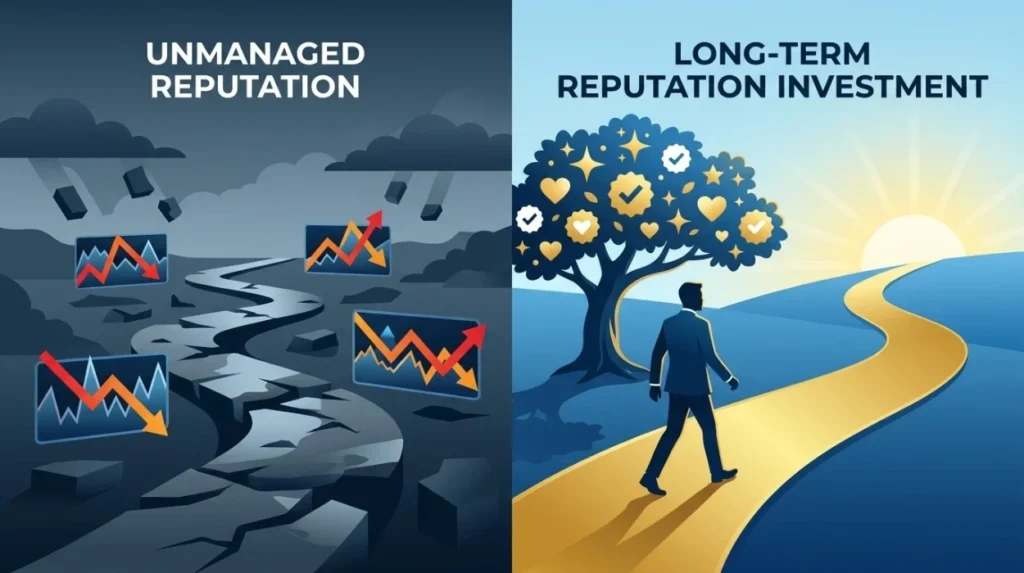
Reputation management delivers long-term value when the cost of unmanaged visibility exceeds the cost of maintaining a structured reputation programme. Political reputation damage affects more than immediate public commentary because persistent negative results can influence journalists, voters, stakeholders, organisations and professional contacts conducting background research. A strong response reduces this exposure by addressing high-impact content while strengthening credible digital assets that remain useful beyond a single campaign. This creates cumulative value because authoritative information continues supporting entity credibility as search behaviour evolves. How to Identify and Counter Coordinated Comment Brigades provides a relevant framework for recognising organised comment activity that can amplify negative narratives and distort perceived public sentiment. The investment therefore relates to risk reduction, visibility control and sustained trust rather than short-term comment suppression.
- Reduce search risk by identifying high-ranking negative pages before they become entrenched reputation signals.
- Improve visibility balance by strengthening authoritative information that competes for relevant search positions.
- Strengthen entity credibility by maintaining accurate, consistent and verifiable information across important digital properties.
- Stabilise perception by monitoring recurring narratives and detecting renewed coordinated activity early.
- Measure progress through changes in search visibility, content prominence, sentiment patterns and reputation signal distribution.
Long-term value also depends on sustainability. Removing or reporting one piece of content does not automatically prevent derivative discussions, reposts or new narratives from appearing elsewhere. A sustainable strategy therefore combines remediation with ongoing monitoring and content reinforcement. This reduces the risk of repeatedly responding to the same problem after it resurfaces. Reputation management becomes a continuous control system that protects the integrity of the politician’s searchable identity.
How quickly can search visibility improve after coordinated comment activity is addressed?
Search visibility improves according to the authority, relevance, indexing status and competitive strength of the affected content, so the most reliable approach measures progress through defined visibility indicators rather than promising an arbitrary timeframe. Platform-level removals can change the visible information landscape when qualifying content is successfully actioned, while search optimisation requires time for search engines to reassess competing pages. Strengthening authoritative content also creates a cumulative effect as relevant assets gain stronger visibility for branded and entity-related queries. Monitoring therefore tracks ranking movement, indexed pages, negative-result prominence and the emergence of new narratives. This provides a measurable basis for assessing whether the reputation strategy is delivering the intended direction of change.
Speed also depends on prioritisation. High-authority pages occupying prominent search positions require greater attention than low-visibility comments that have limited discovery potential. A professional assessment ranks issues according to search position, authority, sentiment, relevance and potential audience impact. This prevents resources being distributed evenly across content with radically different reputation risks. The result is a more efficient strategy focused on the information that actually shapes search perception.
Which safeguards make political reputation management a reliable solution?
Reliable political reputation management depends on evidence, transparency and legitimate remediation methods. A professional service does not treat every criticism as removable content because legitimate political disagreement and lawful public commentary form part of the online information environment. Instead, the strategy distinguishes between valid criticism, inaccurate claims, coordinated manipulation, policy violations and content that requires contextual balancing. This distinction protects credibility because the objective remains accurate representation rather than artificial suppression. Clear My Name positions reputation management around measurable reputation signals, search visibility and legitimate content remediation.
The strongest safeguards also include continuous documentation and monitoring. Every significant action needs a clear reason, supporting evidence and an identifiable outcome so that reputation activity remains accountable. Search results require repeated assessment because rankings, news cycles and online discussions change continuously. This creates a feedback loop between discovery, action and measurement. The resulting process reduces operational risk while ensuring that reputation decisions remain connected to observable search behaviour.
How can a politician take the next step towards stronger SERP control?
The most effective next step is a structured reputation assessment that identifies the exact content influencing search perception and separates actionable risks from legitimate public discussion. That assessment establishes the current SERP landscape, identifies dominant negative narratives and determines where reputation signals require reinforcement. From there, a targeted reputation management strategy can address qualifying content, strengthen authoritative information and monitor changes in visibility. This creates a clear path from diagnosis to remediation and measurement. For political figures facing coordinated comment activity, that clarity delivers stronger risk control than reactive engagement with individual accounts.
Clear My Name provides a structured framework for addressing political reputation risks through visibility analysis, content remediation and ongoing reputation monitoring. The focus remains on strengthening accurate information, improving search visibility balance and stabilising entity credibility across the digital ecosystem. When coordinated comment activity threatens search perception, a documented process provides the strongest basis for controlled intervention and measurable improvement. Reputation management for politicians therefore functions as a strategic risk-management discipline, connecting search visibility control with public trust and long-term digital credibility.
For decision-makers validating the underlying risk, understanding coordinated comment activity and political sentiment provides the analytical foundation for recognising how repeated online narratives affect perception. Evaluating that relationship before taking action ensures that reputation resources target the content and visibility signals with the greatest practical impact.
What are comment brigades and how can they affect your online reputation?
Comment brigades are coordinated groups of people who post repeated comments or negative messages about an individual or business. A high volume of coordinated comments can influence public perception, increase negative visibility and affect online reputation signals.
How can I stop a coordinated negative comment campaign?
Start by documenting the comments, accounts, timestamps and URLs involved, then report content that violates the platform’s rules. Reputation management can also focus on reducing the visibility of harmful content through legitimate monitoring, reporting and search optimisation.
Can negative comments from a comment brigade be removed?
Comments can be removed when they violate a platform’s policies, such as rules covering harassment, threats, spam or coordinated abuse. Removal depends on the platform’s moderation process and the specific nature of the content.
How does Clear My Name help with comment brigades?
Clear My Name can assess coordinated negative activity, identify relevant reputation risks and determine which content has legitimate grounds for reporting or removal. The process can also include monitoring search visibility and strengthening accurate information surrounding the affected entity.
Can comment brigades damage how a business appears in Google search results?
Coordinated comments can contribute to negative search visibility when discussions are indexed, linked to authoritative pages or repeatedly referenced online. Managing these reputation signals involves monitoring harmful content while developing accurate, relevant and authoritative information that provides stronger contextual signals.