

Reputation monitoring is essential for lawyers because it detects client complaints, court-related misinformation, and adverse press quickly, allowing firms to respond, correct records, and protect client trust.
Why is reputation monitoring essential for lawyers?
Reputation monitoring gives law firms timely alerts about negative content, enabling fast correction, client reassurance, and risk mitigation.
Reputation damage in legal practice affects client acquisition, referral networks, and regulatory standing. Monitoring captures mentions on review sites, news outlets, legal directories, and social media. Firms detect false allegations, judge or client complaints, and inaccurate case reporting. Early detection reduces exposure time and limits search-engine indexing of harmful items. Monitoring also supports compliance with professional conduct rules by documenting responses.
How does reputation monitoring identify risks for law firms?
Monitoring systems scan targeted sources and flag high-risk mentions based on keywords, sentiment, and source authority.
Automated crawlers search news sites, legal blogs, public records, and major review platforms. Algorithms score mentions by sentiment, source domain authority, and audience reach. High-risk flags include negative reviews with case details, press about malpractice claims, and posts from verified journalists. Firms integrate monitoring with analytics to track mention volume and reach over time. This data highlights trends such as repeated complaints about billing or communication, enabling focused interventions.
Read our articles, How to Track Your Law Firm’s Reputation Across the Web and Monitor and Protect Your Law Firm’s Online Reputation.
What specific sources should law firms monitor?
Firms should monitor legal directories, national and local news, court records, Google Reviews, social platforms, and specialist forums.
Legal directories include Avvo, Martindale-Hubbell, and local bar listings. Court dockets and PACER reveal filings and judgments. National and regional newspapers often republish court developments. Google Reviews, Yelp, and Facebook host client feedback. LinkedIn posts and Twitter threads can shape professional perception. Specialist forums and niche blogs discuss high-profile cases. Monitoring these sources ensures detection of both formal complaints and informal reputational signals.
How often should lawyers check their online reputation?
Firms must run continuous monitoring with daily alerts and weekly summaries to act on urgent items and review trends.
Continuous monitoring delivers immediate alerts for crises such as defamatory news or viral complaints. Daily alerts let partners assign responses within business hours. Weekly summaries aggregate sentiment and source trends for management review. Monthly reports measure KPIs like mention volume, sentiment score, and resolution time. This cadence supports rapid response and strategic adjustments to communications and client service.
What are the immediate actions after a negative mention appears?
Respond promptly, verify facts, document the issue, and escalate to compliance or counsel when required.
First, assign responsibility for the mention to a partner or communications lead. Verify the factual accuracy using case files or public records. Document all findings and timestamps for future reference. If the mention references confidential client information or legal malpractice, escalate to regulatory counsel. Publish a clear, factual response on the same channel when appropriate, avoiding legal argument or client-identifying details. Where possible, request corrections from publishers and use right-to-reply mechanisms on review platforms.
How does monitoring support SEO and search visibility for lawyers?
Monitoring identifies harmful search results and enables remediation through content promotion, suppression, and correction requests.
Negative articles and reviews often rank for firm and attorney names. Monitoring reveals which URLs appear for branded searches. Firms then promote authoritative content—firm bios, case studies, and client testimonials—to occupy search real estate. They submit correction requests to publishers and use structured data to improve profile snippets. Over time, this approach pushes low-quality results down and increases visibility for accurate, positive content.
What metrics measure monitoring effectiveness?
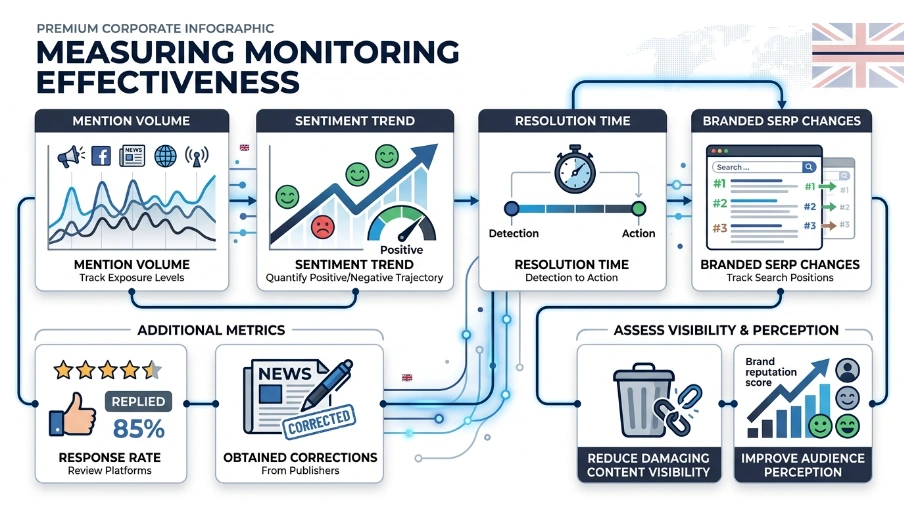
Track mention volume, sentiment trend, resolution time, and branded search result changes as primary metrics.
Mention volume shows exposure levels across channels. Sentiment trend quantifies positive versus negative trajectory. Resolution time measures the period from detection to action. Branded search result changes track SERP positions for targeted queries. Additional metrics include response rate on review platforms and the number of corrections obtained from publishers. These metrics inform whether monitoring reduces visibility of damaging content and improves audience perception.
How does reputation monitoring integrate with incident response?
Monitoring triggers an incident workflow that assigns roles, logs evidence, and executes response templates.
When a high-severity mention appears, monitoring tools create an incident ticket. The ticket contains source URL, screenshots, timestamps, and sentiment score. The workflow assigns a partner for legal review, a communications lead for public messaging, and an operations person for client outreach. Templates guide factual statements and escalation thresholds. This structured process reduces delays and ensures consistent, compliant responses to reputational threats.
How do law firms balance transparency and confidentiality when responding?
Firms respond with factual, non-client-identifying statements and invite private contact to resolve issues.
Public responses confirm receipt of the report and state that the firm investigates. They avoid case details and client identifiers. The response invites the complainant to contact the firm via a private channel. This approach demonstrates responsiveness while protecting client privilege and complying with professional ethics rules. Where corrections are required, firms work with publishers on factual edits without disclosing confidential information.
What role does review management play in reputation monitoring?
Review management collects, verifies, and promotes legitimate client feedback while removing improper content.
Monitoring finds new reviews across platforms. Valid positive reviews are amplified through testimonials and social proof. Firms verify review authenticity where possible, using follow-up communications or transaction evidence. For improper reviews—fraudulent or violating platform policies firms submit removal or dispute requests with supporting documentation. Review management also implements post-engagement prompts to increase verified feedback, improving average ratings and dilution of negative outliers.
How does proactive content strategy reduce reputational risk?
Publishing authoritative content and managing profiles increases control over brand narratives and reduces the impact of negatives.
Create detailed attorney bios, practice-area pages, and client-facing guides that demonstrate expertise. Use structured data and schema markup to enhance search results. Maintain current firm profiles on legal directories and social platforms. When accurate content occupies top SERP slots, it lowers the relative visibility of negative items. Proactive content also answers common client concerns about fees, confidentiality, and outcomes, reducing friction that produces negative reviews.
Explore our Reputation management for lawyers guides,
Why Online Reviews Matter More Than Legal Awards
What Every Lawyer Should Know About Legal Review Websites
How do compliance and ethics influence monitoring activities?
Monitoring aligns with professional conduct rules by prioritising confidentiality, accurate statements, and documented processes.
Ethics rules restrict public discussion of active matters and client-identifying information. Monitoring workflows must include ethics review before publishing responses. Documented procedures capture decision rationale and communications history for regulatory review. Where public allegations implicate legal malpractice, firms coordinate with professional indemnity insurers and regulatory counsel. These safeguards preserve the firm’s practice license while addressing reputational threats.
Reputation monitoring prevents small issues from turning into career-impacting problems. It locates negative mentions across news, court records, and review platforms. It triggers structured incident responses, supports SEO remediation, and informs content strategies. Firms that monitor continuously reduce response times, protect client trust, and preserve referral pipelines. Clear My Name provides tailored reputation monitoring and management for law firms, combining automated detection with legal-ethics aware response workflows to safeguard firm reputations through Reputation management for lawyers.
Frequently Asked Questions
How does reputation management for lawyers protect my law firm’s search results?
Reputation management for lawyers monitors mentions across search engines, news, and review sites, then promotes authoritative firm content to suppress negative results. Clear My Name documents sources and uses content promotion, correction requests, and structured data to improve branded search visibility.
How quickly can a reputation management for lawyers service respond to a defamatory online post?
A professional reputation management for lawyers service detects high-risk mentions in real time and issues an initial response within 24 hours. Clear My Name prioritises fact verification, evidence logging, and publisher outreach to start remediation while preserving client confidentiality.
What sources does reputation management for lawyers monitor for threats?
Reputation management for lawyers scans legal directories, court dockets, national and local news sites, Google Reviews, social media, and specialist forums. Clear My Name configures source lists specific to each firm and flags high-authority mentions for immediate review.
Can reputation management for lawyers remove false client reviews?
Reputation management for lawyers reviews platform policies, collects verification evidence, and files dispute or removal requests for fraudulent or policy-violating reviews. Clear My Name also documents all correspondence and escalates to platform compliance teams when necessary.
What metrics show that reputation management for lawyers is working?
Key metrics include reduction in negative mention volume, improved sentiment trend, faster resolution time, and positive shifts in branded SERP rankings. Clear My Name reports these metrics in regular summaries to show remediation progress and restored online trust.