

Track your law firm’s reputation by monitoring review platforms, legal directories, search results, social media, and news mentions using automated tools, alerts, and sentiment analysis. Consolidate data into dashboards, benchmark against competitors, and respond quickly to feedback to maintain accuracy, trust, and visibility.
What sources should you monitor for a law firm’s online reputation?
Monitor five core sources: review sites, legal directories, search engine results pages, social media platforms, and news or blog mentions. These channels capture client feedback, rankings, and public sentiment, providing a complete view of how your firm is perceived across the web.
Review platforms deliver direct client feedback. Track Google Reviews, Trustpilot, and Yelp. Legal directories shape professional credibility. Track Avvo, Martindale-Hubbell, and Chambers profiles. Each source uses different scoring models, so record ratings and review counts separately.
Search engine results pages (SERPs) define first impressions. Track the top 20 results for your firm name and key partners. Note owned assets, third-party listings, and negative content. Capture position changes weekly to identify reputation volatility.
Social platforms reveal real-time sentiment. Monitor LinkedIn comments, X mentions, Facebook posts, and Reddit threads. News and blogs influence authority signals. Track press coverage, guest articles, and investigative pieces that reference your firm.
Which tools provide reliable reputation tracking for lawyers?
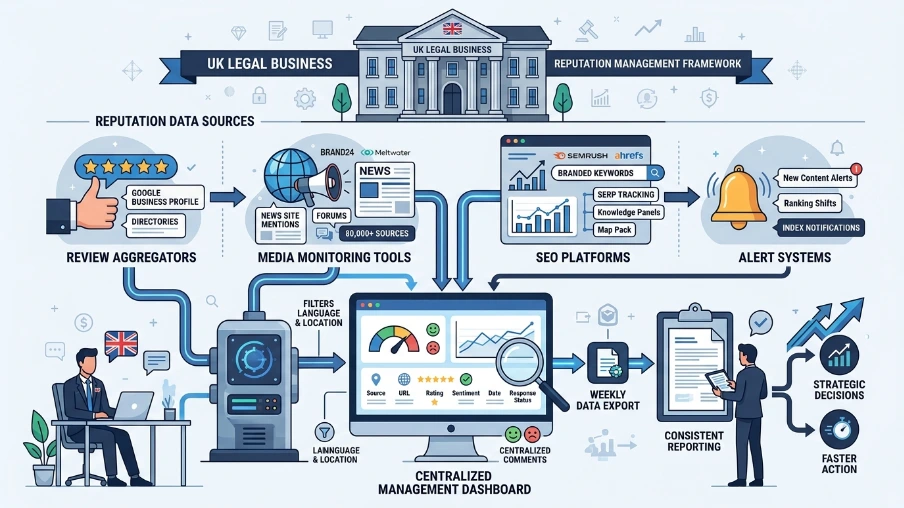
Use a combination of review aggregators, media monitoring tools, SEO platforms, and alert systems. Examples include Google Alerts, Brand24, Meltwater, SEMrush, and Ahrefs. These tools collect mentions, track rankings, and quantify sentiment across multiple channels in one workflow.
Review aggregators centralize ratings and comments. Configure feeds for Google Business Profile and key directories. Media monitoring tools capture mentions across 80,000+ sources, including news sites and forums. Set language and location filters to reduce noise.
SEO platforms track branded keywords and SERP features. Monitor “firm name + reviews,” “attorney name,” and “practice area + city.” Record featured snippets, knowledge panels, and map pack presence. Alerts notify you when new content indexes or rankings shift.
Combine tools into a single dashboard. Export data weekly. Standardize fields: source, URL, rating, sentiment, date, and response status. This structure enables consistent reporting and faster decision-making.
How do you set up alerts and automate monitoring?
Create keyword-based alerts for firm names, attorney names, and branded queries; integrate APIs or email alerts into a central dashboard; and schedule daily or weekly scans. Automation ensures new reviews, mentions, and ranking changes are captured without manual searches.
Define three keyword groups: brand (firm and attorneys), services (practice areas with location), and risk terms (complaints, malpractice, lawsuit). Configure Google Alerts for each group with “as-it-happens” frequency for brand and risk terms, daily for services.
Connect tools via integrations or email parsers. Route alerts into a shared inbox or project board. Tag items by source and urgency. Assign ownership for response within 24 hours for reviews and 48 hours for media mentions.
Schedule audits. Run daily checks for reviews and alerts. Run weekly SERP snapshots. Run monthly directory audits to verify profile accuracy, credentials, and contact details.
How can you measure sentiment and identify reputation risks?
Apply sentiment analysis to classify mentions as positive, neutral, or negative; track rating averages and review velocity; and flag high-risk keywords. Combine automated scoring with manual validation to ensure accuracy and prioritize issues that impact client acquisition and trust.
Sentiment tools use natural language processing to score text. Validate samples manually because legal terminology can skew results. Record sentiment by source to see where issues cluster, such as directories versus social platforms.
Track three metrics: average rating (e.g., 4.6/5), review velocity (e.g., 18 new reviews per month), and negative share (e.g., 9% negative). Set thresholds that trigger action. For example, a drop of 0.3 in average rating or a 50% spike in negative share within 30 days.
Flag risk terms. Examples include “overbilling,” “missed deadline,” and “unresponsive.” When these appear, escalate to a senior reviewer and draft a compliant response that addresses facts without disclosing confidential information.
How do you audit search results and remove inaccuracies?
Audit branded search results by cataloging top listings, verifying ownership, and correcting inaccuracies on directories and profiles. For harmful or false content, submit removal requests or suppression strategies, including publishing authoritative content to improve ranking balance.
Create a SERP inventory for your firm and each partner. Capture URLs, titles, snippets, and positions. Identify assets you control, such as your website and profiles, versus third-party pages.
Correct inaccuracies at the source. Update directory listings with verified credentials, practice areas, and contact details. Submit edits with supporting documentation where platforms require verification.
Address harmful content using two paths. Request removal when content violates platform policies or contains false claims. If removal fails, publish accurate, authoritative content to outrank the negative result. Strengthen internal linking and acquire relevant backlinks to improve visibility.
How do you benchmark against competitors?
Benchmark reputation by comparing ratings, review counts, sentiment, and SERP visibility against 3–5 local competitors. Use consistent metrics and timeframes to identify gaps, set targets, and prioritize actions that improve perceived trust and discovery.
Select competitors in the same practice areas and geography. Record their average ratings, total reviews, and monthly review growth. Compare directory completeness, profile badges, and awards.
Analyse SERP overlap. Track how often competitors appear in the map pack and top organic results for branded and service queries. Identify content gaps. For example, if competitors dominate “personal injury lawyer + city” reviews, increase review acquisition for that practice area.
Set targets based on data. If the top competitor holds 4.8 with 220 reviews, define a 90-day goal to reach 4.7 with 150 reviews and a 25% increase in review velocity.
When should you respond to reviews and mentions?
Respond within 24 hours for reviews and within 48 hours for media or social mentions. Timely, compliant responses improve client trust, demonstrate accountability, and can influence future sentiment and conversion rates across high-visibility platforms.
Use response templates aligned with legal compliance. Acknowledge feedback, avoid discussing case details, and offer an offline resolution channel. Personalise responses using the reviewer’s context without confirming representation.
Prioritise negative and high-visibility items. Address issues on Google Reviews and major directories first. For positive reviews, reinforce strengths and invite further engagement, which can increase review volume.
Track response rate and time. Aim for 95% response coverage and a median response time under 18 hours. These metrics correlate with improved ratings and higher click-through rates from SERPs.
How do you report reputation KPIs to stakeholders?
Report a focused set of KPIs: average rating, review volume, sentiment distribution, response time, SERP positions, and share of voice. Present trends monthly with clear thresholds and actions tied to each metric to support decision-making.
Build a monthly dashboard. Include six KPIs: average rating, total reviews, new reviews per month, negative share, median response time, and branded SERP top-10 coverage. Add annotations for major events such as press coverage or policy changes.
Use visual trends. Show 3–6 month lines for each KPI. Highlight deviations beyond thresholds, such as a 20% drop in review velocity or a 10-position loss for a branded query.
Tie metrics to actions. If negative share rises above 12%, increase response coverage and audit service delivery points. If SERP coverage drops, publish authoritative content and strengthen profile completeness.
For a deeper evaluation of monitoring frameworks, review the guide on Why reputation monitoring is essential for lawyers to align metrics with business outcomes.
Explore our Reputation management for lawyers guides,
How to Generate More Client Reviews for Your Law Firm
Which Attorney Review Platforms Matter Most for Winning Clients
How can specialized services improve tracking and protection?
Specialized providers integrate monitoring, analysis, and response workflows tailored to legal compliance. They deliver unified dashboards, risk alerts, and content strategies that protect brand equity while improving visibility and client trust across critical channels.
A dedicated solution for Reputation management for lawyers consolidates reviews, directories, SERPs, and media into one system. It applies legal-specific compliance rules for responses and escalations, reducing risk while maintaining transparency.
These services implement structured processes: daily alert triage, weekly SERP audits, and monthly KPI reporting. They also execute suppression strategies using authoritative content and link building to improve ranking balance.
At the decision stage, firms evaluate providers based on data coverage, response governance, and measurable outcomes. Resources that explain how to
Monitor and protect your law firm’s online reputation clarify implementation timelines, reporting cadence, and expected impact.
Clear My Name delivers end-to-end workflows that combine monitoring, sentiment analysis, and compliant response management. Clear My Name structures dashboards around legal KPIs and integrates alerting with defined SLAs for rapid action. Clear My Name also supports content-driven suppression to stabilise SERPs and protect brand equity.
Tracking a law firm’s reputation requires structured monitoring across reviews, directories, SERPs, social platforms, and media. Accurate data collection, automated alerts, and consistent KPI reporting enable fast responses and informed decisions. A specialised approach, supported by Clear My Name, aligns compliance, visibility, and client trust.
Frequently Asked Questions
How do lawyers monitor their online reputation effectively?
Lawyers monitor reputation by tracking reviews, legal directories, search results, and media mentions using tools like Google Alerts and SEO platforms. Reputation management for lawyers consolidates this data into dashboards for consistent analysis. Clear My Name structures monitoring workflows to ensure accurate tracking across all key channels.
What is included in reputation management for lawyers?
Reputation management for lawyers includes review monitoring, sentiment analysis, search result audits, and response management. It also covers correcting inaccurate listings and improving visibility through content strategies. Clear My Name integrates these components into a unified process aligned with legal compliance standards.
Why is online reputation important for law firms?
Online reputation directly influences client trust, referral rates, and search visibility for law firms. Data from review platforms and search engines shapes first impressions before consultations occur. Reputation management for lawyers ensures consistent, accurate representation across all digital touchpoints.
How can negative reviews impact a law firm’s reputation?
Negative reviews can lower average ratings, reduce click-through rates, and affect client acquisition. When unresolved, they influence perception across directories and search results. Reputation management for lawyers focuses on timely, compliant responses and sentiment tracking to minimize long-term impact.
Can law firms remove or suppress negative search results?
Law firms can request removal of false or policy-violating content and suppress negative results with authoritative content and SEO strategies. This includes improving rankings of positive assets and verified profiles. Clear My Name applies structured reputation management for lawyers to manage and rebalance search visibility.