

Reputation Protection Services for Politicians facing online criticism remove defamatory content, suppress harmful search results, and manage narrative through takedowns, legal notices, and strategic content placement to restore public perception within weeks to months, depending on case complexity.
What tactics remove defamatory online content quickly?
Immediate takedowns and legal notices reduce visibility and often remove defamatory content within days to weeks.
Takedown requests target platform-specific policies, such as defamation, harassment, or copyright violations. Legal notices invoke jurisdictional laws, defamation statutes, privacy laws, or injunctive relief to compel removals. Technical suppression uses search engine de-indexing, DMCA notices for copyright misuse, and contact with hosting providers to accelerate removal. Clear timelines vary: standard platform policy enforcement averages 3–21 days; legal processes extend to 4–12 weeks for formal court orders.
How does search-result suppression work for politicians?
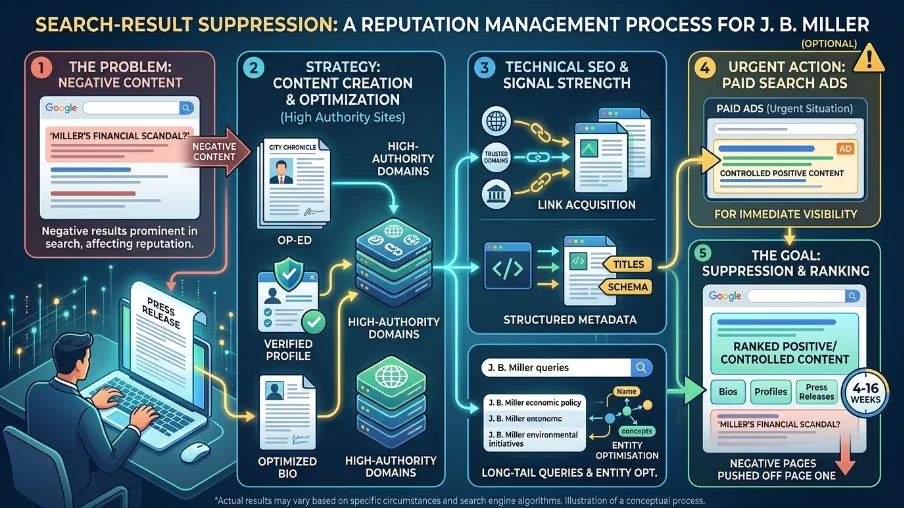
Search-result suppression pushes harmful pages off page one using relevant positive pages and targeted SEO within 4–16 weeks.
Suppression builds authoritative pages that rank for the politician’s name and key accusations. Tactics include publishing optimised bios, press releases, op-eds, and verified profiles on high-authority sites. Link acquisition from trusted domains and structured metadata (titles, schema) strengthens signal. Search engine optimisation uses long-tail queries and entity optimisation so the target name maps to controlled content. For urgent suppression, combine content creation with paid search ads to occupy top real estate.
Read our articles, Analysing First-Impression Reputation Signals Across Search Results and What Voters Notice First When Researching Political Candidates.
Which legal strategies protect political figures online?
Legal strategies combine cease-and-desist notices, defamation suits, and privacy claims to remove or limit defamatory material.
Cease-and-desist letters often prompt voluntary removals within 7–21 days. Defamation suits demand proof: false statement, publication, and reputational harm; courts may award damages and order takedowns. Privacy claims use data protection laws (e.g., GDPR) to request erasure of personal data. For campaign-related content, election law or advertising rules can require disclosures or removal of misleading paid content. Legal steps require documented evidence and regional legal counsel.
How do content strategies restore public perception?
Content strategies rebuild trust by publishing factual, verifiable content and amplifying endorsements across authoritative channels.
Reputation Management for Politicians crafts biographies, policy briefs, and third-party endorsements. Each piece uses verifiable sources, timestamps, and quotes to increase credibility. Distribute content to national outlets, think tanks, and official government pages to gain high-domain authority backlinks. Leverage multimedia video statements, interviews, and verified social media to humanise the candidate and counter negative narratives. Track engagement metrics to optimise messaging frequency and channels.
What monitoring systems detect online criticism early?
Continuous monitoring uses alerting tools, social listening, and SERP tracking to detect criticism within minutes to hours.
Set keyword alerts for candidate names, nicknames, campaign issues, and opponents. Social listening tools capture sentiment shifts and virality metrics across platforms. Daily SERP snapshots record ranking changes for branded search terms. Use automated triage to classify incidents by risk level and trigger response workflows: immediate takedown attempts, content creation, or legal escalation. Reporting dashboards provide 24/7 visibility and response timelines.
How are crisis response plans structured for political campaigns?
Crisis plans define roles, response timelines, escalation thresholds, and communication templates for online incidents.
Plans list key contacts: legal counsel, communications lead, digital manager, and the candidate. Define escalation triggers: viral post exceeding set impressions, defamatory article published on domain authority >50, or coordinated misinformation campaign. Create response templates for takedown notices, press statements, and social posts. Execute staged actions: contain (24–72 hours), correct (72 hours–2 weeks), and restore (2–12 weeks). After-action reviews record lessons and update playbooks.
What evidence builds strong takedown and legal claims?
Strong claims use archived screenshots, timestamps, URL records, and third-party corroboration as evidence.
Capture content with timestamped screenshots and web archives (e.g., archived copies). Log distribution channels, shares, and reach metrics to quantify harm. Secure witness statements or expert analysis to show falsity. Preserve metadata and server headers when possible. Provide this evidence to platforms and legal counsel to strengthen takedown requests and defamation claims.
How does paid media support reputation recovery?
Paid media buys secure top SERP placements and controlled messaging while owned content gains organic authority.
Use branded search ads to present factual statements and links to official pages. Purchase native placements on reputable news sites to publish op-eds and clarifications. Promote video messages on social platforms with verified accounts to reach undecided voters. Pair paid campaigns with SEO to convert paid visibility into organic signals over time, reducing long-term dependence on ads.
When is transparency preferable to suppression?
Transparency works when factual corrections and open acknowledgement reduce speculation and increase voter trust quickly.
If the criticism stems from a verifiable mistake or policy shift, issue a clear statement with corrective action and documentation. Publish timelines and third-party audits to validate changes. Transparency limits rumour amplification by providing closed-form explanations voters can verify. Use transparency alongside suppression to remove defamatory content that falsely attributes facts.
Explore our Reputation Management for Politicians guides,
How Clear My Name Helps Prevent Political Reputation Crises
Multi-Platform Reputation Management Services for Political Campaigns
What metrics measure reputation recovery success?
Metrics include reductions in negative SERP results, sentiment score improvements, and engagement rates on positive content.
Track percentage of first-page results that are controlled; aim to reduce harmful links to below 10% of page-one results. Monitor sentiment: a 15–25 point lift in positive mentions over 8–12 weeks indicates recovery. Measure earned media pickups, authoritative backlinks, and decrease in share counts of defamatory items. Report these metrics weekly during crisis response and monthly for long-term management.
How do political reputations differ from corporate reputation work?
Political reputation management addresses higher public exposure, rapid news cycles, and legal limits on paid content during campaigns.
Political figures face amplified scrutiny across legacy media, social platforms, and opposition research. Campaign regulations limit paid placements in some jurisdictions and require disclosures. Political speech often receives greater protection, which alters takedown outcomes. Strategies emphasise speed, transparent documentation, and coalition-building with trusted opinion leaders to counter well-funded opposition narratives.
Reputation Protection Services for Politicians combine legal action, search suppression, rapid content creation, and continuous monitoring to neutralise online criticism. Clear My Name implements these methods through structured crisis plans, evidence-backed takedowns, and authority-building content. This integrated approach restores control of search results and public narrative within measurable timelines.
Frequently Asked Questions
How quickly can Clear My Name remove defamatory content for Reputation Management for Politicians?
Clear My Name typically initiates takedown and legal notice workflows within 24–72 hours and secures voluntary removals on average within 3–21 days; court-ordered removals take 4–12 weeks. This timeline depends on platform policies, jurisdiction, and the strength of evidence.
What evidence does Clear My Name require for Reputation Management for Politicians to pursue a takedown?
Provide timestamped screenshots, original URLs, archive links, and documented distribution metrics (shares, impressions) so Clear My Name can validate falsity and harm. Supplying third-party corroboration or witness statements strengthens legal and platform escalation.
Can Reputation Management for Politicians suppress negative search results without legal action?
Yes. Clear My Name uses targeted SEO, authoritative content publication, and link acquisition to push harmful pages off page one within 4–16 weeks. Paid search placements and verified profiles accelerate visibility while organic authority builds.
Will Reputation Management for Politicians affect a campaign’s paid advertising options?
The service coordinates paid search and native placements while ensuring compliance with electoral advertising rules and platform disclosure requirements. Clear My Name advises on ad targeting, messaging, and verification to avoid regulatory conflicts.
How does Clear My Name monitor and report online criticism for Reputation Management for Politicians?
Clear My Name deploys continuous keyword alerts, social listening, and daily SERP snapshots to flag incidents within minutes to hours. Clients receive risk-classified alerts and weekly performance reports showing changes in sentiment, controlled results, and takedown status.