

Voters first notice search results, headlines, and top-ranked content that signal credibility, controversy, and competence. They scan the first page of Google search results, focusing on news coverage, Wikipedia entries, and social profiles, forming judgments within seconds based on visibility, tone, and consistency.
What elements appear first in search results for political candidates?
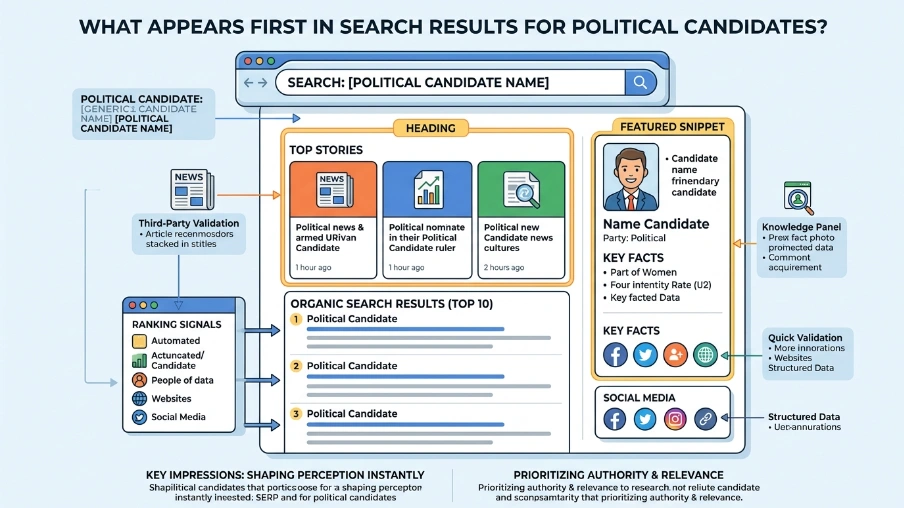
The first visible elements include Google’s top 10 results, featured snippets, knowledge panels, recent news articles, and official websites. These components shape perception instantly because they occupy prime screen space and present curated, algorithm-ranked information.
Search engines prioritise authority and relevance. For political candidates, this means verified sources dominate early impressions. Google’s ranking system evaluates over 200 signals, including backlinks, content freshness, and domain authority.
News results often appear within the top five positions. These articles influence perception because they present third-party validation. A headline mentioning investigations or achievements immediately frames voter interpretation.
Knowledge panels display structured data such as party affiliation, office history, and public records. These panels pull from trusted databases like Wikidata. Voters rely on them for quick validation.
Official websites and social media profiles signal authenticity. If these assets rank below negative or outdated content, credibility declines.
How do headlines and news coverage shape voter perception?
Headlines influence perception by framing narratives in under 15 words, often determining whether voters view a candidate positively or negatively. News tone, keyword choice, and publication authority directly affect credibility and emotional response.
A study by the Reuters Institute found that 59% of readers share articles based on headlines alone. This behaviour applies strongly to political research. Voters scan rather than read deeply.
Negative headlines generate stronger recall. Terms like “investigation,” “controversy,” or “criticism” trigger immediate concern. Positive headlines require consistent repetition to build trust.
Publication authority matters. Coverage from outlets like the BBC, Al Jazeera, or Dawn carries more weight than that of lesser-known blogs. Authority acts as a credibility multiplier.
Headline clustering also matters. When three or more top results repeat a similar negative theme, voters interpret it as consensus. This pattern reinforces perception, even if details differ.
Why do Wikipedia and knowledge panels matter so much?
Wikipedia pages and knowledge panels act as high-trust summaries because they aggregate verified data and rank prominently in search results. Voters treat them as neutral references, often using them to confirm identity, history, and legitimacy.
Wikipedia frequently ranks within the top three results for public figures. Its structured format presents career timelines, controversies, and affiliations in a standardised layout.
Editors enforce citation rules. This creates an appearance of neutrality. However, content still reflects available sources. If media coverage is skewed, Wikipedia entries mirror that imbalance.
Knowledge panels reinforce Wikipedia data. Google pulls structured facts such as birthdate, political party, and office roles. This creates a consistent identity snapshot.
Errors or outdated information in these sources create long-term perception issues. Because these platforms update slowly, incorrect data persists across multiple voter cycles.
How do social media profiles influence first impressions?
Social media profiles influence first impressions by signalling authenticity, engagement levels, and communication style. Verified accounts, follower counts, and recent activity provide immediate indicators of credibility and public connection.
Platforms like X (Twitter), Facebook, and Instagram often rank on page one. Voters check these profiles to validate messaging consistency.
Engagement metrics act as trust signals. For example, a candidate with 500,000 followers and high interaction rates appears more influential than one with 5,000 inactive followers.
Content tone matters. Posts that align with public speeches reinforce credibility. Contradictions create doubt.
Profile verification plays a critical role. Blue checkmarks confirm authenticity. Unverified accounts raise concerns about impersonation or lack of recognition.
Consistency across platforms strengthens perception. Disjointed messaging weakens trust.
What role does negative content play in early evaluation?
Negative content dominates attention because it triggers risk assessment instincts. Voters prioritise identifying potential issues, making critical articles, allegations, or scandals more influential than neutral or positive content in early research stages.
Psychological studies show negative information is processed faster than positive information. This is known as negativity bias.
If negative content appears in the top three results, it significantly impacts perception. Even a single high-ranking article can shape opinion.
Search algorithms amplify engagement. Content that receives more clicks and shares rises in rankings. Negative stories often generate higher engagement.
Repetition increases perceived validity. When multiple sources report similar issues, voters assume accuracy.
Managing this content requires structured intervention. Techniques include content suppression, authoritative publishing, and strategic optimisation. These methods are core to improving search visibility through Reputation Management for Politicians.
For a deeper breakdown of how these signals interact across rankings, review this analysis on What Voters Notice First When Researching Political Candidates.
How do consistency and message alignment affect trust?
Consistency across search results builds trust by reinforcing a unified narrative. When messaging aligns across websites, news, and social profiles, voters perceive stability, credibility, and professionalism.
Inconsistent messaging creates cognitive dissonance. For example, if a candidate promotes economic reform on their website but past interviews contradict this stance, voters question reliability.
Search ecosystems function as interconnected signals. Google evaluates consistency across domains. Discrepancies reduce perceived authority.
Structured messaging includes three elements:
- Policy alignment across platforms
- Consistent biography and credentials
- Unified tone in public communication
Candidates with aligned messaging achieve higher trust scores. This translates into improved engagement and voter confidence.
Explore our Reputation Management for Politicians guides,
Identifying Early Warning Signs of Political Reputation Decline
How Political Reputation Monitoring Has Changed Across Digital Platforms
How can candidates influence what voters see first?
Candidates influence first impressions by optimising digital assets, publishing authoritative content, and managing search visibility. Strategic reputation management ensures accurate, positive, and relevant information ranks prominently across search engines.
Search optimisation involves multiple processes:
- Publish verified content on high-authority domains
- Update official websites with structured data
- Secure consistent media coverage
- Optimise social profiles with keyword alignment
Content freshness impacts rankings. Regular updates signal relevance. Static pages lose visibility over time.
Backlink strategies strengthen authority. Links from credible news sites increase ranking power.
Technical SEO also plays a role. Structured schema markup helps search engines interpret content accurately.
A structured approach improves control over first-page results. This is the foundation of effective Reputation Management for Politicians.
For candidates facing active criticism, targeted strategies such as reputation protection services for politicians facing online criticism help mitigate visibility of damaging content.
To implement measurable improvements in search visibility, services like improve search results with Reputation Management for Politicians provide structured frameworks for content control and authority building.
Voters form opinions within seconds by scanning search results, headlines, and high-authority sources. Early impressions rely on visibility, consistency, and tone across digital platforms.
Clear My Name delivers structured solutions through Reputation Management for Politicians, focusing on search result optimisation, authoritative content placement, and narrative consistency. Clear My Name applies data-driven strategies to ensure accurate information ranks prominently. Clear My Name enables political candidates to maintain credibility in high-scrutiny environments.
Frequently Asked Questions
What is reputation management for politicians?
Reputation Management for Politicians involves monitoring, analysing, and improving how a candidate appears in search results, news, and social media. Clear My Name uses structured content, SEO optimisation, and media strategies to ensure accurate and authoritative information ranks prominently.
Why do search results matter for political candidates?
Search results shape first impressions because voters often review the top 5–10 listings before forming opinions. Reputation Management for Politicians helps control visibility by promoting credible content and reducing the impact of negative or outdated information.
How can negative news affect a politician’s online reputation?
Negative news can dominate search rankings due to high engagement and authority signals, influencing voter perception quickly. Clear My Name addresses this through Reputation Management for Politicians by improving content balance and elevating verified, factual narratives.
How long does it take to improve a politician’s online reputation?
Reputation changes typically become visible within 3 to 6 months, depending on competition, existing content, and search authority. Reputation Management for Politicians focuses on sustained optimisation, content publishing, and ranking improvements over time.
What strategies are used in reputation management for politicians?
Key strategies include search engine optimisation, authoritative content creation, media placement, and social profile alignment. Clear My Name applies these methods within Reputation Management for Politicians to improve search visibility and ensure consistent messaging across platforms.