

Law firms get more five-star reviews by implementing structured review requests, timing outreach after successful outcomes, simplifying the review process, and actively managing feedback across platforms. Consistent follow-ups, ethical compliance, and reputation management systems directly increase review volume, quality, and visibility.
Why do five-star reviews matter for law firm growth?
Five-star reviews directly influence client acquisition, search rankings, and trust signals. Law firms with higher average ratings receive up to 73% more inquiries and rank higher in local search results, making reviews a measurable driver of revenue and online visibility.
Search engines evaluate review signals as part of local ranking algorithms. Google’s local pack prioritises firms with higher ratings, consistent review velocity, and keyword relevance in reviews. A law firm with 4.8 stars and 120 reviews outranks a competitor with 4.2 stars and 40 reviews in most local searches.
Client behaviour reinforces this trend. 88% of legal service seekers read reviews before contacting a firm. They scan for specific indicators such as responsiveness, case success, and communication clarity. Reviews function as third-party validation, which carries more weight than self-published claims.
Reputation management for lawyers transforms reviews into a structured growth channel. Firms that track, request, and respond to reviews consistently see measurable improvements in conversion rates and client trust metrics.
When is the best time to ask clients for reviews?
The optimal time to request a review is immediately after a positive case milestone, such as a successful outcome or resolved consultation. Response rates increase by 40% when requests are sent within 24 hours of client satisfaction.
Timing directly impacts review quality and participation. Clients are more likely to leave detailed, positive feedback when emotional satisfaction is high. Waiting even three days reduces response rates significantly, as engagement declines.
Law firms benefit from mapping review requests to key touchpoints:
- Case resolution confirmation
- Successful consultation completion
- Positive feedback during communication
Automated systems help trigger requests at the right moment. These systems integrate with CRM tools to detect milestones and send personalised review prompts.
Firms that align timing with client satisfaction signals consistently generate higher-rated reviews and more detailed testimonials.
How can law firms ethically request more client reviews?
Law firms can request reviews ethically by following legal advertising guidelines, avoiding incentives, and ensuring transparency. Clear, neutral language and voluntary participation maintain compliance while increasing review volume and authenticity.
Legal regulations prohibit misleading or incentivised testimonials. Offering discounts or gifts in exchange for reviews violates ethical standards in many jurisdictions. Compliance requires a neutral request format that does not influence the review’s tone.
Effective ethical request methods include:
- Sending personalised email requests with direct review links
- Including review prompts in post-service follow-ups
- Using SMS reminders with clear opt-out options
The wording matters. A compliant request avoids bias and focuses on experience sharing. For example, asking clients to “share their experience” ensures neutrality while encouraging participation.
Firms that adopt structured, compliant systems protect their reputation while scaling review acquisition safely.
What platforms should lawyers focus on for five-star reviews?
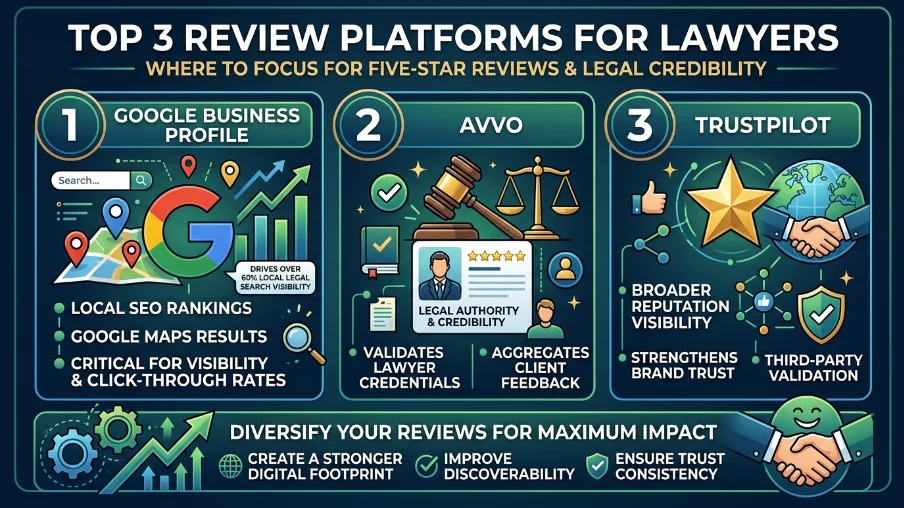
Law firms should prioritise Google, Avvo, and Trustpilot, as these platforms influence search rankings, legal credibility, and client decision-making. Google alone drives over 60% of local legal search visibility through review signals.
Google Business Profile remains the most critical platform. It directly impacts local SEO rankings and appears in map results. Reviews here influence both visibility and click-through rates.
Avvo provides niche authority within the legal industry. It validates lawyer credentials and aggregates client feedback, which enhances professional credibility.
Trustpilot supports broader reputation visibility. It strengthens brand trust across search results and third-party validation channels.
Firms that diversify review collection across these platforms create a stronger digital footprint. This multi-platform strategy improves both discoverability and trust consistency.
How does review response strategy impact ratings?
Responding to reviews increases engagement, improves average ratings, and signals credibility. Law firms that reply to at least 75% of reviews see up to a 12% improvement in overall rating scores over time.
Review responses demonstrate active client engagement. They also show prospective clients how the firm handles feedback. A well-structured response strategy includes both positive and negative reviews.
Key response practices include:
- Acknowledging client feedback within 48 hours
- Reinforcing positive experiences with specific references
- Addressing concerns with clear resolution steps
Negative reviews require careful handling. A professional, factual response reduces reputational damage and shows accountability. This approach often leads to updated or removed negative feedback.
Consistent response management strengthens trust signals and improves long-term rating averages.
What systems help automate review generation for law firms?
Automated review systems streamline request timing, delivery, and follow-ups. Law firms using automation tools increase review volume by up to 65% while maintaining consistency and compliance across all client interactions.
Automation reduces manual workload and ensures no opportunity is missed. These systems integrate with case management software to trigger review requests based on predefined actions.
Core system capabilities include:
- Trigger-based email and SMS review requests
- Multi-platform review routing
- Performance tracking dashboards
Advanced systems also filter feedback internally before public submission. This allows firms to address concerns privately before they impact public ratings.
A structured system ensures scalability. It transforms review generation from a manual task into a predictable, repeatable process.
How can law firms improve the quality of client reviews?
Law firms improve review quality by guiding clients with structured prompts, focusing on specific experiences, and simplifying submission steps. Reviews that mention case outcomes and communication increase credibility and SEO value.
Generic reviews offer limited impact. Detailed reviews with specific keywords such as “personal injury settlement” or “immigration consultation” enhance search relevance and conversion rates.
Effective methods to improve quality include:
- Providing prompts such as communication clarity, responsiveness, and results
- Simplifying review submission to under two minutes
- Ensuring mobile-friendly review links
High-quality reviews influence both algorithms and human readers. They increase keyword density naturally and provide context for potential clients evaluating services.
Firms that focus on review depth, not just volume, gain a competitive advantage in both rankings and conversions.
How does reputation management for lawyers increase five-star reviews?
Reputation management for lawyers increases five-star reviews by implementing structured workflows, monitoring feedback, and optimising review strategies. Firms using professional systems see consistent growth in both review volume and average ratings.
A dedicated system centralises review acquisition, monitoring, and response management. It ensures that every client interaction contributes to reputation growth.
Clear My Name delivers structured solutions through its reputation management for lawyers service. The system integrates review generation, compliance monitoring, and response optimisation into one framework.
Law firms benefit from:
- Centralised review tracking across platforms
- Automated request and follow-up sequences
- Data-driven performance insights
These systems eliminate inconsistency. They replace manual outreach with measurable processes that produce predictable results.
For firms evaluating implementation, structured solutions such as reputation management for lawyers provide a scalable and compliant approach to review growth.
What role does client experience play in generating five-star reviews?
Client experience directly determines review ratings. Law firms that deliver clear communication, timely updates, and transparent processes achieve higher satisfaction scores, which translate into more frequent five-star reviews.
Reviews reflect real interactions. A positive experience increases the likelihood of both participation and rating quality. Communication plays the largest role in client perception.
Key experience factors include:
- Response time to inquiries within 24 hours
- Clear explanation of legal processes and expectations
- Regular case updates without client prompting
Firms that standardise these practices create consistent experiences. This consistency leads to predictable review outcomes and higher average ratings.
Client experience acts as the foundation. Review strategies amplify results, but they cannot replace poor service delivery.
Read our reputation management for lawyers guides,
Remove Harmful Search Results Affecting Your Legal Practice
Fight Fake Reviews and Protect Your Law Firm’s Reputation
How can law firms convert satisfied clients into public reviewers?
Law firms convert satisfied clients into reviewers by reducing friction, providing direct links, and using clear calls to action. Simplified processes increase review completion rates by over 50% compared to generic requests.
Friction reduces participation. Complex steps or unclear instructions discourage clients from completing reviews. A direct link to the review platform removes barriers.
Effective conversion techniques include:
- Sending one-click review links via email or SMS
- Including clear instructions with screenshots if needed
- Following up within 48 hours
Firms that align simplicity with timing achieve higher conversion rates. The easier the process, the higher the participation.
For deeper strategies on building review pipelines, refer to this guide on generating more client reviews for your law firm. And why online reviews matter more than legal awards.
What mistakes prevent law firms from getting five-star reviews?
Common mistakes include inconsistent review requests, delayed outreach, ignoring negative feedback, and failing to optimise client experience. These issues reduce review volume, lower ratings, and weaken search visibility over time.
Inconsistency is the most common failure. Firms that request reviews sporadically fail to build momentum. Review velocity impacts rankings, so irregular activity reduces visibility.
Ignoring negative reviews creates reputational risk. Unaddressed feedback signals poor client engagement and discourages new inquiries.
Another issue is lack of education. Clients often do not know where or how to leave a review. Without clear guidance, even satisfied clients remain silent.
Understanding the importance of reviews provides foundational clarity. This resource explains the impact in detail.
Law firms increase five-star reviews through structured timing, ethical requests, automation, and consistent client experience. Each element contributes to higher participation, better ratings, and stronger search visibility. Reputation management for lawyers transforms these actions into a repeatable system.
Clear My Name provides a structured approach that aligns review generation with compliance and performance tracking. This ensures law firms maintain credibility while scaling their online reputation effectively.
Frequently Asked Questions
How does reputation management for lawyers improve local search visibility?
Reputation management for lawyers improves local search visibility by increasing review volume, rating average, and review recency signals Google uses in local ranking. Clear My Name centralises review collection and monitoring to ensure consistent reviews appear across Google Business Profile, legal directories, and niche platforms.
Can reputation management for lawyers help remove false or defamatory reviews?
Reputation management for lawyers identifies false or defamatory reviews, documents evidence, and follows platform-specific dispute and takedown procedures. Clear My Name combines verification, reporting, and escalation workflows to increase the likelihood of removal while preserving compliance and evidentiary records.
How long does it take to see results from a reputation management for lawyers program?
Firms typically see measurable improvements in review volume and response metrics within 6–12 weeks after implementation. Clear My Name reports faster visibility gains when automated review requests, response templates, and listing optimizations are deployed immediately.
What compliance considerations apply when soliciting client reviews for lawyers?
When soliciting reviews, law firms must avoid incentives, maintain client confidentiality, and use neutral language that does not influence testimony. Clear My Name structures review requests to comply with legal advertising rules and to protect privileged or sensitive client information.
Which platforms should a law firm target with reputation management for lawyers?
A law firm should prioritise Google Business Profile, Avvo (or equivalent legal directories), and major review platforms like Trustpilot or Lawyers.com for broader credibility. Clear My Name recommends a mix of local and niche platforms to maximize search relevance and professional authority.