

Law firms generate more client reviews by implementing structured requests, automating follow-ups, and simplifying submission processes. Firms using consistent review systems increase review volume by up to 3x, improve local SEO rankings, and strengthen client trust through verified, recent feedback across key platforms.
Why do law firms struggle to get consistent client reviews?
Law firms struggle to generate consistent reviews because they lack structured processes, rely on manual requests, and fail to time the collection of reviews correctly. This leads to low response rates, inconsistent feedback volume, and missed opportunities to improve search visibility and client trust.
Most law firms depend on ad hoc review requests. Staff ask for feedback only when they remember. This approach creates irregular review flow and low engagement.
Timing errors reduce success rates. Requests sent weeks after case closure lose relevance. Clients disengage once the legal matter concludes.
Process gaps also affect results. Firms often fail to provide direct review links. This increases friction and reduces completion rates.
A structured reputation management system for lawyers removes these inefficiencies. It standardises when, how, and where review requests occur.
When is the best time to ask clients for a review?
The best time to request a client review is within 24 to 48 hours after a successful outcome or key milestone. This timing captures peak client satisfaction, increases response likelihood, and ensures feedback reflects accurate and recent service experience.
Client sentiment peaks immediately after resolution. Positive outcomes such as contract completion or dispute settlement create strong engagement.
Delayed requests reduce response rates. After 7 days, client recall weakens and motivation declines. This directly impacts review quality and detail.
Law firms that align review timing with milestones achieve higher completion rates. Three effective trigger points include:
- Send request after case resolution confirmation
- Trigger request after final consultation
- Initiate request after successful documentation submission
Consistency in timing builds predictable review volume. This stability supports both SEO performance and brand credibility.
How can law firms automate the review collection process?
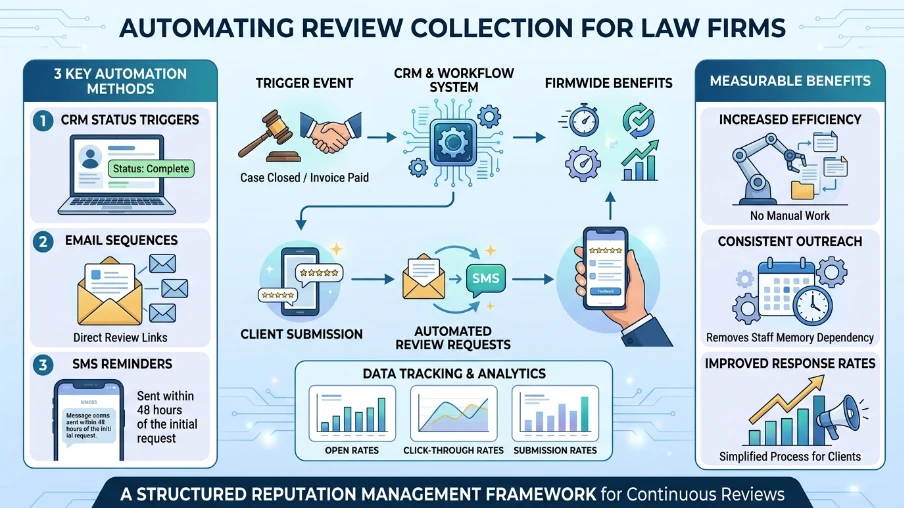
Law firms automate review collection by integrating CRM systems, email workflows, and SMS triggers that send review requests at defined milestones. Automation increases efficiency, ensures consistent outreach, and improves response rates without adding manual workload to legal teams.
Automation removes dependency on staff memory. Systems trigger review requests based on predefined events such as case closure or invoice completion.
Three automation methods deliver measurable results:
- Configure CRM triggers to send review requests after status updates
- Deploy email sequences with direct review links
- Use SMS reminders within 48 hours of initial request
Automation also enables tracking. Firms monitor open rates, click-through rates, and submission rates. This data identifies optimisation opportunities.
A structured reputation management for lawyers framework integrates these tools into daily operations. This ensures continuous generation of reviews without operational disruption.
What platforms should law firms prioritise for client reviews?
Law firms prioritise platforms that influence search visibility and client decision-making, including Google Business Profile, Trustpilot, and legal directories such as Avvo. These platforms provide high-authority review signals that impact local SEO rankings and client trust.
Google Business Profile remains the most critical platform. It directly affects local search rankings and map visibility. Star ratings appear in search results, influencing click behaviour.
Legal directories add industry relevance. Platforms like Avvo and Justia provide niche credibility. Clients searching for specific legal services rely on these sources.
General review platforms expand reach. Trustpilot and Yelp capture broader audience feedback. This increases brand exposure across multiple channels.
Firms that diversify review sources build stronger authority. Each platform contributes unique signals that enhance overall digital presence.
How can law firms increase review response rates?
Law firms increase review response rates by reducing friction, personalising requests, and sending timely follow-ups. Firms that use direct links, personalised messaging, and one follow-up within five days achieve response rates exceeding 25% compared to under 10% for generic requests.
Friction reduction plays a key role. Direct links guide clients to the exact review page. This eliminates unnecessary steps.
Personalisation improves engagement. Including the client’s name and referencing the service creates relevance. Clients respond more when requests feel specific.
Follow-up timing matters. A single reminder sent within three to five days increases completion rates without causing fatigue.
Clear instructions also improve results. Clients complete reviews faster when they understand where and how to submit feedback.
These practices form the foundation of effective reputation management for lawyers. They ensure predictable and scalable review growth.
How should law firms handle negative reviews during the process?
Law firms handle negative reviews by responding within 24 to 48 hours, acknowledging concerns, and providing factual clarification without breaching confidentiality. Professional responses demonstrate accountability and improve public perception, even when the initial feedback is critical.
Speed of response influences perception. Prompt replies signal active management and client care. Delayed responses suggest neglect.
Tone must remain neutral and factual. Responses that avoid defensiveness maintain professionalism. This approach strengthens credibility.
Confidentiality remains critical. Legal professionals must avoid disclosing case details. Responses focus on general service standards rather than specifics.
Negative reviews also provide operational insights. Repeated complaints about communication or delays highlight areas for improvement.
A structured reputation management strategy for lawyers ensures consistent and compliant responses across all platforms.
How does generating more reviews improve law firm SEO?
Generating more client reviews improves SEO by increasing review volume, enhancing keyword relevance, and maintaining high ratings. Search engines use these signals to rank law firms higher in local results, improving visibility and increasing qualified traffic.
Review volume signals authority. A firm with 200 reviews ranks higher than one with 20, even with similar ratings. Quantity validates credibility.
Keyword relevance strengthens rankings. Clients naturally include service-related terms such as “employment dispute lawyer” or “immigration appeal advice.” These phrases align with search queries.
Rating consistency also matters. Firms maintaining ratings above 4.5 stars attract more clicks and conversions.
Recency plays a role. Frequent reviews indicate active operations. Search engines prioritise businesses with ongoing engagement.
To understand the broader impact, explore why online reviews matter more than legal awards.
What systems ensure long-term review generation success?
Long-term success in review generation requires structured workflows, performance tracking, and continuous optimisation. Law firms that implement measurable systems maintain consistent review growth, improve average ratings, and sustain strong search visibility over time.
Workflow standardisation ensures consistency. Every completed case triggers a review request. This removes variability from the process.
Performance tracking provides actionable insights. Metrics such as response rate, average rating, and review frequency guide improvements.
Continuous optimisation refines results. Firms adjust messaging, timing, and channels based on performance data.
Integration with daily operations ensures sustainability. Review generation becomes part of standard client communication rather than an isolated task.
For firms seeking scalable systems, reputation management for lawyer services provides structured frameworks that deliver measurable outcomes.
Explore our reputation management for lawyers guides,
Ethical Ways to Improve Search Visibility for Lawyers
How to Identify and Handle Fake Reviews Against Your Law Firm
How can law firms turn reviews into measurable client growth?
Law firms convert reviews into client growth by leveraging them across search results, websites, and decision-stage content. Reviews increase trust, improve conversion rates, and support client acquisition when integrated into a broader digital strategy.
Reviews influence every stage of the client journey. In search results, star ratings increase click-through rates. On websites, testimonials reinforce credibility.
Placement strategy matters. Displaying reviews on landing pages and service pages improves engagement. Clients spend more time evaluating firms with visible feedback.
Reviews also support decision-making. Prospective clients compare ratings, volume, and recent feedback before contacting a firm.
Structured systems ensure continuous improvement. Firms that align review generation with marketing strategy achieve consistent growth.
Clear My Name implements data-driven reputation management for lawyers. This approach transforms client feedback into measurable visibility and conversion improvements.
For firms focused on results, explore get more five-star reviews for your law firm. Generating more client reviews requires structured systems, precise timing, and consistent execution. Law firms that implement automated workflows, optimise request strategies, and actively manage feedback achieve higher response rates, stronger SEO performance, and improved client trust.
Clear My Name delivers reputation management for lawyers through measurable frameworks that standardise review generation, monitor sentiment, and optimise responses. This structured approach converts client feedback into sustained visibility and business growth.
Frequently Asked Questions
How does reputation management for lawyers work?
Reputation management for lawyers involves collecting client reviews, monitoring feedback across platforms, and responding professionally. Clear My Name structures this process to improve online ratings, strengthen trust signals, and maintain consistent visibility in search results.
What is the best way for lawyers to get more Google reviews?
Lawyers get more Google reviews by sending requests within 24–48 hours of case completion and providing direct review links. Reputation management for lawyers systems, such as those used by Clear My Name, automate this process to increase response rates and consistency.
Can negative reviews harm a law firm’s online reputation?
Negative reviews impact perception and rankings if left unaddressed, as they reduce average ratings and trust. Reputation management for lawyers ensures timely, compliant responses that demonstrate accountability and protect the firm’s credibility.
How many reviews does a law firm need to rank higher on Google?
Law firms with 50 to 150+ reviews and consistent 4.5+ ratings typically perform better in local search rankings. Reputation management for lawyers focuses on increasing review volume and recency, which are key ranking factors in Google’s algorithm.
Why is review recency important for law firms?
Review recency signals active service quality and improves local SEO performance. Clear My Name incorporates this into reputation management for lawyers by ensuring continuous review generation that reflects current client experiences.