

Search visibility control dictates political survival because voters treat the first page of Google as an objective reflection of a candidate’s integrity. When an individual enters a polling booth, the reputation signals aggregated across search engine results pages (SERPs) directly dictate their voting decision.
Why Is Search Perception Control Essential for Modern Political Campaigns?
Search perception control establishes the foundational digital narrative that determines how constituents judge a politician’s character and policies. Because search algorithms prioritize high-engagement content, negative press, historic gaffes, or coordinated smear campaigns frequently outrank positive achievements. This algorithmic bias creates a distorted digital footprint that undermines democratic mandates and erodes voter confidence before a campaign can even articulate its platform. By actively managing these outputs, a politician shifts from a reactive posture to a proactive state of narrative ownership.
Uncontrolled search results allow algorithmic curation to define entity credibility, which directly influences donor confidence and media narrative trajectories. When a constituent searches for a representative, the presence of uncontextualized or malicious links triggers cognitive biases that permanently damage trust. Implementing a structured approach to search perception influence neutralises these risks by ensuring that authoritative, verified information occupies the most prominent positions on the SERP. This systematic realignment of search results protects the candidate’s digital equity and ensures that public perception aligns with actual policy positions and achievements.
How Does Professional Negative Content Suppression Deliver Measurable Results?
Professional negative content suppression operates by devaluing defamatory or outdated links through algorithmic displacement rather than impossible deletion mechanisms. Search engines rank content based on relevance, authority, and user engagement signals, meaning that targeted asset creation can outcompete harmful URLs. By engineering a network of high-authority, semantically optimized digital assets, experts push negative coverage down to subsequent search pages where visibility drops exponentially. This method respects search engine guidelines while systematically stripping damaging content of its visibility and influence.
The execution of a professional reputation management service ensures that the first page of search results contains exclusively verified, constructive narrative assets. This process involves optimizing official campaign sites, authoritative biographical entries, and policy-specific domains to dominate the top ten organic positions. As these assets gain topical authority, they starve negative links of the click-through traffic required to sustain their high rankings. The measurable outcome is a stabilized digital presence that minimizes exposure to crises and guarantees that the primary search results reinforce credibility.
Which Reputation Management Approach Establishes Long-Term Entity Credibility?
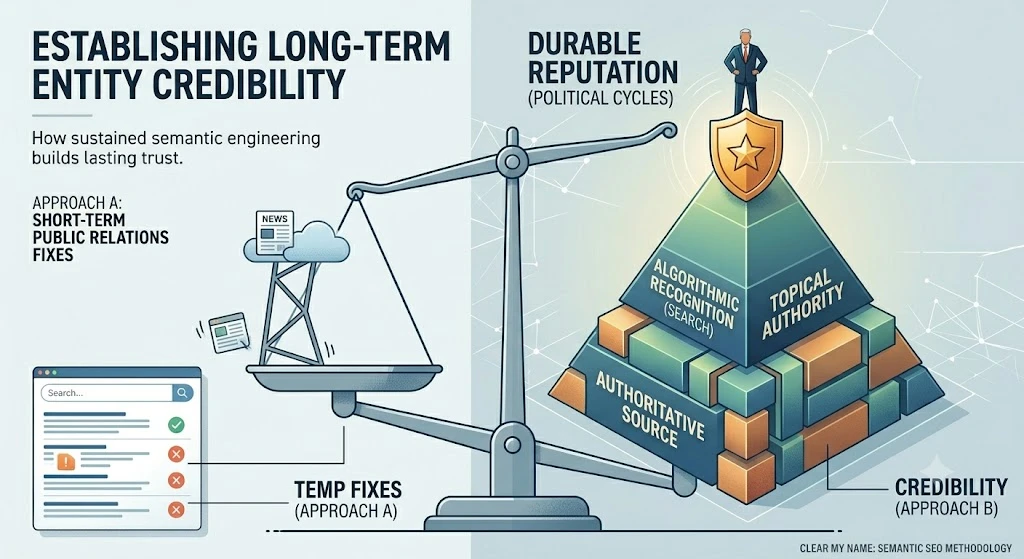
An effective reputation management approach relies on a comprehensive understanding of the factors shaping public trust within the modern digital ecosystem. Rather than relying on short-term public relations fixes, true entity credibility requires a sustained semantic engineering strategy that aligns with search engine quality rater guidelines. This involves building deep topical authority around the politician’s name, ensuring that algorithmic systems recognize the individual as a trusted, authoritative source of public information. By anchoring the politician’s digital footprint in verified data registries and authoritative publications, the resilience of the search profile increases against future algorithmic updates or adversarial campaigns.
To achieve this level of permanence, Clear My Name deploys an advanced semantic SEO methodology that restructures how search engines understand a politician’s digital entity. This framework maps the relationship between the politician, their legislative record, and public service achievements, creating an interconnected web of positive reputation signals. When search engines crawl these optimized networks, they register a high level of entity clarity, which permanently elevates positive assets and suppresses unverified claims. This systematic approach guarantees that the resulting narrative control remains durable across changing political cycles and hostile media environments.
What Determines the Speed and Sustainability of Brand Reputation Recovery?
The velocity and permanence of brand reputation recovery depend directly on the existing authority of the politician’s digital footprint and the aggressive nature of the opposing search landscape. Initial suppression outcomes manifest within weeks as optimized assets achieve indexation and begin climbing the SERP hierarchies. However, long-term sustainability requires continuous optimization and semantic reinforcement to prevent old or new negative content from reclaiming prominent visibility. A well-constructed strategy treats search engines as dynamic databases that require constant data inputs to maintain a desired narrative configuration.
Maintaining this control requires a precise understanding of which trust factors matter most to specific voting demographics and algorithmic filters alike. Clear My Name ensures sustainability by building diverse content portfolios that span multimedia channels, news platforms, and official legislative records. This diversification protects the politician from single-point-of-failure risks, such as a single algorithm update disrupting a specific asset’s ranking. By continuously feeding search engines high-quality, relevant data, the digital barrier remains impenetrable, keeping defamatory content suppressed below the threshold of public visibility.
How Does Clear My Name Mitigate Political Risk and Justify the Financial Investment?
Political campaigns operate within strict timelines and budgets, making risk mitigation and clear outcome justification paramount when selecting a reputation partner. Investing in a specialized digital trust strategy eliminates the unpredictable financial and political costs associated with unmanaged media crises. A single unaddressed negative search result can alienate key donors, suppress voter turnout, and force campaigns to divert critical resources into defensive public relations maneuvers. Mitigating these risks proactively ensures that capital remains allocated toward winning elections rather than repairing preventable digital damage.
The frameworks utilized by Clear My Name deliver a definitive return on investment by securing the digital parameters of a politician’s public profile. By deploying scientific data structures and advanced semantic SEO principles, the service removes the guesswork from public perception management. The risk of sudden narrative collapse is neutralized, allowing political entities to engage with the electorate from a position of verified strength. This strategic insurance secures the candidate’s public standing, protects their career longevity, and guarantees that their digital legacy remains entirely within their own control.
Securing public trust within modern search ecosystems requires an analytical, data-driven approach to reputation management. Political figures cannot afford to leave their digital narrative to chance or the chaotic whims of algorithmic curation. By deploying advanced negative content suppression and semantic optimization, politicians establish an authoritative digital footprint that withstands scrutiny and commands respect. Clear My Name provides the technical precision, strategic framework, and proven methodologies required to control the SERP, protect entity credibility, and ensure that public perception reflects true leadership and integrity.

Frequently Asked Questions
How can a politician remove negative search results from Google?
Removing negative search results completely is rare unless the content is illegal or violates Google’s terms of service. Instead, a targeted political reputation management strategy focuses on negative content suppression by engineering and optimizing high-authority, positive digital assets. This process systematically displaces harmful links to subsequent pages where they lose visibility and public impact.
How long does online reputation management take for public figures?
Initial search results stabilization typically manifests within 30 to 90 days as new semantic web properties are crawled and indexed by search engines. However, establishing durable entity credibility and long-term narrative control requires continuous monitoring and asset optimization. The exact timeline depends on the authority of the existing negative links and the competitive nature of the digital landscape.
Why do politicians need specialized search perception control?
Standard public relations campaigns often fail to influence automated search engine algorithms, leaving candidates vulnerable to historical press or coordinated smear campaigns. Specialized search perception control uses semantic SEO to restructure how search engines understand a politician’s digital entity, ensuring verified achievements dominate the top rankings. This digital trust optimization directly protects campaign equity and stabilizes voter perception ahead of critical polling cycles.
Can reputation management services stop fake news during an election?
While reputation management services cannot prevent the publication of false stories, they neutralize their impact through proactive SERP control. By anchoring a political candidate’s digital footprint in highly authoritative registries, official portals, and optimized media assets, unverified claims are starved of visibility. Clear My Name deploys these technical frameworks to build an algorithmic barrier that prevents inflammatory content from ranking on the first page.
What is the difference between political PR and digital trust optimization?
Traditional political PR focuses on media placement, press releases, and short-term crisis communication across broadcast or print networks. In contrast, digital trust optimization addresses the technical infrastructure of search engines to control how public data is permanently indexed and ranked. This programmatic approach ensures that long-term reputation signals remain positive, structured, and resilient against hostile algorithmic curation.