

City candidates vet finance recruiters by comparing search results, professional profiles, reviews, sector expertise and third-party information before sharing their CV. Reputation management strategies differ based on whether the objective is to improve existing reputation signals, address negative content, or build stronger long-term entity credibility.
Online reputation control methods are evaluated through search visibility, information consistency, sentiment distribution and the composition of search engine results pages (SERPs). For finance recruiters, these factors determine how candidates interpret professional credibility before entering a recruitment relationship.
How do candidates compare different reputation signals when vetting finance recruiters?
Candidates compare reputation signals by examining whether information from different sources presents a consistent picture of the recruiter. A company website, LinkedIn profile, review platform, industry publication and recruitment directory each provide a different form of evidence about the same entity.
Entity credibility is not created by one profile or one review. It develops through relationships between information sources, including professional history, specialist recruitment expertise, candidate feedback and published market knowledge. Consistency across these sources reduces ambiguity when a candidate evaluates whether a recruiter is relevant to their career objectives.
Search ranking also affects which evidence candidates encounter first. Highly visible pages receive greater exposure during branded and sector-specific searches, while lower-ranking information receives less immediate attention. This makes SERP composition an important part of reputation evaluation because candidates frequently interpret the first page as an initial information set.
Is content creation or content removal more effective for recruiter reputation?
Content creation and content removal address different reputation problems, so their effectiveness depends on the type of information affecting the SERP. Content creation focuses on increasing the presence and visibility of relevant, authoritative information, while content removal attempts to eliminate or de-index information where a valid removal mechanism exists.
Content enhancement operates by expanding the pool of relevant information associated with an entity. A finance recruiter can publish specialist material covering investment banking, private equity, fintech recruitment, salary trends and candidate guidance. This creates additional topical relationships that search engines can associate with the recruiter.
Content removal operates differently because it depends on the status and characteristics of the existing content. Removal can be relevant where information violates a platform policy, contains legally actionable material or meets another recognised removal criterion. It does not provide a universal mechanism for suppressing criticism or unfavourable but legitimate information.
The two approaches also produce different risk profiles. Content enhancement relies on creating and maintaining additional information, while removal depends on an external platform, publisher or search engine accepting the applicable grounds. A strategy based exclusively on removal therefore has less control over outcomes than a broader approach that also considers the information ecosystem surrounding the entity.
How does organic reputation management compare with reactive reputation management?
Organic reputation management develops reputation signals continuously through accurate content, professional information and consistent digital presence. Reactive reputation management responds to a specific event, such as a negative review, inaccurate profile or damaging search result.
Organic activity has a long-term orientation because each relevant piece of content contributes to the entity’s broader information environment. Consistent publication creates additional opportunities for search engines to understand the recruiter’s specialist areas. Its limitation is that content development does not directly resolve a problematic page that already has strong search visibility.
Reactive activity has a shorter response cycle because it targets an identified reputation issue. Reporting an inaccurate profile or requesting removal of policy-violating content addresses a specific source rather than expanding the overall content environment. Its limitation is that successful resolution depends on the rules and decisions of the platform hosting the content.
The approaches therefore differ in sustainability and risk exposure. Organic activity provides a continuing framework for entity development, while reactive activity addresses immediate information problems. A useful evaluation distinguishes between maintaining a healthy information environment and responding to individual reputation events.
How does content enhancement influence SERP composition?
Content enhancement influences SERP composition by introducing additional relevant documents that compete for visibility around the same entity or subject. Search engines evaluate these documents according to relevance, quality, authority and other ranking signals before determining their position for individual queries.
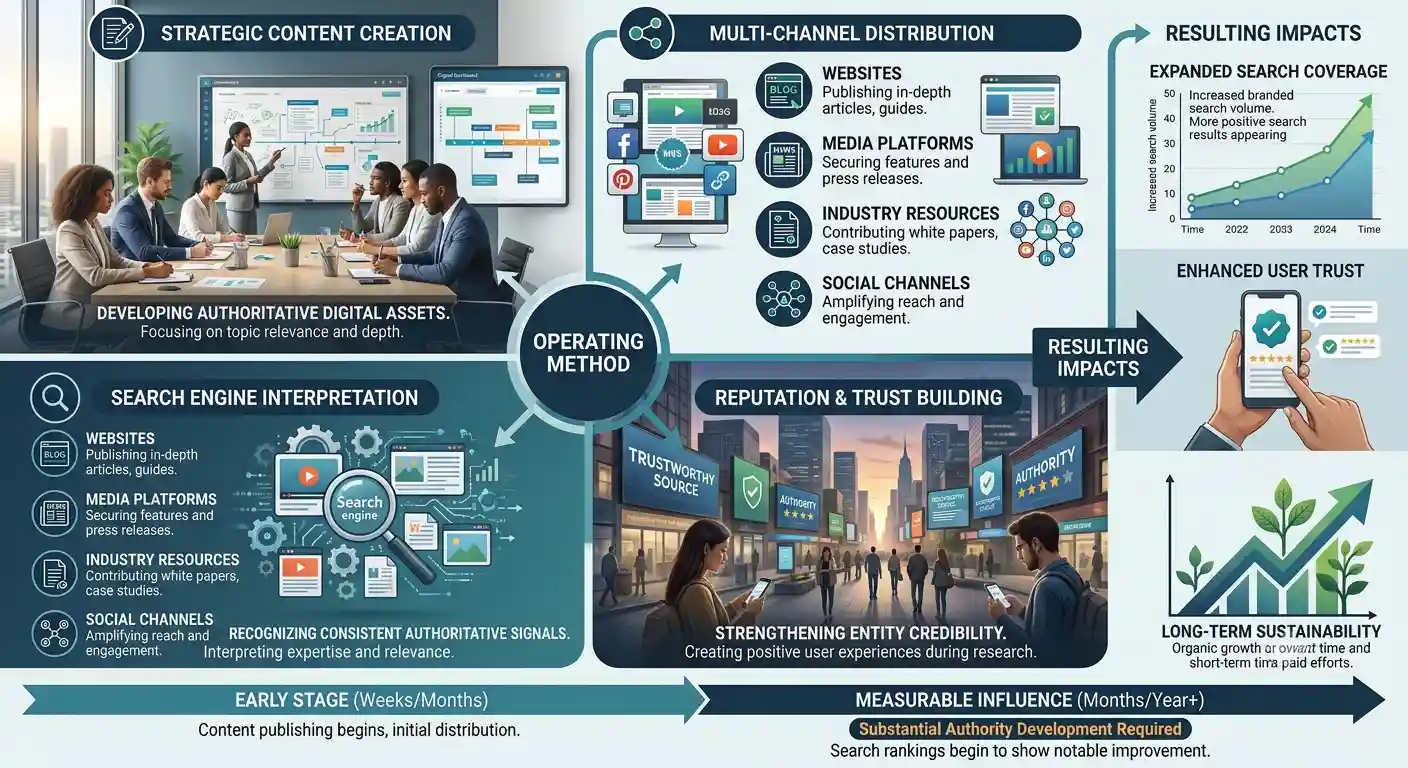
A finance recruiter publishing authoritative content about private equity recruitment creates documents that relate the entity to that specialist topic. Similar content covering banking recruitment, fintech hiring and salary information expands the entity’s topical footprint. The resulting documents provide additional search opportunities without directly altering the content of existing third-party pages.
This differs from direct content suppression. Suppression-focused strategies attempt to reduce the visibility of specific results, while enhancement strategies attempt to increase the visibility of alternative relevant information. Search ranking influence therefore operates through different mechanisms depending on whether the objective is reducing exposure to a particular result or increasing exposure to another.
Content enhancement also requires topical relevance. Publishing unrelated material simply to increase page volume does not establish meaningful reputation signals. Search engines evaluate relationships between queries, content, entities and context, making semantic alignment more important than the quantity of published pages.
When is content removal preferable to content enhancement?
Content removal becomes more relevant when an existing page contains information that qualifies for removal under an applicable platform, legal or content policy. The mechanism is corrective rather than developmental because it addresses a specific piece of information already present within the search ecosystem.
Removal strategies can have a direct effect when the targeted content is successfully taken down or de-indexed. This changes the available information set for searches involving the affected entity. The limitation is that eligibility depends on the circumstances of the content and the rules governing the platform or search engine.
Content enhancement has a different purpose. It does not necessarily eliminate negative information but creates additional relevant content that can compete for search visibility. This distinction is important because legitimate criticism, genuine reviews and accurate third-party reporting do not automatically qualify for removal.
The evaluation therefore depends on the underlying problem. An inaccurate or policy-violating page requires a different response from a legitimate negative review or an absence of authoritative information. Treating all negative search results as removal targets creates unnecessary risk and fails to distinguish content validity from content sentiment.
How do short-term and long-term reputation strategies differ?
Short-term reputation strategies focus on immediate information problems, while long-term strategies focus on developing durable entity credibility. The difference is primarily measured through timescale, control and the persistence of reputation signals.
A short-term response can address an inaccurate business listing, review dispute or specific search result. These actions can change the information environment quickly when the relevant platform accepts the request. Their limitation is that they do not automatically establish a stronger long-term reputation structure.
Long-term reputation development relies on consistent information across owned and third-party channels. Publishing relevant expertise, maintaining accurate profiles and generating authentic customer or professional feedback creates an ongoing information environment. The process requires continuous maintenance because outdated profiles, inconsistent details and new third-party content can alter entity perception over time.
Sustainability therefore depends on whether the strategy continues to generate credible information after the initial reputation issue is resolved. A one-off intervention has a different durability profile from an integrated approach that continuously maintains the entity’s digital footprint.
How does sentiment distribution affect recruiter reputation?

Sentiment distribution refers to the balance of positive, neutral and negative language associated with an entity across reviews and other user-generated or editorial content. It provides contextual information about how an organisation is discussed rather than acting as a standalone measure of credibility.
Search engines can process textual and contextual signals from indexed content, while candidates interpret recurring themes when assessing a recruiter. Reviews mentioning communication, professionalism, candidate handling or industry expertise can create different perception signals depending on their content and consistency.
A high volume of positive sentiment does not automatically establish credibility, just as negative sentiment does not independently establish poor professional performance. Candidates can compare sentiment with other evidence, including company information, professional credentials and third-party references.
The distribution also matters because isolated comments and recurring patterns provide different informational contexts. A single review represents one source, whereas consistent themes across independent sources create a broader reputation signal. Reputation analysis therefore examines sentiment alongside source quality, relevance and entity consistency.
How scalable are different reputation management approaches?
Scalability depends on whether an approach can be applied consistently across multiple entities, platforms, queries and reputation issues. Content creation can scale through structured editorial processes, while reactive management often becomes more complex as the number of individual issues increases.

A content-based approach can use defined topic clusters covering banking recruitment, private equity, fintech, salary information and candidate guidance. Each cluster creates a structured set of documents associated with specific search intents. This makes the approach easier to organise across a growing recruitment operation.
Reactive management requires individual assessment of each review, profile, article or search result. The applicable policy, source, publication date and factual circumstances can differ between cases. Scaling this process therefore requires careful classification rather than applying one removal method to every negative result.
Scalability also affects risk exposure. Automated or indiscriminate reputation activity can create inconsistent information or trigger platform compliance concerns. A scalable strategy therefore requires repeatable evaluation criteria while preserving source-specific analysis.
How can candidates distinguish genuine reputation signals from artificial ones?
Candidates distinguish genuine reputation signals by comparing independent information rather than relying on isolated ratings or promotional claims. Authenticity becomes easier to assess when professional profiles, reviews, published expertise and third-party references demonstrate consistent underlying facts.
Artificial reputation signals often attempt to create an appearance of credibility without corresponding evidence across the wider information environment. Examples include fabricated reviews, manipulated ratings, undisclosed endorsements or artificially generated content. Such tactics introduce compliance and trust risks because the underlying information does not accurately represent genuine experience or expertise.
Search systems also operate within an environment where content quality and source relationships influence visibility. Creating artificial signals does not guarantee durable search ranking influence. A stronger analytical approach examines whether the information is independently supported and contextually relevant.
For finance recruiters, this distinction is particularly important because candidates share professional information based on perceived credibility. CVs contain career history, contact details, qualifications and employment information, making the credibility of the recruitment entity an important part of the candidate’s evaluation process.
How does personal branding compare with broader recruiter reputation management?
Personal branding focuses on the professional identity and expertise associated with an individual recruiter, while broader reputation management considers the organisation, its digital properties and external information environment. Both approaches contribute to entity perception but operate at different levels.
Personal branding can establish an identifiable expert associated with a particular finance recruitment specialism. Consistent professional publishing, sector commentary and accurate career information create signals connecting an individual with relevant topics. The approach is particularly relevant where candidates research the person contacting them rather than only the recruitment company.
Broader reputation management evaluates the complete entity environment. It includes company profiles, reviews, search results, third-party references, recruitment content and professional networks. This provides wider coverage but also introduces more information sources to monitor and maintain.
The two approaches therefore address different layers of trust formation. Personal branding strengthens the relationship between an individual and a specialist topic, while organisational reputation establishes credibility around the wider recruitment entity. Understanding this distinction helps explain why candidates often evaluate both the recruiter and the firm before sharing their CV.
Dive Deeper With Our Expert Guides:
How Do FCA Fines and Press Coverage Affect Finance Recruiter Reputations?
How Does Reputation Decide Which Agencies Win PMO Recruitment Frameworks?
What factors determine the sustainability of a finance recruiter’s reputation strategy?
Sustainability depends on information accuracy, consistency, topical relevance, platform compliance and the ability to maintain reputation signals over time. A strategy that produces short-term visibility without maintaining the underlying information environment has limited durability.
Search ecosystems change continuously as new pages are indexed, existing pages are updated and search results are recalculated. This means reputation management cannot be evaluated solely through a single SERP snapshot. Long-term analysis tracks changes in search visibility, sentiment distribution, entity associations and the composition of relevant results.
Sustainable approaches also distinguish between controllable and uncontrollable information. A recruiter controls information on its own website and professional profiles but has less direct control over independent reviews, editorial coverage and third-party discussions. This difference affects the appropriate response to each type of content.
The most important consideration is therefore strategic fit rather than a universal reputation-management formula. Content enhancement, content suppression, reactive intervention and personal branding each operate through different mechanisms. Their effectiveness depends on the specific reputation signal, search environment, source authority and objective being evaluated.
How does personal brand credibility affect candidate trust in finance recruitment?
Personal brand credibility affects candidate trust by connecting an identifiable professional with expertise, experience and consistent information across relevant channels. How Do Finance Recruiters Build a Personal Brand Candidates Trust? is therefore closely connected to the wider evaluation of recruiter reputation.
A recruiter’s personal profile can provide context that a company page does not contain. Professional history, specialist finance knowledge, published commentary and sector-specific content can help candidates understand the recruiter’s expertise before direct engagement. These signals work alongside, rather than independently from, organisational reputation.
The strongest analytical distinction is between visibility and credibility. A highly visible personal profile receives attention, but credibility depends on whether the information is accurate, relevant and supported by consistent evidence. Candidates can therefore evaluate personal branding alongside company reputation, reviews and third-party references rather than treating personal visibility as proof of trustworthiness.
Which reputation approach fits finance recruiter evaluation?
Finance recruiter reputation strategies differ according to the problem being addressed, the information source involved and the desired timescale. Content enhancement expands relevant information and strengthens topical relationships, while content removal targets specific information that qualifies for an applicable removal mechanism.
Organic approaches focus on sustained entity development, whereas reactive approaches address individual reputation events. Short-term interventions can resolve discrete information problems, while long-term activity maintains consistency across websites, professional profiles, reviews and third-party references.
The comparison also demonstrates why reputation cannot be reduced to one rating, ranking or search result. Candidates evaluate multiple reputation signals simultaneously, and search engines organise those signals through indexing, relevance, entity relationships and ranking systems.
For finance recruiters, the central consideration is the relationship between search visibility and entity credibility. A sustainable reputation environment depends on accurate information, authentic feedback, relevant expertise and consistent digital signals rather than artificial reputation manipulation.
How do city candidates vet finance recruiters before sharing their CV?
City candidates can review a finance recruiter’s professional reputation, client relationships, online presence, and handling of candidate information before sharing a CV. Checking independent reviews and search results can also reveal reputation signals linked to the recruiter or recruitment agency.
What should candidates check before sending a CV to a finance recruiter?
Candidates should verify the recruiter’s identity, company affiliation, professional history, privacy practices, and the legitimacy of the vacancy. A search for the recruiter’s name and organisation can help identify inconsistent information or negative reputation content.
How does a finance recruiter’s online reputation affect candidate trust?
A recruiter’s online reputation can influence how candidates assess credibility, professionalism, and data-handling practices. Search results, reviews, professional profiles, and public complaints can all contribute to the overall perception of a recruitment professional.
Can candidates check negative information about a finance recruiter online?
Yes, candidates can review search results, business reviews, professional profiles, forums, and other publicly available sources for relevant reputation information. Clear My Name focuses on online reputation and content issues, including information that can affect how an individual or organisation is perceived in search results.
Why is reputation important when choosing a finance recruitment agency?
Reputation provides candidates with additional information about a recruitment agency’s credibility, professional conduct, and relationship with job seekers. Reviewing consistent signals across search engines, business listings, reviews, and professional platforms helps candidates make an informed assessment before sharing personal information.