

International recruiters remove scam allegations from Google results through a structured reputation management process combining content removal, negative content suppression and SERP control. The strongest approach targets both the harmful source and the search signals influencing how prospective candidates and employers perceive the recruiter.
For international recruitment businesses, Google visibility functions as a trust layer before a candidate submits documents, pays a fee or accepts an overseas placement. Scam allegations appearing prominently for a recruiter’s name can therefore influence decision-making before direct contact takes place. Reputation management for recruiters addresses this exposure by identifying damaging search results, assessing their source and applying the appropriate resolution strategy. The objective is not to manipulate facts but to establish an accurate, credible and defensible search environment. This creates stronger entity credibility while reducing the commercial risk associated with negative search perception.
Which reputation management approach delivers measurable SERP control?
A structured reputation management approach delivers measurable SERP control because it addresses the specific mechanisms determining what appears when a recruiter is searched. How Do Scam Accusations Destroy International Recruiter Reputations Overnight? Google results contain different content types, including review pages, forums, social profiles, news coverage, directories and recruitment-related websites. Each source carries different authority, indexing behaviour and removal options, so one generic response cannot resolve every allegation. Professional reputation management begins with a search perception assessment that maps the recruiter’s branded queries and identifies the pages contributing to negative visibility. This creates a defined baseline against which changes in rankings, visibility and sentiment can be measured.
How does the process distinguish removal from suppression?
Content removal and negative content suppression represent separate reputation strategies. Removal focuses on taking an allegation off the originating platform through policy-based reporting, legal processes or direct publisher engagement where a valid basis exists. Suppression focuses on improving the visibility and authority of accurate, relevant content so harmful pages lose prominence within the search results. A reliable service selects the mechanism according to the source rather than promising universal removal. This distinction improves risk control because it prevents a recruiter from investing time in an unsuitable resolution route.
The commercial value comes from controlling the complete search environment rather than focusing on one URL. A recruiter can experience reputational damage even when an allegation appears on only one website if that page ranks prominently for high-intent searches. Search perception influence therefore requires analysis of rankings, source authority, branded queries and competing positive or neutral assets. Effective reputation management strengthens relevant pages while addressing harmful content wherever a legitimate resolution route exists. The result is a more balanced search environment that supports informed decision-making.
Can reputation management remove scam allegations directly from Google?
Reputation management can secure direct removal when the originating content qualifies for a valid platform, legal or search-related removal mechanism. Google does not generally erase truthful or policy-compliant third-party allegations simply because a business dislikes them, so a professional process first establishes whether the content breaches applicable rules. Evidence, publication context, source behaviour and the nature of the allegation determine the appropriate route. Where direct removal is unavailable, negative content suppression provides a separate method of reducing the allegation’s search prominence. This approach creates realistic control without relying on unsupported removal promises.
Which removal routes provide the strongest risk reduction?
A professional assessment can prioritise actions according to the source and the evidence available.
- Identify the exact URLs, search queries and publication sources generating negative visibility.
- Assess each allegation against platform policies, factual accuracy and available removal criteria.
- Submit properly supported removal or reporting requests through the relevant channels.
- Strengthen authoritative recruiter profiles and factual business information that establish entity credibility.
- Monitor ranking changes, indexing behaviour and recurring negative references across priority searches.
This process creates traceable decision points rather than relying on vague reputation repair activity. Each action connects to a measurable search or content outcome, such as removal status, ranking movement, improved positive-content visibility or reduced exposure to damaging pages. For international recruiters, this evidence-led structure also supports internal compliance and management reporting. The business can see which sources were targeted, why each action was selected and what changed afterwards. Process clarity is therefore a core component of reputation management reliability.
How does negative content suppression improve an international recruiter’s search perception?
Negative content suppression improves search perception by changing the composition and prominence of information encountered during branded searches. Search engines evaluate relevance, authority, content relationships and other ranking signals when determining which pages appear prominently. A reputation management strategy works within this ecosystem by developing or strengthening credible assets that deserve visibility for relevant recruiter-related queries. These assets can include authoritative business profiles, expert content, company information, professional publications and relevant third-party references. As stronger assets gain visibility, damaging pages face greater competition for prominent positions.
Why does entity credibility matter for recruiter reputation?
Entity credibility connects the recruiter’s name with consistent, verifiable and relevant information across the search ecosystem. When business details, professional profiles, authoritative references and organisational information align, search engines receive clearer contextual signals about the entity. Prospective candidates also encounter a more coherent representation of the recruitment organisation. This matters because candidates frequently assess recruiters through search results before deciding whether to share personal information or proceed with a placement. Strengthening entity credibility therefore supports both search visibility and real-world trust.
A recruiter’s reputation cannot rely solely on positive statements about the organisation. Credible search perception requires information that demonstrates what the business does, where it operates, how it communicates and how candidates can verify relevant claims. This is why a reputation management strategy evaluates the entire branded search landscape rather than creating isolated promotional pages. Stronger contextual relevance helps establish authoritative alternatives to harmful narratives. The outcome is a controlled and evidence-led digital footprint rather than an artificially positive one.
For businesses evaluating this service, understanding the operational side of international recruitment also provides useful context. A detailed resource on how international recruitment agencies handle visas, compliance and fees helps establish the factual framework against which online claims can be assessed. This distinction is important because legitimate recruitment processes often involve complex documentation, overseas partners and fee structures that can be misunderstood when presented without context.
How quickly can an international recruiter improve harmful Google results?
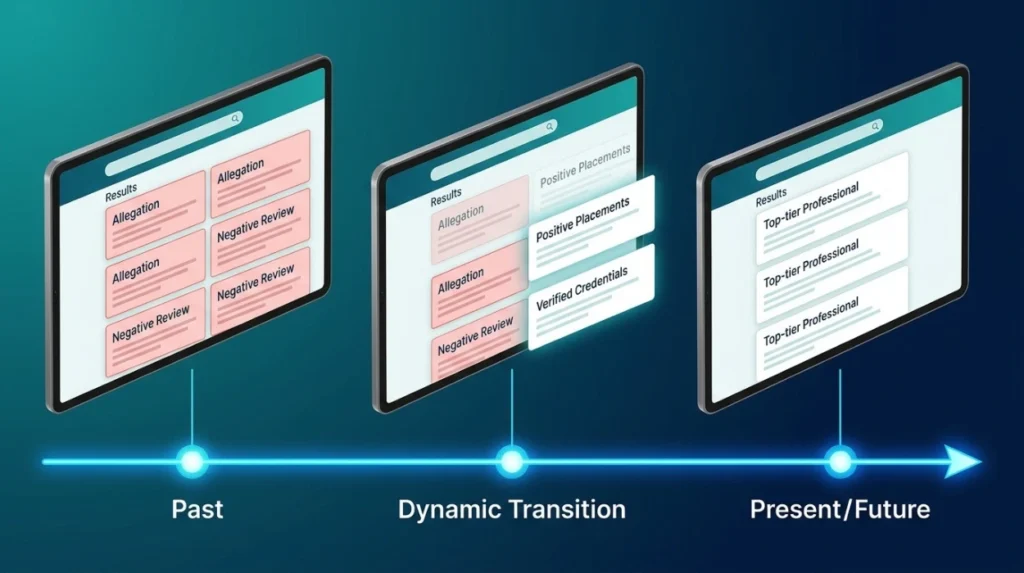
Search-result improvement begins once the relevant sources, queries and ranking relationships have been identified, but the speed of visible change depends on the mechanism being used. A successful removal request follows the timetable of the relevant platform or publisher, while suppression depends on search-engine crawling, indexing and ranking changes. These mechanisms operate differently, so a professional service measures progress through defined indicators rather than promising an arbitrary timeframe. Early progress can include successful reporting outcomes, improved indexing of authoritative assets or changes in the ranking position of priority pages. Sustainable improvement then depends on maintaining the broader search ecosystem.
What indicators demonstrate measurable progress?
A robust reputation programme tracks visibility rather than relying solely on subjective impressions.
- Track priority branded searches to measure the position and visibility of harmful URLs.
- Measure positive and neutral content coverage across important search-result positions.
- Monitor removal requests and publisher responses to establish operational progress.
- Evaluate branded search sentiment to identify changes in public-facing perception.
- Review new mentions and indexed pages to prevent fresh negative content from gaining momentum.
These indicators create a practical framework for evaluating return on investment. A recruiter can compare the search environment before intervention with subsequent visibility patterns and identify which actions generated meaningful improvement. This also reduces the risk of paying for activity that produces no measurable change. Search perception control becomes a managed process with defined outputs rather than an abstract promise of reputation repair.
Dive Deeper With Our Expert Guides:
What Does an Agency Reputation Recovery Programme Include? Step-by-Step
How Do Tech Recruiters Build a LinkedIn Reputation Developers Trust?
Is reputation management for recruiters worth the long-term investment?
Reputation management for recruiters delivers long-term value when negative search visibility threatens candidate trust, commercial relationships or the credibility of an international recruitment operation. A single damaging result can influence numerous future searches because candidates, employers and business partners can repeatedly encounter the same allegation. Addressing the search environment therefore protects more than one immediate conversion opportunity. It supports the underlying trust infrastructure through which the recruiter attracts candidates, communicates opportunities and establishes professional credibility. The financial value comes from reducing reputational risk before it becomes embedded in decision-making.
How does reputation management reduce commercial risk?
Reputation risk becomes commercially significant when negative search results interfere with high-intent actions. Candidates researching visa arrangements, recruitment fees or overseas placements often use search engines as a verification mechanism before continuing. If prominent results associate the recruiter with fraud or scams, that association can become a barrier to communication even when the underlying business information tells a different story. A structured reputation strategy reduces this exposure by improving the visibility of accurate information and resolving damaging content through appropriate channels. The objective is a more reliable search environment that supports informed decisions.
The cost of reputation management also needs to be assessed against the duration of the problem. Allowing harmful results to remain prominent creates repeated exposure across future searches, while competitors and third-party publishers continue to occupy valuable search positions. A planned intervention creates a defined route for addressing current visibility and maintaining the resulting improvements. This transforms reputation expenditure from reactive crisis management into a controlled risk-reduction investment. For recruiters operating across multiple markets, that consistency becomes particularly valuable because search perception can influence audiences in different jurisdictions.
Why choose a professional service to manage recruiter scam allegations?
A professional service provides process clarity, search expertise and coordinated execution across the different mechanisms affecting reputation visibility. Reputation management for recruiters requires more than publishing positive content because the underlying problem can involve removal requests, ranking behaviour, source authority, entity relationships and recurring negative references. Clear My Name approaches these issues as a connected search-perception problem rather than as isolated pieces of content. The strategy focuses on identifying the strongest intervention for each source and measuring the resulting visibility changes. This provides a structured route from reputation assessment to search-result improvement.
What makes the process reliable?
Reliability comes from evidence, defined actions and measurable outcomes rather than exaggerated guarantees. A credible service distinguishes between content that qualifies for removal and content that requires suppression or search-visibility management. It also maintains clear records of targeted URLs, reporting routes, ranking changes and content-development activity. This allows the recruiter to understand what has been attempted and why each action supports the wider reputation strategy. Clear My Name provides value through this distinction because the objective is controlled search perception supported by a transparent process.
A professional approach also reduces the risk of damaging the recruiter’s credibility through aggressive or inappropriate tactics. Search ecosystems reward relevance and authority, while platforms enforce rules governing user-generated content, reviews and reporting procedures. A strategy that ignores these constraints creates additional reputational exposure. Evidence-led reputation management instead works within legitimate platform processes while strengthening the recruiter’s authoritative digital footprint. The result is a more sustainable form of SERP control.
How can international recruiters maintain reputation improvements after negative results decline?
Sustaining reputation improvements requires continuous monitoring because the search environment changes as new pages are published, existing pages are updated and search rankings fluctuate. A one-time campaign does not provide permanent control over every future reference to a recruiter. Ongoing monitoring identifies new allegations, emerging review patterns and changes in priority search results before they become established. Maintaining authoritative content also protects the visibility gained during the initial campaign. This creates a continuous reputation management system rather than a short-term response to one incident.
Effective monitoring focuses on the search terms and sources that matter most to the recruiter’s commercial reputation.
- Monitor branded searches for new allegations, reviews and negative references.
- Maintain authoritative company information to preserve entity credibility.
- Update relevant content when recruitment services, markets or compliance information changes.
- Assess new negative pages quickly to determine the appropriate resolution route.
- Measure SERP visibility regularly to identify ranking changes and emerging risks.
This approach makes reputation control sustainable because it connects monitoring with action. Instead of waiting for a damaging result to become highly visible, the recruiter can identify changes within the wider search ecosystem and respond according to evidence. It also preserves the relevance of authoritative content as the business evolves. Long-term search perception therefore depends on both corrective action and consistent digital trust management.
International recruiters facing scam allegations need a strategy that separates legitimate removal opportunities from search-result suppression and reputation strengthening. The most reliable approach combines evidence-led assessment, platform-appropriate action, entity credibility and continuous SERP monitoring. Clear My Name positions reputation management for recruiters around these mechanisms, providing a structured process designed to improve search visibility, strengthen trust and reduce reputational risk. When the objective is reliable search perception control, process clarity and measurable visibility outcomes provide the strongest basis for decision-making.
Can international recruiters remove scam allegations from Google results?
Scam allegations can sometimes be removed when the underlying content violates a website’s policies or applicable legal requirements. Otherwise, reputation management focuses on reducing the visibility of inaccurate allegations through legitimate search suppression and stronger relevant content.
How do recruiters deal with false scam allegations online?
Recruiters can document the allegation, identify its original source, and assess whether it breaches the platform’s rules or legal standards. Where removal is unavailable, search reputation management can help improve the visibility of accurate, authoritative information.
How long does it take to remove a scam allegation from Google?
There is no universal timeframe because removal depends on the source website, its review process, and the circumstances of the allegation. Changes in Google search visibility also depend on crawling, indexing, ranking, and competing content.
Can Google remove false scam allegations about an international recruitment agency?
Google can remove certain search results when they meet its applicable removal criteria, but it does not generally decide whether an allegation is true or false. Recruiters should address the original source where possible and use search reputation management for remaining results.
What reputation management strategies help international recruiters suppress scam allegations?
Effective strategies include source assessment, policy-based removal requests, accurate entity information, authoritative content development, and search result suppression. The objective is to strengthen trustworthy information about the recruitment agency while reducing the prominence of inaccurate or misleading results.